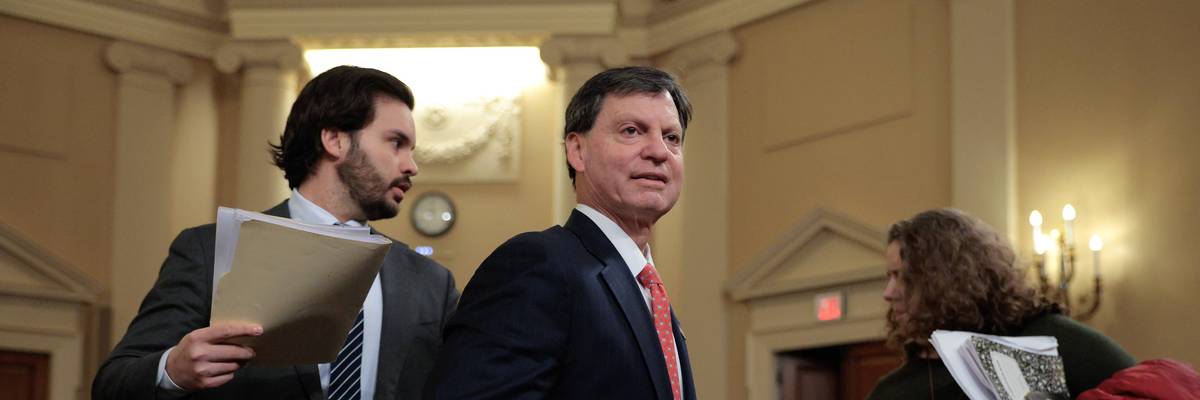
Internal Revenue Service CEO Frank Bisignano was pictured during a House Ways and Means Committee hearing on March 4, 2026 in Washington, DC.
Who’s Leading Trump’s IRS as Tax Dodgers Run Wild? Apparently No One
Investigations and enforcement actions against rich tax cheats have plummeted amid a leadership vacuum at the Internal Revenue Service.
A group of Senate Democrats on Monday accused the Trump administration of "evading or ignoring" federal law by leaving the decimated Internal Revenue Service without a permanent leader during tax season, further enabling rich tax dodgers to run wild with no accountability.
In a letter to Treasury Secretary Scott Bessent, who has been serving as acting IRS commissioner since President Donald Trump's removal of Billy Long last August, a trio of Democratic senators stressed that "commissioner of Internal Revenue is not an optional role." The lawmakers—Sens. Ron Wyden (D-Ore.), Chuck Schumer (D-NY), and Elizabeth Warren (D-Mass.)—also ripped the Trump administration's establishment of the IRS chief executive officer position, calling it a "fake job that Congress never authorized."
Frank Bisignano is currently the CEO of the IRS, splitting his time there and at the Social Security Administration, his Senate-confirmed role.
The Democratic senators note in their letter that, under federal law, Bessent's authority to serve as acting commissioner expired on March 6, "absent a pending nomination."
"No nominee has been submitted," the lawmakers wrote. "Treasury previously assured [Republican Sen. Chuck Grassley] that a nomination would be forthcoming. That assurance has not yet been honored. The clock has now run out."
"Although the IRS is supposed to be nonpartisan, the only two Senate-confirmed positions at the IRS continue to be held 'temporarily' by Treasury officials who have political jobs," the senators added, referring to Bessent and Kenneth Kies, the assistant secretary for tax policy who is also serving as acting chief counsel of the IRS. (Kies was previously a lobbyist who helped corporations and rich Americans avoid taxes.)
During Trump's first year back in the White House, his administration terminated tens of thousands of IRS employees, leaving the long-underresourced agency with even fewer employees to enforce tax law.
Wyden, Schumer, and Warren wrote Monday that "leadership churn" at the IRS has also been "extreme," pointing out that seven commissioner or acting commissioner transitions occurred in 2025 and most of the agency's dozens of "top official positions" were "either vacant or filled by acting officials as of late last year."
The gutting of IRS staff—including a unit tasked with auditing billionaires—and the leadership vacuum at the top of the agency appear to have been boons for rich tax cheats.
The International Consortium of Investigative Journalists (ICIJ) reported last week that "during the new administration’s first year, the US Internal Revenue Service has referred at most two cases of possible tax evasion by ultrawealthy people or large businesses to its criminal investigators, a sharp drop from previous years."
"Not all criminal referrals trigger further investigation or lead to a prosecution," the ICIJ observed. "But they are a key metric of how vigorously the IRS civil divisions are investigating sophisticated tax dodging among high-net worth individuals. The wealthiest Americans account for a disproportionately large share of tax cheating, according to the US Treasury Department, and experts see sophisticated tax evasion schemes as a big contributor to runaway economic inequality."
Corporate tax avoidance is also rampant, thanks in large part to the latest round of Trump-GOP tax cuts enacted last summer. The Institute on Taxation and Economic Policy (ITEP) noted last month that "annual financial reports recently released by Amazon, Alphabet, Meta, and Tesla disclose that these corporations collectively reported $315 billion in US profits for 2025, and collectively paid just 4.9% of that amount in federal corporate income taxes—with Tesla paying exactly zero."
"The tax avoidance of these four companies alone blew a $51 billion hole in the federal budget last year," wrote ITEP's Matthew Gardner, "and this is likely just the tip of the iceberg."
Citing new disclosures, the Financial Accountability and Corporate Transparency (FACT) Coalition said Monday that major US corporations "collectively reduced their tax bills by more than $11 billion through tax havens in 2025."
"Meanwhile, American companies are getting out of paying a... US minimum tax, which has been effectively dismantled [by the Trump administration]," the coalition said. "The Corporate Alternative Minimum Tax, or CAMT, was intended to act as a backstop to ensure that large, profitable companies pay at least some tax, but has been eviscerated via recent regulatory changes that could be unlawful and unconstitutional."
We are at a crossroads
This country and this world are at a monumental crossroads. In a few short weeks, US voters will have an opportunity to beat back the forces of fascism and confront the billionaires who are rigging the economy, our media system, and our democracy, making it increasingly impossible for ordinary people to get by. We’re not just talking about the election. We’re talking about what must be done once these fascist elements are vanquished from power. We need a bolder set of solutions than what either major party has so far been willing to offer and a working-class movement ready to fight like hell for it. Trump didn't emerge from nowhere. The conditions that fueled MAGA authoritarianism were created by decades of radical neoliberal economic policies and a corrupt political system dominated by corporate interests. They slashed taxes on the super-rich, promising that the benefits would trickle down. They said giveaways to the corporate titans would make life more affordable for the rest of us. It was all bullshit. And when a bitter, betrayed populace searches for someone to blame, right-wing demagogues have little trouble finding scapegoats. People know when they're being lied to, but you won't hear any of this from the corporate media. Only independent journalism—powered and funded by people who believe in building a better world—can deliver truly trustworthy daily news. Our Fall Campaign is underway, and we need your help. To power our newsroom through the rest of the year, we need to raise $125,000 by midnight on October 31. So if you share our vision, please contribute whatever you can to sustain our work. |
A group of Senate Democrats on Monday accused the Trump administration of "evading or ignoring" federal law by leaving the decimated Internal Revenue Service without a permanent leader during tax season, further enabling rich tax dodgers to run wild with no accountability.
In a letter to Treasury Secretary Scott Bessent, who has been serving as acting IRS commissioner since President Donald Trump's removal of Billy Long last August, a trio of Democratic senators stressed that "commissioner of Internal Revenue is not an optional role." The lawmakers—Sens. Ron Wyden (D-Ore.), Chuck Schumer (D-NY), and Elizabeth Warren (D-Mass.)—also ripped the Trump administration's establishment of the IRS chief executive officer position, calling it a "fake job that Congress never authorized."
Frank Bisignano is currently the CEO of the IRS, splitting his time there and at the Social Security Administration, his Senate-confirmed role.
The Democratic senators note in their letter that, under federal law, Bessent's authority to serve as acting commissioner expired on March 6, "absent a pending nomination."
"No nominee has been submitted," the lawmakers wrote. "Treasury previously assured [Republican Sen. Chuck Grassley] that a nomination would be forthcoming. That assurance has not yet been honored. The clock has now run out."
"Although the IRS is supposed to be nonpartisan, the only two Senate-confirmed positions at the IRS continue to be held 'temporarily' by Treasury officials who have political jobs," the senators added, referring to Bessent and Kenneth Kies, the assistant secretary for tax policy who is also serving as acting chief counsel of the IRS. (Kies was previously a lobbyist who helped corporations and rich Americans avoid taxes.)
During Trump's first year back in the White House, his administration terminated tens of thousands of IRS employees, leaving the long-underresourced agency with even fewer employees to enforce tax law.
Wyden, Schumer, and Warren wrote Monday that "leadership churn" at the IRS has also been "extreme," pointing out that seven commissioner or acting commissioner transitions occurred in 2025 and most of the agency's dozens of "top official positions" were "either vacant or filled by acting officials as of late last year."
The gutting of IRS staff—including a unit tasked with auditing billionaires—and the leadership vacuum at the top of the agency appear to have been boons for rich tax cheats.
The International Consortium of Investigative Journalists (ICIJ) reported last week that "during the new administration’s first year, the US Internal Revenue Service has referred at most two cases of possible tax evasion by ultrawealthy people or large businesses to its criminal investigators, a sharp drop from previous years."
"Not all criminal referrals trigger further investigation or lead to a prosecution," the ICIJ observed. "But they are a key metric of how vigorously the IRS civil divisions are investigating sophisticated tax dodging among high-net worth individuals. The wealthiest Americans account for a disproportionately large share of tax cheating, according to the US Treasury Department, and experts see sophisticated tax evasion schemes as a big contributor to runaway economic inequality."
Corporate tax avoidance is also rampant, thanks in large part to the latest round of Trump-GOP tax cuts enacted last summer. The Institute on Taxation and Economic Policy (ITEP) noted last month that "annual financial reports recently released by Amazon, Alphabet, Meta, and Tesla disclose that these corporations collectively reported $315 billion in US profits for 2025, and collectively paid just 4.9% of that amount in federal corporate income taxes—with Tesla paying exactly zero."
"The tax avoidance of these four companies alone blew a $51 billion hole in the federal budget last year," wrote ITEP's Matthew Gardner, "and this is likely just the tip of the iceberg."
Citing new disclosures, the Financial Accountability and Corporate Transparency (FACT) Coalition said Monday that major US corporations "collectively reduced their tax bills by more than $11 billion through tax havens in 2025."
"Meanwhile, American companies are getting out of paying a... US minimum tax, which has been effectively dismantled [by the Trump administration]," the coalition said. "The Corporate Alternative Minimum Tax, or CAMT, was intended to act as a backstop to ensure that large, profitable companies pay at least some tax, but has been eviscerated via recent regulatory changes that could be unlawful and unconstitutional."
A group of Senate Democrats on Monday accused the Trump administration of "evading or ignoring" federal law by leaving the decimated Internal Revenue Service without a permanent leader during tax season, further enabling rich tax dodgers to run wild with no accountability.
In a letter to Treasury Secretary Scott Bessent, who has been serving as acting IRS commissioner since President Donald Trump's removal of Billy Long last August, a trio of Democratic senators stressed that "commissioner of Internal Revenue is not an optional role." The lawmakers—Sens. Ron Wyden (D-Ore.), Chuck Schumer (D-NY), and Elizabeth Warren (D-Mass.)—also ripped the Trump administration's establishment of the IRS chief executive officer position, calling it a "fake job that Congress never authorized."
Frank Bisignano is currently the CEO of the IRS, splitting his time there and at the Social Security Administration, his Senate-confirmed role.
The Democratic senators note in their letter that, under federal law, Bessent's authority to serve as acting commissioner expired on March 6, "absent a pending nomination."
"No nominee has been submitted," the lawmakers wrote. "Treasury previously assured [Republican Sen. Chuck Grassley] that a nomination would be forthcoming. That assurance has not yet been honored. The clock has now run out."
"Although the IRS is supposed to be nonpartisan, the only two Senate-confirmed positions at the IRS continue to be held 'temporarily' by Treasury officials who have political jobs," the senators added, referring to Bessent and Kenneth Kies, the assistant secretary for tax policy who is also serving as acting chief counsel of the IRS. (Kies was previously a lobbyist who helped corporations and rich Americans avoid taxes.)
During Trump's first year back in the White House, his administration terminated tens of thousands of IRS employees, leaving the long-underresourced agency with even fewer employees to enforce tax law.
Wyden, Schumer, and Warren wrote Monday that "leadership churn" at the IRS has also been "extreme," pointing out that seven commissioner or acting commissioner transitions occurred in 2025 and most of the agency's dozens of "top official positions" were "either vacant or filled by acting officials as of late last year."
The gutting of IRS staff—including a unit tasked with auditing billionaires—and the leadership vacuum at the top of the agency appear to have been boons for rich tax cheats.
The International Consortium of Investigative Journalists (ICIJ) reported last week that "during the new administration’s first year, the US Internal Revenue Service has referred at most two cases of possible tax evasion by ultrawealthy people or large businesses to its criminal investigators, a sharp drop from previous years."
"Not all criminal referrals trigger further investigation or lead to a prosecution," the ICIJ observed. "But they are a key metric of how vigorously the IRS civil divisions are investigating sophisticated tax dodging among high-net worth individuals. The wealthiest Americans account for a disproportionately large share of tax cheating, according to the US Treasury Department, and experts see sophisticated tax evasion schemes as a big contributor to runaway economic inequality."
Corporate tax avoidance is also rampant, thanks in large part to the latest round of Trump-GOP tax cuts enacted last summer. The Institute on Taxation and Economic Policy (ITEP) noted last month that "annual financial reports recently released by Amazon, Alphabet, Meta, and Tesla disclose that these corporations collectively reported $315 billion in US profits for 2025, and collectively paid just 4.9% of that amount in federal corporate income taxes—with Tesla paying exactly zero."
"The tax avoidance of these four companies alone blew a $51 billion hole in the federal budget last year," wrote ITEP's Matthew Gardner, "and this is likely just the tip of the iceberg."
Citing new disclosures, the Financial Accountability and Corporate Transparency (FACT) Coalition said Monday that major US corporations "collectively reduced their tax bills by more than $11 billion through tax havens in 2025."
"Meanwhile, American companies are getting out of paying a... US minimum tax, which has been effectively dismantled [by the Trump administration]," the coalition said. "The Corporate Alternative Minimum Tax, or CAMT, was intended to act as a backstop to ensure that large, profitable companies pay at least some tax, but has been eviscerated via recent regulatory changes that could be unlawful and unconstitutional."