SUBSCRIBE TO OUR FREE NEWSLETTER
Daily news & progressive opinion—funded by the people, not the corporations—delivered straight to your inbox.
5
#000000
#FFFFFF
To donate by check, phone, or other method, see our More Ways to Give page.
Daily news & progressive opinion—funded by the people, not the corporations—delivered straight to your inbox.
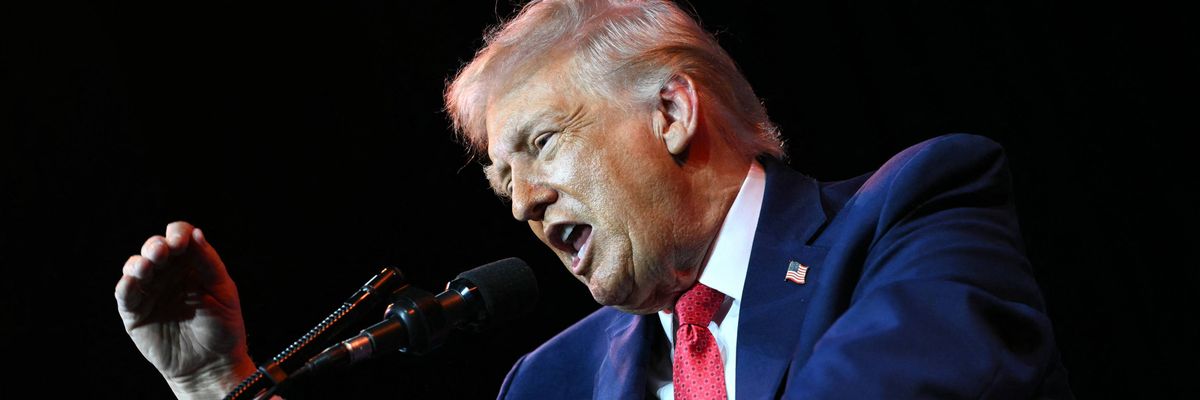
US President Donald Trump speaks during the House Republican Party member retreat at the Kennedy Center in Washington, DC, on January 6, 2026.
Critics pointed out that Trump has often endorsed violence against protesters when they opposed him.
President Donald Trump doubled down on his threats to attack Iran on Thursday in response to its government's increasingly violent crackdown on ongoing protests.
"If they start killing people, which they tend to do during their riots—they have lots of riots—if they do it, we're going to hit them very hard," he said.
Addressing the Iranian people, he added: "You must stand up for your right to freedom. There is nothing like freedom. You are a brave people. It’s a shame what’s happening to your country."
The Norway-based Iran Human Rights (IHR) reported on Thursday that Iranian security forces have killed at least 45 protesters since demonstrations against the regime began in late December. Wednesday was the bloodiest day yet, with 13 people reportedly killed.
On Thursday, Iranian authorities shut down internet access for the population, which has limited the flow of information in and out of the country.
The protests kicked off in response to the sudden collapse in the value of Iran's currency, the rial, which exacerbated the country's already spiraling cost-of-living crisis, heightening inflation and putting many basic goods out of reach for many Iranians.
This economic crisis has been shifted into hyperdrive since Trump returned to office last year and re-implemented his “maximum pressure” strategy against Iran, including more severe economic sanctions and a 12-day war in June during which the US struck several Iranian nuclear sites. Over the past year, the average cost of food has increased by 70%, while the cost of medicine has increased by 50%.
The rial has lost 95% of its value since 2018, when Trump withdrew the US from the nuclear agreement with Iran, which included sanctions relief.
Last Friday, just one day before he bombed Venezuela as part of an operation to overthrow its leader Nicolás Maduro and seize the nation's oil reserves, Trump wrote on Truth Social that "if Iran shoots and violently kills peaceful protesters, which is their custom, the United States of America will come to their rescue. We are locked and loaded and ready to go."
On Tuesday, US Sen. Lindsey Graham (R-SC), a leading proponent of regime change, warned Iran's leaders that "if you keep killing your people who are demanding a better life—Donald J. Trump is going to kill you." Just days before, Graham said that Iran's "weakened" state was thanks in part to Trump's efforts to "economically isolate" the country.
Iran has blamed the unrest on "interference in Iran’s internal affairs” by the United States. The nation's president, Masoud Pezeshkian, has urged authorities to exhibit the “utmost restraint” in handling protesters. But earlier this week, Supreme Leader Ayatollah Ali Khameini said "rioters" must be "put in their place," while a top judge accused demonstrators of being agents of the US and Israel.
The latest swell of protests began after Reza Pahlavi, the former crown prince and son of Iran's former US-backed shah, called for demonstrators to take to the streets. On Thursday, Pahlavi, who has lived most of his life in the US after the royal family was run out of Iran during the 1979 revolution, met with Israeli leaders, including Prime Minister Benjamin Netanyahu and President Isaac Herzog.
Critics pointed out that Trump has often endorsed violence against protesters when they opposed him. Just a day before he issued his latest threat, he defended a federal immigration agent who fatally shot an unarmed mother in Minneapolis, while members of his administration falsely described her as a "domestic terrorist."
He has previously advocated for the US military to be deployed to use force against protesters and threatened to invoke the Insurrection Act to quell peaceful protests, including the No Kings demonstrators who mobilized nationwide in October.
Dear Common Dreams reader, It’s been nearly 30 years since I co-founded Common Dreams with my late wife, Lina Newhouser. We had the radical notion that journalism should serve the public good, not corporate profits. It was clear to us from the outset what it would take to build such a project. No paid advertisements. No corporate sponsors. No millionaire publisher telling us what to think or do. Many people said we wouldn't last a year, but we proved those doubters wrong. Together with a tremendous team of journalists and dedicated staff, we built an independent media outlet free from the constraints of profits and corporate control. Our mission has always been simple: To inform. To inspire. To ignite change for the common good. Building Common Dreams was not easy. Our survival was never guaranteed. When you take on the most powerful forces—Wall Street greed, fossil fuel industry destruction, Big Tech lobbyists, and uber-rich oligarchs who have spent billions upon billions rigging the economy and democracy in their favor—the only bulwark you have is supporters who believe in your work. But here’s the urgent message from me today. It's never been this bad out there. And it's never been this hard to keep us going. At the very moment Common Dreams is most needed, the threats we face are intensifying. We need your support now more than ever. We don't accept corporate advertising and never will. We don't have a paywall because we don't think people should be blocked from critical news based on their ability to pay. Everything we do is funded by the donations of readers like you. When everyone does the little they can afford, we are strong. But if that support retreats or dries up, so do we. Will you donate now to make sure Common Dreams not only survives but thrives? —Craig Brown, Co-founder |
President Donald Trump doubled down on his threats to attack Iran on Thursday in response to its government's increasingly violent crackdown on ongoing protests.
"If they start killing people, which they tend to do during their riots—they have lots of riots—if they do it, we're going to hit them very hard," he said.
Addressing the Iranian people, he added: "You must stand up for your right to freedom. There is nothing like freedom. You are a brave people. It’s a shame what’s happening to your country."
The Norway-based Iran Human Rights (IHR) reported on Thursday that Iranian security forces have killed at least 45 protesters since demonstrations against the regime began in late December. Wednesday was the bloodiest day yet, with 13 people reportedly killed.
On Thursday, Iranian authorities shut down internet access for the population, which has limited the flow of information in and out of the country.
The protests kicked off in response to the sudden collapse in the value of Iran's currency, the rial, which exacerbated the country's already spiraling cost-of-living crisis, heightening inflation and putting many basic goods out of reach for many Iranians.
This economic crisis has been shifted into hyperdrive since Trump returned to office last year and re-implemented his “maximum pressure” strategy against Iran, including more severe economic sanctions and a 12-day war in June during which the US struck several Iranian nuclear sites. Over the past year, the average cost of food has increased by 70%, while the cost of medicine has increased by 50%.
The rial has lost 95% of its value since 2018, when Trump withdrew the US from the nuclear agreement with Iran, which included sanctions relief.
Last Friday, just one day before he bombed Venezuela as part of an operation to overthrow its leader Nicolás Maduro and seize the nation's oil reserves, Trump wrote on Truth Social that "if Iran shoots and violently kills peaceful protesters, which is their custom, the United States of America will come to their rescue. We are locked and loaded and ready to go."
On Tuesday, US Sen. Lindsey Graham (R-SC), a leading proponent of regime change, warned Iran's leaders that "if you keep killing your people who are demanding a better life—Donald J. Trump is going to kill you." Just days before, Graham said that Iran's "weakened" state was thanks in part to Trump's efforts to "economically isolate" the country.
Iran has blamed the unrest on "interference in Iran’s internal affairs” by the United States. The nation's president, Masoud Pezeshkian, has urged authorities to exhibit the “utmost restraint” in handling protesters. But earlier this week, Supreme Leader Ayatollah Ali Khameini said "rioters" must be "put in their place," while a top judge accused demonstrators of being agents of the US and Israel.
The latest swell of protests began after Reza Pahlavi, the former crown prince and son of Iran's former US-backed shah, called for demonstrators to take to the streets. On Thursday, Pahlavi, who has lived most of his life in the US after the royal family was run out of Iran during the 1979 revolution, met with Israeli leaders, including Prime Minister Benjamin Netanyahu and President Isaac Herzog.
Critics pointed out that Trump has often endorsed violence against protesters when they opposed him. Just a day before he issued his latest threat, he defended a federal immigration agent who fatally shot an unarmed mother in Minneapolis, while members of his administration falsely described her as a "domestic terrorist."
He has previously advocated for the US military to be deployed to use force against protesters and threatened to invoke the Insurrection Act to quell peaceful protests, including the No Kings demonstrators who mobilized nationwide in October.
President Donald Trump doubled down on his threats to attack Iran on Thursday in response to its government's increasingly violent crackdown on ongoing protests.
"If they start killing people, which they tend to do during their riots—they have lots of riots—if they do it, we're going to hit them very hard," he said.
Addressing the Iranian people, he added: "You must stand up for your right to freedom. There is nothing like freedom. You are a brave people. It’s a shame what’s happening to your country."
The Norway-based Iran Human Rights (IHR) reported on Thursday that Iranian security forces have killed at least 45 protesters since demonstrations against the regime began in late December. Wednesday was the bloodiest day yet, with 13 people reportedly killed.
On Thursday, Iranian authorities shut down internet access for the population, which has limited the flow of information in and out of the country.
The protests kicked off in response to the sudden collapse in the value of Iran's currency, the rial, which exacerbated the country's already spiraling cost-of-living crisis, heightening inflation and putting many basic goods out of reach for many Iranians.
This economic crisis has been shifted into hyperdrive since Trump returned to office last year and re-implemented his “maximum pressure” strategy against Iran, including more severe economic sanctions and a 12-day war in June during which the US struck several Iranian nuclear sites. Over the past year, the average cost of food has increased by 70%, while the cost of medicine has increased by 50%.
The rial has lost 95% of its value since 2018, when Trump withdrew the US from the nuclear agreement with Iran, which included sanctions relief.
Last Friday, just one day before he bombed Venezuela as part of an operation to overthrow its leader Nicolás Maduro and seize the nation's oil reserves, Trump wrote on Truth Social that "if Iran shoots and violently kills peaceful protesters, which is their custom, the United States of America will come to their rescue. We are locked and loaded and ready to go."
On Tuesday, US Sen. Lindsey Graham (R-SC), a leading proponent of regime change, warned Iran's leaders that "if you keep killing your people who are demanding a better life—Donald J. Trump is going to kill you." Just days before, Graham said that Iran's "weakened" state was thanks in part to Trump's efforts to "economically isolate" the country.
Iran has blamed the unrest on "interference in Iran’s internal affairs” by the United States. The nation's president, Masoud Pezeshkian, has urged authorities to exhibit the “utmost restraint” in handling protesters. But earlier this week, Supreme Leader Ayatollah Ali Khameini said "rioters" must be "put in their place," while a top judge accused demonstrators of being agents of the US and Israel.
The latest swell of protests began after Reza Pahlavi, the former crown prince and son of Iran's former US-backed shah, called for demonstrators to take to the streets. On Thursday, Pahlavi, who has lived most of his life in the US after the royal family was run out of Iran during the 1979 revolution, met with Israeli leaders, including Prime Minister Benjamin Netanyahu and President Isaac Herzog.
Critics pointed out that Trump has often endorsed violence against protesters when they opposed him. Just a day before he issued his latest threat, he defended a federal immigration agent who fatally shot an unarmed mother in Minneapolis, while members of his administration falsely described her as a "domestic terrorist."
He has previously advocated for the US military to be deployed to use force against protesters and threatened to invoke the Insurrection Act to quell peaceful protests, including the No Kings demonstrators who mobilized nationwide in October.