

SUBSCRIBE TO OUR FREE NEWSLETTER
Daily news & progressive opinion—funded by the people, not the corporations—delivered straight to your inbox.
5
#000000
#FFFFFF
To donate by check, phone, or other method, see our More Ways to Give page.
Daily news & progressive opinion—funded by the people, not the corporations—delivered straight to your inbox.
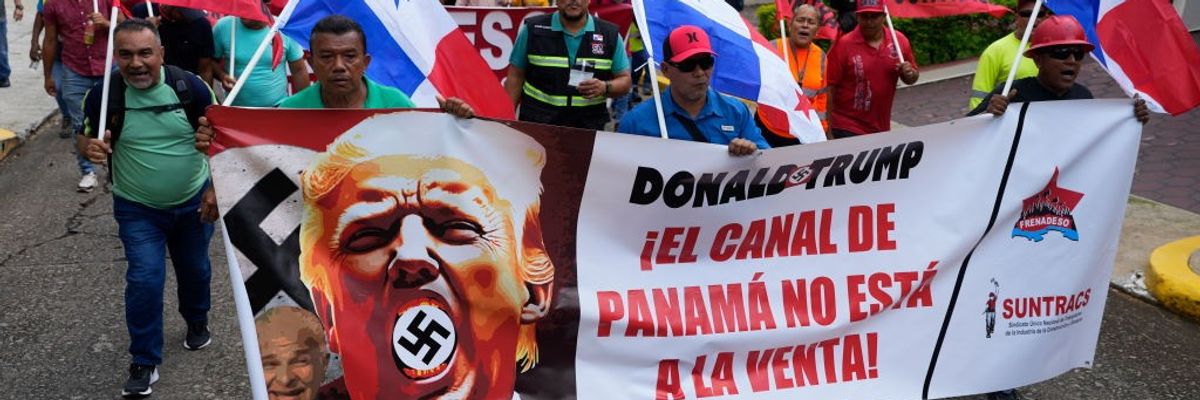
Panamanians march with a banner reading, "Donald Trump, the Panama Canal Is Not for Sale!" in Panama City on January 20, 2025.
One former Swedish prime minister called the Republican president's pledge to grow U.S. territory "a recipe for global instability."
While the global far-right cheered President Donald Trump's return to the White House on Monday, world leaders, elected officials, activists, and others from across the rest of the political spectrum reacted with trepidation as the Republican vowed to expand the nation's territory for the first time in nearly 80 years and threatened the sovereignty of a U.S. trade and security partner.
In his second inaugural address, Trump promised a foreign policy that "expands our territory," as well as the renewed pursuit of "Manifest Destiny"—the 19th-century belief that God intended the United States to control the continent from coast to coast—beyond Earth by "launching American astronauts to plant the stars and stripes on the planet Mars."
"That's a dangerous statement in itself, but then others around the world might also be inspired to do the same."
In the United States, Monday's inauguration coincided with the federal holiday honoring the assassinated civil rights champion Rev. Martin Luther King Jr., whom Trump mentioned in his speech. Some observers noted the incongruity of Trump's message with King's anti-war ethos.
"How dare Donald Trump invoke Dr. King," pan-African studies professor and Black Lives Matter Los Angeles co-founder Melina Abdullah fumed on social media. "Trump IS the embodiment of the three evils that MLK warned of: racism, materialism, and militarism."
Indigenous voices reminded listeners that belief in Manifest Destiny fueled genocidal violence against Native Americans.
"Trump is really going after Native Americans with references to Manifest Destiny, the frontier, Wild West, and erasing Denali's name," attorney Brett Chapman, a direct descendant of the Ponca Cshief White Eagle, said on social media. "This anti-Indigenous inaugural address sounds like one from the 1800s when presidents deployed the U.S. military on Native Americans seeking rights."
In his speech, Trump falsely accused China of "running the Panama Canal," said that Panama—which was last invaded by American forces in 1989—is overcharging U.S. ships to use the crucial waterway, and warned that "we're taking it back."
As angry demonstrators rallied outside the U.S. Embassy in Panama City, right-wing Panamanian President José Raúl Mulino issued a statement refuting Trump's threats and accusations and declaring that "the canal is and will continue to be Panamanian."
Trump's threat follows his refusal earlier this month to rule out the use of military force in order to conquer the Panama Canal or Greenland, a territory of NATO ally Denmark.
South American progressives were left stunned by parts of Trump's address.
"In his inauguration speech, Donald Trump made it clear that reality surpasses fiction," Carol Dartora, a leftist lawmaker in the lower chamber of Brazil's National Congress, said in a video posted online. "Then the U.S. president exuded machismo, imperialism, and xenophobia, especially against immigrants."
Across the Atlantic, former center-right Swedish Prime Minister Carl Bildt said: "Now we know that President Trump wants to 'expand our territory.' That's a dangerous statement in itself, but then others around the world might also be inspired to do the same. It's a recipe for global instability."
German author, filmmaker, and journalist Annette Dittert
responded to Trump's expansionist pledge with a popular three-letter internet acronym: "'We will become a nation that expands our territory?' WTF?"
Dear Common Dreams reader, It’s been nearly 30 years since I co-founded Common Dreams with my late wife, Lina Newhouser. We had the radical notion that journalism should serve the public good, not corporate profits. It was clear to us from the outset what it would take to build such a project. No paid advertisements. No corporate sponsors. No millionaire publisher telling us what to think or do. Many people said we wouldn't last a year, but we proved those doubters wrong. Together with a tremendous team of journalists and dedicated staff, we built an independent media outlet free from the constraints of profits and corporate control. Our mission has always been simple: To inform. To inspire. To ignite change for the common good. Building Common Dreams was not easy. Our survival was never guaranteed. When you take on the most powerful forces—Wall Street greed, fossil fuel industry destruction, Big Tech lobbyists, and uber-rich oligarchs who have spent billions upon billions rigging the economy and democracy in their favor—the only bulwark you have is supporters who believe in your work. But here’s the urgent message from me today. It's never been this bad out there. And it's never been this hard to keep us going. At the very moment Common Dreams is most needed, the threats we face are intensifying. We need your support now more than ever. We don't accept corporate advertising and never will. We don't have a paywall because we don't think people should be blocked from critical news based on their ability to pay. Everything we do is funded by the donations of readers like you. When everyone does the little they can afford, we are strong. But if that support retreats or dries up, so do we. Will you donate now to make sure Common Dreams not only survives but thrives? —Craig Brown, Co-founder |
While the global far-right cheered President Donald Trump's return to the White House on Monday, world leaders, elected officials, activists, and others from across the rest of the political spectrum reacted with trepidation as the Republican vowed to expand the nation's territory for the first time in nearly 80 years and threatened the sovereignty of a U.S. trade and security partner.
In his second inaugural address, Trump promised a foreign policy that "expands our territory," as well as the renewed pursuit of "Manifest Destiny"—the 19th-century belief that God intended the United States to control the continent from coast to coast—beyond Earth by "launching American astronauts to plant the stars and stripes on the planet Mars."
"That's a dangerous statement in itself, but then others around the world might also be inspired to do the same."
In the United States, Monday's inauguration coincided with the federal holiday honoring the assassinated civil rights champion Rev. Martin Luther King Jr., whom Trump mentioned in his speech. Some observers noted the incongruity of Trump's message with King's anti-war ethos.
"How dare Donald Trump invoke Dr. King," pan-African studies professor and Black Lives Matter Los Angeles co-founder Melina Abdullah fumed on social media. "Trump IS the embodiment of the three evils that MLK warned of: racism, materialism, and militarism."
Indigenous voices reminded listeners that belief in Manifest Destiny fueled genocidal violence against Native Americans.
"Trump is really going after Native Americans with references to Manifest Destiny, the frontier, Wild West, and erasing Denali's name," attorney Brett Chapman, a direct descendant of the Ponca Cshief White Eagle, said on social media. "This anti-Indigenous inaugural address sounds like one from the 1800s when presidents deployed the U.S. military on Native Americans seeking rights."
In his speech, Trump falsely accused China of "running the Panama Canal," said that Panama—which was last invaded by American forces in 1989—is overcharging U.S. ships to use the crucial waterway, and warned that "we're taking it back."
As angry demonstrators rallied outside the U.S. Embassy in Panama City, right-wing Panamanian President José Raúl Mulino issued a statement refuting Trump's threats and accusations and declaring that "the canal is and will continue to be Panamanian."
Trump's threat follows his refusal earlier this month to rule out the use of military force in order to conquer the Panama Canal or Greenland, a territory of NATO ally Denmark.
South American progressives were left stunned by parts of Trump's address.
"In his inauguration speech, Donald Trump made it clear that reality surpasses fiction," Carol Dartora, a leftist lawmaker in the lower chamber of Brazil's National Congress, said in a video posted online. "Then the U.S. president exuded machismo, imperialism, and xenophobia, especially against immigrants."
Across the Atlantic, former center-right Swedish Prime Minister Carl Bildt said: "Now we know that President Trump wants to 'expand our territory.' That's a dangerous statement in itself, but then others around the world might also be inspired to do the same. It's a recipe for global instability."
German author, filmmaker, and journalist Annette Dittert
responded to Trump's expansionist pledge with a popular three-letter internet acronym: "'We will become a nation that expands our territory?' WTF?"
While the global far-right cheered President Donald Trump's return to the White House on Monday, world leaders, elected officials, activists, and others from across the rest of the political spectrum reacted with trepidation as the Republican vowed to expand the nation's territory for the first time in nearly 80 years and threatened the sovereignty of a U.S. trade and security partner.
In his second inaugural address, Trump promised a foreign policy that "expands our territory," as well as the renewed pursuit of "Manifest Destiny"—the 19th-century belief that God intended the United States to control the continent from coast to coast—beyond Earth by "launching American astronauts to plant the stars and stripes on the planet Mars."
"That's a dangerous statement in itself, but then others around the world might also be inspired to do the same."
In the United States, Monday's inauguration coincided with the federal holiday honoring the assassinated civil rights champion Rev. Martin Luther King Jr., whom Trump mentioned in his speech. Some observers noted the incongruity of Trump's message with King's anti-war ethos.
"How dare Donald Trump invoke Dr. King," pan-African studies professor and Black Lives Matter Los Angeles co-founder Melina Abdullah fumed on social media. "Trump IS the embodiment of the three evils that MLK warned of: racism, materialism, and militarism."
Indigenous voices reminded listeners that belief in Manifest Destiny fueled genocidal violence against Native Americans.
"Trump is really going after Native Americans with references to Manifest Destiny, the frontier, Wild West, and erasing Denali's name," attorney Brett Chapman, a direct descendant of the Ponca Cshief White Eagle, said on social media. "This anti-Indigenous inaugural address sounds like one from the 1800s when presidents deployed the U.S. military on Native Americans seeking rights."
In his speech, Trump falsely accused China of "running the Panama Canal," said that Panama—which was last invaded by American forces in 1989—is overcharging U.S. ships to use the crucial waterway, and warned that "we're taking it back."
As angry demonstrators rallied outside the U.S. Embassy in Panama City, right-wing Panamanian President José Raúl Mulino issued a statement refuting Trump's threats and accusations and declaring that "the canal is and will continue to be Panamanian."
Trump's threat follows his refusal earlier this month to rule out the use of military force in order to conquer the Panama Canal or Greenland, a territory of NATO ally Denmark.
South American progressives were left stunned by parts of Trump's address.
"In his inauguration speech, Donald Trump made it clear that reality surpasses fiction," Carol Dartora, a leftist lawmaker in the lower chamber of Brazil's National Congress, said in a video posted online. "Then the U.S. president exuded machismo, imperialism, and xenophobia, especially against immigrants."
Across the Atlantic, former center-right Swedish Prime Minister Carl Bildt said: "Now we know that President Trump wants to 'expand our territory.' That's a dangerous statement in itself, but then others around the world might also be inspired to do the same. It's a recipe for global instability."
German author, filmmaker, and journalist Annette Dittert
responded to Trump's expansionist pledge with a popular three-letter internet acronym: "'We will become a nation that expands our territory?' WTF?"

