SUBSCRIBE TO OUR FREE NEWSLETTER
Daily news & progressive opinion—funded by the people, not the corporations—delivered straight to your inbox.
5
#000000
#FFFFFF
To donate by check, phone, or other method, see our More Ways to Give page.
Daily news & progressive opinion—funded by the people, not the corporations—delivered straight to your inbox.
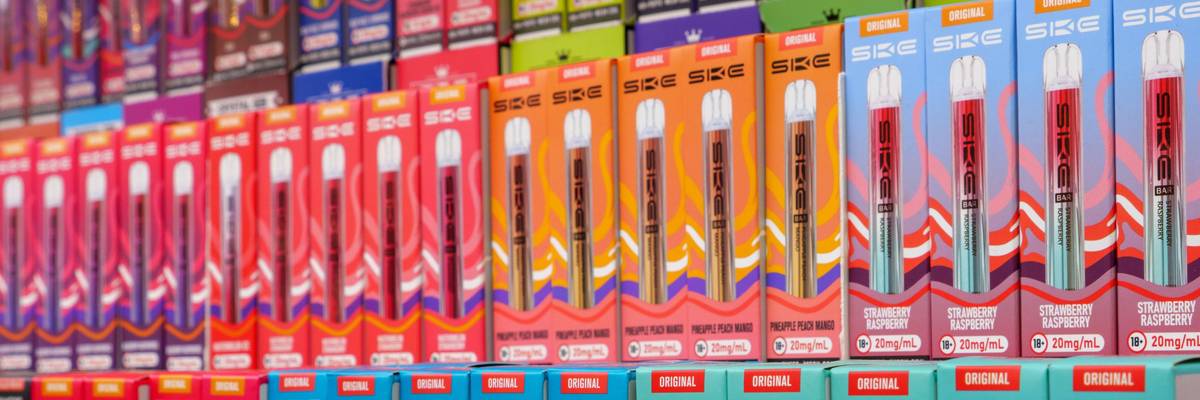
Fruit flavor vape refills for e-cigarettes on shelves of a vaping shop, England, UK on December 15, 2025.
"Trump could not care less about the health consequences and costs of giving teenagers access to addictive flavored poison if it means his tobacco industry donors can make record profits," said one public health advocate.
The resignation of a pair of top health officials in the Trump administration this week has brought to light efforts by the president to help Big Tobacco executives and lobbyists sell addictive flavored e-cigarettes that could be marketed to children.
On Friday, the Food and Drug Administration (FDA) issued new guidance allowing cigarette makers to begin marketing and selling fruit- and candy-flavored vape products on store shelves, which were banned under previous administrations due to evidence that they were driving youth vaping.
The policy was enacted despite the strong opposition of then-FDA Commissioner Marty Makary, who resigned on Tuesday, reportedly because he could not in good conscience support it.
Makary's resignation was followed by the departure of Rich Danker, the chief spokesperson for Health and Human Services (HHS) Secretary Robert F. Kennedy Jr., who similarly warned that the policy "would appeal to children and expose them to nicotine addiction, lung damage, and higher risk of cancer" in a letter addressed to Trump on Wednesday.
Danker did not blame Trump for the policy in his letter; instead, he attributed it to "senior HHS officials in the immediate office of the secretary."
This is despite the fact that The Wall Street Journal reported last week that Trump had personally berated Makary over his hesitation to enact the policy and had signed off on a plan to fire him.
A New York Times report on Wednesday confirms the extent of Trump's direct involvement in strong-arming the FDA into enacting the policy. It found that he pressured higher-ups in HHS to move the policy forward amid a tongue-lashing from tobacco industry lobbyists and executives angry that they could not get in on the highly profitable sale of fruit- and candy-flavored vapes. Despite being illegal and mostly imported to the US from China, these vapes make up about 60% of the total e-cigarette market.
Trump, who ran in 2024 on a pledge to "save vaping" as part of an effort to appeal to young voters, has raked in huge sums of money from the tobacco industry. According to data from OpenSecrets, his inaugural committee took over $3 million from vaping special interests, including $1.25 million from the Vapor Technology Association, and $1 million apiece from Altria and Breeze Smoke.
Altria, which owns Marlboro maker Philip Morris, and Reynolds American, which owns Lucky Strike and Camel, have also offered donations to Trump's $400 million White House ballroom project. Reynolds, the biggest producer of menthol cigarettes, also gave $10 million to the super PAC backing Trump in 2024.
According to The New York Times, executives for Altria and Reynolds were turning the screws on Trump over lunch at his golf club in Jupiter, Florida, in early May because they were "unhappy with the way the Food and Drug Administration was regulating their industry."
Trump interrupted the conversation to call up RFK Jr. and Mehmet Oz, the head of the Centers for Medicare and Medicaid Services (CMS), and complained to them about the FDA's regulation of e-cigarettes.
Within a week, the new policy had been enacted, and its leading opponent, Makary, was gone. He has since been replaced by Kyle Diamantas, whom the healthcare advocacy group Protect Our Care described as "a 30-something lawyer whose qualifications for such a critical public health role seem to begin and end at being Donald Trump Jr.’s 'hunting buddy.'”
"Donald Trump’s fury at FDA head Makary was motivated by gross political opportunism and fat checks from the big vape industry," said Jeremy Funk, the deputy director of Protect Our Care's Public Health Watch team. "Trump could not care less about the health consequences and costs of giving teenagers access to addictive flavored poison if it means his tobacco industry donors can make record profits."
While youth vaping is at a 10-year low, about 1.6 million middle and high school students were estimated to use vape products in the Centers for Disease Control and Prevention's 2024 National Youth Tobacco Survey. Nearly 90% of them said they used fruit and candy-flavored vapes.
Dr. Jerome Adams, a physician and professor at Purdue University, said in a post on social media that the rise of vaping has fueled a rebound in nicotine usage among college-aged adults.
"Youth combustible cigarette smoking was already at an all-time low and consistently dropping before vaping came on the scene. There is literally no reason to believe that the majority of young people who are now vaping would have otherwise been smoking combustible cigarettes," he said. "Amongst college-age and young adults, nicotine use is going back up to incredibly high rates—largely due to vaping."
The new policy enacted by the FDA has so far only authorized the sale of flavored products by one company, the Los Angeles-based Glas Inc., which will be allowed to sell vapes in flavors like mango and blueberry under names like "Gold" and "Sapphire."
The FDA sought to assuage fears of underage use by pointing to the Glas' digital age-verification system, which requires the product to be connected to the Bluetooth of a phone owned by a person over the age of 21. However, it is expected that, especially amid industry pressure, more companies will have their products approved soon.
Kayla Hancock, director of Protect Our Care’s Public Health Project, said that while Makary had a "terrible record" as FDA commissioner, having taken actions that slowed vaccine development and launched dubious, politically charged "reviews" of abortion pills long found to be safe, "apparently, it wasn’t terrible enough for Donald Trump."
"Hesitating to approve flavored vapes and not put American teens on a fast-track to lifelong addiction to harmful nicotine products is the bare minimum anyone could hope for from the Trump FDA," she said. "But that was a bridge too far for Donald Trump, who sees young people as disposable political pawns that he can appeal to with poison while lining the pockets of his big vape donors."
She said the ouster of Makary and his replacement with Diamantas "all but guarantees an FDA further consumed by chaos and driven by the wish lists of special interests that want profits put before public health."
Dear Common Dreams reader, It’s been nearly 30 years since I co-founded Common Dreams with my late wife, Lina Newhouser. We had the radical notion that journalism should serve the public good, not corporate profits. It was clear to us from the outset what it would take to build such a project. No paid advertisements. No corporate sponsors. No millionaire publisher telling us what to think or do. Many people said we wouldn't last a year, but we proved those doubters wrong. Together with a tremendous team of journalists and dedicated staff, we built an independent media outlet free from the constraints of profits and corporate control. Our mission has always been simple: To inform. To inspire. To ignite change for the common good. Building Common Dreams was not easy. Our survival was never guaranteed. When you take on the most powerful forces—Wall Street greed, fossil fuel industry destruction, Big Tech lobbyists, and uber-rich oligarchs who have spent billions upon billions rigging the economy and democracy in their favor—the only bulwark you have is supporters who believe in your work. But here’s the urgent message from me today. It's never been this bad out there. And it's never been this hard to keep us going. At the very moment Common Dreams is most needed, the threats we face are intensifying. We need your support now more than ever. We don't accept corporate advertising and never will. We don't have a paywall because we don't think people should be blocked from critical news based on their ability to pay. Everything we do is funded by the donations of readers like you. When everyone does the little they can afford, we are strong. But if that support retreats or dries up, so do we. Will you donate now to make sure Common Dreams not only survives but thrives? —Craig Brown, Co-founder |
The resignation of a pair of top health officials in the Trump administration this week has brought to light efforts by the president to help Big Tobacco executives and lobbyists sell addictive flavored e-cigarettes that could be marketed to children.
On Friday, the Food and Drug Administration (FDA) issued new guidance allowing cigarette makers to begin marketing and selling fruit- and candy-flavored vape products on store shelves, which were banned under previous administrations due to evidence that they were driving youth vaping.
The policy was enacted despite the strong opposition of then-FDA Commissioner Marty Makary, who resigned on Tuesday, reportedly because he could not in good conscience support it.
Makary's resignation was followed by the departure of Rich Danker, the chief spokesperson for Health and Human Services (HHS) Secretary Robert F. Kennedy Jr., who similarly warned that the policy "would appeal to children and expose them to nicotine addiction, lung damage, and higher risk of cancer" in a letter addressed to Trump on Wednesday.
Danker did not blame Trump for the policy in his letter; instead, he attributed it to "senior HHS officials in the immediate office of the secretary."
This is despite the fact that The Wall Street Journal reported last week that Trump had personally berated Makary over his hesitation to enact the policy and had signed off on a plan to fire him.
A New York Times report on Wednesday confirms the extent of Trump's direct involvement in strong-arming the FDA into enacting the policy. It found that he pressured higher-ups in HHS to move the policy forward amid a tongue-lashing from tobacco industry lobbyists and executives angry that they could not get in on the highly profitable sale of fruit- and candy-flavored vapes. Despite being illegal and mostly imported to the US from China, these vapes make up about 60% of the total e-cigarette market.
Trump, who ran in 2024 on a pledge to "save vaping" as part of an effort to appeal to young voters, has raked in huge sums of money from the tobacco industry. According to data from OpenSecrets, his inaugural committee took over $3 million from vaping special interests, including $1.25 million from the Vapor Technology Association, and $1 million apiece from Altria and Breeze Smoke.
Altria, which owns Marlboro maker Philip Morris, and Reynolds American, which owns Lucky Strike and Camel, have also offered donations to Trump's $400 million White House ballroom project. Reynolds, the biggest producer of menthol cigarettes, also gave $10 million to the super PAC backing Trump in 2024.
According to The New York Times, executives for Altria and Reynolds were turning the screws on Trump over lunch at his golf club in Jupiter, Florida, in early May because they were "unhappy with the way the Food and Drug Administration was regulating their industry."
Trump interrupted the conversation to call up RFK Jr. and Mehmet Oz, the head of the Centers for Medicare and Medicaid Services (CMS), and complained to them about the FDA's regulation of e-cigarettes.
Within a week, the new policy had been enacted, and its leading opponent, Makary, was gone. He has since been replaced by Kyle Diamantas, whom the healthcare advocacy group Protect Our Care described as "a 30-something lawyer whose qualifications for such a critical public health role seem to begin and end at being Donald Trump Jr.’s 'hunting buddy.'”
"Donald Trump’s fury at FDA head Makary was motivated by gross political opportunism and fat checks from the big vape industry," said Jeremy Funk, the deputy director of Protect Our Care's Public Health Watch team. "Trump could not care less about the health consequences and costs of giving teenagers access to addictive flavored poison if it means his tobacco industry donors can make record profits."
While youth vaping is at a 10-year low, about 1.6 million middle and high school students were estimated to use vape products in the Centers for Disease Control and Prevention's 2024 National Youth Tobacco Survey. Nearly 90% of them said they used fruit and candy-flavored vapes.
Dr. Jerome Adams, a physician and professor at Purdue University, said in a post on social media that the rise of vaping has fueled a rebound in nicotine usage among college-aged adults.
"Youth combustible cigarette smoking was already at an all-time low and consistently dropping before vaping came on the scene. There is literally no reason to believe that the majority of young people who are now vaping would have otherwise been smoking combustible cigarettes," he said. "Amongst college-age and young adults, nicotine use is going back up to incredibly high rates—largely due to vaping."
The new policy enacted by the FDA has so far only authorized the sale of flavored products by one company, the Los Angeles-based Glas Inc., which will be allowed to sell vapes in flavors like mango and blueberry under names like "Gold" and "Sapphire."
The FDA sought to assuage fears of underage use by pointing to the Glas' digital age-verification system, which requires the product to be connected to the Bluetooth of a phone owned by a person over the age of 21. However, it is expected that, especially amid industry pressure, more companies will have their products approved soon.
Kayla Hancock, director of Protect Our Care’s Public Health Project, said that while Makary had a "terrible record" as FDA commissioner, having taken actions that slowed vaccine development and launched dubious, politically charged "reviews" of abortion pills long found to be safe, "apparently, it wasn’t terrible enough for Donald Trump."
"Hesitating to approve flavored vapes and not put American teens on a fast-track to lifelong addiction to harmful nicotine products is the bare minimum anyone could hope for from the Trump FDA," she said. "But that was a bridge too far for Donald Trump, who sees young people as disposable political pawns that he can appeal to with poison while lining the pockets of his big vape donors."
She said the ouster of Makary and his replacement with Diamantas "all but guarantees an FDA further consumed by chaos and driven by the wish lists of special interests that want profits put before public health."
The resignation of a pair of top health officials in the Trump administration this week has brought to light efforts by the president to help Big Tobacco executives and lobbyists sell addictive flavored e-cigarettes that could be marketed to children.
On Friday, the Food and Drug Administration (FDA) issued new guidance allowing cigarette makers to begin marketing and selling fruit- and candy-flavored vape products on store shelves, which were banned under previous administrations due to evidence that they were driving youth vaping.
The policy was enacted despite the strong opposition of then-FDA Commissioner Marty Makary, who resigned on Tuesday, reportedly because he could not in good conscience support it.
Makary's resignation was followed by the departure of Rich Danker, the chief spokesperson for Health and Human Services (HHS) Secretary Robert F. Kennedy Jr., who similarly warned that the policy "would appeal to children and expose them to nicotine addiction, lung damage, and higher risk of cancer" in a letter addressed to Trump on Wednesday.
Danker did not blame Trump for the policy in his letter; instead, he attributed it to "senior HHS officials in the immediate office of the secretary."
This is despite the fact that The Wall Street Journal reported last week that Trump had personally berated Makary over his hesitation to enact the policy and had signed off on a plan to fire him.
A New York Times report on Wednesday confirms the extent of Trump's direct involvement in strong-arming the FDA into enacting the policy. It found that he pressured higher-ups in HHS to move the policy forward amid a tongue-lashing from tobacco industry lobbyists and executives angry that they could not get in on the highly profitable sale of fruit- and candy-flavored vapes. Despite being illegal and mostly imported to the US from China, these vapes make up about 60% of the total e-cigarette market.
Trump, who ran in 2024 on a pledge to "save vaping" as part of an effort to appeal to young voters, has raked in huge sums of money from the tobacco industry. According to data from OpenSecrets, his inaugural committee took over $3 million from vaping special interests, including $1.25 million from the Vapor Technology Association, and $1 million apiece from Altria and Breeze Smoke.
Altria, which owns Marlboro maker Philip Morris, and Reynolds American, which owns Lucky Strike and Camel, have also offered donations to Trump's $400 million White House ballroom project. Reynolds, the biggest producer of menthol cigarettes, also gave $10 million to the super PAC backing Trump in 2024.
According to The New York Times, executives for Altria and Reynolds were turning the screws on Trump over lunch at his golf club in Jupiter, Florida, in early May because they were "unhappy with the way the Food and Drug Administration was regulating their industry."
Trump interrupted the conversation to call up RFK Jr. and Mehmet Oz, the head of the Centers for Medicare and Medicaid Services (CMS), and complained to them about the FDA's regulation of e-cigarettes.
Within a week, the new policy had been enacted, and its leading opponent, Makary, was gone. He has since been replaced by Kyle Diamantas, whom the healthcare advocacy group Protect Our Care described as "a 30-something lawyer whose qualifications for such a critical public health role seem to begin and end at being Donald Trump Jr.’s 'hunting buddy.'”
"Donald Trump’s fury at FDA head Makary was motivated by gross political opportunism and fat checks from the big vape industry," said Jeremy Funk, the deputy director of Protect Our Care's Public Health Watch team. "Trump could not care less about the health consequences and costs of giving teenagers access to addictive flavored poison if it means his tobacco industry donors can make record profits."
While youth vaping is at a 10-year low, about 1.6 million middle and high school students were estimated to use vape products in the Centers for Disease Control and Prevention's 2024 National Youth Tobacco Survey. Nearly 90% of them said they used fruit and candy-flavored vapes.
Dr. Jerome Adams, a physician and professor at Purdue University, said in a post on social media that the rise of vaping has fueled a rebound in nicotine usage among college-aged adults.
"Youth combustible cigarette smoking was already at an all-time low and consistently dropping before vaping came on the scene. There is literally no reason to believe that the majority of young people who are now vaping would have otherwise been smoking combustible cigarettes," he said. "Amongst college-age and young adults, nicotine use is going back up to incredibly high rates—largely due to vaping."
The new policy enacted by the FDA has so far only authorized the sale of flavored products by one company, the Los Angeles-based Glas Inc., which will be allowed to sell vapes in flavors like mango and blueberry under names like "Gold" and "Sapphire."
The FDA sought to assuage fears of underage use by pointing to the Glas' digital age-verification system, which requires the product to be connected to the Bluetooth of a phone owned by a person over the age of 21. However, it is expected that, especially amid industry pressure, more companies will have their products approved soon.
Kayla Hancock, director of Protect Our Care’s Public Health Project, said that while Makary had a "terrible record" as FDA commissioner, having taken actions that slowed vaccine development and launched dubious, politically charged "reviews" of abortion pills long found to be safe, "apparently, it wasn’t terrible enough for Donald Trump."
"Hesitating to approve flavored vapes and not put American teens on a fast-track to lifelong addiction to harmful nicotine products is the bare minimum anyone could hope for from the Trump FDA," she said. "But that was a bridge too far for Donald Trump, who sees young people as disposable political pawns that he can appeal to with poison while lining the pockets of his big vape donors."
She said the ouster of Makary and his replacement with Diamantas "all but guarantees an FDA further consumed by chaos and driven by the wish lists of special interests that want profits put before public health."