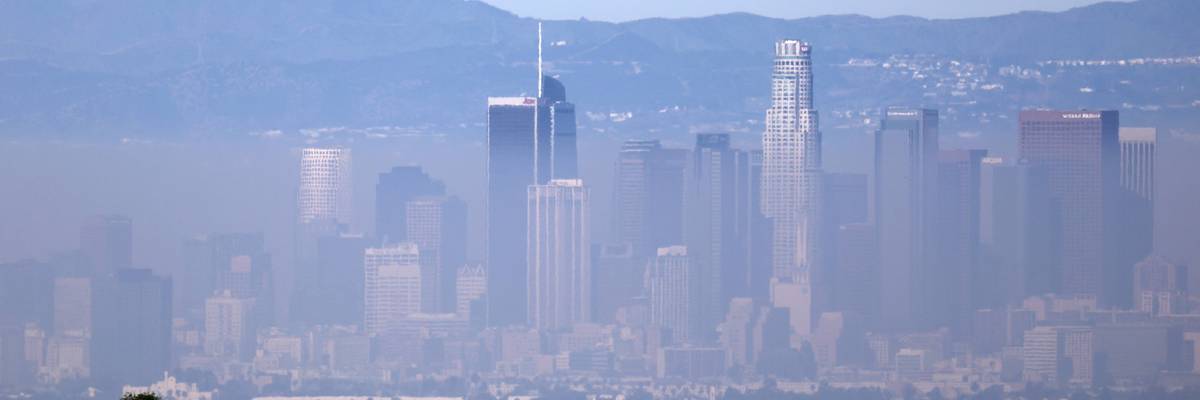
Smog hangs low around downtown Los Angeles, California on March 16, 2026.
Trump Promised 'Cleanest Air.' Report Shows Half of All US Children Live Amid Dangerous Pollution
The head of the American Lung Association said President Donald Trump's Environmental Protection Agency has "rolled back rules that would have protected kids from power plant and vehicle pollution."
Close to half of the children in the United States—more than 33 million kids—live in counties with dangerously high levels of toxic air pollution, according to the American Lung Association's annual air quality report out Wednesday.
The 27th iteration of the ALA's report examines "two of the most widespread and dangerous air pollutants"—fine particles and ground-level ozone, commonly known as smog—and assigns grades to counties and cities based on pollution levels, both daily and annually. In what the report describes as a "grim indication of the deterioration of air quality nationwide," just one city—Bangor, Maine—was "ranked on all three cleanest-cities lists by earning an 'A' for ozone and short-term particle pollution and being listed among the 25 cities with the lowest year-round particle levels."
"Last year, there were two (the other metro area being San Juan-Bayamón, Puerto Rico)," the report notes. "Past reports have been graced by as many as half a dozen metro areas meeting these criteria."
The report, which uses air quality data collected between 2022 and 2024, estimated that 46% of all children in the US live in counties that received a failing grade on at least one measure of air pollution analyzed by the ALA. More than 7 million children—10% of all kids in the country—live in an area with failing grades for all three of the ALA's measures.
Harold Wimmer, president and CEO of the ALA, said at a time when the federal government should be strengthening air quality standards, President Donald Trump's Environmental Protection Agency (EPA) "is doing the opposite," despite Trump's campaign promise to deliver "the cleanest air."
"In the last year, EPA has weakened enforcement and rolled back rules that would have protected kids from power plant and vehicle pollution," said Wimmer. "Children need clean air to grow and play, and communities need clean air to thrive. Leaders at every level must act to improve and protect America’s air quality."
For the seventh consecutive year, Bakersfield, California ranked as the US metropolitan area with the worse year-round particle pollution. Fairbanks, Alaska ranked as the city with the worse short-term particle pollution, while Los Angeles topped the list of cities with the worst ozone pollution.
The Trump administration has gleefully taken an ax to climate regulations—including air pollution standards—and the legal finding underpinning environmental rules while aggressively promoting the oil, gas, and coal industries, threatening decades of progress toward cleaner air and water.
The Guardian noted Wednesday that "since returning to office last year, the Trump administration has initiated at least 70 actions to roll back environmental and climate protections. Among them is the loosening of regulations on power plants that limit mercury and other hazardous air toxins."
"Other rollbacks include overturning limits on major air pollution sources, disbanding EPA advisory committees on air quality, and ending the practice of estimating the monetary value of lives saved by limiting fine particulate matter and ozone while still calculating costs to companies," the outlet added.
We are at a crossroads
This country and this world are at a monumental crossroads. In a few short weeks, US voters will have an opportunity to beat back the forces of fascism and confront the billionaires who are rigging the economy, our media system, and our democracy, making it increasingly impossible for ordinary people to get by. We’re not just talking about the election. We’re talking about what must be done once these fascist elements are vanquished from power. We need a bolder set of solutions than what either major party has so far been willing to offer and a working-class movement ready to fight like hell for it. Trump didn't emerge from nowhere. The conditions that fueled MAGA authoritarianism were created by decades of radical neoliberal economic policies and a corrupt political system dominated by corporate interests. They slashed taxes on the super-rich, promising that the benefits would trickle down. They said giveaways to the corporate titans would make life more affordable for the rest of us. It was all bullshit. And when a bitter, betrayed populace searches for someone to blame, right-wing demagogues have little trouble finding scapegoats. People know when they're being lied to, but you won't hear any of this from the corporate media. Only independent journalism—powered and funded by people who believe in building a better world—can deliver truly trustworthy daily news. Our Fall Campaign is underway, and we need your help. To power our newsroom through the rest of the year, we need to raise $125,000 by midnight on October 31. So if you share our vision, please contribute whatever you can to sustain our work. |
Close to half of the children in the United States—more than 33 million kids—live in counties with dangerously high levels of toxic air pollution, according to the American Lung Association's annual air quality report out Wednesday.
The 27th iteration of the ALA's report examines "two of the most widespread and dangerous air pollutants"—fine particles and ground-level ozone, commonly known as smog—and assigns grades to counties and cities based on pollution levels, both daily and annually. In what the report describes as a "grim indication of the deterioration of air quality nationwide," just one city—Bangor, Maine—was "ranked on all three cleanest-cities lists by earning an 'A' for ozone and short-term particle pollution and being listed among the 25 cities with the lowest year-round particle levels."
"Last year, there were two (the other metro area being San Juan-Bayamón, Puerto Rico)," the report notes. "Past reports have been graced by as many as half a dozen metro areas meeting these criteria."
The report, which uses air quality data collected between 2022 and 2024, estimated that 46% of all children in the US live in counties that received a failing grade on at least one measure of air pollution analyzed by the ALA. More than 7 million children—10% of all kids in the country—live in an area with failing grades for all three of the ALA's measures.
Harold Wimmer, president and CEO of the ALA, said at a time when the federal government should be strengthening air quality standards, President Donald Trump's Environmental Protection Agency (EPA) "is doing the opposite," despite Trump's campaign promise to deliver "the cleanest air."
"In the last year, EPA has weakened enforcement and rolled back rules that would have protected kids from power plant and vehicle pollution," said Wimmer. "Children need clean air to grow and play, and communities need clean air to thrive. Leaders at every level must act to improve and protect America’s air quality."
For the seventh consecutive year, Bakersfield, California ranked as the US metropolitan area with the worse year-round particle pollution. Fairbanks, Alaska ranked as the city with the worse short-term particle pollution, while Los Angeles topped the list of cities with the worst ozone pollution.
The Trump administration has gleefully taken an ax to climate regulations—including air pollution standards—and the legal finding underpinning environmental rules while aggressively promoting the oil, gas, and coal industries, threatening decades of progress toward cleaner air and water.
The Guardian noted Wednesday that "since returning to office last year, the Trump administration has initiated at least 70 actions to roll back environmental and climate protections. Among them is the loosening of regulations on power plants that limit mercury and other hazardous air toxins."
"Other rollbacks include overturning limits on major air pollution sources, disbanding EPA advisory committees on air quality, and ending the practice of estimating the monetary value of lives saved by limiting fine particulate matter and ozone while still calculating costs to companies," the outlet added.
Close to half of the children in the United States—more than 33 million kids—live in counties with dangerously high levels of toxic air pollution, according to the American Lung Association's annual air quality report out Wednesday.
The 27th iteration of the ALA's report examines "two of the most widespread and dangerous air pollutants"—fine particles and ground-level ozone, commonly known as smog—and assigns grades to counties and cities based on pollution levels, both daily and annually. In what the report describes as a "grim indication of the deterioration of air quality nationwide," just one city—Bangor, Maine—was "ranked on all three cleanest-cities lists by earning an 'A' for ozone and short-term particle pollution and being listed among the 25 cities with the lowest year-round particle levels."
"Last year, there were two (the other metro area being San Juan-Bayamón, Puerto Rico)," the report notes. "Past reports have been graced by as many as half a dozen metro areas meeting these criteria."
The report, which uses air quality data collected between 2022 and 2024, estimated that 46% of all children in the US live in counties that received a failing grade on at least one measure of air pollution analyzed by the ALA. More than 7 million children—10% of all kids in the country—live in an area with failing grades for all three of the ALA's measures.
Harold Wimmer, president and CEO of the ALA, said at a time when the federal government should be strengthening air quality standards, President Donald Trump's Environmental Protection Agency (EPA) "is doing the opposite," despite Trump's campaign promise to deliver "the cleanest air."
"In the last year, EPA has weakened enforcement and rolled back rules that would have protected kids from power plant and vehicle pollution," said Wimmer. "Children need clean air to grow and play, and communities need clean air to thrive. Leaders at every level must act to improve and protect America’s air quality."
For the seventh consecutive year, Bakersfield, California ranked as the US metropolitan area with the worse year-round particle pollution. Fairbanks, Alaska ranked as the city with the worse short-term particle pollution, while Los Angeles topped the list of cities with the worst ozone pollution.
The Trump administration has gleefully taken an ax to climate regulations—including air pollution standards—and the legal finding underpinning environmental rules while aggressively promoting the oil, gas, and coal industries, threatening decades of progress toward cleaner air and water.
The Guardian noted Wednesday that "since returning to office last year, the Trump administration has initiated at least 70 actions to roll back environmental and climate protections. Among them is the loosening of regulations on power plants that limit mercury and other hazardous air toxins."
"Other rollbacks include overturning limits on major air pollution sources, disbanding EPA advisory committees on air quality, and ending the practice of estimating the monetary value of lives saved by limiting fine particulate matter and ozone while still calculating costs to companies," the outlet added.