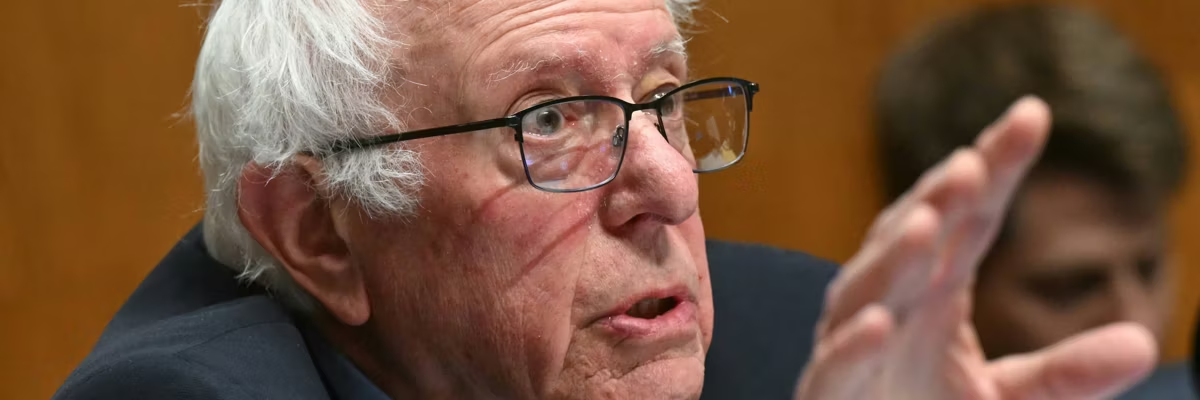
US Sen. Bernie Sanders (I-Vt.) speaks during a hearing of the Senate Committee on Health, Education, Labor, and Pensions on Capitol Hill in Washington, DC on April 22, 2026.
Bernie Sanders Leads Senators in Demand to End Super PACs in Democratic Primaries
“We cannot allow unlimited outside spending to distort our elections or drown out the voices of working people."
Sen. Bernie Sanders is leading a coalition of Democratic senators pushing for the party's leaders to require candidates to swear off billionaire- and corporate-backed super PACs, or political action committees, in this year's primary elections.
Sens. Jeff Merkley (D-Ore.), Tina Smith (D-Minn.), Elizabeth Warren (D-Mass.), Peter Welch (D-Vt.), and Chris Van Hollen (D-Md.) joined the independent senator from Vermont to send a letter to Senate Minority Leader Chuck Schumer (D-NY) and Democratic National Committee (DNC) Chair Ken Martin on Sunday.
Five of the senators are members of a group of Senate Democrats known as the "Fight Club" that has formed to oppose Schumer's preferred candidates in contested Democratic primaries, many of whom are closely aligned with the party's traditional corporate backers.
While the senators applauded the DNC's resolution last month broadly condemning the influence of dark money in party elections, calling it an "important first step," they said Democratic leaders needed to take more "concrete steps to curb the influence of dark money," particularly the artificial intelligence and cryptocurrency industries and the American Israel Public Affairs Committee (AIPAC).
"Corporate-funded super PACs are shaping the 2026 elections as we speak, and the scale of their resources is unprecedented," the senators said. "Crypto-aligned groups are preparing to spend $200 million, and AIPAC-affiliated groups already control more than $90 million. The AI industry has already spent over $185 million this year alone. These sums are being deployed to influence Democratic primaries and overwhelm candidates who rely on grassroots support."
April's broad anti-dark money resolution was passed by the DNC in lieu of one that directly singled out “the growing influence” of AIPAC, specifically over its more than $100 million spending blitz in 2024 to oust progressive candidates. Despite a dramatic shift toward opposition to Israel among Democratic voters over the past three years, that resolution was voted down by a DNC panel.
AIPAC continues to dump massive amounts of money behind its preferred candidates. The senators' letter notes that "in Illinois alone, outside groups spent over $50 million in recent Democratic primaries." Nearly half of that money was spent by AIPAC, which secretly funneled money to support its candidates using shell groups that appeared to be unaffiliated.
The group has used similar tactics in New Jersey and Pennsylvania. Ala Stanford, a candidate for Pennsylvania's 3rd District in Philadelphia, was recently revealed to have received $500,000 worth of backing from AIPAC through a super PAC despite claiming to have received no support from the Israel lobby.
Meanwhile, in Maine, a clique of Republican billionaires who back Sen. Susan Collins (R-Maine)—including Blackstone CEO Stephen Schwarzman and Palantir CEO Alex Karp—also recently dropped $2 million to fund an ad campaign seeking to hamper the chances of the Democratic Senate primary front-runner Graham Platner.
"We cannot allow unlimited outside spending to distort our elections or drown out the voices of working people," the senators said in Sunday's letter.
The senators noted Schumer's past statement that overturning the Supreme Court's 2010 ruling in Citizens United v. Federal Election Commission, which opened the door for the flood of corporate money into elections by allowing individuals to independently spend unlimited amounts in support of candidates, was "probably more important than any other single thing we could do to preserve this great and grand democracy.”
They said that while reversing the ruling remained a "critical long-term goal," the party "has the authority—and the responsibility—to act now with clear, enforceable rules."
"National and state parties should require all Democratic candidates to sign a pledge opposing billionaire- and corporate-backed super PAC spending on their behalf in Democratic primaries," they said. "The DNC, state parties, and committees working to elect Democrats to the House and Senate have many potential tools at their disposal to enforce that pledge, including withholding endorsements for those who make endorsements in the primary, and they should use whatever tools necessary to do so."
Sanders has said that simply requiring candidates to take a pledge is not enough and that party leaders need to be diligent about holding them to it.
“If the Democrats are going to be honest and consistent in terms of their concerns about money and politics, they’ve got to clean up, in my view, their own house immediately,” he said in an interview on Saturday. “That means getting super PACs out of Democratic primaries, congressional as well as presidential.”
We are at a crossroads
This country and this world are at a monumental crossroads. In a few short weeks, US voters will have an opportunity to beat back the forces of fascism and confront the billionaires who are rigging the economy, our media system, and our democracy, making it increasingly impossible for ordinary people to get by. We’re not just talking about the election. We’re talking about what must be done once these fascist elements are vanquished from power. We need a bolder set of solutions than what either major party has so far been willing to offer and a working-class movement ready to fight like hell for it. Trump didn't emerge from nowhere. The conditions that fueled MAGA authoritarianism were created by decades of radical neoliberal economic policies and a corrupt political system dominated by corporate interests. They slashed taxes on the super-rich, promising that the benefits would trickle down. They said giveaways to the corporate titans would make life more affordable for the rest of us. It was all bullshit. And when a bitter, betrayed populace searches for someone to blame, right-wing demagogues have little trouble finding scapegoats. People know when they're being lied to, but you won't hear any of this from the corporate media. Only independent journalism—powered and funded by people who believe in building a better world—can deliver truly trustworthy daily news. Our Fall Campaign is underway, and we need your help. To power our newsroom through the rest of the year, we need to raise $125,000 by midnight on October 31. So if you share our vision, please contribute whatever you can to sustain our work. |
Sen. Bernie Sanders is leading a coalition of Democratic senators pushing for the party's leaders to require candidates to swear off billionaire- and corporate-backed super PACs, or political action committees, in this year's primary elections.
Sens. Jeff Merkley (D-Ore.), Tina Smith (D-Minn.), Elizabeth Warren (D-Mass.), Peter Welch (D-Vt.), and Chris Van Hollen (D-Md.) joined the independent senator from Vermont to send a letter to Senate Minority Leader Chuck Schumer (D-NY) and Democratic National Committee (DNC) Chair Ken Martin on Sunday.
Five of the senators are members of a group of Senate Democrats known as the "Fight Club" that has formed to oppose Schumer's preferred candidates in contested Democratic primaries, many of whom are closely aligned with the party's traditional corporate backers.
While the senators applauded the DNC's resolution last month broadly condemning the influence of dark money in party elections, calling it an "important first step," they said Democratic leaders needed to take more "concrete steps to curb the influence of dark money," particularly the artificial intelligence and cryptocurrency industries and the American Israel Public Affairs Committee (AIPAC).
"Corporate-funded super PACs are shaping the 2026 elections as we speak, and the scale of their resources is unprecedented," the senators said. "Crypto-aligned groups are preparing to spend $200 million, and AIPAC-affiliated groups already control more than $90 million. The AI industry has already spent over $185 million this year alone. These sums are being deployed to influence Democratic primaries and overwhelm candidates who rely on grassroots support."
April's broad anti-dark money resolution was passed by the DNC in lieu of one that directly singled out “the growing influence” of AIPAC, specifically over its more than $100 million spending blitz in 2024 to oust progressive candidates. Despite a dramatic shift toward opposition to Israel among Democratic voters over the past three years, that resolution was voted down by a DNC panel.
AIPAC continues to dump massive amounts of money behind its preferred candidates. The senators' letter notes that "in Illinois alone, outside groups spent over $50 million in recent Democratic primaries." Nearly half of that money was spent by AIPAC, which secretly funneled money to support its candidates using shell groups that appeared to be unaffiliated.
The group has used similar tactics in New Jersey and Pennsylvania. Ala Stanford, a candidate for Pennsylvania's 3rd District in Philadelphia, was recently revealed to have received $500,000 worth of backing from AIPAC through a super PAC despite claiming to have received no support from the Israel lobby.
Meanwhile, in Maine, a clique of Republican billionaires who back Sen. Susan Collins (R-Maine)—including Blackstone CEO Stephen Schwarzman and Palantir CEO Alex Karp—also recently dropped $2 million to fund an ad campaign seeking to hamper the chances of the Democratic Senate primary front-runner Graham Platner.
"We cannot allow unlimited outside spending to distort our elections or drown out the voices of working people," the senators said in Sunday's letter.
The senators noted Schumer's past statement that overturning the Supreme Court's 2010 ruling in Citizens United v. Federal Election Commission, which opened the door for the flood of corporate money into elections by allowing individuals to independently spend unlimited amounts in support of candidates, was "probably more important than any other single thing we could do to preserve this great and grand democracy.”
They said that while reversing the ruling remained a "critical long-term goal," the party "has the authority—and the responsibility—to act now with clear, enforceable rules."
"National and state parties should require all Democratic candidates to sign a pledge opposing billionaire- and corporate-backed super PAC spending on their behalf in Democratic primaries," they said. "The DNC, state parties, and committees working to elect Democrats to the House and Senate have many potential tools at their disposal to enforce that pledge, including withholding endorsements for those who make endorsements in the primary, and they should use whatever tools necessary to do so."
Sanders has said that simply requiring candidates to take a pledge is not enough and that party leaders need to be diligent about holding them to it.
“If the Democrats are going to be honest and consistent in terms of their concerns about money and politics, they’ve got to clean up, in my view, their own house immediately,” he said in an interview on Saturday. “That means getting super PACs out of Democratic primaries, congressional as well as presidential.”
- The Abolish Super PAC Act: Sanders and Lee Seek End to 'Corrupting Influence' of Dark Money | Common Dreams ›
- Crypto, AI Industries Setting Up ‘Pop-Up Super PACs’ to Defeat Big Tech Critics in Dem Primaries | Common Dreams ›
- ‘Super PACs Should Be Outlawed,’ Says Platner, as Pro-Collins Corporate Dark Money Pours Into Maine to Attack Him | Common Dreams ›
Sen. Bernie Sanders is leading a coalition of Democratic senators pushing for the party's leaders to require candidates to swear off billionaire- and corporate-backed super PACs, or political action committees, in this year's primary elections.
Sens. Jeff Merkley (D-Ore.), Tina Smith (D-Minn.), Elizabeth Warren (D-Mass.), Peter Welch (D-Vt.), and Chris Van Hollen (D-Md.) joined the independent senator from Vermont to send a letter to Senate Minority Leader Chuck Schumer (D-NY) and Democratic National Committee (DNC) Chair Ken Martin on Sunday.
Five of the senators are members of a group of Senate Democrats known as the "Fight Club" that has formed to oppose Schumer's preferred candidates in contested Democratic primaries, many of whom are closely aligned with the party's traditional corporate backers.
While the senators applauded the DNC's resolution last month broadly condemning the influence of dark money in party elections, calling it an "important first step," they said Democratic leaders needed to take more "concrete steps to curb the influence of dark money," particularly the artificial intelligence and cryptocurrency industries and the American Israel Public Affairs Committee (AIPAC).
"Corporate-funded super PACs are shaping the 2026 elections as we speak, and the scale of their resources is unprecedented," the senators said. "Crypto-aligned groups are preparing to spend $200 million, and AIPAC-affiliated groups already control more than $90 million. The AI industry has already spent over $185 million this year alone. These sums are being deployed to influence Democratic primaries and overwhelm candidates who rely on grassroots support."
April's broad anti-dark money resolution was passed by the DNC in lieu of one that directly singled out “the growing influence” of AIPAC, specifically over its more than $100 million spending blitz in 2024 to oust progressive candidates. Despite a dramatic shift toward opposition to Israel among Democratic voters over the past three years, that resolution was voted down by a DNC panel.
AIPAC continues to dump massive amounts of money behind its preferred candidates. The senators' letter notes that "in Illinois alone, outside groups spent over $50 million in recent Democratic primaries." Nearly half of that money was spent by AIPAC, which secretly funneled money to support its candidates using shell groups that appeared to be unaffiliated.
The group has used similar tactics in New Jersey and Pennsylvania. Ala Stanford, a candidate for Pennsylvania's 3rd District in Philadelphia, was recently revealed to have received $500,000 worth of backing from AIPAC through a super PAC despite claiming to have received no support from the Israel lobby.
Meanwhile, in Maine, a clique of Republican billionaires who back Sen. Susan Collins (R-Maine)—including Blackstone CEO Stephen Schwarzman and Palantir CEO Alex Karp—also recently dropped $2 million to fund an ad campaign seeking to hamper the chances of the Democratic Senate primary front-runner Graham Platner.
"We cannot allow unlimited outside spending to distort our elections or drown out the voices of working people," the senators said in Sunday's letter.
The senators noted Schumer's past statement that overturning the Supreme Court's 2010 ruling in Citizens United v. Federal Election Commission, which opened the door for the flood of corporate money into elections by allowing individuals to independently spend unlimited amounts in support of candidates, was "probably more important than any other single thing we could do to preserve this great and grand democracy.”
They said that while reversing the ruling remained a "critical long-term goal," the party "has the authority—and the responsibility—to act now with clear, enforceable rules."
"National and state parties should require all Democratic candidates to sign a pledge opposing billionaire- and corporate-backed super PAC spending on their behalf in Democratic primaries," they said. "The DNC, state parties, and committees working to elect Democrats to the House and Senate have many potential tools at their disposal to enforce that pledge, including withholding endorsements for those who make endorsements in the primary, and they should use whatever tools necessary to do so."
Sanders has said that simply requiring candidates to take a pledge is not enough and that party leaders need to be diligent about holding them to it.
“If the Democrats are going to be honest and consistent in terms of their concerns about money and politics, they’ve got to clean up, in my view, their own house immediately,” he said in an interview on Saturday. “That means getting super PACs out of Democratic primaries, congressional as well as presidential.”
- The Abolish Super PAC Act: Sanders and Lee Seek End to 'Corrupting Influence' of Dark Money | Common Dreams ›
- Crypto, AI Industries Setting Up ‘Pop-Up Super PACs’ to Defeat Big Tech Critics in Dem Primaries | Common Dreams ›
- ‘Super PACs Should Be Outlawed,’ Says Platner, as Pro-Collins Corporate Dark Money Pours Into Maine to Attack Him | Common Dreams ›