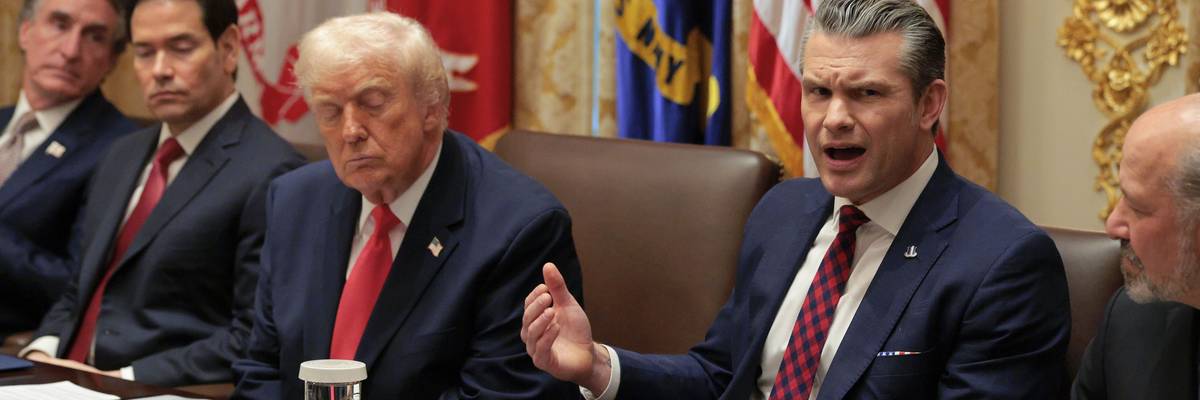
US Defense Secretary Pete Hegseth speaks alongside President Donald Trump, Secretary of State Marco Rubio, and other senior administration officials at the White House in Washington, DC on December 2, 2025.
Pentagon Weighed Sending Boat Strike Survivors to Salvadoran Prison to Avoid Defending Bombings in Court
One former Navy lawyer said the Trump administration "might not want to get into the messy issues involving detention and habeas corpus lawsuits.”
Pentagon officials asked about sending survivors of US boat strikes in the Caribbean Sea and Pacific Ocean to a notorious maximum security prison in El Salvador in a bid to keep them out of American courts—where the Trump administration's high seas extrajudicial killing spree would be subject to legal scrutiny.
New details published Tuesday by the New York Times revealed that attorneys at the US Department of Defense inquired about whether two survivors of an October 16 strike on a boat allegedly smuggling drugs in the southern Caribbean could be sent to El Salvador’s Terrorism Confinement Center (CECOT), where the Trump administration has shipped hundreds of mostly Venezuelan victims of its mass deportation campaign.
The prison—the centerpiece of right-wing Salvadoran President Nayib Bukele’s war on crime—has been plagued by allegations of torture and other abuse.
One Trump administration official speaking on condition of anonymity told the Times that State Department lawyers were "stunned" by the query. The two boat strike survivors were ultimately returned to Colombia and Ecuador, their home countries.
Other unnamed officials told the newspaper that repatriations—either to survivors' home countries or to third nations—would become the administration's default plan for dealing with anyone who lived through the US attacks.
The goal, the officials said, was to avoid trying boat strike survivors in US courts, where the discovery process would compel the Trump administration—which has offered no concrete evidence to support its claims that the targeted vessels were carrying drugs—to provide legal justification for attacks that experts say are illegal.
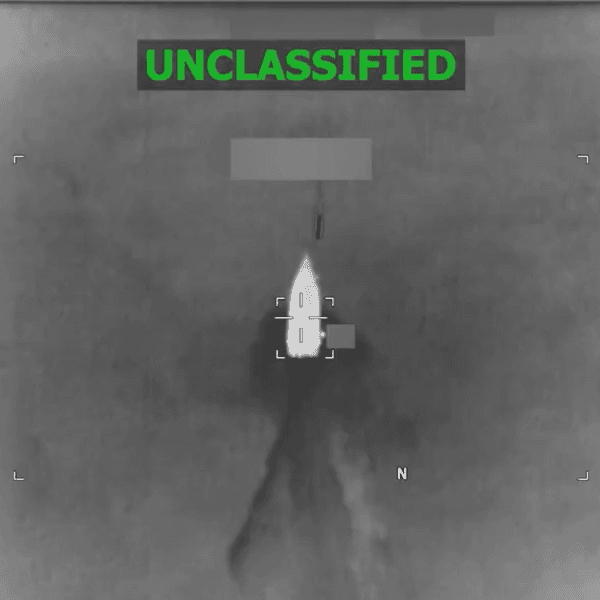
The Pentagon's inquiry followed a September 2 "double-tap" strike on a vessel carrying 11 passengers. Two men survived the initial bombing but were killed in a second strike. Since then, at least 76 other people have been killed in 23 boat strikes reported by the Trump administration.
In addition to the two men who initially survived the September 2 strike and the two repatriated survivors of the October 16 attack, one other person who lived through a boat bombing was left adrift at sea and is presumed dead.
Some observers have noted similarities between the Trump administration's goal of keeping boat strike survivors out of US courtrooms and War on Terror policies and practices—first implemented during the George W. Bush administration—such as extraordinary rendition, the use of Central Intelligence Agency "black sites," and imprisonment of terrorism suspects at Guantánamo Bay in Cuba—designed to circumvent the law.
While the Trump administration previously sent migrants captured during its crackdown to Guantánamo, sending boat strike survivors to the lockup allow their lawyers to sue for habeas corpus, a right granted by the US Supreme Court in its 2008 Boumediene v. Bush decision.
The Trump administration has revived the term "unlawful enemy combatant"—which was used by the Bush administration to classify people caught up in the War on Terror in a way that skirts the law—to apply to boat strike survivors. The Pentagon has also called such survivors "distressed mariners," a term that normally applies to civilians stranded at sea.
“If we’re in a war, they should be using the term ‘shipwrecked survivors,’” Mark Nevitt, a former Navy lawyer who is now a law professor at Emory University, told the Times. “My theory is they might not want to get into the messy issues involving detention and habeas corpus lawsuits.”
Relatives of men killed in the strikes, as well as officials in Venezuela and Colombia, say that at least some of the victims were fishermen who were not linked to the illicit drug trade. One expert said last month that even in cases of vessels that were involved in drug trafficking, the bombings were "the equivalent of straight-up massacring 16-year-old drug dealers on US street corners.”
Even if the men targeted in the boat strikes were running drugs, "the appropriate response is to interdict the boats and arrest the occupants for prosecution," former Human Rights Watch executive director Kenneth Roth said Wednesday.
"The rules governing law enforcement prohibit lethal force except as a last resort to stop an imminent threat of death or serious bodily injury," he added, "which the boats do not present."
We are at a crossroads
This country and this world are at a monumental crossroads. In a few short weeks, US voters will have an opportunity to beat back the forces of fascism and confront the billionaires who are rigging the economy, our media system, and our democracy, making it increasingly impossible for ordinary people to get by. We’re not just talking about the election. We’re talking about what must be done once these fascist elements are vanquished from power. We need a bolder set of solutions than what either major party has so far been willing to offer and a working-class movement ready to fight like hell for it. Trump didn't emerge from nowhere. The conditions that fueled MAGA authoritarianism were created by decades of radical neoliberal economic policies and a corrupt political system dominated by corporate interests. They slashed taxes on the super-rich, promising that the benefits would trickle down. They said giveaways to the corporate titans would make life more affordable for the rest of us. It was all bullshit. And when a bitter, betrayed populace searches for someone to blame, right-wing demagogues have little trouble finding scapegoats. People know when they're being lied to, but you won't hear any of this from the corporate media. Only independent journalism—powered and funded by people who believe in building a better world—can deliver truly trustworthy daily news. Our Fall Campaign is underway, and we need your help. To power our newsroom through the rest of the year, we need to raise $125,000 by midnight on October 31. So if you share our vision, please contribute whatever you can to sustain our work. |
Pentagon officials asked about sending survivors of US boat strikes in the Caribbean Sea and Pacific Ocean to a notorious maximum security prison in El Salvador in a bid to keep them out of American courts—where the Trump administration's high seas extrajudicial killing spree would be subject to legal scrutiny.
New details published Tuesday by the New York Times revealed that attorneys at the US Department of Defense inquired about whether two survivors of an October 16 strike on a boat allegedly smuggling drugs in the southern Caribbean could be sent to El Salvador’s Terrorism Confinement Center (CECOT), where the Trump administration has shipped hundreds of mostly Venezuelan victims of its mass deportation campaign.
The prison—the centerpiece of right-wing Salvadoran President Nayib Bukele’s war on crime—has been plagued by allegations of torture and other abuse.
One Trump administration official speaking on condition of anonymity told the Times that State Department lawyers were "stunned" by the query. The two boat strike survivors were ultimately returned to Colombia and Ecuador, their home countries.
Other unnamed officials told the newspaper that repatriations—either to survivors' home countries or to third nations—would become the administration's default plan for dealing with anyone who lived through the US attacks.
The goal, the officials said, was to avoid trying boat strike survivors in US courts, where the discovery process would compel the Trump administration—which has offered no concrete evidence to support its claims that the targeted vessels were carrying drugs—to provide legal justification for attacks that experts say are illegal.
The Pentagon's inquiry followed a September 2 "double-tap" strike on a vessel carrying 11 passengers. Two men survived the initial bombing but were killed in a second strike. Since then, at least 76 other people have been killed in 23 boat strikes reported by the Trump administration.
In addition to the two men who initially survived the September 2 strike and the two repatriated survivors of the October 16 attack, one other person who lived through a boat bombing was left adrift at sea and is presumed dead.
Some observers have noted similarities between the Trump administration's goal of keeping boat strike survivors out of US courtrooms and War on Terror policies and practices—first implemented during the George W. Bush administration—such as extraordinary rendition, the use of Central Intelligence Agency "black sites," and imprisonment of terrorism suspects at Guantánamo Bay in Cuba—designed to circumvent the law.
While the Trump administration previously sent migrants captured during its crackdown to Guantánamo, sending boat strike survivors to the lockup allow their lawyers to sue for habeas corpus, a right granted by the US Supreme Court in its 2008 Boumediene v. Bush decision.
The Trump administration has revived the term "unlawful enemy combatant"—which was used by the Bush administration to classify people caught up in the War on Terror in a way that skirts the law—to apply to boat strike survivors. The Pentagon has also called such survivors "distressed mariners," a term that normally applies to civilians stranded at sea.
“If we’re in a war, they should be using the term ‘shipwrecked survivors,’” Mark Nevitt, a former Navy lawyer who is now a law professor at Emory University, told the Times. “My theory is they might not want to get into the messy issues involving detention and habeas corpus lawsuits.”
Relatives of men killed in the strikes, as well as officials in Venezuela and Colombia, say that at least some of the victims were fishermen who were not linked to the illicit drug trade. One expert said last month that even in cases of vessels that were involved in drug trafficking, the bombings were "the equivalent of straight-up massacring 16-year-old drug dealers on US street corners.”
Even if the men targeted in the boat strikes were running drugs, "the appropriate response is to interdict the boats and arrest the occupants for prosecution," former Human Rights Watch executive director Kenneth Roth said Wednesday.
"The rules governing law enforcement prohibit lethal force except as a last resort to stop an imminent threat of death or serious bodily injury," he added, "which the boats do not present."
- 'These Are Murders': Trump Condemned After Bombing Yet Another Boat Off Venezuelan Coast ›
- Critics Allege White House 'Propaganda' After US Bombs Boat Off Venezuela Coast ›
- 'Furious Backlash' Inside Pentagon as Hegseth Seeks to Avoid Blame for Deadly War Crimes ›
- Hegseth Says 6 More Men Killed in Latest Boat Bombings ›
- Opinion | Trump and Hegseth's Boat Strikes Are International Terrorism | Common Dreams ›
- Trinidadians Sue US for Caribbean Boat Bombing That Killed Relatives 'In Cold Blood' | Common Dreams ›
- Boat Strike Survivors Say They Were Captured, Tortured by US Forces | Common Dreams ›
Pentagon officials asked about sending survivors of US boat strikes in the Caribbean Sea and Pacific Ocean to a notorious maximum security prison in El Salvador in a bid to keep them out of American courts—where the Trump administration's high seas extrajudicial killing spree would be subject to legal scrutiny.
New details published Tuesday by the New York Times revealed that attorneys at the US Department of Defense inquired about whether two survivors of an October 16 strike on a boat allegedly smuggling drugs in the southern Caribbean could be sent to El Salvador’s Terrorism Confinement Center (CECOT), where the Trump administration has shipped hundreds of mostly Venezuelan victims of its mass deportation campaign.
The prison—the centerpiece of right-wing Salvadoran President Nayib Bukele’s war on crime—has been plagued by allegations of torture and other abuse.
One Trump administration official speaking on condition of anonymity told the Times that State Department lawyers were "stunned" by the query. The two boat strike survivors were ultimately returned to Colombia and Ecuador, their home countries.
Other unnamed officials told the newspaper that repatriations—either to survivors' home countries or to third nations—would become the administration's default plan for dealing with anyone who lived through the US attacks.
The goal, the officials said, was to avoid trying boat strike survivors in US courts, where the discovery process would compel the Trump administration—which has offered no concrete evidence to support its claims that the targeted vessels were carrying drugs—to provide legal justification for attacks that experts say are illegal.
The Pentagon's inquiry followed a September 2 "double-tap" strike on a vessel carrying 11 passengers. Two men survived the initial bombing but were killed in a second strike. Since then, at least 76 other people have been killed in 23 boat strikes reported by the Trump administration.
In addition to the two men who initially survived the September 2 strike and the two repatriated survivors of the October 16 attack, one other person who lived through a boat bombing was left adrift at sea and is presumed dead.
Some observers have noted similarities between the Trump administration's goal of keeping boat strike survivors out of US courtrooms and War on Terror policies and practices—first implemented during the George W. Bush administration—such as extraordinary rendition, the use of Central Intelligence Agency "black sites," and imprisonment of terrorism suspects at Guantánamo Bay in Cuba—designed to circumvent the law.
While the Trump administration previously sent migrants captured during its crackdown to Guantánamo, sending boat strike survivors to the lockup allow their lawyers to sue for habeas corpus, a right granted by the US Supreme Court in its 2008 Boumediene v. Bush decision.
The Trump administration has revived the term "unlawful enemy combatant"—which was used by the Bush administration to classify people caught up in the War on Terror in a way that skirts the law—to apply to boat strike survivors. The Pentagon has also called such survivors "distressed mariners," a term that normally applies to civilians stranded at sea.
“If we’re in a war, they should be using the term ‘shipwrecked survivors,’” Mark Nevitt, a former Navy lawyer who is now a law professor at Emory University, told the Times. “My theory is they might not want to get into the messy issues involving detention and habeas corpus lawsuits.”
Relatives of men killed in the strikes, as well as officials in Venezuela and Colombia, say that at least some of the victims were fishermen who were not linked to the illicit drug trade. One expert said last month that even in cases of vessels that were involved in drug trafficking, the bombings were "the equivalent of straight-up massacring 16-year-old drug dealers on US street corners.”
Even if the men targeted in the boat strikes were running drugs, "the appropriate response is to interdict the boats and arrest the occupants for prosecution," former Human Rights Watch executive director Kenneth Roth said Wednesday.
"The rules governing law enforcement prohibit lethal force except as a last resort to stop an imminent threat of death or serious bodily injury," he added, "which the boats do not present."
- 'These Are Murders': Trump Condemned After Bombing Yet Another Boat Off Venezuelan Coast ›
- Critics Allege White House 'Propaganda' After US Bombs Boat Off Venezuela Coast ›
- 'Furious Backlash' Inside Pentagon as Hegseth Seeks to Avoid Blame for Deadly War Crimes ›
- Hegseth Says 6 More Men Killed in Latest Boat Bombings ›
- Opinion | Trump and Hegseth's Boat Strikes Are International Terrorism | Common Dreams ›
- Trinidadians Sue US for Caribbean Boat Bombing That Killed Relatives 'In Cold Blood' | Common Dreams ›
- Boat Strike Survivors Say They Were Captured, Tortured by US Forces | Common Dreams ›