SUBSCRIBE TO OUR FREE NEWSLETTER
Daily news & progressive opinion—funded by the people, not the corporations—delivered straight to your inbox.
5
#000000
#FFFFFF
To donate by check, phone, or other method, see our More Ways to Give page.
Daily news & progressive opinion—funded by the people, not the corporations—delivered straight to your inbox.
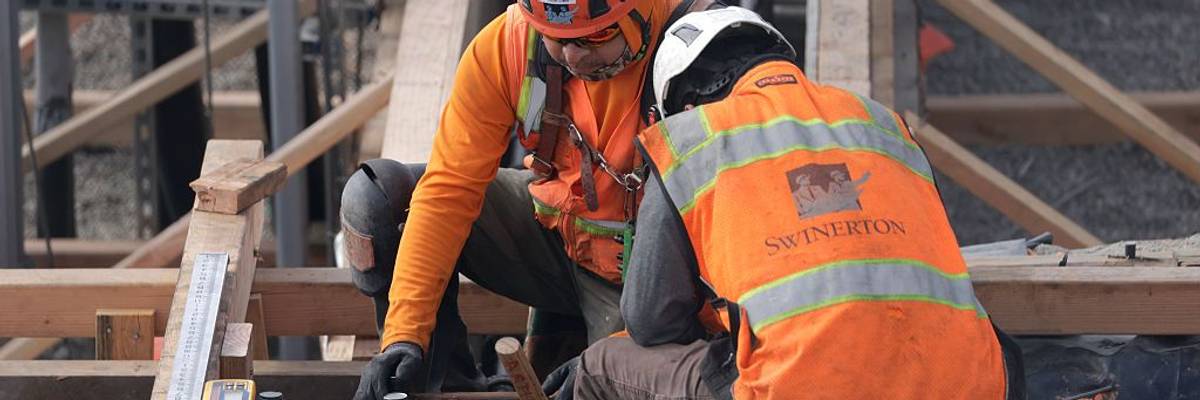
Workers construct a new building on September 5, 2025 in San Francisco, California.
"The jobs aren’t coming back, the wages aren’t rising," one economist said.
President Donald Trump has justified his historically high tariffs on foreign goods by promising that they would lead to a boom in domestic manufacturing jobs in the US.
However, in year-end reviews of the US job market, three economists make the case that Trump's record on creating manufacturing jobs has been a massive bust.
Mike Konczal, senior director of policy and research at the Economic Security Project and a former member of President Joe Biden’s National Economic Council, argued in his personal newsletter on Friday that the Trump administration's efforts to reorganize the US labor market away from service sector jobs have completely failed.
In particular, he found that jobs in manufacturing, mining, and logging have all declined throughout the first year of Trump's second term, while jobs in construction have remained mostly flat after years of steady growth during former President Joe Biden's administration.
What's more, the administration's stated goal of opening up more jobs for native-born US workers by conducting mass deportations of immigrant workers has also flopped, as native-born unemployment has been higher in 2025 than in either of the last two years.
"The bleak irony is that even after sacrificing real prosperity to chase this 4chan-level political economy, they still won’t achieve their goal," Konczal concluded. "The jobs aren’t coming back, the wages aren’t rising, and family formation won’t be rescued by trying to rewind the labor market to a world that never existed in the first place."
Nobel Prize-winning economist Paul Krugman concurred with Konczal's assessment of the US labor market in an analysis published Monday in which he described Trump's record on jobs as "an abject failure."
Krugman argued that Trump's war on clean energy projects is almost certainly making the situation even worse by killing blue-collar manufacturing and construction jobs in the wind and solar industries.
"Trump has scrapped Biden’s green energy policies in favor of tariffs and fossil fuels," Krugman noted. "But it isn’t working. Instead, employment in 'manly' sectors has fallen since Trump took office."
Additionally, said Krugman, Trump's plan to use tariffs to bring back manufacturing jobs to the US was always destined to fail given the realities of how modern economies work.
"In the modern world nations mostly don’t sell each other completed consumer goods," he explained. "Instead, the majority of trade involves sales of goods that are used to produce other goods... What this means in practice is that tariffs, which raise the prices of those capital goods and inputs, raise the production costs of US manufacturers, in many cases making them less competitive with foreign producers."
Ball State University economist Michael J. Hicks, in a column published Monday by the Indianapolis Star, also pointed the finger at Trump's tariffs when explaining his failure to revive US manufacturing.
Hicks argued that the damage the president's policies have done to manufacturing won't be undone any time soon.
"The US is in the early days of a manufacturing contraction that will run through most of 2026, even if the tariffs are lifted today," he warned. "We should call it the deindustrialization of America. All of this flies in the face of the nonsensical claims of a manufacturing renaissance or onshoring that would bring factory jobs back to the US."
Dear Common Dreams reader, It’s been nearly 30 years since I co-founded Common Dreams with my late wife, Lina Newhouser. We had the radical notion that journalism should serve the public good, not corporate profits. It was clear to us from the outset what it would take to build such a project. No paid advertisements. No corporate sponsors. No millionaire publisher telling us what to think or do. Many people said we wouldn't last a year, but we proved those doubters wrong. Together with a tremendous team of journalists and dedicated staff, we built an independent media outlet free from the constraints of profits and corporate control. Our mission has always been simple: To inform. To inspire. To ignite change for the common good. Building Common Dreams was not easy. Our survival was never guaranteed. When you take on the most powerful forces—Wall Street greed, fossil fuel industry destruction, Big Tech lobbyists, and uber-rich oligarchs who have spent billions upon billions rigging the economy and democracy in their favor—the only bulwark you have is supporters who believe in your work. But here’s the urgent message from me today. It's never been this bad out there. And it's never been this hard to keep us going. At the very moment Common Dreams is most needed, the threats we face are intensifying. We need your support now more than ever. We don't accept corporate advertising and never will. We don't have a paywall because we don't think people should be blocked from critical news based on their ability to pay. Everything we do is funded by the donations of readers like you. When everyone does the little they can afford, we are strong. But if that support retreats or dries up, so do we. Will you donate now to make sure Common Dreams not only survives but thrives? —Craig Brown, Co-founder |
President Donald Trump has justified his historically high tariffs on foreign goods by promising that they would lead to a boom in domestic manufacturing jobs in the US.
However, in year-end reviews of the US job market, three economists make the case that Trump's record on creating manufacturing jobs has been a massive bust.
Mike Konczal, senior director of policy and research at the Economic Security Project and a former member of President Joe Biden’s National Economic Council, argued in his personal newsletter on Friday that the Trump administration's efforts to reorganize the US labor market away from service sector jobs have completely failed.
In particular, he found that jobs in manufacturing, mining, and logging have all declined throughout the first year of Trump's second term, while jobs in construction have remained mostly flat after years of steady growth during former President Joe Biden's administration.
What's more, the administration's stated goal of opening up more jobs for native-born US workers by conducting mass deportations of immigrant workers has also flopped, as native-born unemployment has been higher in 2025 than in either of the last two years.
"The bleak irony is that even after sacrificing real prosperity to chase this 4chan-level political economy, they still won’t achieve their goal," Konczal concluded. "The jobs aren’t coming back, the wages aren’t rising, and family formation won’t be rescued by trying to rewind the labor market to a world that never existed in the first place."
Nobel Prize-winning economist Paul Krugman concurred with Konczal's assessment of the US labor market in an analysis published Monday in which he described Trump's record on jobs as "an abject failure."
Krugman argued that Trump's war on clean energy projects is almost certainly making the situation even worse by killing blue-collar manufacturing and construction jobs in the wind and solar industries.
"Trump has scrapped Biden’s green energy policies in favor of tariffs and fossil fuels," Krugman noted. "But it isn’t working. Instead, employment in 'manly' sectors has fallen since Trump took office."
Additionally, said Krugman, Trump's plan to use tariffs to bring back manufacturing jobs to the US was always destined to fail given the realities of how modern economies work.
"In the modern world nations mostly don’t sell each other completed consumer goods," he explained. "Instead, the majority of trade involves sales of goods that are used to produce other goods... What this means in practice is that tariffs, which raise the prices of those capital goods and inputs, raise the production costs of US manufacturers, in many cases making them less competitive with foreign producers."
Ball State University economist Michael J. Hicks, in a column published Monday by the Indianapolis Star, also pointed the finger at Trump's tariffs when explaining his failure to revive US manufacturing.
Hicks argued that the damage the president's policies have done to manufacturing won't be undone any time soon.
"The US is in the early days of a manufacturing contraction that will run through most of 2026, even if the tariffs are lifted today," he warned. "We should call it the deindustrialization of America. All of this flies in the face of the nonsensical claims of a manufacturing renaissance or onshoring that would bring factory jobs back to the US."
President Donald Trump has justified his historically high tariffs on foreign goods by promising that they would lead to a boom in domestic manufacturing jobs in the US.
However, in year-end reviews of the US job market, three economists make the case that Trump's record on creating manufacturing jobs has been a massive bust.
Mike Konczal, senior director of policy and research at the Economic Security Project and a former member of President Joe Biden’s National Economic Council, argued in his personal newsletter on Friday that the Trump administration's efforts to reorganize the US labor market away from service sector jobs have completely failed.
In particular, he found that jobs in manufacturing, mining, and logging have all declined throughout the first year of Trump's second term, while jobs in construction have remained mostly flat after years of steady growth during former President Joe Biden's administration.
What's more, the administration's stated goal of opening up more jobs for native-born US workers by conducting mass deportations of immigrant workers has also flopped, as native-born unemployment has been higher in 2025 than in either of the last two years.
"The bleak irony is that even after sacrificing real prosperity to chase this 4chan-level political economy, they still won’t achieve their goal," Konczal concluded. "The jobs aren’t coming back, the wages aren’t rising, and family formation won’t be rescued by trying to rewind the labor market to a world that never existed in the first place."
Nobel Prize-winning economist Paul Krugman concurred with Konczal's assessment of the US labor market in an analysis published Monday in which he described Trump's record on jobs as "an abject failure."
Krugman argued that Trump's war on clean energy projects is almost certainly making the situation even worse by killing blue-collar manufacturing and construction jobs in the wind and solar industries.
"Trump has scrapped Biden’s green energy policies in favor of tariffs and fossil fuels," Krugman noted. "But it isn’t working. Instead, employment in 'manly' sectors has fallen since Trump took office."
Additionally, said Krugman, Trump's plan to use tariffs to bring back manufacturing jobs to the US was always destined to fail given the realities of how modern economies work.
"In the modern world nations mostly don’t sell each other completed consumer goods," he explained. "Instead, the majority of trade involves sales of goods that are used to produce other goods... What this means in practice is that tariffs, which raise the prices of those capital goods and inputs, raise the production costs of US manufacturers, in many cases making them less competitive with foreign producers."
Ball State University economist Michael J. Hicks, in a column published Monday by the Indianapolis Star, also pointed the finger at Trump's tariffs when explaining his failure to revive US manufacturing.
Hicks argued that the damage the president's policies have done to manufacturing won't be undone any time soon.
"The US is in the early days of a manufacturing contraction that will run through most of 2026, even if the tariffs are lifted today," he warned. "We should call it the deindustrialization of America. All of this flies in the face of the nonsensical claims of a manufacturing renaissance or onshoring that would bring factory jobs back to the US."