SUBSCRIBE TO OUR FREE NEWSLETTER
Daily news & progressive opinion—funded by the people, not the corporations—delivered straight to your inbox.
5
#000000
#FFFFFF
To donate by check, phone, or other method, see our More Ways to Give page.
Daily news & progressive opinion—funded by the people, not the corporations—delivered straight to your inbox.
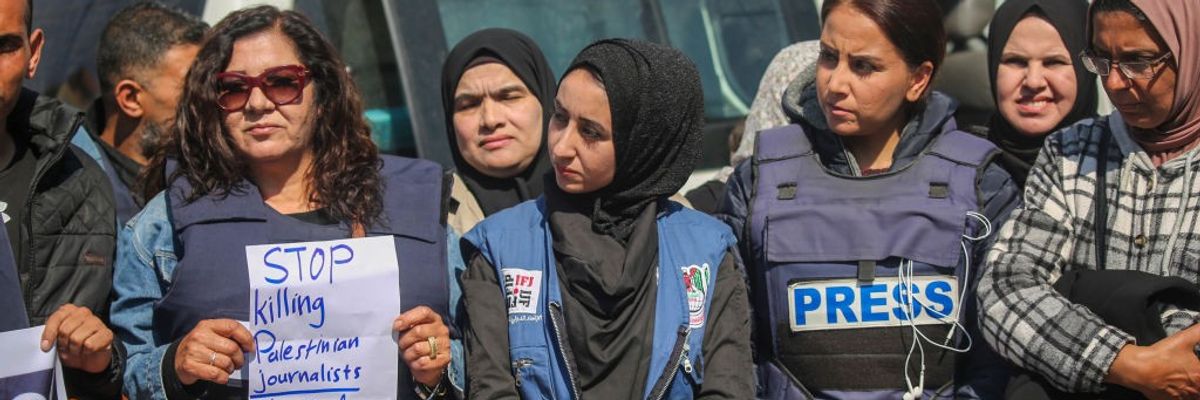
Palestinian journalists stage a protest to draw attention to Palestinian press killed while covering the war in the Gaza Strip on February 26, 2024 in Rafah.
Reporters Without Borders says it has "reasonable grounds for thinking that some of these journalists were deliberately killed and that the others were the victims of deliberate IDF attacks against civilians."
The press freedom group Reporters Without Borders announced Monday that it has filed a third complaint at the International Criminal Court alleging "war crimes against journalists in Gaza," where over 100 media professionals have been killed by Israeli forces since October 7.
Paris-based Reporters Without Borders (RSF) is asking the ICC to investigate the Israel Defense Forces' (IDF) killing of eight Palestinian journalists and wounding of another between December 15 and May 20 and, more broadly, the over 100 media workers slain during the course of Israel's 234-day assault on Gaza.
RSF said it "has reasonable grounds for thinking that some of these journalists were deliberately killed and that the others were the victims of deliberate IDF attacks against civilians" and accused Israel of "an eradication of the Palestinian media."
"Impunity endangers journalists not only in Palestine but also throughout the world," RSF advocacy and assistance director Antoine Bernard said in a statement. "Those who kill journalists are attacking the public's right to information, which is even more essential in times of conflict. They must be held accountable, and RSF will continue to work to this end, in solidarity with Gaza's reporters."
Journalists in RSF's latest complaint include Mustapha Thuraya and Hamza al-Dahdouh, freelancers working for Al Jazeera in Rafah when they were killed by a targeted Israeli drone strike on their vehicle on January 7, and Hazem Rajab, who was injured in the strike.
According to RSF:
The complaint also cites the cases of Hadaf News website reporter Ahmed Badir, who was killed by an airstrike at the entrance to Shuhada al-Aqsa Hospital in Deir al-Balah on 10 January; Kan'an News Agency correspondent Yasser Mamdouh, who was killed near Al-Nasser Hospital in Khan Yunis on 11 February; Ayat Khadoura, an independent video blogger killed by an Israeli strike on his home on 20 November shortly after posting a video; Yazan Emad Al-Zwaidi, a cameraman with the Egyptian satellite TV news channel Al Ghad, who was killed on 14 January when an Israeli strike hit the group of civilians he was with in Beit Hanoun; Ahmed Fatima, a journalist with the Al Qahera News TV channel, who was killed during a bombardment in Khan Yunis on 13 November; and Rami Bdeir, a reporter for the Palestinian New Press media outlet, who was killed during an Israeli bombardment in Khan Yunis on 15 December.
Another advocacy group, the Committee to Protect Journalists, previously condemned what it called an "apparent pattern of targeting journalists and their families," noting cases in which media workers were killed while wearing press insignia and after being threatened by Israeli officials.
Monday marked the ninth anniversary of United Nations Security Council Resolution 2222, which concerns the protection of journalists in conflict zones and "emphasizes the responsibility of states to comply with the relevant obligations under international law to end impunity and to prosecute those responsible for serious violations of international humanitarian law."
Last month, Francesca Albanese, the U.N. special rapporteur on the occupied Palestinian territories, said: "Killing journalists is a war crime that undermines the most basic human rights. Justice starts with the cessation of injustice."
Dear Common Dreams reader, It’s been nearly 30 years since I co-founded Common Dreams with my late wife, Lina Newhouser. We had the radical notion that journalism should serve the public good, not corporate profits. It was clear to us from the outset what it would take to build such a project. No paid advertisements. No corporate sponsors. No millionaire publisher telling us what to think or do. Many people said we wouldn't last a year, but we proved those doubters wrong. Together with a tremendous team of journalists and dedicated staff, we built an independent media outlet free from the constraints of profits and corporate control. Our mission has always been simple: To inform. To inspire. To ignite change for the common good. Building Common Dreams was not easy. Our survival was never guaranteed. When you take on the most powerful forces—Wall Street greed, fossil fuel industry destruction, Big Tech lobbyists, and uber-rich oligarchs who have spent billions upon billions rigging the economy and democracy in their favor—the only bulwark you have is supporters who believe in your work. But here’s the urgent message from me today. It's never been this bad out there. And it's never been this hard to keep us going. At the very moment Common Dreams is most needed, the threats we face are intensifying. We need your support now more than ever. We don't accept corporate advertising and never will. We don't have a paywall because we don't think people should be blocked from critical news based on their ability to pay. Everything we do is funded by the donations of readers like you. When everyone does the little they can afford, we are strong. But if that support retreats or dries up, so do we. Will you donate now to make sure Common Dreams not only survives but thrives? —Craig Brown, Co-founder |
The press freedom group Reporters Without Borders announced Monday that it has filed a third complaint at the International Criminal Court alleging "war crimes against journalists in Gaza," where over 100 media professionals have been killed by Israeli forces since October 7.
Paris-based Reporters Without Borders (RSF) is asking the ICC to investigate the Israel Defense Forces' (IDF) killing of eight Palestinian journalists and wounding of another between December 15 and May 20 and, more broadly, the over 100 media workers slain during the course of Israel's 234-day assault on Gaza.
RSF said it "has reasonable grounds for thinking that some of these journalists were deliberately killed and that the others were the victims of deliberate IDF attacks against civilians" and accused Israel of "an eradication of the Palestinian media."
"Impunity endangers journalists not only in Palestine but also throughout the world," RSF advocacy and assistance director Antoine Bernard said in a statement. "Those who kill journalists are attacking the public's right to information, which is even more essential in times of conflict. They must be held accountable, and RSF will continue to work to this end, in solidarity with Gaza's reporters."
Journalists in RSF's latest complaint include Mustapha Thuraya and Hamza al-Dahdouh, freelancers working for Al Jazeera in Rafah when they were killed by a targeted Israeli drone strike on their vehicle on January 7, and Hazem Rajab, who was injured in the strike.
According to RSF:
The complaint also cites the cases of Hadaf News website reporter Ahmed Badir, who was killed by an airstrike at the entrance to Shuhada al-Aqsa Hospital in Deir al-Balah on 10 January; Kan'an News Agency correspondent Yasser Mamdouh, who was killed near Al-Nasser Hospital in Khan Yunis on 11 February; Ayat Khadoura, an independent video blogger killed by an Israeli strike on his home on 20 November shortly after posting a video; Yazan Emad Al-Zwaidi, a cameraman with the Egyptian satellite TV news channel Al Ghad, who was killed on 14 January when an Israeli strike hit the group of civilians he was with in Beit Hanoun; Ahmed Fatima, a journalist with the Al Qahera News TV channel, who was killed during a bombardment in Khan Yunis on 13 November; and Rami Bdeir, a reporter for the Palestinian New Press media outlet, who was killed during an Israeli bombardment in Khan Yunis on 15 December.
Another advocacy group, the Committee to Protect Journalists, previously condemned what it called an "apparent pattern of targeting journalists and their families," noting cases in which media workers were killed while wearing press insignia and after being threatened by Israeli officials.
Monday marked the ninth anniversary of United Nations Security Council Resolution 2222, which concerns the protection of journalists in conflict zones and "emphasizes the responsibility of states to comply with the relevant obligations under international law to end impunity and to prosecute those responsible for serious violations of international humanitarian law."
Last month, Francesca Albanese, the U.N. special rapporteur on the occupied Palestinian territories, said: "Killing journalists is a war crime that undermines the most basic human rights. Justice starts with the cessation of injustice."
The press freedom group Reporters Without Borders announced Monday that it has filed a third complaint at the International Criminal Court alleging "war crimes against journalists in Gaza," where over 100 media professionals have been killed by Israeli forces since October 7.
Paris-based Reporters Without Borders (RSF) is asking the ICC to investigate the Israel Defense Forces' (IDF) killing of eight Palestinian journalists and wounding of another between December 15 and May 20 and, more broadly, the over 100 media workers slain during the course of Israel's 234-day assault on Gaza.
RSF said it "has reasonable grounds for thinking that some of these journalists were deliberately killed and that the others were the victims of deliberate IDF attacks against civilians" and accused Israel of "an eradication of the Palestinian media."
"Impunity endangers journalists not only in Palestine but also throughout the world," RSF advocacy and assistance director Antoine Bernard said in a statement. "Those who kill journalists are attacking the public's right to information, which is even more essential in times of conflict. They must be held accountable, and RSF will continue to work to this end, in solidarity with Gaza's reporters."
Journalists in RSF's latest complaint include Mustapha Thuraya and Hamza al-Dahdouh, freelancers working for Al Jazeera in Rafah when they were killed by a targeted Israeli drone strike on their vehicle on January 7, and Hazem Rajab, who was injured in the strike.
According to RSF:
The complaint also cites the cases of Hadaf News website reporter Ahmed Badir, who was killed by an airstrike at the entrance to Shuhada al-Aqsa Hospital in Deir al-Balah on 10 January; Kan'an News Agency correspondent Yasser Mamdouh, who was killed near Al-Nasser Hospital in Khan Yunis on 11 February; Ayat Khadoura, an independent video blogger killed by an Israeli strike on his home on 20 November shortly after posting a video; Yazan Emad Al-Zwaidi, a cameraman with the Egyptian satellite TV news channel Al Ghad, who was killed on 14 January when an Israeli strike hit the group of civilians he was with in Beit Hanoun; Ahmed Fatima, a journalist with the Al Qahera News TV channel, who was killed during a bombardment in Khan Yunis on 13 November; and Rami Bdeir, a reporter for the Palestinian New Press media outlet, who was killed during an Israeli bombardment in Khan Yunis on 15 December.
Another advocacy group, the Committee to Protect Journalists, previously condemned what it called an "apparent pattern of targeting journalists and their families," noting cases in which media workers were killed while wearing press insignia and after being threatened by Israeli officials.
Monday marked the ninth anniversary of United Nations Security Council Resolution 2222, which concerns the protection of journalists in conflict zones and "emphasizes the responsibility of states to comply with the relevant obligations under international law to end impunity and to prosecute those responsible for serious violations of international humanitarian law."
Last month, Francesca Albanese, the U.N. special rapporteur on the occupied Palestinian territories, said: "Killing journalists is a war crime that undermines the most basic human rights. Justice starts with the cessation of injustice."