SUBSCRIBE TO OUR FREE NEWSLETTER
Daily news & progressive opinion—funded by the people, not the corporations—delivered straight to your inbox.
5
#000000
#FFFFFF
To donate by check, phone, or other method, see our More Ways to Give page.
Daily news & progressive opinion—funded by the people, not the corporations—delivered straight to your inbox.
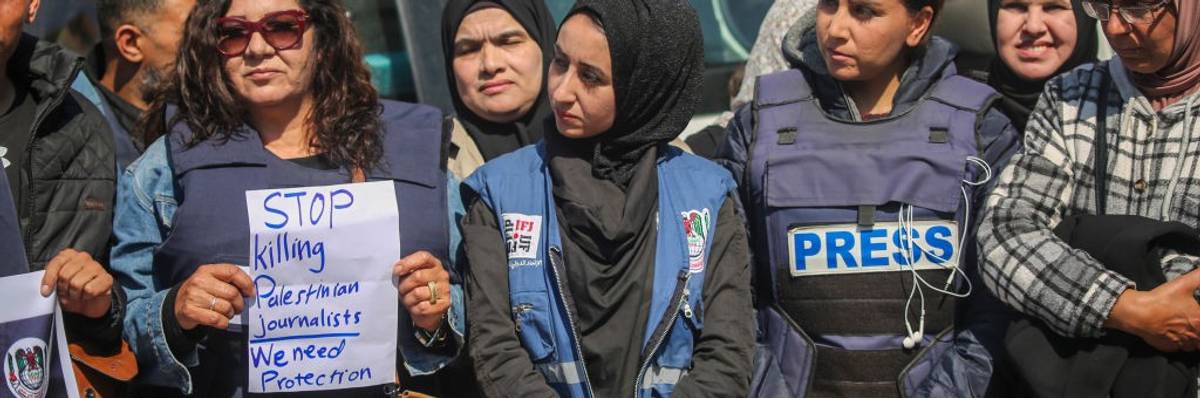
Palestinian journalists stage a protest to draw attention to Palestinian press killed while covering the war in the Gaza Strip on February 26, 2024 in Rafah, Gaza.
"Journalists are civilians and Israeli authorities must protect journalists as noncombatants according to international law."
As Palestinian journalists brave Israeli bombs and bullets to show the world the Gaza genocide, leaders of three dozen prominent international media outlets on Thursday signed an open letter voicing solidarity with Palestinian media professionals "in their call for safety, protection, and the freedom to report."
"For nearly five months, journalists and media workers in Gaza—overwhelmingly, the sole source of on-the-ground reporting from within the Palestinian territory—have been working in unprecedented conditions: At least 89 have been killed in the war... more journalists than have ever been killed in a single country over an entire year," states the letter, which was coordinated by the Committee to Protect Journalists (CPJ) with the support of the World Association of News Publishers.
"These journalists—on whom the international news media and the international community rely for information about the situation inside Gaza—continue to report despite grave personal risk," the letter notes. "They continue despite the loss of family, friends, and colleagues, the destruction of homes and offices, constant displacement, communications blackouts, and shortages of food and fuel."
"Journalists are civilians and Israeli authorities must protect journalists as noncombatants according to international law," the signers stressed. "Those responsible for any violations of that long-standing protection should be held accountable. Attacks on journalists are also attacks on truth. We commit to championing the safety of journalists in Gaza, which is fundamental for the protection of press freedom everywhere."
Signatories to the letter include CEOs, editors, and publishers of outlets including ABC News, Agence France-Presse, Al-Araby, Asahi Shimbun, The Associated Press, CNN, Financial Times, The Guardian, Haaretz, The Independent, ITN, ITV, The Irish Times, Los Angeles Times, NBC News, The New Yorker, The New York Times, Rappler, Reuters, The Sowetan, Der Spiegel, Süddeutsche Zeitung, The Washington Post, and others.
More journalists have been killed in Gaza in less than five months than in all of World War II or the Vietnam War, according to the U.S.-based advocacy group Freedom Forum.
CPJ has previously condemned Israel's "apparent pattern of targeting journalists and their families," noting cases in which media workers were killed while wearing press insignia and after being threatened by Israeli officials.
"The Israeli army killed dozens of journalists while wearing [identification]," Palestinian journalist Ruwaida Amer told i's Kieron Monks in an interview this week. "You may protect yourself if you do not wear it."
Other journalists have been wounded, sometimes severely, by Israeli forces. For example,
Agence France-Presse photojournalist Christina Assi had her legs blown off by an Israeli tank shell while she and a group of journalists were covering cross-border clashes between Israel and the Lebanese resistance group Hezbollah. The attack killed 37-year-old Lebanese Reuters videographer Issam Abdallah and wounded five other media workers. Human Rights Watch called the incident an "apparently deliberate" act and a "likely war crime."
Dozens of media professionals have also been arrested and others have reported being abused by Israeli troops, even during live broadcasts.
United Nations officials have also condemned Israel's "killing and silencing of journalists" in Gaza.
"In times of conflict, the right to information is a 'survival right' on which the very lives of civilians depend, and journalists play an indispensable role as a vital source of information, and as human rights defenders and witnesses to atrocities, reporting on violations and abuses of international humanitarian law and human rights," a group of U.N. special rapporteurs recently wrote.
"Journalists are entitled to protection as civilians under international humanitarian law. Targeted attacks and killings of journalists are war crimes," they stressed, adding that "we urge the International Court of Justice and the International Criminal Court to give particular attention to the dangerous pattern of attacks and impunity for crimes against journalists, which has intensified since October 7."
The International Court of Justice is currently investigating South Africa-led accusations of Israeli genocide in Gaza. The ICJ issued a preliminary ruling in January ordering Israel to avoid genocidal acts—an order human rights groups say Israel is ignoring.
Gaza officials say Israeli forces have killed at least 30,228 Palestinians—mostly women and children—and wounded more than 71,300 others while forcibly displacing around 90% of Gaza's 2.3 million people since October 7. Israel also severely tightened its economic stranglehold on the besieged coastal enclave, precipitating the spread of disease and starvation that is now killing children.
Dear Common Dreams reader, It’s been nearly 30 years since I co-founded Common Dreams with my late wife, Lina Newhouser. We had the radical notion that journalism should serve the public good, not corporate profits. It was clear to us from the outset what it would take to build such a project. No paid advertisements. No corporate sponsors. No millionaire publisher telling us what to think or do. Many people said we wouldn't last a year, but we proved those doubters wrong. Together with a tremendous team of journalists and dedicated staff, we built an independent media outlet free from the constraints of profits and corporate control. Our mission has always been simple: To inform. To inspire. To ignite change for the common good. Building Common Dreams was not easy. Our survival was never guaranteed. When you take on the most powerful forces—Wall Street greed, fossil fuel industry destruction, Big Tech lobbyists, and uber-rich oligarchs who have spent billions upon billions rigging the economy and democracy in their favor—the only bulwark you have is supporters who believe in your work. But here’s the urgent message from me today. It's never been this bad out there. And it's never been this hard to keep us going. At the very moment Common Dreams is most needed, the threats we face are intensifying. We need your support now more than ever. We don't accept corporate advertising and never will. We don't have a paywall because we don't think people should be blocked from critical news based on their ability to pay. Everything we do is funded by the donations of readers like you. When everyone does the little they can afford, we are strong. But if that support retreats or dries up, so do we. Will you donate now to make sure Common Dreams not only survives but thrives? —Craig Brown, Co-founder |
As Palestinian journalists brave Israeli bombs and bullets to show the world the Gaza genocide, leaders of three dozen prominent international media outlets on Thursday signed an open letter voicing solidarity with Palestinian media professionals "in their call for safety, protection, and the freedom to report."
"For nearly five months, journalists and media workers in Gaza—overwhelmingly, the sole source of on-the-ground reporting from within the Palestinian territory—have been working in unprecedented conditions: At least 89 have been killed in the war... more journalists than have ever been killed in a single country over an entire year," states the letter, which was coordinated by the Committee to Protect Journalists (CPJ) with the support of the World Association of News Publishers.
"These journalists—on whom the international news media and the international community rely for information about the situation inside Gaza—continue to report despite grave personal risk," the letter notes. "They continue despite the loss of family, friends, and colleagues, the destruction of homes and offices, constant displacement, communications blackouts, and shortages of food and fuel."
"Journalists are civilians and Israeli authorities must protect journalists as noncombatants according to international law," the signers stressed. "Those responsible for any violations of that long-standing protection should be held accountable. Attacks on journalists are also attacks on truth. We commit to championing the safety of journalists in Gaza, which is fundamental for the protection of press freedom everywhere."
Signatories to the letter include CEOs, editors, and publishers of outlets including ABC News, Agence France-Presse, Al-Araby, Asahi Shimbun, The Associated Press, CNN, Financial Times, The Guardian, Haaretz, The Independent, ITN, ITV, The Irish Times, Los Angeles Times, NBC News, The New Yorker, The New York Times, Rappler, Reuters, The Sowetan, Der Spiegel, Süddeutsche Zeitung, The Washington Post, and others.
More journalists have been killed in Gaza in less than five months than in all of World War II or the Vietnam War, according to the U.S.-based advocacy group Freedom Forum.
CPJ has previously condemned Israel's "apparent pattern of targeting journalists and their families," noting cases in which media workers were killed while wearing press insignia and after being threatened by Israeli officials.
"The Israeli army killed dozens of journalists while wearing [identification]," Palestinian journalist Ruwaida Amer told i's Kieron Monks in an interview this week. "You may protect yourself if you do not wear it."
Other journalists have been wounded, sometimes severely, by Israeli forces. For example,
Agence France-Presse photojournalist Christina Assi had her legs blown off by an Israeli tank shell while she and a group of journalists were covering cross-border clashes between Israel and the Lebanese resistance group Hezbollah. The attack killed 37-year-old Lebanese Reuters videographer Issam Abdallah and wounded five other media workers. Human Rights Watch called the incident an "apparently deliberate" act and a "likely war crime."
Dozens of media professionals have also been arrested and others have reported being abused by Israeli troops, even during live broadcasts.
United Nations officials have also condemned Israel's "killing and silencing of journalists" in Gaza.
"In times of conflict, the right to information is a 'survival right' on which the very lives of civilians depend, and journalists play an indispensable role as a vital source of information, and as human rights defenders and witnesses to atrocities, reporting on violations and abuses of international humanitarian law and human rights," a group of U.N. special rapporteurs recently wrote.
"Journalists are entitled to protection as civilians under international humanitarian law. Targeted attacks and killings of journalists are war crimes," they stressed, adding that "we urge the International Court of Justice and the International Criminal Court to give particular attention to the dangerous pattern of attacks and impunity for crimes against journalists, which has intensified since October 7."
The International Court of Justice is currently investigating South Africa-led accusations of Israeli genocide in Gaza. The ICJ issued a preliminary ruling in January ordering Israel to avoid genocidal acts—an order human rights groups say Israel is ignoring.
Gaza officials say Israeli forces have killed at least 30,228 Palestinians—mostly women and children—and wounded more than 71,300 others while forcibly displacing around 90% of Gaza's 2.3 million people since October 7. Israel also severely tightened its economic stranglehold on the besieged coastal enclave, precipitating the spread of disease and starvation that is now killing children.
As Palestinian journalists brave Israeli bombs and bullets to show the world the Gaza genocide, leaders of three dozen prominent international media outlets on Thursday signed an open letter voicing solidarity with Palestinian media professionals "in their call for safety, protection, and the freedom to report."
"For nearly five months, journalists and media workers in Gaza—overwhelmingly, the sole source of on-the-ground reporting from within the Palestinian territory—have been working in unprecedented conditions: At least 89 have been killed in the war... more journalists than have ever been killed in a single country over an entire year," states the letter, which was coordinated by the Committee to Protect Journalists (CPJ) with the support of the World Association of News Publishers.
"These journalists—on whom the international news media and the international community rely for information about the situation inside Gaza—continue to report despite grave personal risk," the letter notes. "They continue despite the loss of family, friends, and colleagues, the destruction of homes and offices, constant displacement, communications blackouts, and shortages of food and fuel."
"Journalists are civilians and Israeli authorities must protect journalists as noncombatants according to international law," the signers stressed. "Those responsible for any violations of that long-standing protection should be held accountable. Attacks on journalists are also attacks on truth. We commit to championing the safety of journalists in Gaza, which is fundamental for the protection of press freedom everywhere."
Signatories to the letter include CEOs, editors, and publishers of outlets including ABC News, Agence France-Presse, Al-Araby, Asahi Shimbun, The Associated Press, CNN, Financial Times, The Guardian, Haaretz, The Independent, ITN, ITV, The Irish Times, Los Angeles Times, NBC News, The New Yorker, The New York Times, Rappler, Reuters, The Sowetan, Der Spiegel, Süddeutsche Zeitung, The Washington Post, and others.
More journalists have been killed in Gaza in less than five months than in all of World War II or the Vietnam War, according to the U.S.-based advocacy group Freedom Forum.
CPJ has previously condemned Israel's "apparent pattern of targeting journalists and their families," noting cases in which media workers were killed while wearing press insignia and after being threatened by Israeli officials.
"The Israeli army killed dozens of journalists while wearing [identification]," Palestinian journalist Ruwaida Amer told i's Kieron Monks in an interview this week. "You may protect yourself if you do not wear it."
Other journalists have been wounded, sometimes severely, by Israeli forces. For example,
Agence France-Presse photojournalist Christina Assi had her legs blown off by an Israeli tank shell while she and a group of journalists were covering cross-border clashes between Israel and the Lebanese resistance group Hezbollah. The attack killed 37-year-old Lebanese Reuters videographer Issam Abdallah and wounded five other media workers. Human Rights Watch called the incident an "apparently deliberate" act and a "likely war crime."
Dozens of media professionals have also been arrested and others have reported being abused by Israeli troops, even during live broadcasts.
United Nations officials have also condemned Israel's "killing and silencing of journalists" in Gaza.
"In times of conflict, the right to information is a 'survival right' on which the very lives of civilians depend, and journalists play an indispensable role as a vital source of information, and as human rights defenders and witnesses to atrocities, reporting on violations and abuses of international humanitarian law and human rights," a group of U.N. special rapporteurs recently wrote.
"Journalists are entitled to protection as civilians under international humanitarian law. Targeted attacks and killings of journalists are war crimes," they stressed, adding that "we urge the International Court of Justice and the International Criminal Court to give particular attention to the dangerous pattern of attacks and impunity for crimes against journalists, which has intensified since October 7."
The International Court of Justice is currently investigating South Africa-led accusations of Israeli genocide in Gaza. The ICJ issued a preliminary ruling in January ordering Israel to avoid genocidal acts—an order human rights groups say Israel is ignoring.
Gaza officials say Israeli forces have killed at least 30,228 Palestinians—mostly women and children—and wounded more than 71,300 others while forcibly displacing around 90% of Gaza's 2.3 million people since October 7. Israel also severely tightened its economic stranglehold on the besieged coastal enclave, precipitating the spread of disease and starvation that is now killing children.