

SUBSCRIBE TO OUR FREE NEWSLETTER
Daily news & progressive opinion—funded by the people, not the corporations—delivered straight to your inbox.
5
#000000
#FFFFFF
To donate by check, phone, or other method, see our More Ways to Give page.
Daily news & progressive opinion—funded by the people, not the corporations—delivered straight to your inbox.
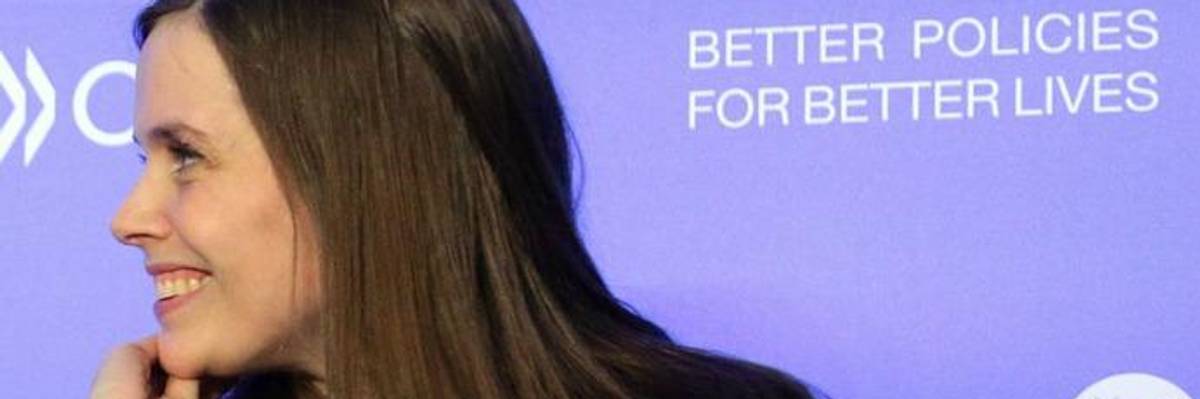
Icelandic Prime Minister Katrin Jakobsdottir is seen at a conference.
"An 'equality paradise' should not have a 21% wage gap and 40% of women experiencing gender-based or sexual violence in their lifetime," said one organizer.
Schools, health systems, and television broadcasters in Iceland were among the businesses that said they would have to close or reduce services on Tuesday due to the country's first full-day women's strike in nearly 50 years—potentially helping to prove the point that tens of thousands of women and non-binary workers are hoping to make by demonstrating that their labor is vital and must be paid accordingly.
Prime Minister Katrín Jakobsdóttir is among the women taking part in the "kvennafrí," or "women's day off," and told reporters she expects women in her cabinet to strike as well, as organizers push to close Iceland's gender pay gap and end gender-based violence.
While Iceland has been recognized for 14 straight years as having the smallest gap in gender equality among the countries in the World Economic Forum's annual rankings, strike organizer Freyja Steingrímsdóttir told The Guardian it is hardly an "equality paradise," and women are demanding greater action from the government to ensure true parity.
On average, Icelandic women still earn about 10% less than men, and as much as 21% less in some professions. Forty percent of women report experiencing gender-based violence.
"An 'equality paradise' should not have a 21% wage gap and 40% of women experiencing gender-based or sexual violence in their lifetime," said Steingrímsdóttir, communications director for the Icelandic Federation for Public Workers. "That's not what women around the world are striving for."
Taking place 48 years after the last full-day women's strike, in which 25,000 people rallied in Reykjavík and 90% of women staged a work stoppage affecting paid and unpaid labor, this year's protest has adopted the slogan, "Kallarðu þetta jafnrétti?" or "You call this equality?"
Icelandic President Gudni Th. Johannesson expressed his support for the strike, saying women's "activism for equality has changed Icelandic society for the better and continues to do so today."
The country's trade unions—which count 90% of Icelandic workers as members—are key organizers of the action and are calling on women and nonbinary workers to join the strike.
The 1975 action was tied to passage of an equal rights law the following year and the election of the country's first female president—the first woman to be democratically elected president in any country—in 1980. Other successes have followed in recent years, such as the passage of a law that requires some companies to prove they're paying people of different genders equally for equal work.
Former Climate Minister Kolbrún Halldórsdóttir told The Guardian that men continue to fail to take responsibility for domestic labor, leaving unpaid work such as childcare to women who are also attempting to succeed in the workplace.
"If you look at it economically women seem to be punished for taking these extra burdens, which is not righteous," Halldórsdóttir told the outlet. "It's something that we need to look into and need to change."
Organizers are calling for the wages of workers in female-dominated professions to be made public and for the federal government to take greater action against gender-based violence, ensuring perpetrators are held accountable. One 2018 University of Iceland study found that only 12% of survivors of sexual assault press charges, and those who do have their cases dismissed nearly 75% of the time. Women told researchers they feared the "shame, guilt, and condemnation" that would come with having their cases tried in the justice system.
"We are now trying to connect the dots, saying that violence against women and undervalued work of women in the labor market are two sides of the same coin and have an effect on each other," Drífa Snædal, spokesperson for Stígamót, an anti-sexual violence group, told The Guardian.
Kate Jarman, a director of corporate affairs at a National Health Service hospital in the United Kingdom, said a similar women's strike in the U.K. would force numerous workplaces with majority-female staff to "recognize our worth."
The Left in the European Parliament also expressed support for the action.
" Solidarity with the strikers," the progressive political party said.
Dear Common Dreams reader, It’s been nearly 30 years since I co-founded Common Dreams with my late wife, Lina Newhouser. We had the radical notion that journalism should serve the public good, not corporate profits. It was clear to us from the outset what it would take to build such a project. No paid advertisements. No corporate sponsors. No millionaire publisher telling us what to think or do. Many people said we wouldn't last a year, but we proved those doubters wrong. Together with a tremendous team of journalists and dedicated staff, we built an independent media outlet free from the constraints of profits and corporate control. Our mission has always been simple: To inform. To inspire. To ignite change for the common good. Building Common Dreams was not easy. Our survival was never guaranteed. When you take on the most powerful forces—Wall Street greed, fossil fuel industry destruction, Big Tech lobbyists, and uber-rich oligarchs who have spent billions upon billions rigging the economy and democracy in their favor—the only bulwark you have is supporters who believe in your work. But here’s the urgent message from me today. It's never been this bad out there. And it's never been this hard to keep us going. At the very moment Common Dreams is most needed, the threats we face are intensifying. We need your support now more than ever. We don't accept corporate advertising and never will. We don't have a paywall because we don't think people should be blocked from critical news based on their ability to pay. Everything we do is funded by the donations of readers like you. When everyone does the little they can afford, we are strong. But if that support retreats or dries up, so do we. Will you donate now to make sure Common Dreams not only survives but thrives? —Craig Brown, Co-founder |
Schools, health systems, and television broadcasters in Iceland were among the businesses that said they would have to close or reduce services on Tuesday due to the country's first full-day women's strike in nearly 50 years—potentially helping to prove the point that tens of thousands of women and non-binary workers are hoping to make by demonstrating that their labor is vital and must be paid accordingly.
Prime Minister Katrín Jakobsdóttir is among the women taking part in the "kvennafrí," or "women's day off," and told reporters she expects women in her cabinet to strike as well, as organizers push to close Iceland's gender pay gap and end gender-based violence.
While Iceland has been recognized for 14 straight years as having the smallest gap in gender equality among the countries in the World Economic Forum's annual rankings, strike organizer Freyja Steingrímsdóttir told The Guardian it is hardly an "equality paradise," and women are demanding greater action from the government to ensure true parity.
On average, Icelandic women still earn about 10% less than men, and as much as 21% less in some professions. Forty percent of women report experiencing gender-based violence.
"An 'equality paradise' should not have a 21% wage gap and 40% of women experiencing gender-based or sexual violence in their lifetime," said Steingrímsdóttir, communications director for the Icelandic Federation for Public Workers. "That's not what women around the world are striving for."
Taking place 48 years after the last full-day women's strike, in which 25,000 people rallied in Reykjavík and 90% of women staged a work stoppage affecting paid and unpaid labor, this year's protest has adopted the slogan, "Kallarðu þetta jafnrétti?" or "You call this equality?"
Icelandic President Gudni Th. Johannesson expressed his support for the strike, saying women's "activism for equality has changed Icelandic society for the better and continues to do so today."
The country's trade unions—which count 90% of Icelandic workers as members—are key organizers of the action and are calling on women and nonbinary workers to join the strike.
The 1975 action was tied to passage of an equal rights law the following year and the election of the country's first female president—the first woman to be democratically elected president in any country—in 1980. Other successes have followed in recent years, such as the passage of a law that requires some companies to prove they're paying people of different genders equally for equal work.
Former Climate Minister Kolbrún Halldórsdóttir told The Guardian that men continue to fail to take responsibility for domestic labor, leaving unpaid work such as childcare to women who are also attempting to succeed in the workplace.
"If you look at it economically women seem to be punished for taking these extra burdens, which is not righteous," Halldórsdóttir told the outlet. "It's something that we need to look into and need to change."
Organizers are calling for the wages of workers in female-dominated professions to be made public and for the federal government to take greater action against gender-based violence, ensuring perpetrators are held accountable. One 2018 University of Iceland study found that only 12% of survivors of sexual assault press charges, and those who do have their cases dismissed nearly 75% of the time. Women told researchers they feared the "shame, guilt, and condemnation" that would come with having their cases tried in the justice system.
"We are now trying to connect the dots, saying that violence against women and undervalued work of women in the labor market are two sides of the same coin and have an effect on each other," Drífa Snædal, spokesperson for Stígamót, an anti-sexual violence group, told The Guardian.
Kate Jarman, a director of corporate affairs at a National Health Service hospital in the United Kingdom, said a similar women's strike in the U.K. would force numerous workplaces with majority-female staff to "recognize our worth."
The Left in the European Parliament also expressed support for the action.
" Solidarity with the strikers," the progressive political party said.
Schools, health systems, and television broadcasters in Iceland were among the businesses that said they would have to close or reduce services on Tuesday due to the country's first full-day women's strike in nearly 50 years—potentially helping to prove the point that tens of thousands of women and non-binary workers are hoping to make by demonstrating that their labor is vital and must be paid accordingly.
Prime Minister Katrín Jakobsdóttir is among the women taking part in the "kvennafrí," or "women's day off," and told reporters she expects women in her cabinet to strike as well, as organizers push to close Iceland's gender pay gap and end gender-based violence.
While Iceland has been recognized for 14 straight years as having the smallest gap in gender equality among the countries in the World Economic Forum's annual rankings, strike organizer Freyja Steingrímsdóttir told The Guardian it is hardly an "equality paradise," and women are demanding greater action from the government to ensure true parity.
On average, Icelandic women still earn about 10% less than men, and as much as 21% less in some professions. Forty percent of women report experiencing gender-based violence.
"An 'equality paradise' should not have a 21% wage gap and 40% of women experiencing gender-based or sexual violence in their lifetime," said Steingrímsdóttir, communications director for the Icelandic Federation for Public Workers. "That's not what women around the world are striving for."
Taking place 48 years after the last full-day women's strike, in which 25,000 people rallied in Reykjavík and 90% of women staged a work stoppage affecting paid and unpaid labor, this year's protest has adopted the slogan, "Kallarðu þetta jafnrétti?" or "You call this equality?"
Icelandic President Gudni Th. Johannesson expressed his support for the strike, saying women's "activism for equality has changed Icelandic society for the better and continues to do so today."
The country's trade unions—which count 90% of Icelandic workers as members—are key organizers of the action and are calling on women and nonbinary workers to join the strike.
The 1975 action was tied to passage of an equal rights law the following year and the election of the country's first female president—the first woman to be democratically elected president in any country—in 1980. Other successes have followed in recent years, such as the passage of a law that requires some companies to prove they're paying people of different genders equally for equal work.
Former Climate Minister Kolbrún Halldórsdóttir told The Guardian that men continue to fail to take responsibility for domestic labor, leaving unpaid work such as childcare to women who are also attempting to succeed in the workplace.
"If you look at it economically women seem to be punished for taking these extra burdens, which is not righteous," Halldórsdóttir told the outlet. "It's something that we need to look into and need to change."
Organizers are calling for the wages of workers in female-dominated professions to be made public and for the federal government to take greater action against gender-based violence, ensuring perpetrators are held accountable. One 2018 University of Iceland study found that only 12% of survivors of sexual assault press charges, and those who do have their cases dismissed nearly 75% of the time. Women told researchers they feared the "shame, guilt, and condemnation" that would come with having their cases tried in the justice system.
"We are now trying to connect the dots, saying that violence against women and undervalued work of women in the labor market are two sides of the same coin and have an effect on each other," Drífa Snædal, spokesperson for Stígamót, an anti-sexual violence group, told The Guardian.
Kate Jarman, a director of corporate affairs at a National Health Service hospital in the United Kingdom, said a similar women's strike in the U.K. would force numerous workplaces with majority-female staff to "recognize our worth."
The Left in the European Parliament also expressed support for the action.
" Solidarity with the strikers," the progressive political party said.

