

SUBSCRIBE TO OUR FREE NEWSLETTER
Daily news & progressive opinion—funded by the people, not the corporations—delivered straight to your inbox.
5
#000000
#FFFFFF
To donate by check, phone, or other method, see our More Ways to Give page.
Daily news & progressive opinion—funded by the people, not the corporations—delivered straight to your inbox.
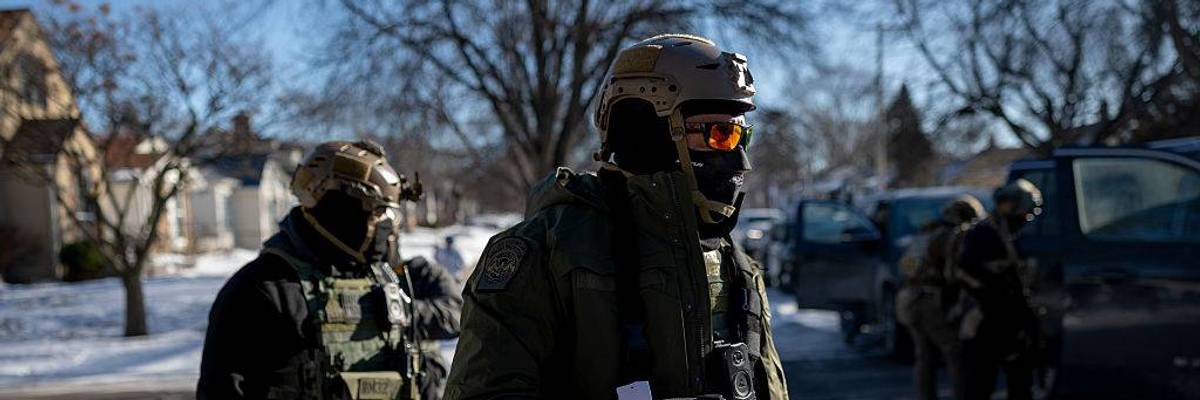
An agent with the Department of Homeland Security, which includes Immigration and Customs Enforcement, Border Patrol, and Customs Enforcement, patrols a neighborhood on January 31, 2026 in St. Paul, Minnesota.
"You don’t see evidence of gang association," said one legal expert. "It just feels like a dirtying up of the defendant."
After a US Border Patrol Agent shot two Venezuelan immigrants in Portland, Oregon in January, the Department of Homeland Security claimed that the two victims were "vicious Tren de Aragua gang members" who "weaponized their vehicle" against federal agents, who had no choice but to open fire in self-defense.
However, court records obtained by the Guardian reveal that a Department of Justice prosecutor subsequently told a judge the government was "not suggesting" that one of the victims, Luis Niño-Moncada, was a gang member.
The Guardian also obtained an FBI affidavit contradicting DHS claims about the second victim, Yorlenys Zambrano-Contreras, being "involved" in a shooting in Portland last year, when in reality she was a "reported victim of sexual assault and robbery."
Attorneys representing Niño-Moncada and Zambrano-Contreras, who both survived the shooting and were subsequently hospitalized, told the Guardian that neither of them have any prior criminal convictions.
Legal experts who spoke with the Guardian about the shooting said it appeared that DHS was waging a "smear campaign" against the victims.
Sergio Perez, a civil rights lawyer and former US prosecutor, noted in an interview that prosecutors filed criminal charges against Niño-Moncada and Zambrano-Contreras just two days after they were shot, even before it had obtained crucial video evidence of the incident.
"This government needs to go back to the practice of slow and thorough investigations," he told the Guardian, "rather than what we consistently see in immigration enforcement activities—which is a rush to smear individuals."
Carley Palmer, a former federal prosecutor, told the Guardian that the court records obtained by the paper don't show DOJ presenting any of the usual evidence that prosecutors use to establish defendants' alleged gang membership.
"What’s interesting about the filings is that you don’t see evidence of gang association," said Palmer. "It just feels like a dirtying up of the defendant."
DHS in recent months has made a number of claims about people who have been shot or killed by federal immigration officers that have not held up to scrutiny.
Most recently, Homeland Security Secretary Kristi Noem claimed that slain Minneapolis intensive care nurse Alex Pretti was a "domestic terrorist" intent on inflicting "maximum damage" on federal agents, when video clearly showed that Pretti was swarmed by multiple federal agents and was disarmed before two agents opened fire and killed him.
Noem also openly lied about the circumstances and actions that resulted in the shooting death of Renee Nicole Good by a federal agent weeks earlier.
In November, federal prosecutors abruptly dropped charges against Marimar Martinez, a woman who was shot multiple times by a US Border Patrol agent in October in Chicago’s Brighton Park neighborhood.
In the indictment filed against Martinez, prosecutors said that the Border Patrol agent who shot her had been acting in self-defense, and that he had only opened fire after Martinez’s car collided with his vehicle.
However, uncovered text messages showed the Border Patrol agent apparently bragging about shooting Martinez, as he boasted that he “fired five rounds and she had seven holes” in a message sent to fellow agents.
An attorney representing Martinez also claimed that he had seen body camera footage that directly undermined DHS claims about how the shooting unfolded.
No explanation was provided for why charges against Martinez were dropped.
Dear Common Dreams reader, It’s been nearly 30 years since I co-founded Common Dreams with my late wife, Lina Newhouser. We had the radical notion that journalism should serve the public good, not corporate profits. It was clear to us from the outset what it would take to build such a project. No paid advertisements. No corporate sponsors. No millionaire publisher telling us what to think or do. Many people said we wouldn't last a year, but we proved those doubters wrong. Together with a tremendous team of journalists and dedicated staff, we built an independent media outlet free from the constraints of profits and corporate control. Our mission has always been simple: To inform. To inspire. To ignite change for the common good. Building Common Dreams was not easy. Our survival was never guaranteed. When you take on the most powerful forces—Wall Street greed, fossil fuel industry destruction, Big Tech lobbyists, and uber-rich oligarchs who have spent billions upon billions rigging the economy and democracy in their favor—the only bulwark you have is supporters who believe in your work. But here’s the urgent message from me today. It's never been this bad out there. And it's never been this hard to keep us going. At the very moment Common Dreams is most needed, the threats we face are intensifying. We need your support now more than ever. We don't accept corporate advertising and never will. We don't have a paywall because we don't think people should be blocked from critical news based on their ability to pay. Everything we do is funded by the donations of readers like you. When everyone does the little they can afford, we are strong. But if that support retreats or dries up, so do we. Will you donate now to make sure Common Dreams not only survives but thrives? —Craig Brown, Co-founder |
After a US Border Patrol Agent shot two Venezuelan immigrants in Portland, Oregon in January, the Department of Homeland Security claimed that the two victims were "vicious Tren de Aragua gang members" who "weaponized their vehicle" against federal agents, who had no choice but to open fire in self-defense.
However, court records obtained by the Guardian reveal that a Department of Justice prosecutor subsequently told a judge the government was "not suggesting" that one of the victims, Luis Niño-Moncada, was a gang member.
The Guardian also obtained an FBI affidavit contradicting DHS claims about the second victim, Yorlenys Zambrano-Contreras, being "involved" in a shooting in Portland last year, when in reality she was a "reported victim of sexual assault and robbery."
Attorneys representing Niño-Moncada and Zambrano-Contreras, who both survived the shooting and were subsequently hospitalized, told the Guardian that neither of them have any prior criminal convictions.
Legal experts who spoke with the Guardian about the shooting said it appeared that DHS was waging a "smear campaign" against the victims.
Sergio Perez, a civil rights lawyer and former US prosecutor, noted in an interview that prosecutors filed criminal charges against Niño-Moncada and Zambrano-Contreras just two days after they were shot, even before it had obtained crucial video evidence of the incident.
"This government needs to go back to the practice of slow and thorough investigations," he told the Guardian, "rather than what we consistently see in immigration enforcement activities—which is a rush to smear individuals."
Carley Palmer, a former federal prosecutor, told the Guardian that the court records obtained by the paper don't show DOJ presenting any of the usual evidence that prosecutors use to establish defendants' alleged gang membership.
"What’s interesting about the filings is that you don’t see evidence of gang association," said Palmer. "It just feels like a dirtying up of the defendant."
DHS in recent months has made a number of claims about people who have been shot or killed by federal immigration officers that have not held up to scrutiny.
Most recently, Homeland Security Secretary Kristi Noem claimed that slain Minneapolis intensive care nurse Alex Pretti was a "domestic terrorist" intent on inflicting "maximum damage" on federal agents, when video clearly showed that Pretti was swarmed by multiple federal agents and was disarmed before two agents opened fire and killed him.
Noem also openly lied about the circumstances and actions that resulted in the shooting death of Renee Nicole Good by a federal agent weeks earlier.
In November, federal prosecutors abruptly dropped charges against Marimar Martinez, a woman who was shot multiple times by a US Border Patrol agent in October in Chicago’s Brighton Park neighborhood.
In the indictment filed against Martinez, prosecutors said that the Border Patrol agent who shot her had been acting in self-defense, and that he had only opened fire after Martinez’s car collided with his vehicle.
However, uncovered text messages showed the Border Patrol agent apparently bragging about shooting Martinez, as he boasted that he “fired five rounds and she had seven holes” in a message sent to fellow agents.
An attorney representing Martinez also claimed that he had seen body camera footage that directly undermined DHS claims about how the shooting unfolded.
No explanation was provided for why charges against Martinez were dropped.
After a US Border Patrol Agent shot two Venezuelan immigrants in Portland, Oregon in January, the Department of Homeland Security claimed that the two victims were "vicious Tren de Aragua gang members" who "weaponized their vehicle" against federal agents, who had no choice but to open fire in self-defense.
However, court records obtained by the Guardian reveal that a Department of Justice prosecutor subsequently told a judge the government was "not suggesting" that one of the victims, Luis Niño-Moncada, was a gang member.
The Guardian also obtained an FBI affidavit contradicting DHS claims about the second victim, Yorlenys Zambrano-Contreras, being "involved" in a shooting in Portland last year, when in reality she was a "reported victim of sexual assault and robbery."
Attorneys representing Niño-Moncada and Zambrano-Contreras, who both survived the shooting and were subsequently hospitalized, told the Guardian that neither of them have any prior criminal convictions.
Legal experts who spoke with the Guardian about the shooting said it appeared that DHS was waging a "smear campaign" against the victims.
Sergio Perez, a civil rights lawyer and former US prosecutor, noted in an interview that prosecutors filed criminal charges against Niño-Moncada and Zambrano-Contreras just two days after they were shot, even before it had obtained crucial video evidence of the incident.
"This government needs to go back to the practice of slow and thorough investigations," he told the Guardian, "rather than what we consistently see in immigration enforcement activities—which is a rush to smear individuals."
Carley Palmer, a former federal prosecutor, told the Guardian that the court records obtained by the paper don't show DOJ presenting any of the usual evidence that prosecutors use to establish defendants' alleged gang membership.
"What’s interesting about the filings is that you don’t see evidence of gang association," said Palmer. "It just feels like a dirtying up of the defendant."
DHS in recent months has made a number of claims about people who have been shot or killed by federal immigration officers that have not held up to scrutiny.
Most recently, Homeland Security Secretary Kristi Noem claimed that slain Minneapolis intensive care nurse Alex Pretti was a "domestic terrorist" intent on inflicting "maximum damage" on federal agents, when video clearly showed that Pretti was swarmed by multiple federal agents and was disarmed before two agents opened fire and killed him.
Noem also openly lied about the circumstances and actions that resulted in the shooting death of Renee Nicole Good by a federal agent weeks earlier.
In November, federal prosecutors abruptly dropped charges against Marimar Martinez, a woman who was shot multiple times by a US Border Patrol agent in October in Chicago’s Brighton Park neighborhood.
In the indictment filed against Martinez, prosecutors said that the Border Patrol agent who shot her had been acting in self-defense, and that he had only opened fire after Martinez’s car collided with his vehicle.
However, uncovered text messages showed the Border Patrol agent apparently bragging about shooting Martinez, as he boasted that he “fired five rounds and she had seven holes” in a message sent to fellow agents.
An attorney representing Martinez also claimed that he had seen body camera footage that directly undermined DHS claims about how the shooting unfolded.
No explanation was provided for why charges against Martinez were dropped.

