SUBSCRIBE TO OUR FREE NEWSLETTER
Daily news & progressive opinion—funded by the people, not the corporations—delivered straight to your inbox.
5
#000000
#FFFFFF
To donate by check, phone, or other method, see our More Ways to Give page.
Daily news & progressive opinion—funded by the people, not the corporations—delivered straight to your inbox.
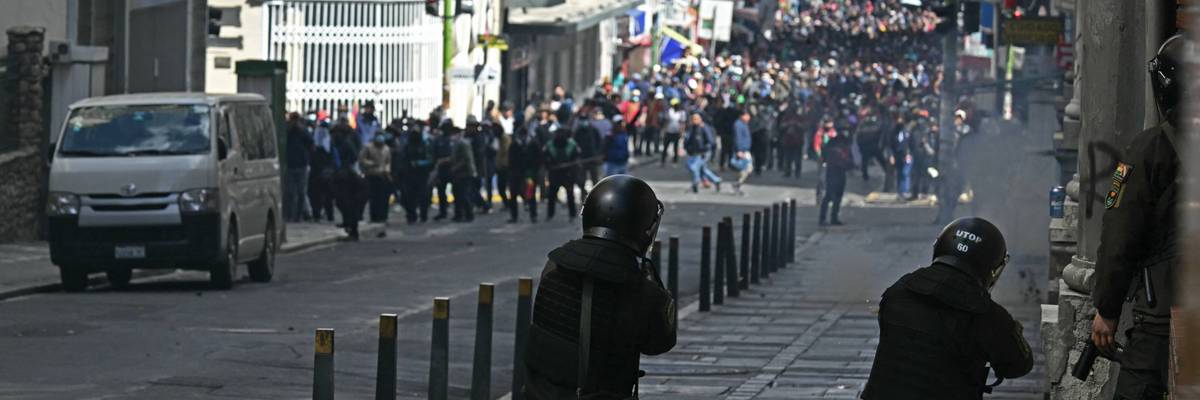
Riot police fire tear gas at demonstrators during a protest demanding the resignation of Bolivian President Rodrigo Paz, in La Paz, on May 18, 2026.
The leader of the country's main labor federation said officials were responding to protesters who have marched hundreds of miles in recent days with "militarization and repression instead of listening to the people."
A leader of Bolivia's main labor federation, the Bolivian Workers' Union, said late Monday that the country's public prosecutor is "trying to silence" mass protests that have included Indigenous communities, miners, peasants, and teachers in recent days, as the government issued arrest warrants for labor and grassroots organizers.
TeleSUR reported that State Attorney General Roger Mariaca confirmed his office was charging Mario Argollo, executive secretary of the union, known in Spanish as Central Obrera Boliviana (COB), with public instigation to commit crimes and terrorism.
“They will not subdue us in the struggle we have undertaken," Argollo said in a statement. "They are trying to silence us as leaders with popular actions and criminal charges."
Drop Site News also reported that the public prosecutor issued an arrest order targeting Justino Apaza Callisaya, a leader of the Federation of Neighborhood Councils of La Paz (FEJUVE), "an influential grassroots organization tied to urban protest movements and labor mobilizations."
The office is also reportedly investigating "several individuals" following COB's declaration of a general strike on May 1.
"The accused are being investigated for extremely serious offenses including: public incitement to commit crimes, criminal association, terrorism, financing terrorism, attacks on transportation security, [and] attacks on public services," reported Drop Site.
The mass mobilization has included dozens of road blockades across the country as the union and other groups have demanded the resignation of President Rodrigo Paz, whose administration ended a fuel subsidy amid an economic crisis; higher wages; and an end to privatization, including through Law 1720, which opponents say would allow the transfer of Indigenous and peasant land to corporations.
Protesters have spent days marching from their communities to La Paz, where thousands were met by riot police armed with tear gas canisters on Monday.
Al Jazeera reported that some protesters brandished "dynamite sticks and slingshots" as they arrived in the capital city.
An unspecified number of protesters were injured Monday as the government deployed the police and the military to try to break the road blockades, Al Jazeera reported. TeleSUR said that at least four demonstrators were reportedly killed. About 90 arrests were made.
The US State Department said Sunday that it supported Paz's efforts to "restore order for the peace, security, and stability of the Bolivian people."
COB said the government was responding with "militarization and repression instead of listening to the people."
"History will remember who defended the citizenry and who turned their backs. No force should be above the people or their rights," said COB.
The arrest documents and government investigations, said Drop Site, showed that "the Bolivian government is escalating its response to the protests by describing parts of the strike movement not simply as civil unrest, but as potential terrorism and organized criminal activity."
A student leader at the Public University of El Alto told Drop Site, "No matter what the Paz government attempts to do, repress the protesters or sanction us as terrorists... we will continue to uphold the sovereignty and rights of our peoples."
A former Altiplano mayor and Aymara social leader was direct about the betrayal: "This government was clearly elected with a mandate from the social movements and from indigenous peoples — who have been stabbed in the back the minute they entered office. They have attempted to… pic.twitter.com/tS80WqG1Zi
— Drop Site (@DropSiteNews) May 18, 2026
An Indigenous leader told the outlet that Paz's government "was clearly elected with a mandate from the social movements and from indigenous peoples—who have been stabbed in the back the minute they entered office. They have attempted to use the state to go after the very forces that got them to power."
Dear Common Dreams reader, It’s been nearly 30 years since I co-founded Common Dreams with my late wife, Lina Newhouser. We had the radical notion that journalism should serve the public good, not corporate profits. It was clear to us from the outset what it would take to build such a project. No paid advertisements. No corporate sponsors. No millionaire publisher telling us what to think or do. Many people said we wouldn't last a year, but we proved those doubters wrong. Together with a tremendous team of journalists and dedicated staff, we built an independent media outlet free from the constraints of profits and corporate control. Our mission has always been simple: To inform. To inspire. To ignite change for the common good. Building Common Dreams was not easy. Our survival was never guaranteed. When you take on the most powerful forces—Wall Street greed, fossil fuel industry destruction, Big Tech lobbyists, and uber-rich oligarchs who have spent billions upon billions rigging the economy and democracy in their favor—the only bulwark you have is supporters who believe in your work. But here’s the urgent message from me today. It's never been this bad out there. And it's never been this hard to keep us going. At the very moment Common Dreams is most needed, the threats we face are intensifying. We need your support now more than ever. We don't accept corporate advertising and never will. We don't have a paywall because we don't think people should be blocked from critical news based on their ability to pay. Everything we do is funded by the donations of readers like you. When everyone does the little they can afford, we are strong. But if that support retreats or dries up, so do we. Will you donate now to make sure Common Dreams not only survives but thrives? —Craig Brown, Co-founder |
A leader of Bolivia's main labor federation, the Bolivian Workers' Union, said late Monday that the country's public prosecutor is "trying to silence" mass protests that have included Indigenous communities, miners, peasants, and teachers in recent days, as the government issued arrest warrants for labor and grassroots organizers.
TeleSUR reported that State Attorney General Roger Mariaca confirmed his office was charging Mario Argollo, executive secretary of the union, known in Spanish as Central Obrera Boliviana (COB), with public instigation to commit crimes and terrorism.
“They will not subdue us in the struggle we have undertaken," Argollo said in a statement. "They are trying to silence us as leaders with popular actions and criminal charges."
Drop Site News also reported that the public prosecutor issued an arrest order targeting Justino Apaza Callisaya, a leader of the Federation of Neighborhood Councils of La Paz (FEJUVE), "an influential grassroots organization tied to urban protest movements and labor mobilizations."
The office is also reportedly investigating "several individuals" following COB's declaration of a general strike on May 1.
"The accused are being investigated for extremely serious offenses including: public incitement to commit crimes, criminal association, terrorism, financing terrorism, attacks on transportation security, [and] attacks on public services," reported Drop Site.
The mass mobilization has included dozens of road blockades across the country as the union and other groups have demanded the resignation of President Rodrigo Paz, whose administration ended a fuel subsidy amid an economic crisis; higher wages; and an end to privatization, including through Law 1720, which opponents say would allow the transfer of Indigenous and peasant land to corporations.
Protesters have spent days marching from their communities to La Paz, where thousands were met by riot police armed with tear gas canisters on Monday.
Al Jazeera reported that some protesters brandished "dynamite sticks and slingshots" as they arrived in the capital city.
An unspecified number of protesters were injured Monday as the government deployed the police and the military to try to break the road blockades, Al Jazeera reported. TeleSUR said that at least four demonstrators were reportedly killed. About 90 arrests were made.
The US State Department said Sunday that it supported Paz's efforts to "restore order for the peace, security, and stability of the Bolivian people."
COB said the government was responding with "militarization and repression instead of listening to the people."
"History will remember who defended the citizenry and who turned their backs. No force should be above the people or their rights," said COB.
The arrest documents and government investigations, said Drop Site, showed that "the Bolivian government is escalating its response to the protests by describing parts of the strike movement not simply as civil unrest, but as potential terrorism and organized criminal activity."
A student leader at the Public University of El Alto told Drop Site, "No matter what the Paz government attempts to do, repress the protesters or sanction us as terrorists... we will continue to uphold the sovereignty and rights of our peoples."
A former Altiplano mayor and Aymara social leader was direct about the betrayal: "This government was clearly elected with a mandate from the social movements and from indigenous peoples — who have been stabbed in the back the minute they entered office. They have attempted to… pic.twitter.com/tS80WqG1Zi
— Drop Site (@DropSiteNews) May 18, 2026
An Indigenous leader told the outlet that Paz's government "was clearly elected with a mandate from the social movements and from indigenous peoples—who have been stabbed in the back the minute they entered office. They have attempted to use the state to go after the very forces that got them to power."
A leader of Bolivia's main labor federation, the Bolivian Workers' Union, said late Monday that the country's public prosecutor is "trying to silence" mass protests that have included Indigenous communities, miners, peasants, and teachers in recent days, as the government issued arrest warrants for labor and grassroots organizers.
TeleSUR reported that State Attorney General Roger Mariaca confirmed his office was charging Mario Argollo, executive secretary of the union, known in Spanish as Central Obrera Boliviana (COB), with public instigation to commit crimes and terrorism.
“They will not subdue us in the struggle we have undertaken," Argollo said in a statement. "They are trying to silence us as leaders with popular actions and criminal charges."
Drop Site News also reported that the public prosecutor issued an arrest order targeting Justino Apaza Callisaya, a leader of the Federation of Neighborhood Councils of La Paz (FEJUVE), "an influential grassroots organization tied to urban protest movements and labor mobilizations."
The office is also reportedly investigating "several individuals" following COB's declaration of a general strike on May 1.
"The accused are being investigated for extremely serious offenses including: public incitement to commit crimes, criminal association, terrorism, financing terrorism, attacks on transportation security, [and] attacks on public services," reported Drop Site.
The mass mobilization has included dozens of road blockades across the country as the union and other groups have demanded the resignation of President Rodrigo Paz, whose administration ended a fuel subsidy amid an economic crisis; higher wages; and an end to privatization, including through Law 1720, which opponents say would allow the transfer of Indigenous and peasant land to corporations.
Protesters have spent days marching from their communities to La Paz, where thousands were met by riot police armed with tear gas canisters on Monday.
Al Jazeera reported that some protesters brandished "dynamite sticks and slingshots" as they arrived in the capital city.
An unspecified number of protesters were injured Monday as the government deployed the police and the military to try to break the road blockades, Al Jazeera reported. TeleSUR said that at least four demonstrators were reportedly killed. About 90 arrests were made.
The US State Department said Sunday that it supported Paz's efforts to "restore order for the peace, security, and stability of the Bolivian people."
COB said the government was responding with "militarization and repression instead of listening to the people."
"History will remember who defended the citizenry and who turned their backs. No force should be above the people or their rights," said COB.
The arrest documents and government investigations, said Drop Site, showed that "the Bolivian government is escalating its response to the protests by describing parts of the strike movement not simply as civil unrest, but as potential terrorism and organized criminal activity."
A student leader at the Public University of El Alto told Drop Site, "No matter what the Paz government attempts to do, repress the protesters or sanction us as terrorists... we will continue to uphold the sovereignty and rights of our peoples."
A former Altiplano mayor and Aymara social leader was direct about the betrayal: "This government was clearly elected with a mandate from the social movements and from indigenous peoples — who have been stabbed in the back the minute they entered office. They have attempted to… pic.twitter.com/tS80WqG1Zi
— Drop Site (@DropSiteNews) May 18, 2026
An Indigenous leader told the outlet that Paz's government "was clearly elected with a mandate from the social movements and from indigenous peoples—who have been stabbed in the back the minute they entered office. They have attempted to use the state to go after the very forces that got them to power."