5
#000000
#FFFFFF
To donate by check, phone, or other method, see our More Ways to Give page.
Daily news & progressive opinion—funded by the people, not the corporations—delivered straight to your inbox.
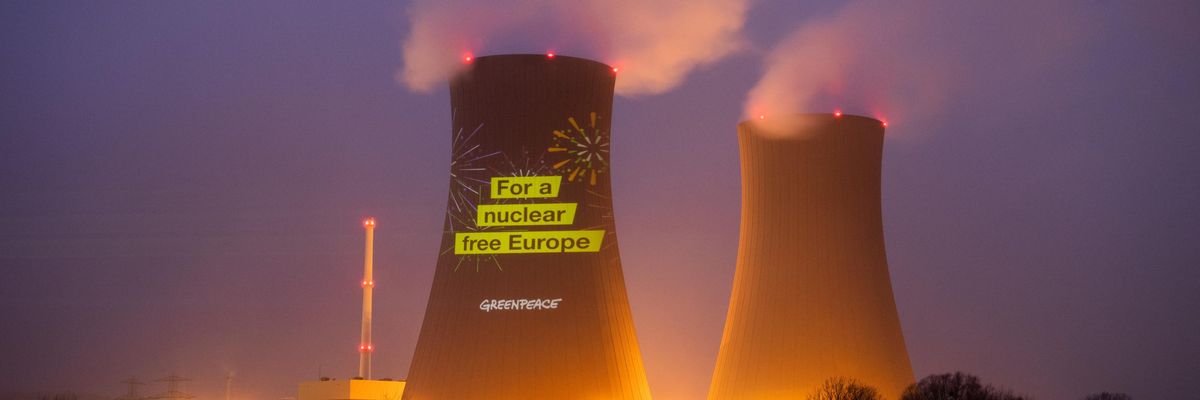
A projection by the environmental group Greenpeace shines on the Grohnde nuclear power plant near Hamelin, Germany, which went offline on December 31, 2021.
"The United States would do well to follow this example, rather than continue to fund nuclear power, the slowest, and most expensive of all energy choices," asserted one activist.
Environmentalists in Europe and beyond cheered as Germany's last three nuclear power plants went offline over the weekend, a controversial move the country's environmental minister hailed as the start of "a new era of energy production."
The Associated Press reports the Emsland, Neckarwestheim II, and Isar II nuclear plants were shut down shortly before midnight Saturday after decades of protests and pressure by anti-nuclear campaigners.
"Millions of people worked towards this day for years," Greenpeace Germany managing director Roland Hipp wrote in an opinion piece published Sunday by Common Dreams. "People who protested against reprocessing plants, nuclear waste transport, unsafe nuclear waste storage facilities, and the construction of new nuclear power plants. Those decades of resistance were worth it."
"The German nuclear phaseout is a victory of reason over the lust for profit; over powerful corporations and their client politicians," Hipp added. "It is a people-powered success against all the odds."
Germany's nuclear shutdown—which was originally scheduled for completion by the end of 2022—was postponed as part of a compromise by German Chancellor Olaf Scholz, a member of the Social Democratic Party, due to Russia's invasion of Ukraine and subsequent fuel shortages.
The phaseout—a key component of Germany's plan to produce 80% of the country's power from renewable sources by the end of the decade—is highly controversial, as numerous experts including former NASA climate scientist James Hansen urged Scholz to keep the reactors online.
Opponents of the phaseout argued that Germany's plan to replace the roughly 6% of electricity generated by the three shuttered nuclear plants with renewables, gas, and coal—the latter of which fuels more than 30% of the country's power—poses a greater climate risk than keeping the reactors in operation.
"Germany recognizes that renewables are cheaper, faster, and safer than nuclear power and come without a lethal waste legacy."
However, German Environment Minister Steffi Lemke, a member of Alliance 90/The Greens, argued that "the risks of nuclear power are ultimately unmanageable."
Last week, Lemke visited Fukushima, Japan, site of the March 2011 nuclear disaster—the worst since the Chernobyl meltdown in Ukraine in 1986, when the country was part of the Soviet Union.
Juergen Trittin, parliamentary leader of Alliance 90/The Greens, said that "we are putting an end to a dangerous, unsustainable, and costly technology."
Linda Pentz Gunter, founder of the advocacy group Beyond Nuclear, said in a statement that "the renewable energy revolution needed to save us from the worst of the climate crisis is a matter of political will, not technical know-how, and Germany's weekend shutdown of its last three nuclear reactors marks a strong step in that direction."
"The nuclear phaseout opened the way for renewable energy growth in Germany," she added. "Germany recognizes that renewables are cheaper, faster, and safer than nuclear power and come without a lethal waste legacy. The United States would do well to follow this example, rather than continue to fund nuclear power, the slowest, and most expensive of all energy choices."
Germany's neighbors remain heavily dependent upon nuclear power. France derives about 70% of its electricity from 56 nuclear power plants, while such facilities provide Switzerland and Belgium with between 30% and 40% of their electric power.
During a Group of Seven meeting that included Germany over the weekend, Canada, France, Japan, the United Kingdom, and the United States announced a new nuclear power alliance and G7 ministers put out a statement that says "those countries that opt to use nuclear energy recognize its potential to provide affordable low-carbon energy that can reduce dependence on fossil fuels, to address the climate crisis, and to ensure global energy security as a source of baseload energy and grid flexibility."
Dear Common Dreams reader, It’s been nearly 30 years since I co-founded Common Dreams with my late wife, Lina Newhouser. We had the radical notion that journalism should serve the public good, not corporate profits. It was clear to us from the outset what it would take to build such a project. No paid advertisements. No corporate sponsors. No millionaire publisher telling us what to think or do. Many people said we wouldn't last a year, but we proved those doubters wrong. Together with a tremendous team of journalists and dedicated staff, we built an independent media outlet free from the constraints of profits and corporate control. Our mission has always been simple: To inform. To inspire. To ignite change for the common good. Building Common Dreams was not easy. Our survival was never guaranteed. When you take on the most powerful forces—Wall Street greed, fossil fuel industry destruction, Big Tech lobbyists, and uber-rich oligarchs who have spent billions upon billions rigging the economy and democracy in their favor—the only bulwark you have is supporters who believe in your work. But here’s the urgent message from me today. It's never been this bad out there. And it's never been this hard to keep us going. At the very moment Common Dreams is most needed, the threats we face are intensifying. We need your support now more than ever. We don't accept corporate advertising and never will. We don't have a paywall because we don't think people should be blocked from critical news based on their ability to pay. Everything we do is funded by the donations of readers like you. When everyone does the little they can afford, we are strong. But if that support retreats or dries up, so do we. Will you donate now to make sure Common Dreams not only survives but thrives? —Craig Brown, Co-founder |
Environmentalists in Europe and beyond cheered as Germany's last three nuclear power plants went offline over the weekend, a controversial move the country's environmental minister hailed as the start of "a new era of energy production."
The Associated Press reports the Emsland, Neckarwestheim II, and Isar II nuclear plants were shut down shortly before midnight Saturday after decades of protests and pressure by anti-nuclear campaigners.
"Millions of people worked towards this day for years," Greenpeace Germany managing director Roland Hipp wrote in an opinion piece published Sunday by Common Dreams. "People who protested against reprocessing plants, nuclear waste transport, unsafe nuclear waste storage facilities, and the construction of new nuclear power plants. Those decades of resistance were worth it."
"The German nuclear phaseout is a victory of reason over the lust for profit; over powerful corporations and their client politicians," Hipp added. "It is a people-powered success against all the odds."
Germany's nuclear shutdown—which was originally scheduled for completion by the end of 2022—was postponed as part of a compromise by German Chancellor Olaf Scholz, a member of the Social Democratic Party, due to Russia's invasion of Ukraine and subsequent fuel shortages.
The phaseout—a key component of Germany's plan to produce 80% of the country's power from renewable sources by the end of the decade—is highly controversial, as numerous experts including former NASA climate scientist James Hansen urged Scholz to keep the reactors online.
Opponents of the phaseout argued that Germany's plan to replace the roughly 6% of electricity generated by the three shuttered nuclear plants with renewables, gas, and coal—the latter of which fuels more than 30% of the country's power—poses a greater climate risk than keeping the reactors in operation.
"Germany recognizes that renewables are cheaper, faster, and safer than nuclear power and come without a lethal waste legacy."
However, German Environment Minister Steffi Lemke, a member of Alliance 90/The Greens, argued that "the risks of nuclear power are ultimately unmanageable."
Last week, Lemke visited Fukushima, Japan, site of the March 2011 nuclear disaster—the worst since the Chernobyl meltdown in Ukraine in 1986, when the country was part of the Soviet Union.
Juergen Trittin, parliamentary leader of Alliance 90/The Greens, said that "we are putting an end to a dangerous, unsustainable, and costly technology."
Linda Pentz Gunter, founder of the advocacy group Beyond Nuclear, said in a statement that "the renewable energy revolution needed to save us from the worst of the climate crisis is a matter of political will, not technical know-how, and Germany's weekend shutdown of its last three nuclear reactors marks a strong step in that direction."
"The nuclear phaseout opened the way for renewable energy growth in Germany," she added. "Germany recognizes that renewables are cheaper, faster, and safer than nuclear power and come without a lethal waste legacy. The United States would do well to follow this example, rather than continue to fund nuclear power, the slowest, and most expensive of all energy choices."
Germany's neighbors remain heavily dependent upon nuclear power. France derives about 70% of its electricity from 56 nuclear power plants, while such facilities provide Switzerland and Belgium with between 30% and 40% of their electric power.
During a Group of Seven meeting that included Germany over the weekend, Canada, France, Japan, the United Kingdom, and the United States announced a new nuclear power alliance and G7 ministers put out a statement that says "those countries that opt to use nuclear energy recognize its potential to provide affordable low-carbon energy that can reduce dependence on fossil fuels, to address the climate crisis, and to ensure global energy security as a source of baseload energy and grid flexibility."
Environmentalists in Europe and beyond cheered as Germany's last three nuclear power plants went offline over the weekend, a controversial move the country's environmental minister hailed as the start of "a new era of energy production."
The Associated Press reports the Emsland, Neckarwestheim II, and Isar II nuclear plants were shut down shortly before midnight Saturday after decades of protests and pressure by anti-nuclear campaigners.
"Millions of people worked towards this day for years," Greenpeace Germany managing director Roland Hipp wrote in an opinion piece published Sunday by Common Dreams. "People who protested against reprocessing plants, nuclear waste transport, unsafe nuclear waste storage facilities, and the construction of new nuclear power plants. Those decades of resistance were worth it."
"The German nuclear phaseout is a victory of reason over the lust for profit; over powerful corporations and their client politicians," Hipp added. "It is a people-powered success against all the odds."
Germany's nuclear shutdown—which was originally scheduled for completion by the end of 2022—was postponed as part of a compromise by German Chancellor Olaf Scholz, a member of the Social Democratic Party, due to Russia's invasion of Ukraine and subsequent fuel shortages.
The phaseout—a key component of Germany's plan to produce 80% of the country's power from renewable sources by the end of the decade—is highly controversial, as numerous experts including former NASA climate scientist James Hansen urged Scholz to keep the reactors online.
Opponents of the phaseout argued that Germany's plan to replace the roughly 6% of electricity generated by the three shuttered nuclear plants with renewables, gas, and coal—the latter of which fuels more than 30% of the country's power—poses a greater climate risk than keeping the reactors in operation.
"Germany recognizes that renewables are cheaper, faster, and safer than nuclear power and come without a lethal waste legacy."
However, German Environment Minister Steffi Lemke, a member of Alliance 90/The Greens, argued that "the risks of nuclear power are ultimately unmanageable."
Last week, Lemke visited Fukushima, Japan, site of the March 2011 nuclear disaster—the worst since the Chernobyl meltdown in Ukraine in 1986, when the country was part of the Soviet Union.
Juergen Trittin, parliamentary leader of Alliance 90/The Greens, said that "we are putting an end to a dangerous, unsustainable, and costly technology."
Linda Pentz Gunter, founder of the advocacy group Beyond Nuclear, said in a statement that "the renewable energy revolution needed to save us from the worst of the climate crisis is a matter of political will, not technical know-how, and Germany's weekend shutdown of its last three nuclear reactors marks a strong step in that direction."
"The nuclear phaseout opened the way for renewable energy growth in Germany," she added. "Germany recognizes that renewables are cheaper, faster, and safer than nuclear power and come without a lethal waste legacy. The United States would do well to follow this example, rather than continue to fund nuclear power, the slowest, and most expensive of all energy choices."
Germany's neighbors remain heavily dependent upon nuclear power. France derives about 70% of its electricity from 56 nuclear power plants, while such facilities provide Switzerland and Belgium with between 30% and 40% of their electric power.
During a Group of Seven meeting that included Germany over the weekend, Canada, France, Japan, the United Kingdom, and the United States announced a new nuclear power alliance and G7 ministers put out a statement that says "those countries that opt to use nuclear energy recognize its potential to provide affordable low-carbon energy that can reduce dependence on fossil fuels, to address the climate crisis, and to ensure global energy security as a source of baseload energy and grid flexibility."