

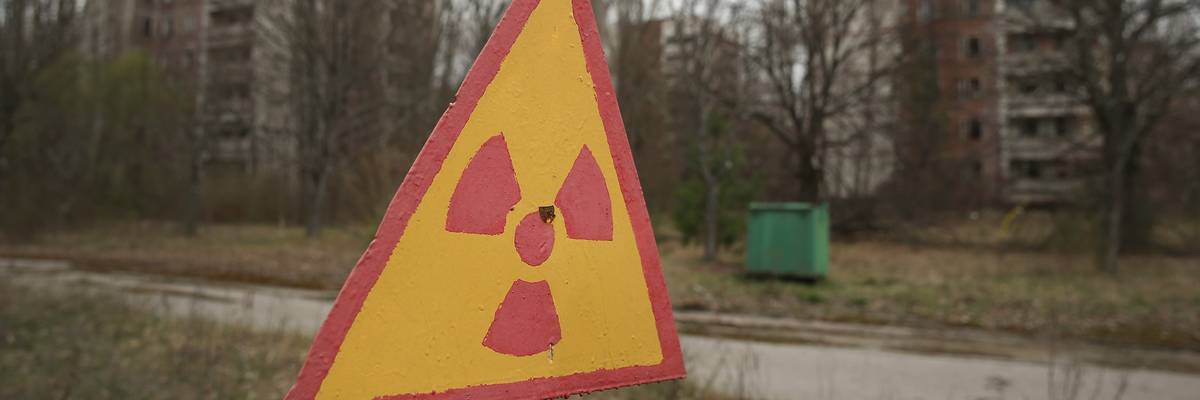
A sign warns of radiation contamination near former apartment buildings on April 9, 2016 in Pripyat, Ukraine.
Nuclear Disaster Threat Posed by War in Sharp Relief 40 Years After Chernobyl
"Nuclear power stations have inherent risks," said an official at Greenpeace Ukraine. "In a world at war, with massive geopolitical tension and climate extremes, those risks are increasing."
The continuing conflict between Russia and Ukraine is once again raising concerns about a nucelar disaster in the region on the 40th anniversary of the catastrophic accident at the Chernobyl power plant.
Reuters reported on Monday that a Ukrainian drone the struck a transport department at the Zaporizhzhia Nuclear Power Plant, which has been under Russian control since March 2022, shortly after its armed forces invaded Ukraine.
The Russian government said that an employee at the Zaporizhzhia plant was killed in the attack, and International Atomic Energy Agency Director General Rafael Mariano Grossi reiterated in a social media post that "strikes on or near [nuclear power plants] can endanger nuclear safety and must not take place."
Russia has also engaged in dangerous attacks around nuclear power infrastructure over the last four years, and a report released this month by Greenpeace Ukraine found that the New Safe Confinement (NSC) at Chernobyl, which contains the ruins of the plant's reactor unit 4, was significantly compromised after being struck by a high-explosive warhead from a Russian drone last year.
"The Russian drone strike... destroyed the main functions of the [NSC]," the report states. "The impact of the drone on the northwest side of the NSC caused an opening... which penetrated both the outside and inside arch shells. Critical structural elements of the NSC have been deformed and damaged including the Main Crane System, making their load-bearing capability impossible to assess."
The drone strike also burned the membrane layer inside the NSC, which has taken out the ability to control humidity at the site and could lead to accelerated corrosion of the NSC's steel components.
"The NSC was designed to last 100 years on the basis that its low humidity control was maintained," notes the report. "Accelerated corrosion may reduce the 100-year design life of the structure if humidity control is not restored by 2030."
Greenpeace Ukraine nuclear expert Shaun Burnie described the damage done to the NSC as "a Russian-made war crime," and lamented it will mean "years of repairs and further delays before the sarcophagus can be safely dismantled."
Polina Kolodiazhna, senior campaigner from Greenpeace Ukraine, said on Sunday that Russia's invasion of Ukraine had added new urgency for her country to end its dependence on nuclear power given the massive environmental and human risks.
"Nuclear power stations have inherent risks, and those risks are escalating," Kolodiazhna said. "Russia, for the first time in the history of warfare, has systematically attacked and occupied nuclear plants, showing how they can be used as military and political tools. In a world at war, with massive geopolitical tension and climate extremes, those risks are increasing."
We are at a crossroads
This country and this world are at a monumental crossroads. In a few short weeks, US voters will have an opportunity to beat back the forces of fascism and confront the billionaires who are rigging the economy, our media system, and our democracy, making it increasingly impossible for ordinary people to get by. We’re not just talking about the election. We’re talking about what must be done once these fascist elements are vanquished from power. We need a bolder set of solutions than what either major party has so far been willing to offer and a working-class movement ready to fight like hell for it. Trump didn't emerge from nowhere. The conditions that fueled MAGA authoritarianism were created by decades of radical neoliberal economic policies and a corrupt political system dominated by corporate interests. They slashed taxes on the super-rich, promising that the benefits would trickle down. They said giveaways to the corporate titans would make life more affordable for the rest of us. It was all bullshit. And when a bitter, betrayed populace searches for someone to blame, right-wing demagogues have little trouble finding scapegoats. People know when they're being lied to, but you won't hear any of this from the corporate media. Only independent journalism—powered and funded by people who believe in building a better world—can deliver truly trustworthy daily news. Our Fall Campaign is underway, and we need your help. To power our newsroom through the rest of the year, we need to raise $125,000 by midnight on October 31. So if you share our vision, please contribute whatever you can to sustain our work. |
The continuing conflict between Russia and Ukraine is once again raising concerns about a nucelar disaster in the region on the 40th anniversary of the catastrophic accident at the Chernobyl power plant.
Reuters reported on Monday that a Ukrainian drone the struck a transport department at the Zaporizhzhia Nuclear Power Plant, which has been under Russian control since March 2022, shortly after its armed forces invaded Ukraine.
The Russian government said that an employee at the Zaporizhzhia plant was killed in the attack, and International Atomic Energy Agency Director General Rafael Mariano Grossi reiterated in a social media post that "strikes on or near [nuclear power plants] can endanger nuclear safety and must not take place."
Russia has also engaged in dangerous attacks around nuclear power infrastructure over the last four years, and a report released this month by Greenpeace Ukraine found that the New Safe Confinement (NSC) at Chernobyl, which contains the ruins of the plant's reactor unit 4, was significantly compromised after being struck by a high-explosive warhead from a Russian drone last year.
"The Russian drone strike... destroyed the main functions of the [NSC]," the report states. "The impact of the drone on the northwest side of the NSC caused an opening... which penetrated both the outside and inside arch shells. Critical structural elements of the NSC have been deformed and damaged including the Main Crane System, making their load-bearing capability impossible to assess."
The drone strike also burned the membrane layer inside the NSC, which has taken out the ability to control humidity at the site and could lead to accelerated corrosion of the NSC's steel components.
"The NSC was designed to last 100 years on the basis that its low humidity control was maintained," notes the report. "Accelerated corrosion may reduce the 100-year design life of the structure if humidity control is not restored by 2030."
Greenpeace Ukraine nuclear expert Shaun Burnie described the damage done to the NSC as "a Russian-made war crime," and lamented it will mean "years of repairs and further delays before the sarcophagus can be safely dismantled."
Polina Kolodiazhna, senior campaigner from Greenpeace Ukraine, said on Sunday that Russia's invasion of Ukraine had added new urgency for her country to end its dependence on nuclear power given the massive environmental and human risks.
"Nuclear power stations have inherent risks, and those risks are escalating," Kolodiazhna said. "Russia, for the first time in the history of warfare, has systematically attacked and occupied nuclear plants, showing how they can be used as military and political tools. In a world at war, with massive geopolitical tension and climate extremes, those risks are increasing."
- Ukraine Officials Warn Chernobyl Radiation Levels 'Exceeded' ›
- 'Insanity Not to Allow This': Calls for Ceasefire to Repair Chernobyl Power Supply ›
- 25 Years After Chernobyl: Lessons Learned ›
The continuing conflict between Russia and Ukraine is once again raising concerns about a nucelar disaster in the region on the 40th anniversary of the catastrophic accident at the Chernobyl power plant.
Reuters reported on Monday that a Ukrainian drone the struck a transport department at the Zaporizhzhia Nuclear Power Plant, which has been under Russian control since March 2022, shortly after its armed forces invaded Ukraine.
The Russian government said that an employee at the Zaporizhzhia plant was killed in the attack, and International Atomic Energy Agency Director General Rafael Mariano Grossi reiterated in a social media post that "strikes on or near [nuclear power plants] can endanger nuclear safety and must not take place."
Russia has also engaged in dangerous attacks around nuclear power infrastructure over the last four years, and a report released this month by Greenpeace Ukraine found that the New Safe Confinement (NSC) at Chernobyl, which contains the ruins of the plant's reactor unit 4, was significantly compromised after being struck by a high-explosive warhead from a Russian drone last year.
"The Russian drone strike... destroyed the main functions of the [NSC]," the report states. "The impact of the drone on the northwest side of the NSC caused an opening... which penetrated both the outside and inside arch shells. Critical structural elements of the NSC have been deformed and damaged including the Main Crane System, making their load-bearing capability impossible to assess."
The drone strike also burned the membrane layer inside the NSC, which has taken out the ability to control humidity at the site and could lead to accelerated corrosion of the NSC's steel components.
"The NSC was designed to last 100 years on the basis that its low humidity control was maintained," notes the report. "Accelerated corrosion may reduce the 100-year design life of the structure if humidity control is not restored by 2030."
Greenpeace Ukraine nuclear expert Shaun Burnie described the damage done to the NSC as "a Russian-made war crime," and lamented it will mean "years of repairs and further delays before the sarcophagus can be safely dismantled."
Polina Kolodiazhna, senior campaigner from Greenpeace Ukraine, said on Sunday that Russia's invasion of Ukraine had added new urgency for her country to end its dependence on nuclear power given the massive environmental and human risks.
"Nuclear power stations have inherent risks, and those risks are escalating," Kolodiazhna said. "Russia, for the first time in the history of warfare, has systematically attacked and occupied nuclear plants, showing how they can be used as military and political tools. In a world at war, with massive geopolitical tension and climate extremes, those risks are increasing."
- Ukraine Officials Warn Chernobyl Radiation Levels 'Exceeded' ›
- 'Insanity Not to Allow This': Calls for Ceasefire to Repair Chernobyl Power Supply ›
- 25 Years After Chernobyl: Lessons Learned ›