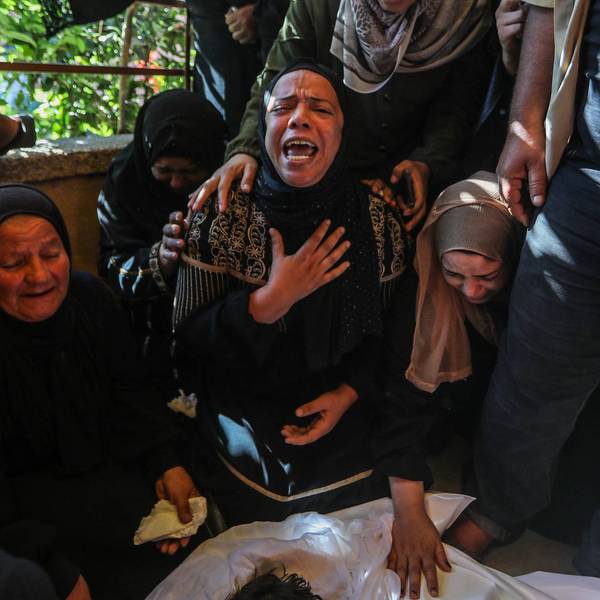
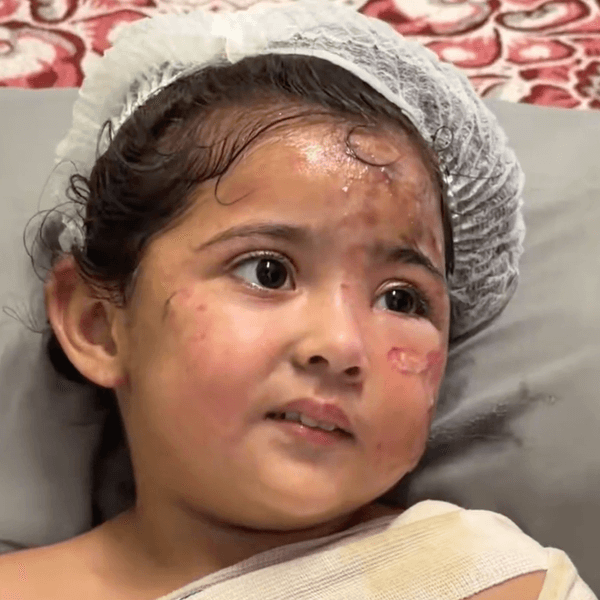

Bodies of Palestinians including children killed in Israeli attacks are brought to Nasser Hospital before burial in Khan Younis, Gaza on May 14, 2025.
Israel Kills 22 Children in Gaza Bombing as Trump Visits Region
Strikes by the Israel Defense Forces hit European Hospital in Khan Younis and a refugee camp in Jabalia.
U.S. President Donald Trump's visit to the Middle East this week had sparked hope that a new cease-fire deal between Israel and Hamas could be imminent, but the Israel Defense Forces' bombardment of northern and southern Gaza on Wednesday—with targets including a hospital and a refugee camp—was seen as a signal from Israel that it has no intention of reversing its plan to escalate the attacks that have killed tens of thousands of Palestinians.
At least 22 children were among those killed in airstrikes, and Gaza's Health Ministry said more than 70 people in total had been killed since dawn.
At least 50 of those people were victims of strikes near Jabalia in the northern part of the enclave, where rescue workers were using hand tools Wednesday to smash through concrete slabs to recover the bodies of children.
The latest round of attacks come as Israel's total blockade on humanitarian aid into Gaza is in its third month, having pushed nearly half a million Palestinians toward possible starvation according to the Integrated Food Security Phase Classification.
Eyewitnesses said the strikes in Jabalia came without any warning and that one explosion "felt like a huge earthquake" and obliterated numerous residential buildings.
"All the houses are gone, including ours. We made it out from under the rubble and thank God we're alive," one man told Al Jazeera.
Wednesday morning also marked the third Israeli bombing of a hospital in Gaza in three days, with the IDF striking European Hospital in Khan Younis.
CCTV footage showed patients heading to the hospital when the facility was struck. One bombing hit a bulldozer that had been deployed to clear the area of rubble from previous attacks in order to allow ambulances to enter the area.
Dr. Marwan al-Hams, director general of field hospitals at Gaza's Health Ministry, told the Associated Press that the bombings had also damaged the hospital's water and sewage systems and represented Israel's latest attack on Palestinian healthcare workers' ability to provide care to thousands of injured and sick people.
"Until these damages are fixed, we will have to shut down most departments of the hospital," he told the AP.
Israeli media reported that Mohammed Sinwar, brother of Hamas leader Yahya Sinwar, who was killed by the IDF last year, was a target of the European Hospital attack. The IDF said a Hamas "command and control center" was located under the facility.
"Surely the images immediately contradict this?" said filmmaker and journalist Richard Sanders. "There's no bunker there."
Israeli Prime Minister Benjamin Netanyahu said Tuesday that there was "no way" a cease-fire would be reached until Israel destroys Hamas.
"There will be no situation where we stop the war," said Netanyahu ahead of Trump's visit to the Middle East.
Israel and the U.S., its top international provider of military aid, have recently discussed setting up a potential U.S.-led government in Gaza after the war and a plan to deliver aid to the enclave via a private foundation and U.S. military contractors—a plan that has been rejected by United Nations aid officials.
In addition to displacing the vast majority of Palestinians in Gaza, Israel's 19-month military campaign has left people in the enclave without the ability to produce their own food, and markets are largely empty, with prices for food that is available skyrocketing.
The United Nations warned this week that charity kitchens, which provided more than 1 million meals per day in late April, now are able to serve just 260,000 per day, and kitchens are rapidly shutting down due to a lack of supplies.
Thousands of children have been diagnosed with acute malnutrition since Israel's latest total blockade began in March.
Clemence Lagourdat, a program coordinator for Oxfam International, told Sky News Wednesday that the blockade combined with the latest bombings have pushed the humanitarian situation in Gaza to "an all-time low since the beginning of the war."
"It's been now more than 70 days that nothing has entered the Gaza strip, not a drop of fuel, of food, no medicine," said Lagourdat. "As humanitarian workers we cannot solve the situation. If there is not a political push for a permanent cease-fire and for the border to open... we are working with scraps, and if the situation doesn't change there is not much more that we will be able to do."
We are at a crossroads
This country and this world are at a monumental crossroads. In a few short weeks, US voters will have an opportunity to beat back the forces of fascism and confront the billionaires who are rigging the economy, our media system, and our democracy, making it increasingly impossible for ordinary people to get by. We’re not just talking about the election. We’re talking about what must be done once these fascist elements are vanquished from power. We need a bolder set of solutions than what either major party has so far been willing to offer and a working-class movement ready to fight like hell for it. Trump didn't emerge from nowhere. The conditions that fueled MAGA authoritarianism were created by decades of radical neoliberal economic policies and a corrupt political system dominated by corporate interests. They slashed taxes on the super-rich, promising that the benefits would trickle down. They said giveaways to the corporate titans would make life more affordable for the rest of us. It was all bullshit. And when a bitter, betrayed populace searches for someone to blame, right-wing demagogues have little trouble finding scapegoats. People know when they're being lied to, but you won't hear any of this from the corporate media. Only independent journalism—powered and funded by people who believe in building a better world—can deliver truly trustworthy daily news. Our Fall Campaign is underway, and we need your help. To power our newsroom through the rest of the year, we need to raise $125,000 by midnight on October 31. So if you share our vision, please contribute whatever you can to sustain our work. |
U.S. President Donald Trump's visit to the Middle East this week had sparked hope that a new cease-fire deal between Israel and Hamas could be imminent, but the Israel Defense Forces' bombardment of northern and southern Gaza on Wednesday—with targets including a hospital and a refugee camp—was seen as a signal from Israel that it has no intention of reversing its plan to escalate the attacks that have killed tens of thousands of Palestinians.
At least 22 children were among those killed in airstrikes, and Gaza's Health Ministry said more than 70 people in total had been killed since dawn.
At least 50 of those people were victims of strikes near Jabalia in the northern part of the enclave, where rescue workers were using hand tools Wednesday to smash through concrete slabs to recover the bodies of children.
The latest round of attacks come as Israel's total blockade on humanitarian aid into Gaza is in its third month, having pushed nearly half a million Palestinians toward possible starvation according to the Integrated Food Security Phase Classification.
Eyewitnesses said the strikes in Jabalia came without any warning and that one explosion "felt like a huge earthquake" and obliterated numerous residential buildings.
"All the houses are gone, including ours. We made it out from under the rubble and thank God we're alive," one man told Al Jazeera.
Wednesday morning also marked the third Israeli bombing of a hospital in Gaza in three days, with the IDF striking European Hospital in Khan Younis.
CCTV footage showed patients heading to the hospital when the facility was struck. One bombing hit a bulldozer that had been deployed to clear the area of rubble from previous attacks in order to allow ambulances to enter the area.
Dr. Marwan al-Hams, director general of field hospitals at Gaza's Health Ministry, told the Associated Press that the bombings had also damaged the hospital's water and sewage systems and represented Israel's latest attack on Palestinian healthcare workers' ability to provide care to thousands of injured and sick people.
"Until these damages are fixed, we will have to shut down most departments of the hospital," he told the AP.
Israeli media reported that Mohammed Sinwar, brother of Hamas leader Yahya Sinwar, who was killed by the IDF last year, was a target of the European Hospital attack. The IDF said a Hamas "command and control center" was located under the facility.
"Surely the images immediately contradict this?" said filmmaker and journalist Richard Sanders. "There's no bunker there."
Israeli Prime Minister Benjamin Netanyahu said Tuesday that there was "no way" a cease-fire would be reached until Israel destroys Hamas.
"There will be no situation where we stop the war," said Netanyahu ahead of Trump's visit to the Middle East.
Israel and the U.S., its top international provider of military aid, have recently discussed setting up a potential U.S.-led government in Gaza after the war and a plan to deliver aid to the enclave via a private foundation and U.S. military contractors—a plan that has been rejected by United Nations aid officials.
In addition to displacing the vast majority of Palestinians in Gaza, Israel's 19-month military campaign has left people in the enclave without the ability to produce their own food, and markets are largely empty, with prices for food that is available skyrocketing.
The United Nations warned this week that charity kitchens, which provided more than 1 million meals per day in late April, now are able to serve just 260,000 per day, and kitchens are rapidly shutting down due to a lack of supplies.
Thousands of children have been diagnosed with acute malnutrition since Israel's latest total blockade began in March.
Clemence Lagourdat, a program coordinator for Oxfam International, told Sky News Wednesday that the blockade combined with the latest bombings have pushed the humanitarian situation in Gaza to "an all-time low since the beginning of the war."
"It's been now more than 70 days that nothing has entered the Gaza strip, not a drop of fuel, of food, no medicine," said Lagourdat. "As humanitarian workers we cannot solve the situation. If there is not a political push for a permanent cease-fire and for the border to open... we are working with scraps, and if the situation doesn't change there is not much more that we will be able to do."
- 'Heinous': Children Among 100 Killed by Israel Bombing of Gaza School Just Hours After US Weapons Approval ›
- 'Nothing Short of Genocide': Israel Kills 200 Children ›
- 'Child After Child': Israel Has Killed 270+ Gaza Children Since Ditching Cease-Fire Last Week, Says NGO ›
- As Israel Slaughters Gazans, US House Progressives Push Block the Bombs Act | Common Dreams ›
- As Press Freedom Groups Decry Latest 'Murder' of Journalists by Israel, Fury Grows Over Impunity | Common Dreams ›
- Opinion | Trump’s Board Has Made Gaza the Most Dangerous Place on Earth to Be a Child | Common Dreams ›
U.S. President Donald Trump's visit to the Middle East this week had sparked hope that a new cease-fire deal between Israel and Hamas could be imminent, but the Israel Defense Forces' bombardment of northern and southern Gaza on Wednesday—with targets including a hospital and a refugee camp—was seen as a signal from Israel that it has no intention of reversing its plan to escalate the attacks that have killed tens of thousands of Palestinians.
At least 22 children were among those killed in airstrikes, and Gaza's Health Ministry said more than 70 people in total had been killed since dawn.
At least 50 of those people were victims of strikes near Jabalia in the northern part of the enclave, where rescue workers were using hand tools Wednesday to smash through concrete slabs to recover the bodies of children.
The latest round of attacks come as Israel's total blockade on humanitarian aid into Gaza is in its third month, having pushed nearly half a million Palestinians toward possible starvation according to the Integrated Food Security Phase Classification.
Eyewitnesses said the strikes in Jabalia came without any warning and that one explosion "felt like a huge earthquake" and obliterated numerous residential buildings.
"All the houses are gone, including ours. We made it out from under the rubble and thank God we're alive," one man told Al Jazeera.
Wednesday morning also marked the third Israeli bombing of a hospital in Gaza in three days, with the IDF striking European Hospital in Khan Younis.
CCTV footage showed patients heading to the hospital when the facility was struck. One bombing hit a bulldozer that had been deployed to clear the area of rubble from previous attacks in order to allow ambulances to enter the area.
Dr. Marwan al-Hams, director general of field hospitals at Gaza's Health Ministry, told the Associated Press that the bombings had also damaged the hospital's water and sewage systems and represented Israel's latest attack on Palestinian healthcare workers' ability to provide care to thousands of injured and sick people.
"Until these damages are fixed, we will have to shut down most departments of the hospital," he told the AP.
Israeli media reported that Mohammed Sinwar, brother of Hamas leader Yahya Sinwar, who was killed by the IDF last year, was a target of the European Hospital attack. The IDF said a Hamas "command and control center" was located under the facility.
"Surely the images immediately contradict this?" said filmmaker and journalist Richard Sanders. "There's no bunker there."
Israeli Prime Minister Benjamin Netanyahu said Tuesday that there was "no way" a cease-fire would be reached until Israel destroys Hamas.
"There will be no situation where we stop the war," said Netanyahu ahead of Trump's visit to the Middle East.
Israel and the U.S., its top international provider of military aid, have recently discussed setting up a potential U.S.-led government in Gaza after the war and a plan to deliver aid to the enclave via a private foundation and U.S. military contractors—a plan that has been rejected by United Nations aid officials.
In addition to displacing the vast majority of Palestinians in Gaza, Israel's 19-month military campaign has left people in the enclave without the ability to produce their own food, and markets are largely empty, with prices for food that is available skyrocketing.
The United Nations warned this week that charity kitchens, which provided more than 1 million meals per day in late April, now are able to serve just 260,000 per day, and kitchens are rapidly shutting down due to a lack of supplies.
Thousands of children have been diagnosed with acute malnutrition since Israel's latest total blockade began in March.
Clemence Lagourdat, a program coordinator for Oxfam International, told Sky News Wednesday that the blockade combined with the latest bombings have pushed the humanitarian situation in Gaza to "an all-time low since the beginning of the war."
"It's been now more than 70 days that nothing has entered the Gaza strip, not a drop of fuel, of food, no medicine," said Lagourdat. "As humanitarian workers we cannot solve the situation. If there is not a political push for a permanent cease-fire and for the border to open... we are working with scraps, and if the situation doesn't change there is not much more that we will be able to do."
- 'Heinous': Children Among 100 Killed by Israel Bombing of Gaza School Just Hours After US Weapons Approval ›
- 'Nothing Short of Genocide': Israel Kills 200 Children ›
- 'Child After Child': Israel Has Killed 270+ Gaza Children Since Ditching Cease-Fire Last Week, Says NGO ›
- As Israel Slaughters Gazans, US House Progressives Push Block the Bombs Act | Common Dreams ›
- As Press Freedom Groups Decry Latest 'Murder' of Journalists by Israel, Fury Grows Over Impunity | Common Dreams ›
- Opinion | Trump’s Board Has Made Gaza the Most Dangerous Place on Earth to Be a Child | Common Dreams ›