SUBSCRIBE TO OUR FREE NEWSLETTER
Daily news & progressive opinion—funded by the people, not the corporations—delivered straight to your inbox.
5
#000000
#FFFFFF
To donate by check, phone, or other method, see our More Ways to Give page.
Daily news & progressive opinion—funded by the people, not the corporations—delivered straight to your inbox.
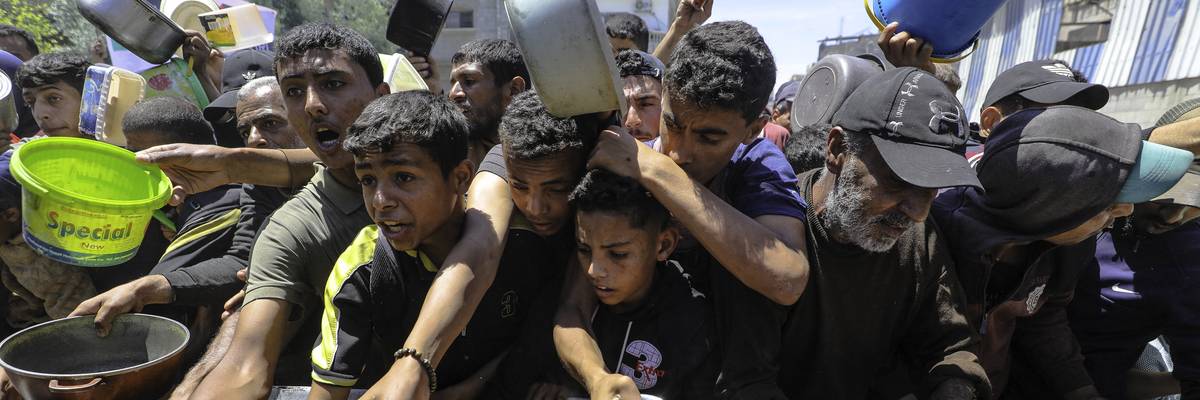
Hungry dislocated Palestinians rush to food distribution kitchen and extend their empty containers to receive food in Gaza on May 7, 2025.
The plan "contravenes basic humanitarian principles," said a spokesperson for the United Nation's children's agency.
United Nations aid officials have rejected a U.S. and Israel-backed plan for aid delivery in Gaza that reportedly involves the use of a private foundation and U.S. military security contractors to deliver far less humanitarian assistance than the besieged enclave needs.
Jens Laerke, a spokesperson for the U.N.'s Office for the Coordination of Humanitarian Affairs (OCHA), warned Friday that the agency "will not participate."
"There is no reason to put in place a system that is at odds with the DNA of any principled humanitarian organization," Laerke told the BBC.
Since early March, Israel has blocked aid from entering Gaza, compounding widespread misery and hunger in the besieged enclave as Israel continues to mount a deadly military campaign there. U.N. officials have decried the fact that aid is close at hand but is not being allowed in.
Speaking in Jerusalem on Friday, U.S. Ambassador to Israel Mike Huckabee said that the plan involves a private U.S.-backed foundation, which will distribute aid from a set number of distribution sites, according to CNN. Huckabee said the idea is to create a system that prevents Hamas from obtaining the aid.
The private entity, called the Gaza Humanitarian Foundation, would administer those distribution sites using private U.S. military contractors and aid workers, according to CNN.
The plan reportedly entails only allowing 60 aid trucks a day, a sliver of what was allowed to enter the enclave during the two-month cease-fire that Israel ended in March. A document from the Gaza Humanitarian Foundation states that there will initially be four distribution sites aimed at providing 1.2 million Palestinians in its first phase, or 60% of Gaza's population.
According to the The New YorkTimes, under the current aid distribution system, the U.N. says there are 400 distribution points.
Huckabee said that Israel would not be involved in delivering aid, but that Israeli forces would handle security around the distribution sites.
The Times of Israel, citing officials familiar with the plan, reported that the Israeli government and military have been involved in putting the plan together, even if the Gaza Humanitarian Foundation is the entity that is slated to distribute the aid.
Reporting from The Washington Post published Monday, which cited unnamed Israeli officials and aid workers, framed the emerging plan as an Israeli initiative to take control of aid distribution in Gaza. The Post's reporting also stated that the distribution centers would be all be located in the south of Gaza.
The Post spoke with officials from a dozen international aid groups working in Gaza, who expressed concerns that restricting aid to a few locations would force more displacement and be discriminatory.
James Elder, spokesperson for the U.N.'s children's agency UNICEF, echoed this, according to the BBC, saying on Friday that the proposed plan would lead to more children suffering and that the decision to locate all the distribution centers in the south appeared designed to weaponize aid as "bait" to force Palestinians to be displaced once again.
The plan "contravenes basic humanitarian principles" and appears designed to "reinforce control over life-sustaining items as a pressure tactic," Elder said, according to U.N. News.
Dear Common Dreams reader, It’s been nearly 30 years since I co-founded Common Dreams with my late wife, Lina Newhouser. We had the radical notion that journalism should serve the public good, not corporate profits. It was clear to us from the outset what it would take to build such a project. No paid advertisements. No corporate sponsors. No millionaire publisher telling us what to think or do. Many people said we wouldn't last a year, but we proved those doubters wrong. Together with a tremendous team of journalists and dedicated staff, we built an independent media outlet free from the constraints of profits and corporate control. Our mission has always been simple: To inform. To inspire. To ignite change for the common good. Building Common Dreams was not easy. Our survival was never guaranteed. When you take on the most powerful forces—Wall Street greed, fossil fuel industry destruction, Big Tech lobbyists, and uber-rich oligarchs who have spent billions upon billions rigging the economy and democracy in their favor—the only bulwark you have is supporters who believe in your work. But here’s the urgent message from me today. It's never been this bad out there. And it's never been this hard to keep us going. At the very moment Common Dreams is most needed, the threats we face are intensifying. We need your support now more than ever. We don't accept corporate advertising and never will. We don't have a paywall because we don't think people should be blocked from critical news based on their ability to pay. Everything we do is funded by the donations of readers like you. When everyone does the little they can afford, we are strong. But if that support retreats or dries up, so do we. Will you donate now to make sure Common Dreams not only survives but thrives? —Craig Brown, Co-founder |
United Nations aid officials have rejected a U.S. and Israel-backed plan for aid delivery in Gaza that reportedly involves the use of a private foundation and U.S. military security contractors to deliver far less humanitarian assistance than the besieged enclave needs.
Jens Laerke, a spokesperson for the U.N.'s Office for the Coordination of Humanitarian Affairs (OCHA), warned Friday that the agency "will not participate."
"There is no reason to put in place a system that is at odds with the DNA of any principled humanitarian organization," Laerke told the BBC.
Since early March, Israel has blocked aid from entering Gaza, compounding widespread misery and hunger in the besieged enclave as Israel continues to mount a deadly military campaign there. U.N. officials have decried the fact that aid is close at hand but is not being allowed in.
Speaking in Jerusalem on Friday, U.S. Ambassador to Israel Mike Huckabee said that the plan involves a private U.S.-backed foundation, which will distribute aid from a set number of distribution sites, according to CNN. Huckabee said the idea is to create a system that prevents Hamas from obtaining the aid.
The private entity, called the Gaza Humanitarian Foundation, would administer those distribution sites using private U.S. military contractors and aid workers, according to CNN.
The plan reportedly entails only allowing 60 aid trucks a day, a sliver of what was allowed to enter the enclave during the two-month cease-fire that Israel ended in March. A document from the Gaza Humanitarian Foundation states that there will initially be four distribution sites aimed at providing 1.2 million Palestinians in its first phase, or 60% of Gaza's population.
According to the The New YorkTimes, under the current aid distribution system, the U.N. says there are 400 distribution points.
Huckabee said that Israel would not be involved in delivering aid, but that Israeli forces would handle security around the distribution sites.
The Times of Israel, citing officials familiar with the plan, reported that the Israeli government and military have been involved in putting the plan together, even if the Gaza Humanitarian Foundation is the entity that is slated to distribute the aid.
Reporting from The Washington Post published Monday, which cited unnamed Israeli officials and aid workers, framed the emerging plan as an Israeli initiative to take control of aid distribution in Gaza. The Post's reporting also stated that the distribution centers would be all be located in the south of Gaza.
The Post spoke with officials from a dozen international aid groups working in Gaza, who expressed concerns that restricting aid to a few locations would force more displacement and be discriminatory.
James Elder, spokesperson for the U.N.'s children's agency UNICEF, echoed this, according to the BBC, saying on Friday that the proposed plan would lead to more children suffering and that the decision to locate all the distribution centers in the south appeared designed to weaponize aid as "bait" to force Palestinians to be displaced once again.
The plan "contravenes basic humanitarian principles" and appears designed to "reinforce control over life-sustaining items as a pressure tactic," Elder said, according to U.N. News.
United Nations aid officials have rejected a U.S. and Israel-backed plan for aid delivery in Gaza that reportedly involves the use of a private foundation and U.S. military security contractors to deliver far less humanitarian assistance than the besieged enclave needs.
Jens Laerke, a spokesperson for the U.N.'s Office for the Coordination of Humanitarian Affairs (OCHA), warned Friday that the agency "will not participate."
"There is no reason to put in place a system that is at odds with the DNA of any principled humanitarian organization," Laerke told the BBC.
Since early March, Israel has blocked aid from entering Gaza, compounding widespread misery and hunger in the besieged enclave as Israel continues to mount a deadly military campaign there. U.N. officials have decried the fact that aid is close at hand but is not being allowed in.
Speaking in Jerusalem on Friday, U.S. Ambassador to Israel Mike Huckabee said that the plan involves a private U.S.-backed foundation, which will distribute aid from a set number of distribution sites, according to CNN. Huckabee said the idea is to create a system that prevents Hamas from obtaining the aid.
The private entity, called the Gaza Humanitarian Foundation, would administer those distribution sites using private U.S. military contractors and aid workers, according to CNN.
The plan reportedly entails only allowing 60 aid trucks a day, a sliver of what was allowed to enter the enclave during the two-month cease-fire that Israel ended in March. A document from the Gaza Humanitarian Foundation states that there will initially be four distribution sites aimed at providing 1.2 million Palestinians in its first phase, or 60% of Gaza's population.
According to the The New YorkTimes, under the current aid distribution system, the U.N. says there are 400 distribution points.
Huckabee said that Israel would not be involved in delivering aid, but that Israeli forces would handle security around the distribution sites.
The Times of Israel, citing officials familiar with the plan, reported that the Israeli government and military have been involved in putting the plan together, even if the Gaza Humanitarian Foundation is the entity that is slated to distribute the aid.
Reporting from The Washington Post published Monday, which cited unnamed Israeli officials and aid workers, framed the emerging plan as an Israeli initiative to take control of aid distribution in Gaza. The Post's reporting also stated that the distribution centers would be all be located in the south of Gaza.
The Post spoke with officials from a dozen international aid groups working in Gaza, who expressed concerns that restricting aid to a few locations would force more displacement and be discriminatory.
James Elder, spokesperson for the U.N.'s children's agency UNICEF, echoed this, according to the BBC, saying on Friday that the proposed plan would lead to more children suffering and that the decision to locate all the distribution centers in the south appeared designed to weaponize aid as "bait" to force Palestinians to be displaced once again.
The plan "contravenes basic humanitarian principles" and appears designed to "reinforce control over life-sustaining items as a pressure tactic," Elder said, according to U.N. News.