SUBSCRIBE TO OUR FREE NEWSLETTER
Daily news & progressive opinion—funded by the people, not the corporations—delivered straight to your inbox.
5
#000000
#FFFFFF
To donate by check, phone, or other method, see our More Ways to Give page.
Daily news & progressive opinion—funded by the people, not the corporations—delivered straight to your inbox.
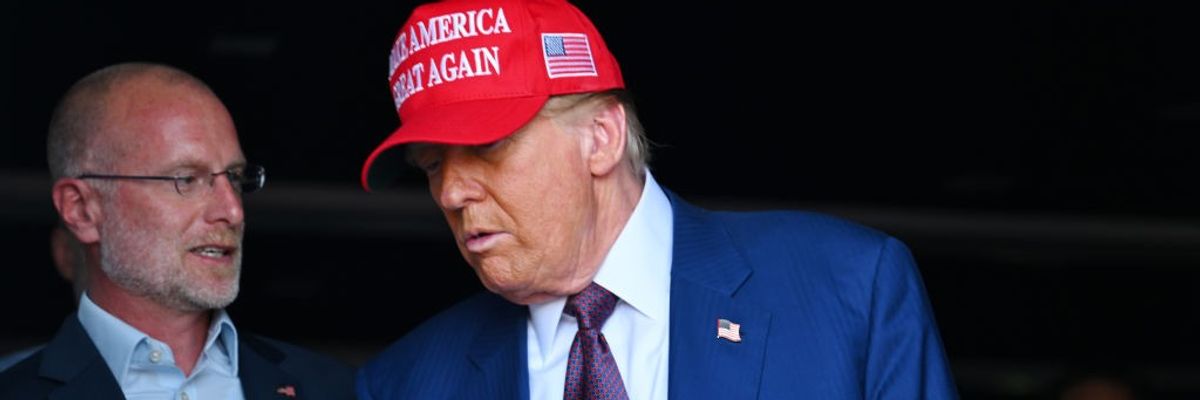
Donald Trump, then U.S. president-elect, spoke wiht Brendan Carr, his intended pick for chair of the Federal Communications Commission, at a SpaceX test flight on November 19, 2024 in Brownsville, Texas.
"The FCC chair is clearly undertaking an effort to bully and intimidate independent journalism, which is a hallmark of authoritarian regimes where democracy is under siege," said one critic.
U.S. press freedom advocates this week forcefully condemned Republican Federal Communications Commission Chair Brendan Carr's investigation into National Public Radio and Public Broadcasting Service that could lead to stripping them of government funding.
"If they weren't ringing already, alarm bells should be going off loudly," said Tim Richardson, program director for journalism and disinformation at PEN America, in a Thursday statement. "By using its investigatory powers, the FCC chair is clearly undertaking an effort to bully and intimidate independent journalism, which is a hallmark of authoritarian regimes where democracy is under siege."
"The Trump administration is clearly embracing such tactics and putting independent media at risk by undermining accountability of elected leaders and risking a less informed public," Richardson added. "We call on the FCC to dispense with such politically motivated investigations."
Jenna Leventoff, senior policy counsel at the ACLU, was similarly critical, saying that "the commission should not bring frivolous investigations into media outlets simply because they do not like their coverage. Investigations like this can chill coverage and threaten the independence of the press, making it harder to hold the government accountable and keep us all informed."
I told @nytimes.com that Carr's claim that NPR and PBS broke sponsorship disclosure rules is an obvious pretext to attack their funding and independence. Carr was appointed to do Trump's censorial bidding. All his moves should be viewed through that lens.This “investigation” is a sham and meant to terrorize NPR and PBS. They have *rigorous* oversight on vetting the “this program brought to you by” statements and literally pages of documentation about it that they give to filmmakers like me. Support your local stations, they’re going to need it.
[image or embed]
— Ariel Waldman (@arielwaldman.com) January 30, 2025 at 2:39 PM
Free Press co-CEO Craig Aaron declared that "his seat as FCC chairman is barely warm, but Brendan Carr is already abusing his power and harassing public broadcasters with a sham investigation designed to scare journalists into silence. This is all part of Carr's far-right, Project 2025-inspired agenda."
"This bogus investigation is an attack on the freedom of the press and a bungling attempt to bash public broadcasters and further weaken their resolve to question the extremism, corruption, and cruelty of the Trump administration," Aaron warned. "This unjustified investigation isn't based on any genuine concern about whether there's too much advertising on public media. It's a blatant attempt to undermine independent, rigorous reporting on the Trump administration."
"Carr may not like public media—and that's no surprise given that he isn't a fan of journalism that holds public officials and billionaires accountable. In this, as in so many other areas under his purview, Chairman Carr is far out of step with the American public and their needs," he continued. "Communities all across the country rely on their local public radio and TV stations to provide trustworthy news reporting and a diversity of opinions. In every survey, the American public indicates it wants more support for public and community media, not less."
Aaron added that "in a healthy democracy, we would be investing enough in our public-media system that it wouldn't need to seek any corporate underwriting. Unfortunately, Carr's cronies in Congress and the Big Media barons they serve have instead for decades tried to zero out funding for public media. They have repeatedly failed because millions of viewers and listeners opposed them."
Carr—whom President Donald Trump first appointed to the FCC in 2017 and recently elevated to chair after he contributed to the Heritage Foundation-led Project 2025—announced the probe in a Wednesday letter to NPR president and CEO Katherine Maher and PBS president and CEO Paula Kerger.
"I am concerned that NPR and PBS broadcasts could be violating federal law by airing commercials," Carr wrote. "I have asked the FCC's Enforcement Bureau, with assistance from the FCC's Media Bureau, to initiate an investigation into the underwriting announcements and related policies of NPR, PBS, and their broadcast member stations."
The chair added:
I will be providing a copy of this letter to relevant members of Congress because I believe this FCC investigation may prove relevant to an ongoing legislative debate. In particular, Congress is actively considering whether to stop requiring taxpayers to subsidize NPR and PBS programming. For my own part, I do not see a reason why Congress should continue sending taxpayer dollars to NPR and PBS given the changes in the media marketplace since the passage of the Public Broadcasting Act of 1967.
To the extent that these taxpayer dollars are being used to support a for-profit endeavor or an entity that is airing commercial advertisements, then that would further undermine any case for continuing to fund NPR and PBS with taxpayer dollars.
Some federal lawmakers have already responded on social media. Sen. Ed Markey (D-Mass.) said that "the letter from Chairman Carr announcing a new FCC investigation into NPR and PBS member stations is baseless. He cites no evidence at all. Instead, this investigation is a dangerous attack on public media and local journalism."
Rep. Doris Matsui (D-Calif.) said that "public television and radio are essential for their local communities. The FCC must not be weaponized to intimidate and silence broadcast media. We should be supporting, not undermining, their contributions to journalism and the marketplace of ideas."
I told @nytimes.com that Carr's claim that NPR and PBS broke sponsorship disclosure rules is an obvious pretext to attack their funding and independence. Carr was appointed to do Trump's censorial bidding. All his moves should be viewed through that lens. www.nytimes.com/2025/01/30/b...
[image or embed]
— Seth Stern (@seth-stern.bsky.social) January 30, 2025 at 5:27 PM
The two Democratic members of the FCC have also responded critically to Carr's move. Commissioner Anna Gomez said that "this appears to be yet another administration effort to weaponize the power of the FCC. The FCC has no business intimidating and silencing broadcast media."
Commissioner Geoffrey Starks said that "public television and radio stations play a significant role in our media ecosystem.
Any attempt to intimidate these local media outlets is a threat to the free flow of information and the marketplace of ideas. The announcement of this investigation gives me serious concern."
Maher said in statement that "NPR programming and underwriting messaging complies with federal regulations, including the FCC guidelines on underwriting messages for noncommercial educational broadcasters, and member stations are expected to be in compliance as well."
"We are confident any review of our programming and underwriting practices will confirm NPR's adherence to these rules," she added. "We have worked for decades with the FCC in support of noncommercial educational broadcasters who provide essential information, educational programming, and emergency alerts to local communities across the United States."
In a statement to NPR media correspondent David Folkenflik, who reported on the probe, Kerger said that "PBS is proud of the noncommercial educational programming we provide to all Americans through our member stations... We work diligently to comply with the FCC's underwriting regulations and welcome the opportunity to demonstrate that to the commission."
Dear Common Dreams reader, It’s been nearly 30 years since I co-founded Common Dreams with my late wife, Lina Newhouser. We had the radical notion that journalism should serve the public good, not corporate profits. It was clear to us from the outset what it would take to build such a project. No paid advertisements. No corporate sponsors. No millionaire publisher telling us what to think or do. Many people said we wouldn't last a year, but we proved those doubters wrong. Together with a tremendous team of journalists and dedicated staff, we built an independent media outlet free from the constraints of profits and corporate control. Our mission has always been simple: To inform. To inspire. To ignite change for the common good. Building Common Dreams was not easy. Our survival was never guaranteed. When you take on the most powerful forces—Wall Street greed, fossil fuel industry destruction, Big Tech lobbyists, and uber-rich oligarchs who have spent billions upon billions rigging the economy and democracy in their favor—the only bulwark you have is supporters who believe in your work. But here’s the urgent message from me today. It's never been this bad out there. And it's never been this hard to keep us going. At the very moment Common Dreams is most needed, the threats we face are intensifying. We need your support now more than ever. We don't accept corporate advertising and never will. We don't have a paywall because we don't think people should be blocked from critical news based on their ability to pay. Everything we do is funded by the donations of readers like you. When everyone does the little they can afford, we are strong. But if that support retreats or dries up, so do we. Will you donate now to make sure Common Dreams not only survives but thrives? —Craig Brown, Co-founder |
U.S. press freedom advocates this week forcefully condemned Republican Federal Communications Commission Chair Brendan Carr's investigation into National Public Radio and Public Broadcasting Service that could lead to stripping them of government funding.
"If they weren't ringing already, alarm bells should be going off loudly," said Tim Richardson, program director for journalism and disinformation at PEN America, in a Thursday statement. "By using its investigatory powers, the FCC chair is clearly undertaking an effort to bully and intimidate independent journalism, which is a hallmark of authoritarian regimes where democracy is under siege."
"The Trump administration is clearly embracing such tactics and putting independent media at risk by undermining accountability of elected leaders and risking a less informed public," Richardson added. "We call on the FCC to dispense with such politically motivated investigations."
Jenna Leventoff, senior policy counsel at the ACLU, was similarly critical, saying that "the commission should not bring frivolous investigations into media outlets simply because they do not like their coverage. Investigations like this can chill coverage and threaten the independence of the press, making it harder to hold the government accountable and keep us all informed."
I told @nytimes.com that Carr's claim that NPR and PBS broke sponsorship disclosure rules is an obvious pretext to attack their funding and independence. Carr was appointed to do Trump's censorial bidding. All his moves should be viewed through that lens.This “investigation” is a sham and meant to terrorize NPR and PBS. They have *rigorous* oversight on vetting the “this program brought to you by” statements and literally pages of documentation about it that they give to filmmakers like me. Support your local stations, they’re going to need it.
[image or embed]
— Ariel Waldman (@arielwaldman.com) January 30, 2025 at 2:39 PM
Free Press co-CEO Craig Aaron declared that "his seat as FCC chairman is barely warm, but Brendan Carr is already abusing his power and harassing public broadcasters with a sham investigation designed to scare journalists into silence. This is all part of Carr's far-right, Project 2025-inspired agenda."
"This bogus investigation is an attack on the freedom of the press and a bungling attempt to bash public broadcasters and further weaken their resolve to question the extremism, corruption, and cruelty of the Trump administration," Aaron warned. "This unjustified investigation isn't based on any genuine concern about whether there's too much advertising on public media. It's a blatant attempt to undermine independent, rigorous reporting on the Trump administration."
"Carr may not like public media—and that's no surprise given that he isn't a fan of journalism that holds public officials and billionaires accountable. In this, as in so many other areas under his purview, Chairman Carr is far out of step with the American public and their needs," he continued. "Communities all across the country rely on their local public radio and TV stations to provide trustworthy news reporting and a diversity of opinions. In every survey, the American public indicates it wants more support for public and community media, not less."
Aaron added that "in a healthy democracy, we would be investing enough in our public-media system that it wouldn't need to seek any corporate underwriting. Unfortunately, Carr's cronies in Congress and the Big Media barons they serve have instead for decades tried to zero out funding for public media. They have repeatedly failed because millions of viewers and listeners opposed them."
Carr—whom President Donald Trump first appointed to the FCC in 2017 and recently elevated to chair after he contributed to the Heritage Foundation-led Project 2025—announced the probe in a Wednesday letter to NPR president and CEO Katherine Maher and PBS president and CEO Paula Kerger.
"I am concerned that NPR and PBS broadcasts could be violating federal law by airing commercials," Carr wrote. "I have asked the FCC's Enforcement Bureau, with assistance from the FCC's Media Bureau, to initiate an investigation into the underwriting announcements and related policies of NPR, PBS, and their broadcast member stations."
The chair added:
I will be providing a copy of this letter to relevant members of Congress because I believe this FCC investigation may prove relevant to an ongoing legislative debate. In particular, Congress is actively considering whether to stop requiring taxpayers to subsidize NPR and PBS programming. For my own part, I do not see a reason why Congress should continue sending taxpayer dollars to NPR and PBS given the changes in the media marketplace since the passage of the Public Broadcasting Act of 1967.
To the extent that these taxpayer dollars are being used to support a for-profit endeavor or an entity that is airing commercial advertisements, then that would further undermine any case for continuing to fund NPR and PBS with taxpayer dollars.
Some federal lawmakers have already responded on social media. Sen. Ed Markey (D-Mass.) said that "the letter from Chairman Carr announcing a new FCC investigation into NPR and PBS member stations is baseless. He cites no evidence at all. Instead, this investigation is a dangerous attack on public media and local journalism."
Rep. Doris Matsui (D-Calif.) said that "public television and radio are essential for their local communities. The FCC must not be weaponized to intimidate and silence broadcast media. We should be supporting, not undermining, their contributions to journalism and the marketplace of ideas."
I told @nytimes.com that Carr's claim that NPR and PBS broke sponsorship disclosure rules is an obvious pretext to attack their funding and independence. Carr was appointed to do Trump's censorial bidding. All his moves should be viewed through that lens. www.nytimes.com/2025/01/30/b...
[image or embed]
— Seth Stern (@seth-stern.bsky.social) January 30, 2025 at 5:27 PM
The two Democratic members of the FCC have also responded critically to Carr's move. Commissioner Anna Gomez said that "this appears to be yet another administration effort to weaponize the power of the FCC. The FCC has no business intimidating and silencing broadcast media."
Commissioner Geoffrey Starks said that "public television and radio stations play a significant role in our media ecosystem.
Any attempt to intimidate these local media outlets is a threat to the free flow of information and the marketplace of ideas. The announcement of this investigation gives me serious concern."
Maher said in statement that "NPR programming and underwriting messaging complies with federal regulations, including the FCC guidelines on underwriting messages for noncommercial educational broadcasters, and member stations are expected to be in compliance as well."
"We are confident any review of our programming and underwriting practices will confirm NPR's adherence to these rules," she added. "We have worked for decades with the FCC in support of noncommercial educational broadcasters who provide essential information, educational programming, and emergency alerts to local communities across the United States."
In a statement to NPR media correspondent David Folkenflik, who reported on the probe, Kerger said that "PBS is proud of the noncommercial educational programming we provide to all Americans through our member stations... We work diligently to comply with the FCC's underwriting regulations and welcome the opportunity to demonstrate that to the commission."
U.S. press freedom advocates this week forcefully condemned Republican Federal Communications Commission Chair Brendan Carr's investigation into National Public Radio and Public Broadcasting Service that could lead to stripping them of government funding.
"If they weren't ringing already, alarm bells should be going off loudly," said Tim Richardson, program director for journalism and disinformation at PEN America, in a Thursday statement. "By using its investigatory powers, the FCC chair is clearly undertaking an effort to bully and intimidate independent journalism, which is a hallmark of authoritarian regimes where democracy is under siege."
"The Trump administration is clearly embracing such tactics and putting independent media at risk by undermining accountability of elected leaders and risking a less informed public," Richardson added. "We call on the FCC to dispense with such politically motivated investigations."
Jenna Leventoff, senior policy counsel at the ACLU, was similarly critical, saying that "the commission should not bring frivolous investigations into media outlets simply because they do not like their coverage. Investigations like this can chill coverage and threaten the independence of the press, making it harder to hold the government accountable and keep us all informed."
I told @nytimes.com that Carr's claim that NPR and PBS broke sponsorship disclosure rules is an obvious pretext to attack their funding and independence. Carr was appointed to do Trump's censorial bidding. All his moves should be viewed through that lens.This “investigation” is a sham and meant to terrorize NPR and PBS. They have *rigorous* oversight on vetting the “this program brought to you by” statements and literally pages of documentation about it that they give to filmmakers like me. Support your local stations, they’re going to need it.
[image or embed]
— Ariel Waldman (@arielwaldman.com) January 30, 2025 at 2:39 PM
Free Press co-CEO Craig Aaron declared that "his seat as FCC chairman is barely warm, but Brendan Carr is already abusing his power and harassing public broadcasters with a sham investigation designed to scare journalists into silence. This is all part of Carr's far-right, Project 2025-inspired agenda."
"This bogus investigation is an attack on the freedom of the press and a bungling attempt to bash public broadcasters and further weaken their resolve to question the extremism, corruption, and cruelty of the Trump administration," Aaron warned. "This unjustified investigation isn't based on any genuine concern about whether there's too much advertising on public media. It's a blatant attempt to undermine independent, rigorous reporting on the Trump administration."
"Carr may not like public media—and that's no surprise given that he isn't a fan of journalism that holds public officials and billionaires accountable. In this, as in so many other areas under his purview, Chairman Carr is far out of step with the American public and their needs," he continued. "Communities all across the country rely on their local public radio and TV stations to provide trustworthy news reporting and a diversity of opinions. In every survey, the American public indicates it wants more support for public and community media, not less."
Aaron added that "in a healthy democracy, we would be investing enough in our public-media system that it wouldn't need to seek any corporate underwriting. Unfortunately, Carr's cronies in Congress and the Big Media barons they serve have instead for decades tried to zero out funding for public media. They have repeatedly failed because millions of viewers and listeners opposed them."
Carr—whom President Donald Trump first appointed to the FCC in 2017 and recently elevated to chair after he contributed to the Heritage Foundation-led Project 2025—announced the probe in a Wednesday letter to NPR president and CEO Katherine Maher and PBS president and CEO Paula Kerger.
"I am concerned that NPR and PBS broadcasts could be violating federal law by airing commercials," Carr wrote. "I have asked the FCC's Enforcement Bureau, with assistance from the FCC's Media Bureau, to initiate an investigation into the underwriting announcements and related policies of NPR, PBS, and their broadcast member stations."
The chair added:
I will be providing a copy of this letter to relevant members of Congress because I believe this FCC investigation may prove relevant to an ongoing legislative debate. In particular, Congress is actively considering whether to stop requiring taxpayers to subsidize NPR and PBS programming. For my own part, I do not see a reason why Congress should continue sending taxpayer dollars to NPR and PBS given the changes in the media marketplace since the passage of the Public Broadcasting Act of 1967.
To the extent that these taxpayer dollars are being used to support a for-profit endeavor or an entity that is airing commercial advertisements, then that would further undermine any case for continuing to fund NPR and PBS with taxpayer dollars.
Some federal lawmakers have already responded on social media. Sen. Ed Markey (D-Mass.) said that "the letter from Chairman Carr announcing a new FCC investigation into NPR and PBS member stations is baseless. He cites no evidence at all. Instead, this investigation is a dangerous attack on public media and local journalism."
Rep. Doris Matsui (D-Calif.) said that "public television and radio are essential for their local communities. The FCC must not be weaponized to intimidate and silence broadcast media. We should be supporting, not undermining, their contributions to journalism and the marketplace of ideas."
I told @nytimes.com that Carr's claim that NPR and PBS broke sponsorship disclosure rules is an obvious pretext to attack their funding and independence. Carr was appointed to do Trump's censorial bidding. All his moves should be viewed through that lens. www.nytimes.com/2025/01/30/b...
[image or embed]
— Seth Stern (@seth-stern.bsky.social) January 30, 2025 at 5:27 PM
The two Democratic members of the FCC have also responded critically to Carr's move. Commissioner Anna Gomez said that "this appears to be yet another administration effort to weaponize the power of the FCC. The FCC has no business intimidating and silencing broadcast media."
Commissioner Geoffrey Starks said that "public television and radio stations play a significant role in our media ecosystem.
Any attempt to intimidate these local media outlets is a threat to the free flow of information and the marketplace of ideas. The announcement of this investigation gives me serious concern."
Maher said in statement that "NPR programming and underwriting messaging complies with federal regulations, including the FCC guidelines on underwriting messages for noncommercial educational broadcasters, and member stations are expected to be in compliance as well."
"We are confident any review of our programming and underwriting practices will confirm NPR's adherence to these rules," she added. "We have worked for decades with the FCC in support of noncommercial educational broadcasters who provide essential information, educational programming, and emergency alerts to local communities across the United States."
In a statement to NPR media correspondent David Folkenflik, who reported on the probe, Kerger said that "PBS is proud of the noncommercial educational programming we provide to all Americans through our member stations... We work diligently to comply with the FCC's underwriting regulations and welcome the opportunity to demonstrate that to the commission."