SUBSCRIBE TO OUR FREE NEWSLETTER
Daily news & progressive opinion—funded by the people, not the corporations—delivered straight to your inbox.
5
#000000
#FFFFFF
To donate by check, phone, or other method, see our More Ways to Give page.
Daily news & progressive opinion—funded by the people, not the corporations—delivered straight to your inbox.
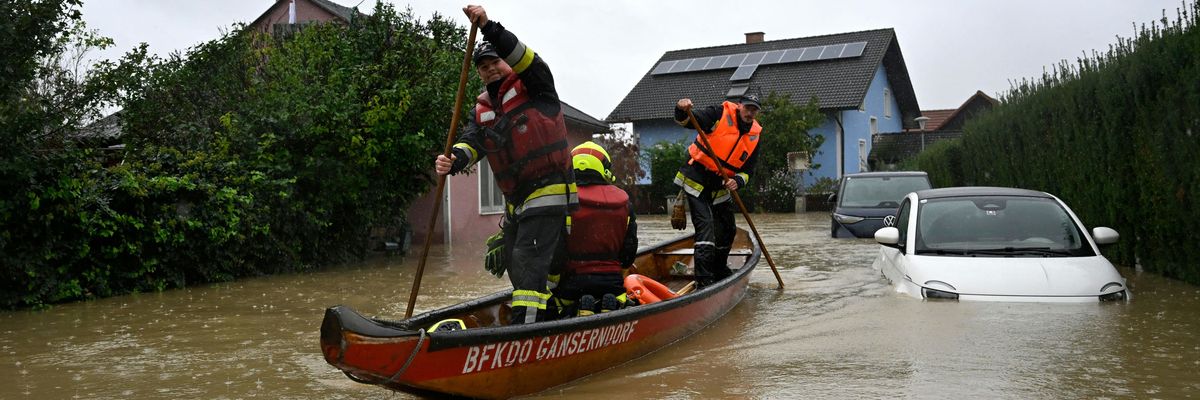
Firefighters in a boat make their way past a car submerged by the floods in Rust im Tullnerfeld, Austria, on September 16, 2024.
"We are deeply worried such events will get worse until oil and gas giants like Shell, Total, Equinor, Exxon, OMV, and ENI are forced to stop drilling for fossil fuels driving climate change," said one campaigner.
The international climate group Greenpeace on Friday called on European leaders to "reciprocate" the courage shown by first responders in several countries over the weekend by forcing fossil fuel giants to pay for climate damages.
Calling out leaders including Polish Prime Minister Donald Tusk, Czech Prime Minister Petr Fiala, and Romania Prime Minister Marcel Ciolacu, Greenpeace campaigner Ian Duff said Central and Eastern European countries should end their "support for fossil fuels and [make] climate polluters pay for this disaster," as emergency workers rescued people from catastrophic flooding.
The death toll on Monday rose to at least 16, with many more people missing and hundreds of thousands of people displaced in countries including Austria, the Czech Republic, Hungary, Romania, and Slovakia after the low-pressure system Storm Boris dumped torrential rains on the region for days starting late last week.
Two men, aged 70 and 80, drowned in their homes in northeastern Lower Austria after being trapped by rising floodwater, and confirmed deaths in Poland rose to six.
About 70% of Litovel, about 140 miles east of the Czech capital of Prague, was underwater Monday, while a power plant servicing the country's third-largest city was forced to shut down and leave residents without heat and hot water.
"Greenpeace is horrified by damages brought by floods across Central and Eastern Europe, claiming lives, leaving homes without power and farmers with ruined fields, after being already ravaged by drought," said Duff, head of Greenpeace's Stop Drilling Start Paying campaign. "We are deeply worried such events will get worse until oil and gas giants like Shell, Total, Equinor, Exxon, OMV, and ENI are forced to stop drilling for fossil fuels driving climate change."
In the U.S., the notion of big polluters being required to pay for damages caused by the climate crisis has recently gained traction, with lawmakers introducing a bill in Congress last week.
In Europe, a "polluter pays" principle is followed for many kinds of pollution, but advocates have called for it to be applied to planet-heating greenhouse gas emissions.
The flooding in Europe comes, as London-based meteorologist Scott Duncan explained on the social media platform X, after "an exceptional summer for the Mediterranean Sea," with heat records broken—just as scientists have warned this year that record heat in the North Atlantic and other oceans around the globe would mean "a busy hurricane season."
"Warmer sea surface temperatures allow more moisture to evaporate, like fuel for a storm. The warmer the water, the greater the evaporation," said Duncan.
Liz Stephens, science lead for the Red Cross Red Crescent Climate Center, noted that in Central and Eastern Europe, "climate change is known to be playing a role in increasing the risk of flooding," with the World Weather Attribution saying in 2021 that disastrous flooding that hit Germany and Belgium was tied to "a rapidly warming climate."
Reports by the Intergovernmental Panel on Climate Change (IPCC), Stephens added, "have indicated that we have already observed an upward trend in heavy rainfall, surface water, and river flooding, and climate models show high confidence of further increases into the future."
"The flooding looks set to be the worst in the region since 2002," she said. "Lessons will have been learned from previous big European floods, but forecasts for some locations are for flooding of unprecedented magnitude, and history tells us that people are often surprised by the seemingly unimaginable consequences of such events."
Journalist and climate advocate George Monbiot pointed out on Al Jazeera that storms previously described as "once-in-1,000-year occurrences [are] happening several times now in the past decade. We're seeing a massive acceleration and intensification of extreme weather events, and unfortunately this is exactly what climate scientists were predicting."
Climate action group Friends of the Earth echoed Greenpeace's demand to "leave fossil fuels in the ground and instead invest in a green future," and Duff emphasized that communities across Central and Eastern Europe are far from the only ones "reeling from deadly floods and torrential rains," with Typhoon Yagi causing flooding and landslides that killed at least 250 people in Southeast Asia in recent days and heavy rains across West and Central Africa leading to floods that killed more than 1,000 people.
"The fossil fuel industry," said Duff, "is worsening weather extremes everywhere."
Dear Common Dreams reader, It’s been nearly 30 years since I co-founded Common Dreams with my late wife, Lina Newhouser. We had the radical notion that journalism should serve the public good, not corporate profits. It was clear to us from the outset what it would take to build such a project. No paid advertisements. No corporate sponsors. No millionaire publisher telling us what to think or do. Many people said we wouldn't last a year, but we proved those doubters wrong. Together with a tremendous team of journalists and dedicated staff, we built an independent media outlet free from the constraints of profits and corporate control. Our mission has always been simple: To inform. To inspire. To ignite change for the common good. Building Common Dreams was not easy. Our survival was never guaranteed. When you take on the most powerful forces—Wall Street greed, fossil fuel industry destruction, Big Tech lobbyists, and uber-rich oligarchs who have spent billions upon billions rigging the economy and democracy in their favor—the only bulwark you have is supporters who believe in your work. But here’s the urgent message from me today. It's never been this bad out there. And it's never been this hard to keep us going. At the very moment Common Dreams is most needed, the threats we face are intensifying. We need your support now more than ever. We don't accept corporate advertising and never will. We don't have a paywall because we don't think people should be blocked from critical news based on their ability to pay. Everything we do is funded by the donations of readers like you. When everyone does the little they can afford, we are strong. But if that support retreats or dries up, so do we. Will you donate now to make sure Common Dreams not only survives but thrives? —Craig Brown, Co-founder |
The international climate group Greenpeace on Friday called on European leaders to "reciprocate" the courage shown by first responders in several countries over the weekend by forcing fossil fuel giants to pay for climate damages.
Calling out leaders including Polish Prime Minister Donald Tusk, Czech Prime Minister Petr Fiala, and Romania Prime Minister Marcel Ciolacu, Greenpeace campaigner Ian Duff said Central and Eastern European countries should end their "support for fossil fuels and [make] climate polluters pay for this disaster," as emergency workers rescued people from catastrophic flooding.
The death toll on Monday rose to at least 16, with many more people missing and hundreds of thousands of people displaced in countries including Austria, the Czech Republic, Hungary, Romania, and Slovakia after the low-pressure system Storm Boris dumped torrential rains on the region for days starting late last week.
Two men, aged 70 and 80, drowned in their homes in northeastern Lower Austria after being trapped by rising floodwater, and confirmed deaths in Poland rose to six.
About 70% of Litovel, about 140 miles east of the Czech capital of Prague, was underwater Monday, while a power plant servicing the country's third-largest city was forced to shut down and leave residents without heat and hot water.
"Greenpeace is horrified by damages brought by floods across Central and Eastern Europe, claiming lives, leaving homes without power and farmers with ruined fields, after being already ravaged by drought," said Duff, head of Greenpeace's Stop Drilling Start Paying campaign. "We are deeply worried such events will get worse until oil and gas giants like Shell, Total, Equinor, Exxon, OMV, and ENI are forced to stop drilling for fossil fuels driving climate change."
In the U.S., the notion of big polluters being required to pay for damages caused by the climate crisis has recently gained traction, with lawmakers introducing a bill in Congress last week.
In Europe, a "polluter pays" principle is followed for many kinds of pollution, but advocates have called for it to be applied to planet-heating greenhouse gas emissions.
The flooding in Europe comes, as London-based meteorologist Scott Duncan explained on the social media platform X, after "an exceptional summer for the Mediterranean Sea," with heat records broken—just as scientists have warned this year that record heat in the North Atlantic and other oceans around the globe would mean "a busy hurricane season."
"Warmer sea surface temperatures allow more moisture to evaporate, like fuel for a storm. The warmer the water, the greater the evaporation," said Duncan.
Liz Stephens, science lead for the Red Cross Red Crescent Climate Center, noted that in Central and Eastern Europe, "climate change is known to be playing a role in increasing the risk of flooding," with the World Weather Attribution saying in 2021 that disastrous flooding that hit Germany and Belgium was tied to "a rapidly warming climate."
Reports by the Intergovernmental Panel on Climate Change (IPCC), Stephens added, "have indicated that we have already observed an upward trend in heavy rainfall, surface water, and river flooding, and climate models show high confidence of further increases into the future."
"The flooding looks set to be the worst in the region since 2002," she said. "Lessons will have been learned from previous big European floods, but forecasts for some locations are for flooding of unprecedented magnitude, and history tells us that people are often surprised by the seemingly unimaginable consequences of such events."
Journalist and climate advocate George Monbiot pointed out on Al Jazeera that storms previously described as "once-in-1,000-year occurrences [are] happening several times now in the past decade. We're seeing a massive acceleration and intensification of extreme weather events, and unfortunately this is exactly what climate scientists were predicting."
Climate action group Friends of the Earth echoed Greenpeace's demand to "leave fossil fuels in the ground and instead invest in a green future," and Duff emphasized that communities across Central and Eastern Europe are far from the only ones "reeling from deadly floods and torrential rains," with Typhoon Yagi causing flooding and landslides that killed at least 250 people in Southeast Asia in recent days and heavy rains across West and Central Africa leading to floods that killed more than 1,000 people.
"The fossil fuel industry," said Duff, "is worsening weather extremes everywhere."
The international climate group Greenpeace on Friday called on European leaders to "reciprocate" the courage shown by first responders in several countries over the weekend by forcing fossil fuel giants to pay for climate damages.
Calling out leaders including Polish Prime Minister Donald Tusk, Czech Prime Minister Petr Fiala, and Romania Prime Minister Marcel Ciolacu, Greenpeace campaigner Ian Duff said Central and Eastern European countries should end their "support for fossil fuels and [make] climate polluters pay for this disaster," as emergency workers rescued people from catastrophic flooding.
The death toll on Monday rose to at least 16, with many more people missing and hundreds of thousands of people displaced in countries including Austria, the Czech Republic, Hungary, Romania, and Slovakia after the low-pressure system Storm Boris dumped torrential rains on the region for days starting late last week.
Two men, aged 70 and 80, drowned in their homes in northeastern Lower Austria after being trapped by rising floodwater, and confirmed deaths in Poland rose to six.
About 70% of Litovel, about 140 miles east of the Czech capital of Prague, was underwater Monday, while a power plant servicing the country's third-largest city was forced to shut down and leave residents without heat and hot water.
"Greenpeace is horrified by damages brought by floods across Central and Eastern Europe, claiming lives, leaving homes without power and farmers with ruined fields, after being already ravaged by drought," said Duff, head of Greenpeace's Stop Drilling Start Paying campaign. "We are deeply worried such events will get worse until oil and gas giants like Shell, Total, Equinor, Exxon, OMV, and ENI are forced to stop drilling for fossil fuels driving climate change."
In the U.S., the notion of big polluters being required to pay for damages caused by the climate crisis has recently gained traction, with lawmakers introducing a bill in Congress last week.
In Europe, a "polluter pays" principle is followed for many kinds of pollution, but advocates have called for it to be applied to planet-heating greenhouse gas emissions.
The flooding in Europe comes, as London-based meteorologist Scott Duncan explained on the social media platform X, after "an exceptional summer for the Mediterranean Sea," with heat records broken—just as scientists have warned this year that record heat in the North Atlantic and other oceans around the globe would mean "a busy hurricane season."
"Warmer sea surface temperatures allow more moisture to evaporate, like fuel for a storm. The warmer the water, the greater the evaporation," said Duncan.
Liz Stephens, science lead for the Red Cross Red Crescent Climate Center, noted that in Central and Eastern Europe, "climate change is known to be playing a role in increasing the risk of flooding," with the World Weather Attribution saying in 2021 that disastrous flooding that hit Germany and Belgium was tied to "a rapidly warming climate."
Reports by the Intergovernmental Panel on Climate Change (IPCC), Stephens added, "have indicated that we have already observed an upward trend in heavy rainfall, surface water, and river flooding, and climate models show high confidence of further increases into the future."
"The flooding looks set to be the worst in the region since 2002," she said. "Lessons will have been learned from previous big European floods, but forecasts for some locations are for flooding of unprecedented magnitude, and history tells us that people are often surprised by the seemingly unimaginable consequences of such events."
Journalist and climate advocate George Monbiot pointed out on Al Jazeera that storms previously described as "once-in-1,000-year occurrences [are] happening several times now in the past decade. We're seeing a massive acceleration and intensification of extreme weather events, and unfortunately this is exactly what climate scientists were predicting."
Climate action group Friends of the Earth echoed Greenpeace's demand to "leave fossil fuels in the ground and instead invest in a green future," and Duff emphasized that communities across Central and Eastern Europe are far from the only ones "reeling from deadly floods and torrential rains," with Typhoon Yagi causing flooding and landslides that killed at least 250 people in Southeast Asia in recent days and heavy rains across West and Central Africa leading to floods that killed more than 1,000 people.
"The fossil fuel industry," said Duff, "is worsening weather extremes everywhere."