SUBSCRIBE TO OUR FREE NEWSLETTER
Daily news & progressive opinion—funded by the people, not the corporations—delivered straight to your inbox.
5
#000000
#FFFFFF
To donate by check, phone, or other method, see our More Ways to Give page.
Daily news & progressive opinion—funded by the people, not the corporations—delivered straight to your inbox.
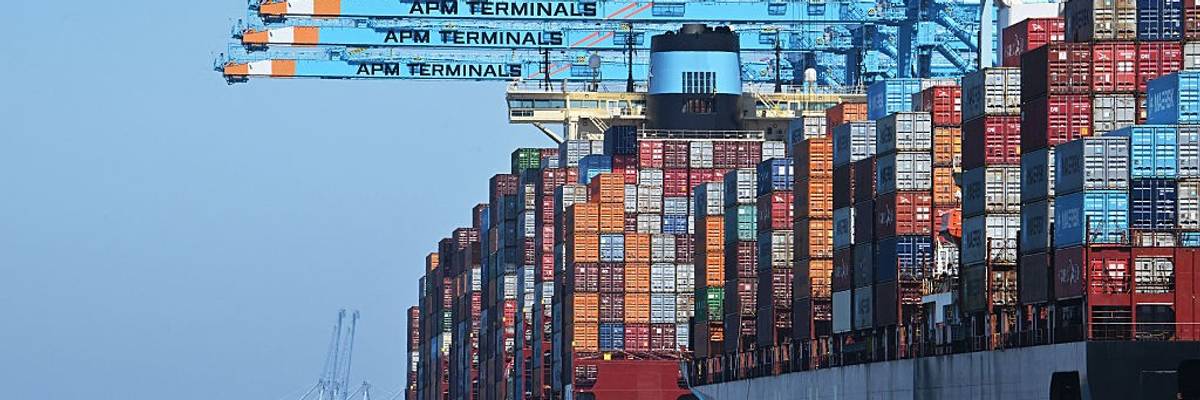
Container ships are docked at the APM Terminal at the Port of Los Angeles, California, on July 31, 2025.
"Trump's definition of 'winning' is hitting the American people with ever-higher taxes," said economist Dean Baker.
U.S. President Donald Trump on Thursday used emergency authority to impose high tariff rates on imports from dozens of American trading partners, including Canada—a move that economists criticized as a senseless approach to global trade that will further increase costs for consumers who are already struggling to get by.
Trump outlined the new tariff rates in executive orders signed just ahead of his arbitrary August 1 deadline for U.S. trading partners to negotiate a deal with the White House, whose erratic, aggressive, and legally dubious approach has alarmed world leaders.
Under the president's new orders, Canadian goods that are not covered by the U.S.-Mexico-Canada Agreement (USMCA) will face 35% import duties, while steel and aluminum imports will face a 50% tariff rate.
Trump claimed Canada "has failed to cooperate in curbing the ongoing flood of fentanyl and other illicit drugs." But Canadian Prime Minister Mark Carney hit back in a statement early Friday, noting that Canada "accounts for only 1% of U.S. fentanyl imports and has been working intensively to further reduce these volumes."
"While we will continue to negotiate with the United States on our trading relationship, the Canadian government is laser-focused on what we can control: building Canada strong," Carney added. "Canadians will be our own best customer, creating more well-paying careers at home, as we strengthen and diversify our trading partnerships throughout the world."
Economist Brad Setser said that while the impact of the higher tariff on Canadian imports could be muted because of the exemption of USMCA-covered products such as oil, the 35% rate is still "insane" and "dumb."
"Same with the high tariff on Switzerland. Crazy," Setser wrote, pointing to the 39% rate for Switzerland imports. "This isn't just protectionism, it is bad protectionism—and will have all sorts of unintended consequences."
The new tariff rates for Canadian goods will take effect Friday while the higher rates for other nations such as Brazil (50%), India (25%), and Vietnam (20%) won't kick in until next week "to give Customs and Border Protection officials time to prepare," The Washington Post reported. Customs and Border Protection collects tariffs, which are effectively taxes paid by importers—who often pass those costs onto consumers in the form of higher prices.
"Trump's definition of 'winning' is hitting the American people with ever-higher taxes," Dean Baker, senior economist at the Center for Economic and Policy Research, wrote late Thursday.
Recent U.S. economic data indicates that Trump's tariffs are already putting upward pressure on prices—and companies are using the president's trade chaos as an excuse to drive up prices further and pad their bottom lines.
The Tax Foundation noted earlier this week that "a variety of food imports" will be impacted by Trump's tariffs, likely leading to "higher food prices for consumers." More than 80% of Americans are already concerned about the price of groceries and many are struggling to stay afloat, according to survey data released Thursday by The Century Foundation.
Baker warned Thursday that even nations that have agreed to trade frameworks with the U.S. are not out of the woods.
"Deals are meaningless to Trump. He'll break them in a second any time he feels like it," Baker wrote. "I trust everyone negotiating with Trump understands that fact."
Dear Common Dreams reader, It’s been nearly 30 years since I co-founded Common Dreams with my late wife, Lina Newhouser. We had the radical notion that journalism should serve the public good, not corporate profits. It was clear to us from the outset what it would take to build such a project. No paid advertisements. No corporate sponsors. No millionaire publisher telling us what to think or do. Many people said we wouldn't last a year, but we proved those doubters wrong. Together with a tremendous team of journalists and dedicated staff, we built an independent media outlet free from the constraints of profits and corporate control. Our mission has always been simple: To inform. To inspire. To ignite change for the common good. Building Common Dreams was not easy. Our survival was never guaranteed. When you take on the most powerful forces—Wall Street greed, fossil fuel industry destruction, Big Tech lobbyists, and uber-rich oligarchs who have spent billions upon billions rigging the economy and democracy in their favor—the only bulwark you have is supporters who believe in your work. But here’s the urgent message from me today. It's never been this bad out there. And it's never been this hard to keep us going. At the very moment Common Dreams is most needed, the threats we face are intensifying. We need your support now more than ever. We don't accept corporate advertising and never will. We don't have a paywall because we don't think people should be blocked from critical news based on their ability to pay. Everything we do is funded by the donations of readers like you. When everyone does the little they can afford, we are strong. But if that support retreats or dries up, so do we. Will you donate now to make sure Common Dreams not only survives but thrives? —Craig Brown, Co-founder |
U.S. President Donald Trump on Thursday used emergency authority to impose high tariff rates on imports from dozens of American trading partners, including Canada—a move that economists criticized as a senseless approach to global trade that will further increase costs for consumers who are already struggling to get by.
Trump outlined the new tariff rates in executive orders signed just ahead of his arbitrary August 1 deadline for U.S. trading partners to negotiate a deal with the White House, whose erratic, aggressive, and legally dubious approach has alarmed world leaders.
Under the president's new orders, Canadian goods that are not covered by the U.S.-Mexico-Canada Agreement (USMCA) will face 35% import duties, while steel and aluminum imports will face a 50% tariff rate.
Trump claimed Canada "has failed to cooperate in curbing the ongoing flood of fentanyl and other illicit drugs." But Canadian Prime Minister Mark Carney hit back in a statement early Friday, noting that Canada "accounts for only 1% of U.S. fentanyl imports and has been working intensively to further reduce these volumes."
"While we will continue to negotiate with the United States on our trading relationship, the Canadian government is laser-focused on what we can control: building Canada strong," Carney added. "Canadians will be our own best customer, creating more well-paying careers at home, as we strengthen and diversify our trading partnerships throughout the world."
Economist Brad Setser said that while the impact of the higher tariff on Canadian imports could be muted because of the exemption of USMCA-covered products such as oil, the 35% rate is still "insane" and "dumb."
"Same with the high tariff on Switzerland. Crazy," Setser wrote, pointing to the 39% rate for Switzerland imports. "This isn't just protectionism, it is bad protectionism—and will have all sorts of unintended consequences."
The new tariff rates for Canadian goods will take effect Friday while the higher rates for other nations such as Brazil (50%), India (25%), and Vietnam (20%) won't kick in until next week "to give Customs and Border Protection officials time to prepare," The Washington Post reported. Customs and Border Protection collects tariffs, which are effectively taxes paid by importers—who often pass those costs onto consumers in the form of higher prices.
"Trump's definition of 'winning' is hitting the American people with ever-higher taxes," Dean Baker, senior economist at the Center for Economic and Policy Research, wrote late Thursday.
Recent U.S. economic data indicates that Trump's tariffs are already putting upward pressure on prices—and companies are using the president's trade chaos as an excuse to drive up prices further and pad their bottom lines.
The Tax Foundation noted earlier this week that "a variety of food imports" will be impacted by Trump's tariffs, likely leading to "higher food prices for consumers." More than 80% of Americans are already concerned about the price of groceries and many are struggling to stay afloat, according to survey data released Thursday by The Century Foundation.
Baker warned Thursday that even nations that have agreed to trade frameworks with the U.S. are not out of the woods.
"Deals are meaningless to Trump. He'll break them in a second any time he feels like it," Baker wrote. "I trust everyone negotiating with Trump understands that fact."
U.S. President Donald Trump on Thursday used emergency authority to impose high tariff rates on imports from dozens of American trading partners, including Canada—a move that economists criticized as a senseless approach to global trade that will further increase costs for consumers who are already struggling to get by.
Trump outlined the new tariff rates in executive orders signed just ahead of his arbitrary August 1 deadline for U.S. trading partners to negotiate a deal with the White House, whose erratic, aggressive, and legally dubious approach has alarmed world leaders.
Under the president's new orders, Canadian goods that are not covered by the U.S.-Mexico-Canada Agreement (USMCA) will face 35% import duties, while steel and aluminum imports will face a 50% tariff rate.
Trump claimed Canada "has failed to cooperate in curbing the ongoing flood of fentanyl and other illicit drugs." But Canadian Prime Minister Mark Carney hit back in a statement early Friday, noting that Canada "accounts for only 1% of U.S. fentanyl imports and has been working intensively to further reduce these volumes."
"While we will continue to negotiate with the United States on our trading relationship, the Canadian government is laser-focused on what we can control: building Canada strong," Carney added. "Canadians will be our own best customer, creating more well-paying careers at home, as we strengthen and diversify our trading partnerships throughout the world."
Economist Brad Setser said that while the impact of the higher tariff on Canadian imports could be muted because of the exemption of USMCA-covered products such as oil, the 35% rate is still "insane" and "dumb."
"Same with the high tariff on Switzerland. Crazy," Setser wrote, pointing to the 39% rate for Switzerland imports. "This isn't just protectionism, it is bad protectionism—and will have all sorts of unintended consequences."
The new tariff rates for Canadian goods will take effect Friday while the higher rates for other nations such as Brazil (50%), India (25%), and Vietnam (20%) won't kick in until next week "to give Customs and Border Protection officials time to prepare," The Washington Post reported. Customs and Border Protection collects tariffs, which are effectively taxes paid by importers—who often pass those costs onto consumers in the form of higher prices.
"Trump's definition of 'winning' is hitting the American people with ever-higher taxes," Dean Baker, senior economist at the Center for Economic and Policy Research, wrote late Thursday.
Recent U.S. economic data indicates that Trump's tariffs are already putting upward pressure on prices—and companies are using the president's trade chaos as an excuse to drive up prices further and pad their bottom lines.
The Tax Foundation noted earlier this week that "a variety of food imports" will be impacted by Trump's tariffs, likely leading to "higher food prices for consumers." More than 80% of Americans are already concerned about the price of groceries and many are struggling to stay afloat, according to survey data released Thursday by The Century Foundation.
Baker warned Thursday that even nations that have agreed to trade frameworks with the U.S. are not out of the woods.
"Deals are meaningless to Trump. He'll break them in a second any time he feels like it," Baker wrote. "I trust everyone negotiating with Trump understands that fact."