SUBSCRIBE TO OUR FREE NEWSLETTER
Daily news & progressive opinion—funded by the people, not the corporations—delivered straight to your inbox.
5
#000000
#FFFFFF
To donate by check, phone, or other method, see our More Ways to Give page.
Daily news & progressive opinion—funded by the people, not the corporations—delivered straight to your inbox.
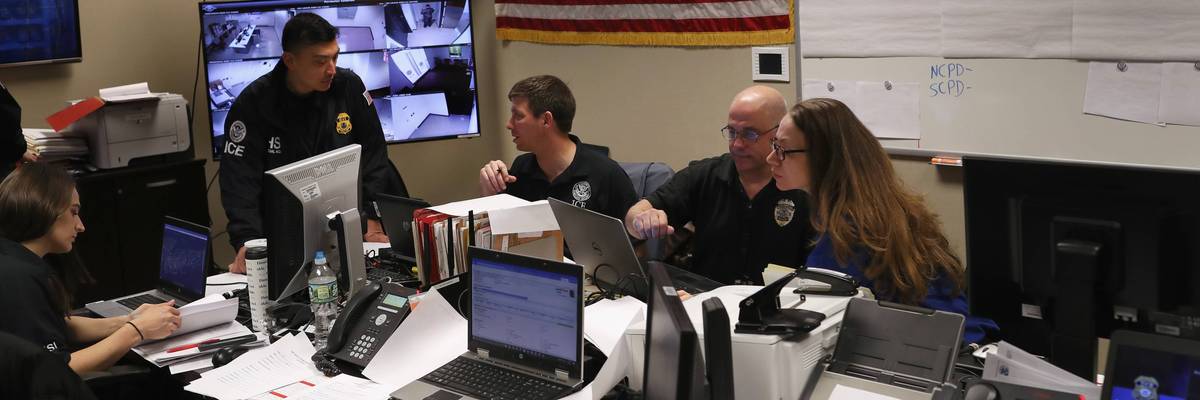
US Immigration and Customs Enforcement (ICE) agents work in a control center in Central Islip, New York on March 29, 2018.
One senior DHS official said the program "is just the first step in breaching people’s privacy settings in ways that they are not even aware of.”
US Department of Homeland Security agents are increasingly infiltrating social media platforms to monitor users, collect intelligence, and target people, according to new reporting based on leaked documents.
Ken Klippenstein exposed the open source monitoring program, which DHS calls "masked engagement," with new reporting Thursday that details how agents "assume false identities and interact with users—friending them, joining closed groups, and gaining access to otherwise private postings, photographs, friend lists, and more."
"A senior [DHS] official tells me that over 6,500 field agents and intelligence operatives can use the new tool, a significant increase explicitly linked to more intense monitoring of American citizens," Klippenstein wrote.
The so-called "masked engagement" by DHS operatives online comes as actual masked federal agents are engaged in the Trump administration's deadly deployments in communities nationwide.
Important to note that "Authorized" here means that DHS/ICE have given *Themselves* permission to do this "masked engagement" bullshit, not that either congress or the courts say it's okay.Challenge this everywhere & every way possible, & in the meantime, keep ourselves & each other safe as we can
[image or embed]
— Dr. Damien P. Williams can't think of a fun display name right n (@wolvendamien.bsky.social) February 12, 2026 at 4:46 PM
Masked engagement adds a new level to DHS' open source intelligence (OSINT) collection regime, which previously consisted of overt engagement, overt research, overt monitoring, masked monitoring, and undercover engagement. Masked engagement, in which agents conceal their government affiliation without assuming a false identity while interacting with a target, is a step below undercover engagement, in which DHS operatives use false identities and cover stories.
According to Klippenstein:
Masked monitoring allows officers at agencies like [Immigration and Customs Enforcement] and Border Patrol to use alias accounts to passively observe public online activity. Crucially, this level of monitoring bars DHS representatives from interacting with other users directly. Under masked monitoring, officers are not allowed to ask an admin for entry into a private group or to “friend” a target to see non-public posts.
But with masked engagement (separate from masked monitoring), that firewall has now been dismantled. The only restriction imposed on masked engagement is that DHS officers [note] the threshold of “substantive engagement”—a term the rules leave conveniently ill-defined.
"By labeling this a 'middle ground' between monitoring and full-blown undercover work, the DHS allows agents to infiltrate private digital spaces without the rigorous internal approvals and legal checks required for a formal undercover 'sting,'" Klippenstein explained.
Sources told Klippenstein that DHS has been using masked engagement tactics to infiltrate pro-Palestine groups in the United States and to compile databases of suspected Mexican and Mexican American transnational criminals.
“Open source monitoring has become so ubiquitous that we even have databases of identities used by the department to track our own online engagements,” the senior DHS official said.
“Yes, we have safeguards against violating people’s privacy, but masked engagement is just the first step in breaching people’s privacy settings in ways that they are not even aware of," they added.
Rachel Levinson-Waldman, director of the Brennan Center for Justice's Liberty and National Security Program, told Klippenstein that “CBP’s expansion into what they’re calling ‘masked engagement’ is cause for real concern."
“This new capability is being shoehorned in one step below undercover engagement (which already allows for a lot of overreach), it appears CBP believes that friending someone, following them, or joining a group is not as invasive as directly engaging or interacting with individuals," she continued.
“In addition, doing so through an alias account—an account that doesn’t reveal the user’s CBP affiliation, and pretends to be someone else—will weaken trust in government and weaken the trust that is critical to building community both online and off,” Levinson-Waldman added.
A DHS spokesperson told Klippenstein that the agency "has utilized its congressionally directed undercover authorities to root out child molesters and predators for years."
“We will continue using every tool at our disposal to protect the American people as our agents and officers Make America Safe Again," they added.
Those tools include an error-plagued mobile facial recognition application, mass phone surveillance technology, data broker platforms that allow operatives to circumvent warrant requirements, forensic extraction to bypass phone locks, artificial intelligence and predictive analytics, and more.
Civil liberties groups, digital rights advocates, and some Democratic lawmakers are pushing back.
Last week, Sens. Ed Markey (D-Mass.), Jeff Merkley (D-Ore.), Ron Wyden (D-Ore.), and Rep. Pramila Jayapal (D-Wash.) introduced the ICE Out of Our Faces Act, legislation that would ban ICE and Customs and Border Protection "from acquiring and using facial recognition technology and other biometric identification systems."
The bill would "also require the deletion of all data collected for use in or by biometric identification systems and allow individuals and state attorneys general to seek civil penalties for violations."
Dear Common Dreams reader, It’s been nearly 30 years since I co-founded Common Dreams with my late wife, Lina Newhouser. We had the radical notion that journalism should serve the public good, not corporate profits. It was clear to us from the outset what it would take to build such a project. No paid advertisements. No corporate sponsors. No millionaire publisher telling us what to think or do. Many people said we wouldn't last a year, but we proved those doubters wrong. Together with a tremendous team of journalists and dedicated staff, we built an independent media outlet free from the constraints of profits and corporate control. Our mission has always been simple: To inform. To inspire. To ignite change for the common good. Building Common Dreams was not easy. Our survival was never guaranteed. When you take on the most powerful forces—Wall Street greed, fossil fuel industry destruction, Big Tech lobbyists, and uber-rich oligarchs who have spent billions upon billions rigging the economy and democracy in their favor—the only bulwark you have is supporters who believe in your work. But here’s the urgent message from me today. It's never been this bad out there. And it's never been this hard to keep us going. At the very moment Common Dreams is most needed, the threats we face are intensifying. We need your support now more than ever. We don't accept corporate advertising and never will. We don't have a paywall because we don't think people should be blocked from critical news based on their ability to pay. Everything we do is funded by the donations of readers like you. When everyone does the little they can afford, we are strong. But if that support retreats or dries up, so do we. Will you donate now to make sure Common Dreams not only survives but thrives? —Craig Brown, Co-founder |
US Department of Homeland Security agents are increasingly infiltrating social media platforms to monitor users, collect intelligence, and target people, according to new reporting based on leaked documents.
Ken Klippenstein exposed the open source monitoring program, which DHS calls "masked engagement," with new reporting Thursday that details how agents "assume false identities and interact with users—friending them, joining closed groups, and gaining access to otherwise private postings, photographs, friend lists, and more."
"A senior [DHS] official tells me that over 6,500 field agents and intelligence operatives can use the new tool, a significant increase explicitly linked to more intense monitoring of American citizens," Klippenstein wrote.
The so-called "masked engagement" by DHS operatives online comes as actual masked federal agents are engaged in the Trump administration's deadly deployments in communities nationwide.
Important to note that "Authorized" here means that DHS/ICE have given *Themselves* permission to do this "masked engagement" bullshit, not that either congress or the courts say it's okay.Challenge this everywhere & every way possible, & in the meantime, keep ourselves & each other safe as we can
[image or embed]
— Dr. Damien P. Williams can't think of a fun display name right n (@wolvendamien.bsky.social) February 12, 2026 at 4:46 PM
Masked engagement adds a new level to DHS' open source intelligence (OSINT) collection regime, which previously consisted of overt engagement, overt research, overt monitoring, masked monitoring, and undercover engagement. Masked engagement, in which agents conceal their government affiliation without assuming a false identity while interacting with a target, is a step below undercover engagement, in which DHS operatives use false identities and cover stories.
According to Klippenstein:
Masked monitoring allows officers at agencies like [Immigration and Customs Enforcement] and Border Patrol to use alias accounts to passively observe public online activity. Crucially, this level of monitoring bars DHS representatives from interacting with other users directly. Under masked monitoring, officers are not allowed to ask an admin for entry into a private group or to “friend” a target to see non-public posts.
But with masked engagement (separate from masked monitoring), that firewall has now been dismantled. The only restriction imposed on masked engagement is that DHS officers [note] the threshold of “substantive engagement”—a term the rules leave conveniently ill-defined.
"By labeling this a 'middle ground' between monitoring and full-blown undercover work, the DHS allows agents to infiltrate private digital spaces without the rigorous internal approvals and legal checks required for a formal undercover 'sting,'" Klippenstein explained.
Sources told Klippenstein that DHS has been using masked engagement tactics to infiltrate pro-Palestine groups in the United States and to compile databases of suspected Mexican and Mexican American transnational criminals.
“Open source monitoring has become so ubiquitous that we even have databases of identities used by the department to track our own online engagements,” the senior DHS official said.
“Yes, we have safeguards against violating people’s privacy, but masked engagement is just the first step in breaching people’s privacy settings in ways that they are not even aware of," they added.
Rachel Levinson-Waldman, director of the Brennan Center for Justice's Liberty and National Security Program, told Klippenstein that “CBP’s expansion into what they’re calling ‘masked engagement’ is cause for real concern."
“This new capability is being shoehorned in one step below undercover engagement (which already allows for a lot of overreach), it appears CBP believes that friending someone, following them, or joining a group is not as invasive as directly engaging or interacting with individuals," she continued.
“In addition, doing so through an alias account—an account that doesn’t reveal the user’s CBP affiliation, and pretends to be someone else—will weaken trust in government and weaken the trust that is critical to building community both online and off,” Levinson-Waldman added.
A DHS spokesperson told Klippenstein that the agency "has utilized its congressionally directed undercover authorities to root out child molesters and predators for years."
“We will continue using every tool at our disposal to protect the American people as our agents and officers Make America Safe Again," they added.
Those tools include an error-plagued mobile facial recognition application, mass phone surveillance technology, data broker platforms that allow operatives to circumvent warrant requirements, forensic extraction to bypass phone locks, artificial intelligence and predictive analytics, and more.
Civil liberties groups, digital rights advocates, and some Democratic lawmakers are pushing back.
Last week, Sens. Ed Markey (D-Mass.), Jeff Merkley (D-Ore.), Ron Wyden (D-Ore.), and Rep. Pramila Jayapal (D-Wash.) introduced the ICE Out of Our Faces Act, legislation that would ban ICE and Customs and Border Protection "from acquiring and using facial recognition technology and other biometric identification systems."
The bill would "also require the deletion of all data collected for use in or by biometric identification systems and allow individuals and state attorneys general to seek civil penalties for violations."
US Department of Homeland Security agents are increasingly infiltrating social media platforms to monitor users, collect intelligence, and target people, according to new reporting based on leaked documents.
Ken Klippenstein exposed the open source monitoring program, which DHS calls "masked engagement," with new reporting Thursday that details how agents "assume false identities and interact with users—friending them, joining closed groups, and gaining access to otherwise private postings, photographs, friend lists, and more."
"A senior [DHS] official tells me that over 6,500 field agents and intelligence operatives can use the new tool, a significant increase explicitly linked to more intense monitoring of American citizens," Klippenstein wrote.
The so-called "masked engagement" by DHS operatives online comes as actual masked federal agents are engaged in the Trump administration's deadly deployments in communities nationwide.
Important to note that "Authorized" here means that DHS/ICE have given *Themselves* permission to do this "masked engagement" bullshit, not that either congress or the courts say it's okay.Challenge this everywhere & every way possible, & in the meantime, keep ourselves & each other safe as we can
[image or embed]
— Dr. Damien P. Williams can't think of a fun display name right n (@wolvendamien.bsky.social) February 12, 2026 at 4:46 PM
Masked engagement adds a new level to DHS' open source intelligence (OSINT) collection regime, which previously consisted of overt engagement, overt research, overt monitoring, masked monitoring, and undercover engagement. Masked engagement, in which agents conceal their government affiliation without assuming a false identity while interacting with a target, is a step below undercover engagement, in which DHS operatives use false identities and cover stories.
According to Klippenstein:
Masked monitoring allows officers at agencies like [Immigration and Customs Enforcement] and Border Patrol to use alias accounts to passively observe public online activity. Crucially, this level of monitoring bars DHS representatives from interacting with other users directly. Under masked monitoring, officers are not allowed to ask an admin for entry into a private group or to “friend” a target to see non-public posts.
But with masked engagement (separate from masked monitoring), that firewall has now been dismantled. The only restriction imposed on masked engagement is that DHS officers [note] the threshold of “substantive engagement”—a term the rules leave conveniently ill-defined.
"By labeling this a 'middle ground' between monitoring and full-blown undercover work, the DHS allows agents to infiltrate private digital spaces without the rigorous internal approvals and legal checks required for a formal undercover 'sting,'" Klippenstein explained.
Sources told Klippenstein that DHS has been using masked engagement tactics to infiltrate pro-Palestine groups in the United States and to compile databases of suspected Mexican and Mexican American transnational criminals.
“Open source monitoring has become so ubiquitous that we even have databases of identities used by the department to track our own online engagements,” the senior DHS official said.
“Yes, we have safeguards against violating people’s privacy, but masked engagement is just the first step in breaching people’s privacy settings in ways that they are not even aware of," they added.
Rachel Levinson-Waldman, director of the Brennan Center for Justice's Liberty and National Security Program, told Klippenstein that “CBP’s expansion into what they’re calling ‘masked engagement’ is cause for real concern."
“This new capability is being shoehorned in one step below undercover engagement (which already allows for a lot of overreach), it appears CBP believes that friending someone, following them, or joining a group is not as invasive as directly engaging or interacting with individuals," she continued.
“In addition, doing so through an alias account—an account that doesn’t reveal the user’s CBP affiliation, and pretends to be someone else—will weaken trust in government and weaken the trust that is critical to building community both online and off,” Levinson-Waldman added.
A DHS spokesperson told Klippenstein that the agency "has utilized its congressionally directed undercover authorities to root out child molesters and predators for years."
“We will continue using every tool at our disposal to protect the American people as our agents and officers Make America Safe Again," they added.
Those tools include an error-plagued mobile facial recognition application, mass phone surveillance technology, data broker platforms that allow operatives to circumvent warrant requirements, forensic extraction to bypass phone locks, artificial intelligence and predictive analytics, and more.
Civil liberties groups, digital rights advocates, and some Democratic lawmakers are pushing back.
Last week, Sens. Ed Markey (D-Mass.), Jeff Merkley (D-Ore.), Ron Wyden (D-Ore.), and Rep. Pramila Jayapal (D-Wash.) introduced the ICE Out of Our Faces Act, legislation that would ban ICE and Customs and Border Protection "from acquiring and using facial recognition technology and other biometric identification systems."
The bill would "also require the deletion of all data collected for use in or by biometric identification systems and allow individuals and state attorneys general to seek civil penalties for violations."