
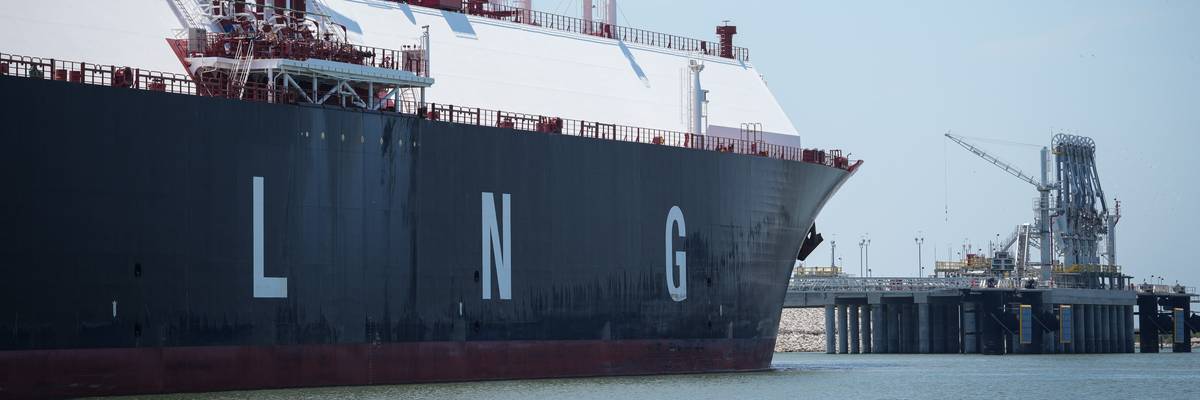
A liquefied natural gas transport ship sits docked in the Calcasieu River in Cameron Parish, Louisiana on June 7, 2023.
Coalition Sues Trump Admin Over 'Unlawful' Approval of LNG Export Project
A lawyer for the plaintiffs argues that the Department of Energy "is using an untested loophole to avoid considering the impacts of this project on Americans’ health and on the environment."
A coalition of green groups filed a lawsuit Tuesday contesting the Trump administration's approval of what would be one of the world's largest liquefied natural gas facilities—permission granted despite the project's threats to frontline communities, the environment, and climate.
The National Resources Defense Council (NRDC) and Earthjustice are representing the Sierra Club, which is suing the US Department of Energy (DOE) for approving Venture Global’s application to export liquefied natural gas (LNG) from the Calcasieu Pass 2, or CP2, terminal, which is now under construction in Cameron Parish, Louisiana.
“We’re suing over DOE’s unlawful approval of this facility that will increase climate-warming pollution and do nothing to lower energy costs for Americans,” NRDC senior attorney Caroline Reiser said. “DOE is using an untested loophole to avoid considering the impacts of this project on Americans’ health and on the environment. The agency also failed to consider how LNG exports could increase US energy prices.”
As Earthjustice explained:
CP2’s pollution, traffic, sprawl, and visual impact would add to the harms the nine overburdened local Gulf Coast communities located near the facility already experience from nearby existing LNG terminals. These communities already bear the burden of other heavy industry and are on the frontlines of the bigger hurricanes and storms fueled by the worsening climate crisis. Approving CP2’s exports will add to environmental injustice, fuel additional climate change, and increase prices for domestic consumers.
CP2 is one of the key projects in what climate campaigners called a "staggering" LNG expansion under former President Joe Biden. In January 2024, his administration announced a temporary pause on DOE approvals of pending and future LNG export applications to nations with which the US did not have free trade agreements. A federal judge appointed by President Donald Trump later ruled the pause illegal.
The United States is the world’s leading natural gas producer and LNG exporter. While the fossil fuel industry often calls LNG a “bridge fuel”—a cleaner alternative to coal that will ease the transition to sustainable energy sources—critics have warned that the fossil gas actually hampers the transition to a green economy. LNG is mostly composed of methane, which has more than 80 times the planetary heating power of carbon dioxide during its first two decades in the atmosphere.
Trump's DOE—headed by former fracking CEO Chris Wright—granted preliminary approval to CP2 last March, with the final green light coming in October. If built as planned, it would export around 20 million metric tons per year of LNG.
"The estimated lifecycle greenhouse gas from this methane gas would be more than the annual emissions of 47 million gas-powered cars, or 54 coal-fired power plants," said NRDC.
CP2 construction has already harmed local communities in Cameron Parish—especially local fishers. Last summer, dredging despoiled hundreds of acres of marshland, burying crab traps and oyster beds, and killing wildlife including the crabs, fish, and shrimp upon which fishers depend for their livelihood.
“We’re routinely seeing less and less catch. LNG has polluted our waters and disrupted the wildlife," one local fisher and dock manager said last year. "The shrimp just do not want to come in because of the LNG projects.”
We are at a crossroads
This country and this world are at a monumental crossroads. In a few short weeks, US voters will have an opportunity to beat back the forces of fascism and confront the billionaires who are rigging the economy, our media system, and our democracy, making it increasingly impossible for ordinary people to get by. We’re not just talking about the election. We’re talking about what must be done once these fascist elements are vanquished from power. We need a bolder set of solutions than what either major party has so far been willing to offer and a working-class movement ready to fight like hell for it. Trump didn't emerge from nowhere. The conditions that fueled MAGA authoritarianism were created by decades of radical neoliberal economic policies and a corrupt political system dominated by corporate interests. They slashed taxes on the super-rich, promising that the benefits would trickle down. They said giveaways to the corporate titans would make life more affordable for the rest of us. It was all bullshit. And when a bitter, betrayed populace searches for someone to blame, right-wing demagogues have little trouble finding scapegoats. People know when they're being lied to, but you won't hear any of this from the corporate media. Only independent journalism—powered and funded by people who believe in building a better world—can deliver truly trustworthy daily news. Our Fall Campaign is underway, and we need your help. To power our newsroom through the rest of the year, we need to raise $125,000 by midnight on October 31. So if you share our vision, please contribute whatever you can to sustain our work. |
A coalition of green groups filed a lawsuit Tuesday contesting the Trump administration's approval of what would be one of the world's largest liquefied natural gas facilities—permission granted despite the project's threats to frontline communities, the environment, and climate.
The National Resources Defense Council (NRDC) and Earthjustice are representing the Sierra Club, which is suing the US Department of Energy (DOE) for approving Venture Global’s application to export liquefied natural gas (LNG) from the Calcasieu Pass 2, or CP2, terminal, which is now under construction in Cameron Parish, Louisiana.
“We’re suing over DOE’s unlawful approval of this facility that will increase climate-warming pollution and do nothing to lower energy costs for Americans,” NRDC senior attorney Caroline Reiser said. “DOE is using an untested loophole to avoid considering the impacts of this project on Americans’ health and on the environment. The agency also failed to consider how LNG exports could increase US energy prices.”
As Earthjustice explained:
CP2’s pollution, traffic, sprawl, and visual impact would add to the harms the nine overburdened local Gulf Coast communities located near the facility already experience from nearby existing LNG terminals. These communities already bear the burden of other heavy industry and are on the frontlines of the bigger hurricanes and storms fueled by the worsening climate crisis. Approving CP2’s exports will add to environmental injustice, fuel additional climate change, and increase prices for domestic consumers.
CP2 is one of the key projects in what climate campaigners called a "staggering" LNG expansion under former President Joe Biden. In January 2024, his administration announced a temporary pause on DOE approvals of pending and future LNG export applications to nations with which the US did not have free trade agreements. A federal judge appointed by President Donald Trump later ruled the pause illegal.
The United States is the world’s leading natural gas producer and LNG exporter. While the fossil fuel industry often calls LNG a “bridge fuel”—a cleaner alternative to coal that will ease the transition to sustainable energy sources—critics have warned that the fossil gas actually hampers the transition to a green economy. LNG is mostly composed of methane, which has more than 80 times the planetary heating power of carbon dioxide during its first two decades in the atmosphere.
Trump's DOE—headed by former fracking CEO Chris Wright—granted preliminary approval to CP2 last March, with the final green light coming in October. If built as planned, it would export around 20 million metric tons per year of LNG.
"The estimated lifecycle greenhouse gas from this methane gas would be more than the annual emissions of 47 million gas-powered cars, or 54 coal-fired power plants," said NRDC.
CP2 construction has already harmed local communities in Cameron Parish—especially local fishers. Last summer, dredging despoiled hundreds of acres of marshland, burying crab traps and oyster beds, and killing wildlife including the crabs, fish, and shrimp upon which fishers depend for their livelihood.
“We’re routinely seeing less and less catch. LNG has polluted our waters and disrupted the wildlife," one local fisher and dock manager said last year. "The shrimp just do not want to come in because of the LNG projects.”
A coalition of green groups filed a lawsuit Tuesday contesting the Trump administration's approval of what would be one of the world's largest liquefied natural gas facilities—permission granted despite the project's threats to frontline communities, the environment, and climate.
The National Resources Defense Council (NRDC) and Earthjustice are representing the Sierra Club, which is suing the US Department of Energy (DOE) for approving Venture Global’s application to export liquefied natural gas (LNG) from the Calcasieu Pass 2, or CP2, terminal, which is now under construction in Cameron Parish, Louisiana.
“We’re suing over DOE’s unlawful approval of this facility that will increase climate-warming pollution and do nothing to lower energy costs for Americans,” NRDC senior attorney Caroline Reiser said. “DOE is using an untested loophole to avoid considering the impacts of this project on Americans’ health and on the environment. The agency also failed to consider how LNG exports could increase US energy prices.”
As Earthjustice explained:
CP2’s pollution, traffic, sprawl, and visual impact would add to the harms the nine overburdened local Gulf Coast communities located near the facility already experience from nearby existing LNG terminals. These communities already bear the burden of other heavy industry and are on the frontlines of the bigger hurricanes and storms fueled by the worsening climate crisis. Approving CP2’s exports will add to environmental injustice, fuel additional climate change, and increase prices for domestic consumers.
CP2 is one of the key projects in what climate campaigners called a "staggering" LNG expansion under former President Joe Biden. In January 2024, his administration announced a temporary pause on DOE approvals of pending and future LNG export applications to nations with which the US did not have free trade agreements. A federal judge appointed by President Donald Trump later ruled the pause illegal.
The United States is the world’s leading natural gas producer and LNG exporter. While the fossil fuel industry often calls LNG a “bridge fuel”—a cleaner alternative to coal that will ease the transition to sustainable energy sources—critics have warned that the fossil gas actually hampers the transition to a green economy. LNG is mostly composed of methane, which has more than 80 times the planetary heating power of carbon dioxide during its first two decades in the atmosphere.
Trump's DOE—headed by former fracking CEO Chris Wright—granted preliminary approval to CP2 last March, with the final green light coming in October. If built as planned, it would export around 20 million metric tons per year of LNG.
"The estimated lifecycle greenhouse gas from this methane gas would be more than the annual emissions of 47 million gas-powered cars, or 54 coal-fired power plants," said NRDC.
CP2 construction has already harmed local communities in Cameron Parish—especially local fishers. Last summer, dredging despoiled hundreds of acres of marshland, burying crab traps and oyster beds, and killing wildlife including the crabs, fish, and shrimp upon which fishers depend for their livelihood.
“We’re routinely seeing less and less catch. LNG has polluted our waters and disrupted the wildlife," one local fisher and dock manager said last year. "The shrimp just do not want to come in because of the LNG projects.”