SUBSCRIBE TO OUR FREE NEWSLETTER
Daily news & progressive opinion—funded by the people, not the corporations—delivered straight to your inbox.
5
#000000
#FFFFFF
To donate by check, phone, or other method, see our More Ways to Give page.
Daily news & progressive opinion—funded by the people, not the corporations—delivered straight to your inbox.
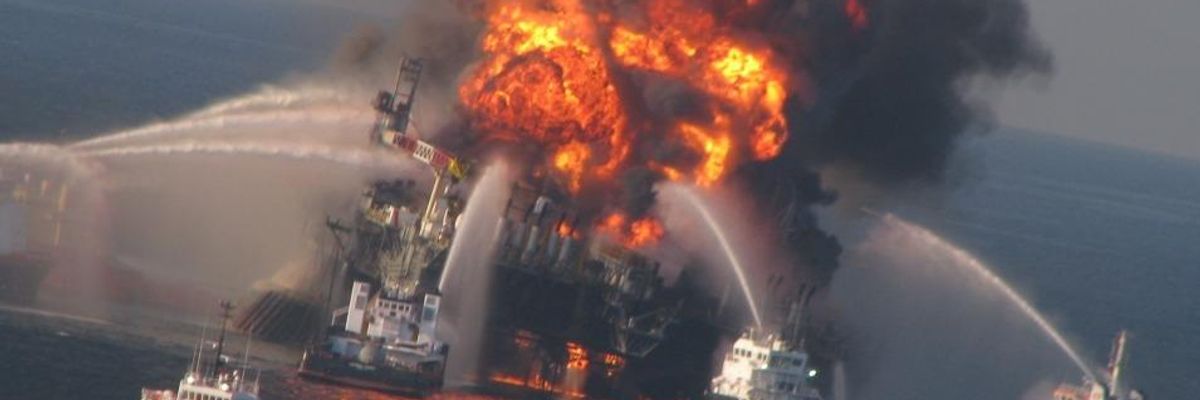
"Instead of learning lessons from the BP disaster, President Trump is proposing to radically expand offshore drilling, while dismantling the few protections put in place as a result of the catastrophic blowout." (Photo: Courtesy of US Coast Guard)
Nearly 10 years after the BP Deepwater Horizon oil catastrophe began in the Gulf of Mexico, a leading ocean conservation group warned Tuesday that the threat of another similar disaster looms large and that the fossil fuel industry and U.S. government have learned practically nothing from the world's worst ever such disaster.
Oceana's new publication--titled "Hindsight 2020: Lessons We Cannot Ignore from the BP Disaster"--provides a broad look at what led up to the "preventable tragedy," the ongoing ecological and economic consequences of the disaster, and how the spill failed to act as a wake-up call on the inherent dangers of offshore drilling.
"Offshore drilling is still as dirty and dangerous as it was 10 years ago," said Diane Hoskins, Oceana campaign director. "If anything, another disaster is more likely today as the oil industry drills deeper and farther offshore. Instead of learning lessons from the BP disaster, President Trump is proposing to radically expand offshore drilling, while dismantling the few protections put in place as a result of the catastrophic blowout."
By pulling together information from a number of sources--including government documents, scientific studies, and interviews with Gulf Coast residents and policy experts--the report conveys a chilling reality: It's not a question of another offshore oil spill happening, but simply when.
"What we found was disturbing," says the report.
While the date of the disaster--April 20, 2010--is well in the rear view mirror, the consequences are not.
"Nobody was ready for this scale of pollution," Nova Southeastern University Professor Tracey Sutton told Oceana. "As far as we know, the actual impact of the spill is not over yet."
Among the impacts that are known are that as many as 800,000 birds died in the midst of and following the disaster. The oil gushing from the ocean floor also devastated bottlednose dolphins--over 75% of all dolphin pregnancies failed in the oiled area. The spill also ravaged frontline communities.
"They failed our people," Clarice Friloux, who worked as outreach coordinator for the United Houma Nation during the spill recovery, told Oceana. "At one point, I remember thinking, 'Wow, this could kill off a whole generation of Native Americans living off the coast of Louisiana.'"
Contributing to the threat of another Deepwater Horizon-like spill is that the fossil fuel industry has pushed for riskier drilling--further out and in deeper waters. Yet safety measures matching hose riskier moves have not been rolled out.
The Trump administration, meanwhile, has done nothing to dampen the industry's appetite for more drilling.
Instead of strengthening safety regulations, the industry and the Trump administration are dismantling the few protections put in place after the BP catastrophe. Without effective oversight and a more robust safety culture, another disaster at the level of Deepwater Horizon may be just as likely today as it was 10 years ago.
The report also points to weak approach taken by the Bureau of Safety and Environmental Enforcement (BSEE)--a panel tasked with oversight of offshore drilling safety and was created in the year after Deepwater Horizon.
"The only significant thing that happened was that BSEE did issue a regulation around blowout preventer devices," Cyn Sarthou, executive director of the New Orleans-based environmental policy organization Healthy Gulf, says in the report. "Under the new administration, they have rolled that back. Even that one regulation, which was very little ... has now been rolled back."
Simply put, the report states, "A decade later, the safety culture has not improved, and oversight of the industry remains deficient."
Oceana's report also points to Trump's move to greatly expand offshore drilling which further paved the path for another diaster. To prevent a similar tragedy, the new report outlines a number of recommendations and called on Congress and the White House to:
"When they drill, they spill," said Hoskins. "The BP disaster devastated the Gulf, and we cannot afford to repeat it. Protecting our environment has never been more important than it is today."
Dear Common Dreams reader, It’s been nearly 30 years since I co-founded Common Dreams with my late wife, Lina Newhouser. We had the radical notion that journalism should serve the public good, not corporate profits. It was clear to us from the outset what it would take to build such a project. No paid advertisements. No corporate sponsors. No millionaire publisher telling us what to think or do. Many people said we wouldn't last a year, but we proved those doubters wrong. Together with a tremendous team of journalists and dedicated staff, we built an independent media outlet free from the constraints of profits and corporate control. Our mission has always been simple: To inform. To inspire. To ignite change for the common good. Building Common Dreams was not easy. Our survival was never guaranteed. When you take on the most powerful forces—Wall Street greed, fossil fuel industry destruction, Big Tech lobbyists, and uber-rich oligarchs who have spent billions upon billions rigging the economy and democracy in their favor—the only bulwark you have is supporters who believe in your work. But here’s the urgent message from me today. It's never been this bad out there. And it's never been this hard to keep us going. At the very moment Common Dreams is most needed, the threats we face are intensifying. We need your support now more than ever. We don't accept corporate advertising and never will. We don't have a paywall because we don't think people should be blocked from critical news based on their ability to pay. Everything we do is funded by the donations of readers like you. When everyone does the little they can afford, we are strong. But if that support retreats or dries up, so do we. Will you donate now to make sure Common Dreams not only survives but thrives? —Craig Brown, Co-founder |
Nearly 10 years after the BP Deepwater Horizon oil catastrophe began in the Gulf of Mexico, a leading ocean conservation group warned Tuesday that the threat of another similar disaster looms large and that the fossil fuel industry and U.S. government have learned practically nothing from the world's worst ever such disaster.
Oceana's new publication--titled "Hindsight 2020: Lessons We Cannot Ignore from the BP Disaster"--provides a broad look at what led up to the "preventable tragedy," the ongoing ecological and economic consequences of the disaster, and how the spill failed to act as a wake-up call on the inherent dangers of offshore drilling.
"Offshore drilling is still as dirty and dangerous as it was 10 years ago," said Diane Hoskins, Oceana campaign director. "If anything, another disaster is more likely today as the oil industry drills deeper and farther offshore. Instead of learning lessons from the BP disaster, President Trump is proposing to radically expand offshore drilling, while dismantling the few protections put in place as a result of the catastrophic blowout."
By pulling together information from a number of sources--including government documents, scientific studies, and interviews with Gulf Coast residents and policy experts--the report conveys a chilling reality: It's not a question of another offshore oil spill happening, but simply when.
"What we found was disturbing," says the report.
While the date of the disaster--April 20, 2010--is well in the rear view mirror, the consequences are not.
"Nobody was ready for this scale of pollution," Nova Southeastern University Professor Tracey Sutton told Oceana. "As far as we know, the actual impact of the spill is not over yet."
Among the impacts that are known are that as many as 800,000 birds died in the midst of and following the disaster. The oil gushing from the ocean floor also devastated bottlednose dolphins--over 75% of all dolphin pregnancies failed in the oiled area. The spill also ravaged frontline communities.
"They failed our people," Clarice Friloux, who worked as outreach coordinator for the United Houma Nation during the spill recovery, told Oceana. "At one point, I remember thinking, 'Wow, this could kill off a whole generation of Native Americans living off the coast of Louisiana.'"
Contributing to the threat of another Deepwater Horizon-like spill is that the fossil fuel industry has pushed for riskier drilling--further out and in deeper waters. Yet safety measures matching hose riskier moves have not been rolled out.
The Trump administration, meanwhile, has done nothing to dampen the industry's appetite for more drilling.
Instead of strengthening safety regulations, the industry and the Trump administration are dismantling the few protections put in place after the BP catastrophe. Without effective oversight and a more robust safety culture, another disaster at the level of Deepwater Horizon may be just as likely today as it was 10 years ago.
The report also points to weak approach taken by the Bureau of Safety and Environmental Enforcement (BSEE)--a panel tasked with oversight of offshore drilling safety and was created in the year after Deepwater Horizon.
"The only significant thing that happened was that BSEE did issue a regulation around blowout preventer devices," Cyn Sarthou, executive director of the New Orleans-based environmental policy organization Healthy Gulf, says in the report. "Under the new administration, they have rolled that back. Even that one regulation, which was very little ... has now been rolled back."
Simply put, the report states, "A decade later, the safety culture has not improved, and oversight of the industry remains deficient."
Oceana's report also points to Trump's move to greatly expand offshore drilling which further paved the path for another diaster. To prevent a similar tragedy, the new report outlines a number of recommendations and called on Congress and the White House to:
"When they drill, they spill," said Hoskins. "The BP disaster devastated the Gulf, and we cannot afford to repeat it. Protecting our environment has never been more important than it is today."
Nearly 10 years after the BP Deepwater Horizon oil catastrophe began in the Gulf of Mexico, a leading ocean conservation group warned Tuesday that the threat of another similar disaster looms large and that the fossil fuel industry and U.S. government have learned practically nothing from the world's worst ever such disaster.
Oceana's new publication--titled "Hindsight 2020: Lessons We Cannot Ignore from the BP Disaster"--provides a broad look at what led up to the "preventable tragedy," the ongoing ecological and economic consequences of the disaster, and how the spill failed to act as a wake-up call on the inherent dangers of offshore drilling.
"Offshore drilling is still as dirty and dangerous as it was 10 years ago," said Diane Hoskins, Oceana campaign director. "If anything, another disaster is more likely today as the oil industry drills deeper and farther offshore. Instead of learning lessons from the BP disaster, President Trump is proposing to radically expand offshore drilling, while dismantling the few protections put in place as a result of the catastrophic blowout."
By pulling together information from a number of sources--including government documents, scientific studies, and interviews with Gulf Coast residents and policy experts--the report conveys a chilling reality: It's not a question of another offshore oil spill happening, but simply when.
"What we found was disturbing," says the report.
While the date of the disaster--April 20, 2010--is well in the rear view mirror, the consequences are not.
"Nobody was ready for this scale of pollution," Nova Southeastern University Professor Tracey Sutton told Oceana. "As far as we know, the actual impact of the spill is not over yet."
Among the impacts that are known are that as many as 800,000 birds died in the midst of and following the disaster. The oil gushing from the ocean floor also devastated bottlednose dolphins--over 75% of all dolphin pregnancies failed in the oiled area. The spill also ravaged frontline communities.
"They failed our people," Clarice Friloux, who worked as outreach coordinator for the United Houma Nation during the spill recovery, told Oceana. "At one point, I remember thinking, 'Wow, this could kill off a whole generation of Native Americans living off the coast of Louisiana.'"
Contributing to the threat of another Deepwater Horizon-like spill is that the fossil fuel industry has pushed for riskier drilling--further out and in deeper waters. Yet safety measures matching hose riskier moves have not been rolled out.
The Trump administration, meanwhile, has done nothing to dampen the industry's appetite for more drilling.
Instead of strengthening safety regulations, the industry and the Trump administration are dismantling the few protections put in place after the BP catastrophe. Without effective oversight and a more robust safety culture, another disaster at the level of Deepwater Horizon may be just as likely today as it was 10 years ago.
The report also points to weak approach taken by the Bureau of Safety and Environmental Enforcement (BSEE)--a panel tasked with oversight of offshore drilling safety and was created in the year after Deepwater Horizon.
"The only significant thing that happened was that BSEE did issue a regulation around blowout preventer devices," Cyn Sarthou, executive director of the New Orleans-based environmental policy organization Healthy Gulf, says in the report. "Under the new administration, they have rolled that back. Even that one regulation, which was very little ... has now been rolled back."
Simply put, the report states, "A decade later, the safety culture has not improved, and oversight of the industry remains deficient."
Oceana's report also points to Trump's move to greatly expand offshore drilling which further paved the path for another diaster. To prevent a similar tragedy, the new report outlines a number of recommendations and called on Congress and the White House to:
"When they drill, they spill," said Hoskins. "The BP disaster devastated the Gulf, and we cannot afford to repeat it. Protecting our environment has never been more important than it is today."