
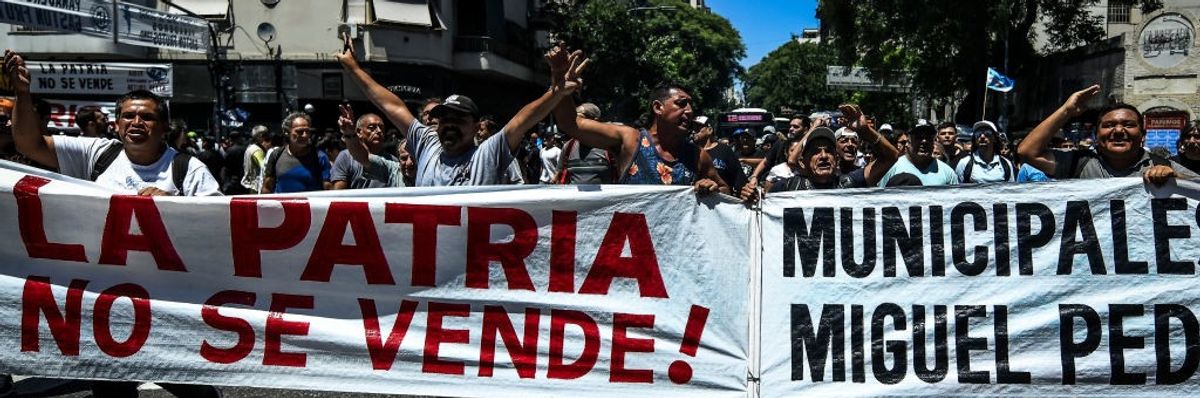
Protesters hold a banner reading, "The homeland is not for sale" during a January 24, 2024 general strike against the government of Argentine President Javier Milei in Buenos Aires.
Argentine Unions Lead General Strike Against Milei's Neoliberal Blitz
"In 40 years of democracy, there has never been such a frontal attack on the labor sector," said one union leader.
Many thousands of Argentine workers walked off their jobs and took to the streets Wednesday in a general strike led by the nation's largest labor unions against far-right President Javier Milei's all-out assault on worker rights, vital social programs, and the right to protest.
The opposition-aligned Confederación General del Trabajo (CGT), an umbrella labor group boasting about 7 million members, led the general strike against Milei, a 53-year-old self-described "anarcho-capitalist" who took office last month following his decisive victory in November's presidential runoff.
Marching under the slogan, "Our Homeland Is Not For Sale," the CGT-led demonstrators filled streets in the capital Buenos Aires and smaller cities around the South American country of nearly 46 million inhabitants.
"We called a march on [January] 24 to defend labor rights, severance pay, collective bargaining agreements, social security, and the right to protest, all of which have been attacked by the DNU," CGT explained on social media, referring to Milei's December 20 Decree of Necessity and Urgency.
CGT leader Pablo Moyano said Wednesday in Buenos Aires that "every time a [neoliberal] model wins, the first thing they target is the workers."
Martín Lucero, head of the private teachers' union in Rosario, Argentina's third-largest city, told La Capital that "in 40 years of democracy there has never been such a frontal attack on the labor sector" as there has been under Milei.
Estela De Carlotto, who leads the activist group Abuelas de Plaza de Mayo—founded by grandmothers searching for children kidnapped under Argentina's U.S.-backed 1976-83 military dictatorship, which Milei has praised—told Buenos Aires Times that the demonstration "is a way of giving support to this resolution from the people to form a protest and a call of attention for this whole situation we are living with this strange government."
Milei—who said he gets political advice from his dogs—has unleashed what critics have called "a textbook case of shock therapy" on the Argentine people and the country's moribund economy, devaluing the peso by 50%, slashing social spending, reducing government subsidies, and opening the nation to foreign capitalist exploitation.
According to Juan Cruz Ferre, a postdoctoral fellow at the Program in Latin American Studies at New Jersey's Princeton University:
The economic plan was followed by an all-encompassing presidential decree issued on December 20, affecting issues as diverse as labor law, healthcare, foreign trade, private property, and mining. The general thrust of it is very clear: an attack on workers' rights, the liberalization of the economy, the strengthening of big business through market deregulation and numerous incentives, and the erosion of protections for tenants, the environment, and small businesses.
Although courts have suspended parts of Milei's decree in response to legal challenges, Cruz Ferre explained, "attention has now shifted to a mirror bill presented to Congress, which includes all issues contained in the decree, plus a request of extraordinary powers to the executive for a period of four years."
Speaking at the World Economic Forum in Davos, Switzerland last week, Milei
hailed the corporate executives and wealthy global elites gathered there as "heroes" and "creators of the most extraordinary period of prosperity we've ever seen."
From November to December, prices in Argentina increased by more than one quarter, compared with just under 13% the previous month. Annual inflation now stands at 211%, with Argentina rivaling Lebanon for the dubious global top spot.
"In this government of Milei, all the food halls of all the social organizations, of the churches, have not received food [from the government]," one Buenos Aires protester said during Wednesday's march.
"There is no food; they told us that there is no money," the demonstrator added, even as the government adopts "measures in favor of the wealthy sector."
The CGT on Wednesday published a statement "in defense of the civil, social, and labor rights of our nation."
"Today we see how the government seeks to break the social contract through policies and reforms that only seek to subjugate the rights and achievements of the Argentine people," the statement asserted. "We reaffirm our conviction about the importance of social dialogue as the only tool to grow with equity, and that allows us to develop a 'sustainable strategy to achieve development, production, and decent work, with social justice.'"
Argentine Security Minister Patricia Bullrich
dismissed the strike as the work of "mafia unionists, poverty managers, complicit judges, and corrupt politicians, all defending their privileges, resisting the change that society decided democratically and that the president leads with determination."
From Brazil to Belgium, unions throughout the Americas and Europe staged solidarity rallies with Argentine workers.
"The [Argentine] government adopted a perverse combination of radical political authoritarianism with dictatorial tendencies and ultraliberal policies that mostly undermine workers," Unified Workers' Central, Brazil's largest trade union, said in a statement.
Myriam Bregman, a Socialist Workers' Party member of the Chamber of Deputies, the lower house of Argentina's National Congress, said in a Wednesday interview with Left Voice that "international solidarity is key to defeating Milei's attacks on the working class in Argentina."
"Milei, as he made clear at the annual meeting of the World Economic Forum, is a friend to the superrich, whom he treats as heroes," she added. "It is in the interests of the international working class that we prevent the government from moving forward with its anti-worker policies."
Cruz Ferre wrote that "the current [Argentine] government has declared war on workers, women, human rights activists, the environment, and more. The goal is clear: to make tabula rasa of all past gains and concessions to the working class, and reset the conditions for profits through the unrestrained exploitation of labor."
"A determined, organized, and massive resistance will be necessary to preserve the rights that are today under attack," he added. "The outcome of these battles will have implications for many years to come."
An Urgent Message From Our Co-Founder
Dear Common Dreams reader, It’s been nearly 30 years since I co-founded Common Dreams with my late wife, Lina Newhouser. We had the radical notion that journalism should serve the public good, not corporate profits. It was clear to us from the outset what it would take to build such a project. No paid advertisements. No corporate sponsors. No millionaire publisher telling us what to think or do. Many people said we wouldn't last a year, but we proved those doubters wrong. Together with a tremendous team of journalists and dedicated staff, we built an independent media outlet free from the constraints of profits and corporate control. Our mission has always been simple: To inform. To inspire. To ignite change for the common good. Building Common Dreams was not easy. Our survival was never guaranteed. When you take on the most powerful forces—Wall Street greed, fossil fuel industry destruction, Big Tech lobbyists, and uber-rich oligarchs who have spent billions upon billions rigging the economy and democracy in their favor—the only bulwark you have is supporters who believe in your work. But here’s the urgent message from me today. It's never been this bad out there. And it's never been this hard to keep us going. At the very moment Common Dreams is most needed, the threats we face are intensifying. We need your support now more than ever. We don't accept corporate advertising and never will. We don't have a paywall because we don't think people should be blocked from critical news based on their ability to pay. Everything we do is funded by the donations of readers like you. When everyone does the little they can afford, we are strong. But if that support retreats or dries up, so do we. Will you donate now to make sure Common Dreams not only survives but thrives? —Craig Brown, Co-founder |
Many thousands of Argentine workers walked off their jobs and took to the streets Wednesday in a general strike led by the nation's largest labor unions against far-right President Javier Milei's all-out assault on worker rights, vital social programs, and the right to protest.
The opposition-aligned Confederación General del Trabajo (CGT), an umbrella labor group boasting about 7 million members, led the general strike against Milei, a 53-year-old self-described "anarcho-capitalist" who took office last month following his decisive victory in November's presidential runoff.
Marching under the slogan, "Our Homeland Is Not For Sale," the CGT-led demonstrators filled streets in the capital Buenos Aires and smaller cities around the South American country of nearly 46 million inhabitants.
"We called a march on [January] 24 to defend labor rights, severance pay, collective bargaining agreements, social security, and the right to protest, all of which have been attacked by the DNU," CGT explained on social media, referring to Milei's December 20 Decree of Necessity and Urgency.
CGT leader Pablo Moyano said Wednesday in Buenos Aires that "every time a [neoliberal] model wins, the first thing they target is the workers."
Martín Lucero, head of the private teachers' union in Rosario, Argentina's third-largest city, told La Capital that "in 40 years of democracy there has never been such a frontal attack on the labor sector" as there has been under Milei.
Estela De Carlotto, who leads the activist group Abuelas de Plaza de Mayo—founded by grandmothers searching for children kidnapped under Argentina's U.S.-backed 1976-83 military dictatorship, which Milei has praised—told Buenos Aires Times that the demonstration "is a way of giving support to this resolution from the people to form a protest and a call of attention for this whole situation we are living with this strange government."
Milei—who said he gets political advice from his dogs—has unleashed what critics have called "a textbook case of shock therapy" on the Argentine people and the country's moribund economy, devaluing the peso by 50%, slashing social spending, reducing government subsidies, and opening the nation to foreign capitalist exploitation.
According to Juan Cruz Ferre, a postdoctoral fellow at the Program in Latin American Studies at New Jersey's Princeton University:
The economic plan was followed by an all-encompassing presidential decree issued on December 20, affecting issues as diverse as labor law, healthcare, foreign trade, private property, and mining. The general thrust of it is very clear: an attack on workers' rights, the liberalization of the economy, the strengthening of big business through market deregulation and numerous incentives, and the erosion of protections for tenants, the environment, and small businesses.
Although courts have suspended parts of Milei's decree in response to legal challenges, Cruz Ferre explained, "attention has now shifted to a mirror bill presented to Congress, which includes all issues contained in the decree, plus a request of extraordinary powers to the executive for a period of four years."
Speaking at the World Economic Forum in Davos, Switzerland last week, Milei
hailed the corporate executives and wealthy global elites gathered there as "heroes" and "creators of the most extraordinary period of prosperity we've ever seen."
From November to December, prices in Argentina increased by more than one quarter, compared with just under 13% the previous month. Annual inflation now stands at 211%, with Argentina rivaling Lebanon for the dubious global top spot.
"In this government of Milei, all the food halls of all the social organizations, of the churches, have not received food [from the government]," one Buenos Aires protester said during Wednesday's march.
"There is no food; they told us that there is no money," the demonstrator added, even as the government adopts "measures in favor of the wealthy sector."
The CGT on Wednesday published a statement "in defense of the civil, social, and labor rights of our nation."
"Today we see how the government seeks to break the social contract through policies and reforms that only seek to subjugate the rights and achievements of the Argentine people," the statement asserted. "We reaffirm our conviction about the importance of social dialogue as the only tool to grow with equity, and that allows us to develop a 'sustainable strategy to achieve development, production, and decent work, with social justice.'"
Argentine Security Minister Patricia Bullrich
dismissed the strike as the work of "mafia unionists, poverty managers, complicit judges, and corrupt politicians, all defending their privileges, resisting the change that society decided democratically and that the president leads with determination."
From Brazil to Belgium, unions throughout the Americas and Europe staged solidarity rallies with Argentine workers.
"The [Argentine] government adopted a perverse combination of radical political authoritarianism with dictatorial tendencies and ultraliberal policies that mostly undermine workers," Unified Workers' Central, Brazil's largest trade union, said in a statement.
Myriam Bregman, a Socialist Workers' Party member of the Chamber of Deputies, the lower house of Argentina's National Congress, said in a Wednesday interview with Left Voice that "international solidarity is key to defeating Milei's attacks on the working class in Argentina."
"Milei, as he made clear at the annual meeting of the World Economic Forum, is a friend to the superrich, whom he treats as heroes," she added. "It is in the interests of the international working class that we prevent the government from moving forward with its anti-worker policies."
Cruz Ferre wrote that "the current [Argentine] government has declared war on workers, women, human rights activists, the environment, and more. The goal is clear: to make tabula rasa of all past gains and concessions to the working class, and reset the conditions for profits through the unrestrained exploitation of labor."
"A determined, organized, and massive resistance will be necessary to preserve the rights that are today under attack," he added. "The outcome of these battles will have implications for many years to come."
- Milei Couples 'Total Crackdown' on Protest With Economic Shocks in Argentina ›
- Argentinians Defy Milei's Crackdown With Mass Protests Against Austerity ›
- Unions Lead Protests Against Milei's Anti-Worker Decree in Argentina ›
- Opinion | What Argentina’s Workers Can Teach the World About Resisting the Far Right | Common Dreams ›
- 'Argentina Stopped': Unions Hold Second General Strike Over Milei Austerity | Common Dreams ›
- AFT Signs On to UAW's Push for 2028 General Strike | Common Dreams ›
- Argentina General Strike Demands End to Milei's 'Chainsaw' Austerity Policies | Common Dreams ›
- Trump Admin Responds to Milei’s Failed Libertarian Policies With a US Taxpayer Bailout for Argentina | Common Dreams ›
Many thousands of Argentine workers walked off their jobs and took to the streets Wednesday in a general strike led by the nation's largest labor unions against far-right President Javier Milei's all-out assault on worker rights, vital social programs, and the right to protest.
The opposition-aligned Confederación General del Trabajo (CGT), an umbrella labor group boasting about 7 million members, led the general strike against Milei, a 53-year-old self-described "anarcho-capitalist" who took office last month following his decisive victory in November's presidential runoff.
Marching under the slogan, "Our Homeland Is Not For Sale," the CGT-led demonstrators filled streets in the capital Buenos Aires and smaller cities around the South American country of nearly 46 million inhabitants.
"We called a march on [January] 24 to defend labor rights, severance pay, collective bargaining agreements, social security, and the right to protest, all of which have been attacked by the DNU," CGT explained on social media, referring to Milei's December 20 Decree of Necessity and Urgency.
CGT leader Pablo Moyano said Wednesday in Buenos Aires that "every time a [neoliberal] model wins, the first thing they target is the workers."
Martín Lucero, head of the private teachers' union in Rosario, Argentina's third-largest city, told La Capital that "in 40 years of democracy there has never been such a frontal attack on the labor sector" as there has been under Milei.
Estela De Carlotto, who leads the activist group Abuelas de Plaza de Mayo—founded by grandmothers searching for children kidnapped under Argentina's U.S.-backed 1976-83 military dictatorship, which Milei has praised—told Buenos Aires Times that the demonstration "is a way of giving support to this resolution from the people to form a protest and a call of attention for this whole situation we are living with this strange government."
Milei—who said he gets political advice from his dogs—has unleashed what critics have called "a textbook case of shock therapy" on the Argentine people and the country's moribund economy, devaluing the peso by 50%, slashing social spending, reducing government subsidies, and opening the nation to foreign capitalist exploitation.
According to Juan Cruz Ferre, a postdoctoral fellow at the Program in Latin American Studies at New Jersey's Princeton University:
The economic plan was followed by an all-encompassing presidential decree issued on December 20, affecting issues as diverse as labor law, healthcare, foreign trade, private property, and mining. The general thrust of it is very clear: an attack on workers' rights, the liberalization of the economy, the strengthening of big business through market deregulation and numerous incentives, and the erosion of protections for tenants, the environment, and small businesses.
Although courts have suspended parts of Milei's decree in response to legal challenges, Cruz Ferre explained, "attention has now shifted to a mirror bill presented to Congress, which includes all issues contained in the decree, plus a request of extraordinary powers to the executive for a period of four years."
Speaking at the World Economic Forum in Davos, Switzerland last week, Milei
hailed the corporate executives and wealthy global elites gathered there as "heroes" and "creators of the most extraordinary period of prosperity we've ever seen."
From November to December, prices in Argentina increased by more than one quarter, compared with just under 13% the previous month. Annual inflation now stands at 211%, with Argentina rivaling Lebanon for the dubious global top spot.
"In this government of Milei, all the food halls of all the social organizations, of the churches, have not received food [from the government]," one Buenos Aires protester said during Wednesday's march.
"There is no food; they told us that there is no money," the demonstrator added, even as the government adopts "measures in favor of the wealthy sector."
The CGT on Wednesday published a statement "in defense of the civil, social, and labor rights of our nation."
"Today we see how the government seeks to break the social contract through policies and reforms that only seek to subjugate the rights and achievements of the Argentine people," the statement asserted. "We reaffirm our conviction about the importance of social dialogue as the only tool to grow with equity, and that allows us to develop a 'sustainable strategy to achieve development, production, and decent work, with social justice.'"
Argentine Security Minister Patricia Bullrich
dismissed the strike as the work of "mafia unionists, poverty managers, complicit judges, and corrupt politicians, all defending their privileges, resisting the change that society decided democratically and that the president leads with determination."
From Brazil to Belgium, unions throughout the Americas and Europe staged solidarity rallies with Argentine workers.
"The [Argentine] government adopted a perverse combination of radical political authoritarianism with dictatorial tendencies and ultraliberal policies that mostly undermine workers," Unified Workers' Central, Brazil's largest trade union, said in a statement.
Myriam Bregman, a Socialist Workers' Party member of the Chamber of Deputies, the lower house of Argentina's National Congress, said in a Wednesday interview with Left Voice that "international solidarity is key to defeating Milei's attacks on the working class in Argentina."
"Milei, as he made clear at the annual meeting of the World Economic Forum, is a friend to the superrich, whom he treats as heroes," she added. "It is in the interests of the international working class that we prevent the government from moving forward with its anti-worker policies."
Cruz Ferre wrote that "the current [Argentine] government has declared war on workers, women, human rights activists, the environment, and more. The goal is clear: to make tabula rasa of all past gains and concessions to the working class, and reset the conditions for profits through the unrestrained exploitation of labor."
"A determined, organized, and massive resistance will be necessary to preserve the rights that are today under attack," he added. "The outcome of these battles will have implications for many years to come."
- Milei Couples 'Total Crackdown' on Protest With Economic Shocks in Argentina ›
- Argentinians Defy Milei's Crackdown With Mass Protests Against Austerity ›
- Unions Lead Protests Against Milei's Anti-Worker Decree in Argentina ›
- Opinion | What Argentina’s Workers Can Teach the World About Resisting the Far Right | Common Dreams ›
- 'Argentina Stopped': Unions Hold Second General Strike Over Milei Austerity | Common Dreams ›
- AFT Signs On to UAW's Push for 2028 General Strike | Common Dreams ›
- Argentina General Strike Demands End to Milei's 'Chainsaw' Austerity Policies | Common Dreams ›
- Trump Admin Responds to Milei’s Failed Libertarian Policies With a US Taxpayer Bailout for Argentina | Common Dreams ›