SUBSCRIBE TO OUR FREE NEWSLETTER
Daily news & progressive opinion—funded by the people, not the corporations—delivered straight to your inbox.
5
#000000
#FFFFFF
To donate by check, phone, or other method, see our More Ways to Give page.
Daily news & progressive opinion—funded by the people, not the corporations—delivered straight to your inbox.
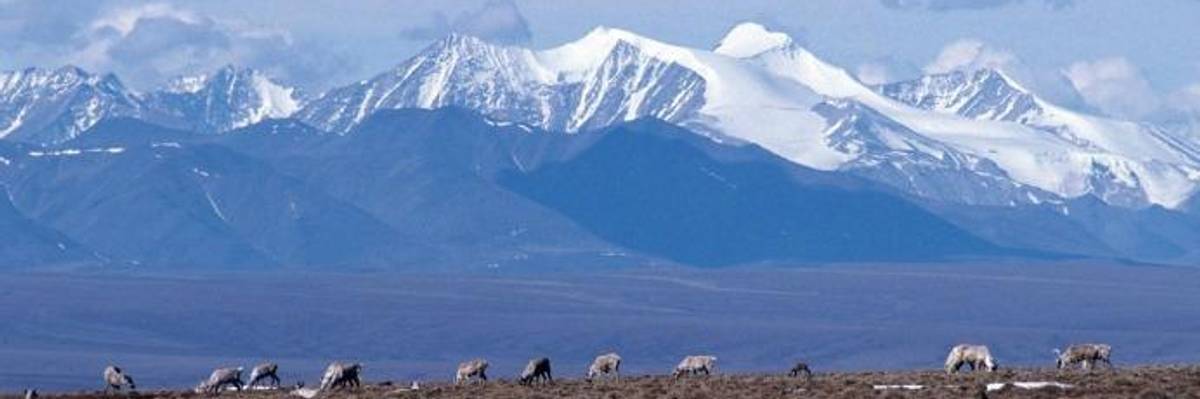
Caribou graze on the coastal plain of the Arctic National Wildlife Refuge, with the Brooks Range as a backdrop. (Photo: USFWS)
Indigenous leaders vowed Thursday to protect their Alaskan lands from fossil fuel exploitation after the Trump administration moved closer to allowing drilling along the coastal plain of the Arctic National Wildlife Refuge--a move the House just tried to block.
"The Gwich'in are protectors," said Bernadette Demientieff, executive director of the Gwich'in Steering Committee, "and we will not give up."
The pledge from the Gwich'in--who call the coastal plain "the sacred place where life begins"--came in response to the Final Environmental Impact Statement (FEIS) for oil and gas leasing, which was released Thursday by the Bureau of Land Management.
The announcement, said Interior Secretary David Bernhardt in a press statement, represents "a big step to carry out the clear mandate we received from Congress to develop and implement a leasing program for the coastal plain," referring to Sen. Lisa Murkowski's (R-Alaska) provision in the "tax scam" of 2017 requiring the sales for drilling rights in the area. Bernhardt is a former fossil fuel lobbyist.
In the new analysis, the administration, as The Washington Post reported, chose "the most aggressive development option for an area long closed to drilling."
"The FEIS unlawfully opens the entire coastal plain to leasing," wrote NRDC staff attorney Garett Rose. "It fails to even consider an approach that minimizes damage to the refuge's unique environment, violating our bedrock environmental review law."
But that choice came to "no one's surprise," according to Adam Kolton, executive director of Alaska Wilderness League, who said the Trump administration was "not even pretending that this is about restraint or meaningful protection."
"With an eye on developing the entirety of the fragile coastal plain," Kolton continued, "the administration has been riding roughshod over science, silencing dissent, and shutting out entire Indigenous communities."
Demientieff, whose community has highlighted the potential catastrophe the exploitation could unleash on the calving and nursery grounds for the Porcupine caribou herd, also criticized the FEIS for disrespecting "the Gwich'in Nation and all people in the Arctic and world who suffer the impacts of climate change and nonstop exploitation, while formally scratching the backs of those who seek to desecrate land and dishonor human rights to fill their pockets."
The FEIS, as The Hill noted, is "one of the final steps before leases can be sold," as bidding may begin after 30 days.
The timing of the release of the environmental impact statement also raised the eyebrows of Kolton, who noted that it came "literally hours" after the Democratic-controlled House voted 225-193 to block the mandate for the ANWR drilling.
Passage of that bill was welcomed by its author, by Rep. Jared Huffman (D-Calif.), who said the measure "reflects a very simple proposition: there are some places too wild, too important, too unique to be spoiled by oil and gas development."
Huffman praised lawmakers voting in favor of the measure for "protecting not just the beating biological heart of the largest wildlife refuge in the United States, but the Indigenous people who depend on this sacred, natural landscape."
The vote was also celebrated by Indigenous and environmental groups.
Alex Taurel, head of League of Conservation Voters' Conservation Program, called the vote "a resounding victory for the Gwich'in people, their sacred traditions, and the invaluable wildlife of the majestic Arctic National Wildlife Refuge."
"The majority of people in the U.S. oppose oil and gas drilling in the Arctic Refuge--we will continue to stand up against special interest big polluters as long as it takes," said Taurel, urging the Senate to follow suit.
Democartic senators including Ed Markey (Mass.) and Michael Bennet (Colo.) took to social media this week to ramp support for their legislation to block the ANWR drilling--though its fate is likely doomed in the Republican-controlled chamber.
Dear Common Dreams reader, It’s been nearly 30 years since I co-founded Common Dreams with my late wife, Lina Newhouser. We had the radical notion that journalism should serve the public good, not corporate profits. It was clear to us from the outset what it would take to build such a project. No paid advertisements. No corporate sponsors. No millionaire publisher telling us what to think or do. Many people said we wouldn't last a year, but we proved those doubters wrong. Together with a tremendous team of journalists and dedicated staff, we built an independent media outlet free from the constraints of profits and corporate control. Our mission has always been simple: To inform. To inspire. To ignite change for the common good. Building Common Dreams was not easy. Our survival was never guaranteed. When you take on the most powerful forces—Wall Street greed, fossil fuel industry destruction, Big Tech lobbyists, and uber-rich oligarchs who have spent billions upon billions rigging the economy and democracy in their favor—the only bulwark you have is supporters who believe in your work. But here’s the urgent message from me today. It's never been this bad out there. And it's never been this hard to keep us going. At the very moment Common Dreams is most needed, the threats we face are intensifying. We need your support now more than ever. We don't accept corporate advertising and never will. We don't have a paywall because we don't think people should be blocked from critical news based on their ability to pay. Everything we do is funded by the donations of readers like you. When everyone does the little they can afford, we are strong. But if that support retreats or dries up, so do we. Will you donate now to make sure Common Dreams not only survives but thrives? —Craig Brown, Co-founder |
Indigenous leaders vowed Thursday to protect their Alaskan lands from fossil fuel exploitation after the Trump administration moved closer to allowing drilling along the coastal plain of the Arctic National Wildlife Refuge--a move the House just tried to block.
"The Gwich'in are protectors," said Bernadette Demientieff, executive director of the Gwich'in Steering Committee, "and we will not give up."
The pledge from the Gwich'in--who call the coastal plain "the sacred place where life begins"--came in response to the Final Environmental Impact Statement (FEIS) for oil and gas leasing, which was released Thursday by the Bureau of Land Management.
The announcement, said Interior Secretary David Bernhardt in a press statement, represents "a big step to carry out the clear mandate we received from Congress to develop and implement a leasing program for the coastal plain," referring to Sen. Lisa Murkowski's (R-Alaska) provision in the "tax scam" of 2017 requiring the sales for drilling rights in the area. Bernhardt is a former fossil fuel lobbyist.
In the new analysis, the administration, as The Washington Post reported, chose "the most aggressive development option for an area long closed to drilling."
"The FEIS unlawfully opens the entire coastal plain to leasing," wrote NRDC staff attorney Garett Rose. "It fails to even consider an approach that minimizes damage to the refuge's unique environment, violating our bedrock environmental review law."
But that choice came to "no one's surprise," according to Adam Kolton, executive director of Alaska Wilderness League, who said the Trump administration was "not even pretending that this is about restraint or meaningful protection."
"With an eye on developing the entirety of the fragile coastal plain," Kolton continued, "the administration has been riding roughshod over science, silencing dissent, and shutting out entire Indigenous communities."
Demientieff, whose community has highlighted the potential catastrophe the exploitation could unleash on the calving and nursery grounds for the Porcupine caribou herd, also criticized the FEIS for disrespecting "the Gwich'in Nation and all people in the Arctic and world who suffer the impacts of climate change and nonstop exploitation, while formally scratching the backs of those who seek to desecrate land and dishonor human rights to fill their pockets."
The FEIS, as The Hill noted, is "one of the final steps before leases can be sold," as bidding may begin after 30 days.
The timing of the release of the environmental impact statement also raised the eyebrows of Kolton, who noted that it came "literally hours" after the Democratic-controlled House voted 225-193 to block the mandate for the ANWR drilling.
Passage of that bill was welcomed by its author, by Rep. Jared Huffman (D-Calif.), who said the measure "reflects a very simple proposition: there are some places too wild, too important, too unique to be spoiled by oil and gas development."
Huffman praised lawmakers voting in favor of the measure for "protecting not just the beating biological heart of the largest wildlife refuge in the United States, but the Indigenous people who depend on this sacred, natural landscape."
The vote was also celebrated by Indigenous and environmental groups.
Alex Taurel, head of League of Conservation Voters' Conservation Program, called the vote "a resounding victory for the Gwich'in people, their sacred traditions, and the invaluable wildlife of the majestic Arctic National Wildlife Refuge."
"The majority of people in the U.S. oppose oil and gas drilling in the Arctic Refuge--we will continue to stand up against special interest big polluters as long as it takes," said Taurel, urging the Senate to follow suit.
Democartic senators including Ed Markey (Mass.) and Michael Bennet (Colo.) took to social media this week to ramp support for their legislation to block the ANWR drilling--though its fate is likely doomed in the Republican-controlled chamber.
Indigenous leaders vowed Thursday to protect their Alaskan lands from fossil fuel exploitation after the Trump administration moved closer to allowing drilling along the coastal plain of the Arctic National Wildlife Refuge--a move the House just tried to block.
"The Gwich'in are protectors," said Bernadette Demientieff, executive director of the Gwich'in Steering Committee, "and we will not give up."
The pledge from the Gwich'in--who call the coastal plain "the sacred place where life begins"--came in response to the Final Environmental Impact Statement (FEIS) for oil and gas leasing, which was released Thursday by the Bureau of Land Management.
The announcement, said Interior Secretary David Bernhardt in a press statement, represents "a big step to carry out the clear mandate we received from Congress to develop and implement a leasing program for the coastal plain," referring to Sen. Lisa Murkowski's (R-Alaska) provision in the "tax scam" of 2017 requiring the sales for drilling rights in the area. Bernhardt is a former fossil fuel lobbyist.
In the new analysis, the administration, as The Washington Post reported, chose "the most aggressive development option for an area long closed to drilling."
"The FEIS unlawfully opens the entire coastal plain to leasing," wrote NRDC staff attorney Garett Rose. "It fails to even consider an approach that minimizes damage to the refuge's unique environment, violating our bedrock environmental review law."
But that choice came to "no one's surprise," according to Adam Kolton, executive director of Alaska Wilderness League, who said the Trump administration was "not even pretending that this is about restraint or meaningful protection."
"With an eye on developing the entirety of the fragile coastal plain," Kolton continued, "the administration has been riding roughshod over science, silencing dissent, and shutting out entire Indigenous communities."
Demientieff, whose community has highlighted the potential catastrophe the exploitation could unleash on the calving and nursery grounds for the Porcupine caribou herd, also criticized the FEIS for disrespecting "the Gwich'in Nation and all people in the Arctic and world who suffer the impacts of climate change and nonstop exploitation, while formally scratching the backs of those who seek to desecrate land and dishonor human rights to fill their pockets."
The FEIS, as The Hill noted, is "one of the final steps before leases can be sold," as bidding may begin after 30 days.
The timing of the release of the environmental impact statement also raised the eyebrows of Kolton, who noted that it came "literally hours" after the Democratic-controlled House voted 225-193 to block the mandate for the ANWR drilling.
Passage of that bill was welcomed by its author, by Rep. Jared Huffman (D-Calif.), who said the measure "reflects a very simple proposition: there are some places too wild, too important, too unique to be spoiled by oil and gas development."
Huffman praised lawmakers voting in favor of the measure for "protecting not just the beating biological heart of the largest wildlife refuge in the United States, but the Indigenous people who depend on this sacred, natural landscape."
The vote was also celebrated by Indigenous and environmental groups.
Alex Taurel, head of League of Conservation Voters' Conservation Program, called the vote "a resounding victory for the Gwich'in people, their sacred traditions, and the invaluable wildlife of the majestic Arctic National Wildlife Refuge."
"The majority of people in the U.S. oppose oil and gas drilling in the Arctic Refuge--we will continue to stand up against special interest big polluters as long as it takes," said Taurel, urging the Senate to follow suit.
Democartic senators including Ed Markey (Mass.) and Michael Bennet (Colo.) took to social media this week to ramp support for their legislation to block the ANWR drilling--though its fate is likely doomed in the Republican-controlled chamber.