SUBSCRIBE TO OUR FREE NEWSLETTER
Daily news & progressive opinion—funded by the people, not the corporations—delivered straight to your inbox.
5
#000000
#FFFFFF
To donate by check, phone, or other method, see our More Ways to Give page.
Daily news & progressive opinion—funded by the people, not the corporations—delivered straight to your inbox.
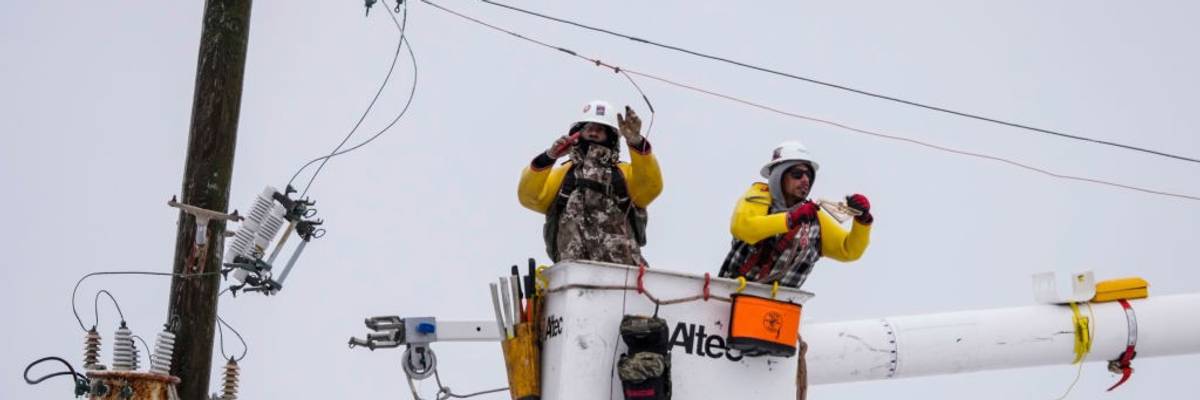
Electrical lineman work on power lines during an icy winter storm on Tuesday, Jan. 21, 2025 in Galveston.
Rising storm damage, opaque cost recovery, and inaccessible proceedings are making utility rate cases one of the defining economic justice battlegrounds of our time.
Across the US, electric utility customers are being asked to pay for the same storms twice. First, they pay the costs of the damage through rate increases and special adjustors that quietly appear on monthly bills. Then they pay again as infrastructure investment charges that utilities say will prevent the next storm from costing so much. The accounting for what happened with the money is rarely provided. When called to account, they are pointed to bureaucratic filing systems that require expert navigation to decode.
This is not a bug in the utility regulatory system. For utilities, it is a feature.
The evidence is hiding in plain sight. It’s available to everyone inside the regulatory dockets that govern what every household pays for electricity, but these documents are practically inaccessible. And inside them, a pattern is repeating across states, as utilities are collecting ratepayer money to manage storm risk, spending it in bad years, and then updating the recovery mechanism. Simultaneously, they request rate increases to fund infrastructure hardening they say will protect against future storms. The cycle repeats. The bills keep rising. The accounting stays buried.
In Vermont, Green Mountain Power (GMP) collected $6 million annually from customers beginning in fiscal year 2023 as a dedicated Major Storm Restoration Fund. It was established as a separate line item on customer bills to pre-fund major storm restoration costs. The mechanism made sense. Collect in the good years, draw down in the bad ones, smooth the bill impact of catastrophic weather events.
Politicians who want to talk about energy affordability need to understand regulatory proceedings. Saying utility bills are too high is easy. Doing something about it requires visible, deeper engagement.
Then came 2023, the worst storm year in GMP’s 11-year data record. The company incurred $53.6 million in total storm costs, including $45.2 million in major storm expense alone. And 2024 followed with $47 million in total storm costs. Two years of storms accounted for nearly half of all the storm damage GMP recorded over 11 years. The $6 million annual collection covered roughly 13 cents of every dollar in major storm damage incurred in those peak years.
By January 2026, GMP filed its FY2027 rate case, seeking a 7.5% increase, and disclosed that the storm fund would cease. The complete disclosure was one sentence. When Vermont’s ratepayer advocate formally asked GMP to provide a year-by-year table of fund collections and expenditures, GMP essentially declined. It pointed to quarterly filings spread across two separate regulatory dockets and told the regulator that the information was “already available.” No table or verification. They just pointed to a bureaucratic maze that most residential ratepayers would need weeks to navigate. The move suggests that utilities do not consider dockets a place where everyday people might need plain language guidance to understand what will affect their livelihoods.
In New York, a parallel story is unfolding in New York State Electric and Gas’ (NYSEG) service territory. The utility filed for a 35% increase in electric delivery revenues last June. The filing landed on top of a separate Recovery Charge that had already begun appearing on customer bills last February, tied to $710 million in bonds issued to cover nearly a decade of accumulated storm costs. Customers are being asked to pay for the storms twice: once to retire the debt and again to fund the hardening investments the company says will mitigate increasing recovery costs. An independent audit released the same month as the rate filing found that NYSEG had missed its enforceable reliability targets for six consecutive years. And customers are already funding multiple rounds of rate increases explicitly justified as investments in grid resilience.
The pattern is a business model.
Utility rate cases are decided in proceedings that look like courtrooms. There is testimony and cross-examination. Detailed exhibits are entered into the record. The parties with legal representation and expert witnesses are the parties with resources to sustain that kind of participation.
The people who are affected by the outcomes almost never appear in the case, because the barrier to participation is genuinely prohibitive. The dockets run to hundreds of thousands of pages. The filings reference prior proceedings going back years. Understanding what a utility is actually asking for requires the kind of institutional expertise that most people simply don’t have the time or resources to develop.
This is the accountability gap that utility regulation was designed to prevent and has done little in practice to close.
Rate increases of the magnitude being requested across the country are landing on kitchen tables at a moment when many households are already stretched. Utility affordability is not abstract for everyday people in 2026. It affects every household; disproportionately burdens lower-income families; and compounds with rising food costs, insurance premiums, and healthcare expenses.
Utilities are right that storms are worsening and are causing more expensive damage. But those facts do not resolve the question of who bears the cost, how the accounting is done, or whether the evidence supports what utilities are asking for.
Those questions are being answered right now, in regulatory dockets most people have never heard of.
Politicians who want to talk about energy affordability need to understand regulatory proceedings. Saying utility bills are too high is easy. Doing something about it requires visible, deeper engagement.
They need to demonstrate that they can find funding for ratepayer advocates to match utility resources. They need to push for plain-language disclosure requirements so that when a utility shifts storm funding tactics, the accounting isn’t buried.
The 2026 election cycle is the right moment to ensure utility ratemaking on storm cost recovery is transparent. Rate cases are decided in public proceedings. The decisions being made in those dockets right now will appear on customer bills beginning this fall, as voters head to the polls. Candidates who want to talk about affordability should be asked, specifically, what they intend to do about the system producing these bills. The playbook is in the docket. It’s time to open it.
Dear Common Dreams reader, It’s been nearly 30 years since I co-founded Common Dreams with my late wife, Lina Newhouser. We had the radical notion that journalism should serve the public good, not corporate profits. It was clear to us from the outset what it would take to build such a project. No paid advertisements. No corporate sponsors. No millionaire publisher telling us what to think or do. Many people said we wouldn't last a year, but we proved those doubters wrong. Together with a tremendous team of journalists and dedicated staff, we built an independent media outlet free from the constraints of profits and corporate control. Our mission has always been simple: To inform. To inspire. To ignite change for the common good. Building Common Dreams was not easy. Our survival was never guaranteed. When you take on the most powerful forces—Wall Street greed, fossil fuel industry destruction, Big Tech lobbyists, and uber-rich oligarchs who have spent billions upon billions rigging the economy and democracy in their favor—the only bulwark you have is supporters who believe in your work. But here’s the urgent message from me today. It's never been this bad out there. And it's never been this hard to keep us going. At the very moment Common Dreams is most needed, the threats we face are intensifying. We need your support now more than ever. We don't accept corporate advertising and never will. We don't have a paywall because we don't think people should be blocked from critical news based on their ability to pay. Everything we do is funded by the donations of readers like you. When everyone does the little they can afford, we are strong. But if that support retreats or dries up, so do we. Will you donate now to make sure Common Dreams not only survives but thrives? —Craig Brown, Co-founder |
Across the US, electric utility customers are being asked to pay for the same storms twice. First, they pay the costs of the damage through rate increases and special adjustors that quietly appear on monthly bills. Then they pay again as infrastructure investment charges that utilities say will prevent the next storm from costing so much. The accounting for what happened with the money is rarely provided. When called to account, they are pointed to bureaucratic filing systems that require expert navigation to decode.
This is not a bug in the utility regulatory system. For utilities, it is a feature.
The evidence is hiding in plain sight. It’s available to everyone inside the regulatory dockets that govern what every household pays for electricity, but these documents are practically inaccessible. And inside them, a pattern is repeating across states, as utilities are collecting ratepayer money to manage storm risk, spending it in bad years, and then updating the recovery mechanism. Simultaneously, they request rate increases to fund infrastructure hardening they say will protect against future storms. The cycle repeats. The bills keep rising. The accounting stays buried.
In Vermont, Green Mountain Power (GMP) collected $6 million annually from customers beginning in fiscal year 2023 as a dedicated Major Storm Restoration Fund. It was established as a separate line item on customer bills to pre-fund major storm restoration costs. The mechanism made sense. Collect in the good years, draw down in the bad ones, smooth the bill impact of catastrophic weather events.
Politicians who want to talk about energy affordability need to understand regulatory proceedings. Saying utility bills are too high is easy. Doing something about it requires visible, deeper engagement.
Then came 2023, the worst storm year in GMP’s 11-year data record. The company incurred $53.6 million in total storm costs, including $45.2 million in major storm expense alone. And 2024 followed with $47 million in total storm costs. Two years of storms accounted for nearly half of all the storm damage GMP recorded over 11 years. The $6 million annual collection covered roughly 13 cents of every dollar in major storm damage incurred in those peak years.
By January 2026, GMP filed its FY2027 rate case, seeking a 7.5% increase, and disclosed that the storm fund would cease. The complete disclosure was one sentence. When Vermont’s ratepayer advocate formally asked GMP to provide a year-by-year table of fund collections and expenditures, GMP essentially declined. It pointed to quarterly filings spread across two separate regulatory dockets and told the regulator that the information was “already available.” No table or verification. They just pointed to a bureaucratic maze that most residential ratepayers would need weeks to navigate. The move suggests that utilities do not consider dockets a place where everyday people might need plain language guidance to understand what will affect their livelihoods.
In New York, a parallel story is unfolding in New York State Electric and Gas’ (NYSEG) service territory. The utility filed for a 35% increase in electric delivery revenues last June. The filing landed on top of a separate Recovery Charge that had already begun appearing on customer bills last February, tied to $710 million in bonds issued to cover nearly a decade of accumulated storm costs. Customers are being asked to pay for the storms twice: once to retire the debt and again to fund the hardening investments the company says will mitigate increasing recovery costs. An independent audit released the same month as the rate filing found that NYSEG had missed its enforceable reliability targets for six consecutive years. And customers are already funding multiple rounds of rate increases explicitly justified as investments in grid resilience.
The pattern is a business model.
Utility rate cases are decided in proceedings that look like courtrooms. There is testimony and cross-examination. Detailed exhibits are entered into the record. The parties with legal representation and expert witnesses are the parties with resources to sustain that kind of participation.
The people who are affected by the outcomes almost never appear in the case, because the barrier to participation is genuinely prohibitive. The dockets run to hundreds of thousands of pages. The filings reference prior proceedings going back years. Understanding what a utility is actually asking for requires the kind of institutional expertise that most people simply don’t have the time or resources to develop.
This is the accountability gap that utility regulation was designed to prevent and has done little in practice to close.
Rate increases of the magnitude being requested across the country are landing on kitchen tables at a moment when many households are already stretched. Utility affordability is not abstract for everyday people in 2026. It affects every household; disproportionately burdens lower-income families; and compounds with rising food costs, insurance premiums, and healthcare expenses.
Utilities are right that storms are worsening and are causing more expensive damage. But those facts do not resolve the question of who bears the cost, how the accounting is done, or whether the evidence supports what utilities are asking for.
Those questions are being answered right now, in regulatory dockets most people have never heard of.
Politicians who want to talk about energy affordability need to understand regulatory proceedings. Saying utility bills are too high is easy. Doing something about it requires visible, deeper engagement.
They need to demonstrate that they can find funding for ratepayer advocates to match utility resources. They need to push for plain-language disclosure requirements so that when a utility shifts storm funding tactics, the accounting isn’t buried.
The 2026 election cycle is the right moment to ensure utility ratemaking on storm cost recovery is transparent. Rate cases are decided in public proceedings. The decisions being made in those dockets right now will appear on customer bills beginning this fall, as voters head to the polls. Candidates who want to talk about affordability should be asked, specifically, what they intend to do about the system producing these bills. The playbook is in the docket. It’s time to open it.
Across the US, electric utility customers are being asked to pay for the same storms twice. First, they pay the costs of the damage through rate increases and special adjustors that quietly appear on monthly bills. Then they pay again as infrastructure investment charges that utilities say will prevent the next storm from costing so much. The accounting for what happened with the money is rarely provided. When called to account, they are pointed to bureaucratic filing systems that require expert navigation to decode.
This is not a bug in the utility regulatory system. For utilities, it is a feature.
The evidence is hiding in plain sight. It’s available to everyone inside the regulatory dockets that govern what every household pays for electricity, but these documents are practically inaccessible. And inside them, a pattern is repeating across states, as utilities are collecting ratepayer money to manage storm risk, spending it in bad years, and then updating the recovery mechanism. Simultaneously, they request rate increases to fund infrastructure hardening they say will protect against future storms. The cycle repeats. The bills keep rising. The accounting stays buried.
In Vermont, Green Mountain Power (GMP) collected $6 million annually from customers beginning in fiscal year 2023 as a dedicated Major Storm Restoration Fund. It was established as a separate line item on customer bills to pre-fund major storm restoration costs. The mechanism made sense. Collect in the good years, draw down in the bad ones, smooth the bill impact of catastrophic weather events.
Politicians who want to talk about energy affordability need to understand regulatory proceedings. Saying utility bills are too high is easy. Doing something about it requires visible, deeper engagement.
Then came 2023, the worst storm year in GMP’s 11-year data record. The company incurred $53.6 million in total storm costs, including $45.2 million in major storm expense alone. And 2024 followed with $47 million in total storm costs. Two years of storms accounted for nearly half of all the storm damage GMP recorded over 11 years. The $6 million annual collection covered roughly 13 cents of every dollar in major storm damage incurred in those peak years.
By January 2026, GMP filed its FY2027 rate case, seeking a 7.5% increase, and disclosed that the storm fund would cease. The complete disclosure was one sentence. When Vermont’s ratepayer advocate formally asked GMP to provide a year-by-year table of fund collections and expenditures, GMP essentially declined. It pointed to quarterly filings spread across two separate regulatory dockets and told the regulator that the information was “already available.” No table or verification. They just pointed to a bureaucratic maze that most residential ratepayers would need weeks to navigate. The move suggests that utilities do not consider dockets a place where everyday people might need plain language guidance to understand what will affect their livelihoods.
In New York, a parallel story is unfolding in New York State Electric and Gas’ (NYSEG) service territory. The utility filed for a 35% increase in electric delivery revenues last June. The filing landed on top of a separate Recovery Charge that had already begun appearing on customer bills last February, tied to $710 million in bonds issued to cover nearly a decade of accumulated storm costs. Customers are being asked to pay for the storms twice: once to retire the debt and again to fund the hardening investments the company says will mitigate increasing recovery costs. An independent audit released the same month as the rate filing found that NYSEG had missed its enforceable reliability targets for six consecutive years. And customers are already funding multiple rounds of rate increases explicitly justified as investments in grid resilience.
The pattern is a business model.
Utility rate cases are decided in proceedings that look like courtrooms. There is testimony and cross-examination. Detailed exhibits are entered into the record. The parties with legal representation and expert witnesses are the parties with resources to sustain that kind of participation.
The people who are affected by the outcomes almost never appear in the case, because the barrier to participation is genuinely prohibitive. The dockets run to hundreds of thousands of pages. The filings reference prior proceedings going back years. Understanding what a utility is actually asking for requires the kind of institutional expertise that most people simply don’t have the time or resources to develop.
This is the accountability gap that utility regulation was designed to prevent and has done little in practice to close.
Rate increases of the magnitude being requested across the country are landing on kitchen tables at a moment when many households are already stretched. Utility affordability is not abstract for everyday people in 2026. It affects every household; disproportionately burdens lower-income families; and compounds with rising food costs, insurance premiums, and healthcare expenses.
Utilities are right that storms are worsening and are causing more expensive damage. But those facts do not resolve the question of who bears the cost, how the accounting is done, or whether the evidence supports what utilities are asking for.
Those questions are being answered right now, in regulatory dockets most people have never heard of.
Politicians who want to talk about energy affordability need to understand regulatory proceedings. Saying utility bills are too high is easy. Doing something about it requires visible, deeper engagement.
They need to demonstrate that they can find funding for ratepayer advocates to match utility resources. They need to push for plain-language disclosure requirements so that when a utility shifts storm funding tactics, the accounting isn’t buried.
The 2026 election cycle is the right moment to ensure utility ratemaking on storm cost recovery is transparent. Rate cases are decided in public proceedings. The decisions being made in those dockets right now will appear on customer bills beginning this fall, as voters head to the polls. Candidates who want to talk about affordability should be asked, specifically, what they intend to do about the system producing these bills. The playbook is in the docket. It’s time to open it.