SUBSCRIBE TO OUR FREE NEWSLETTER
Daily news & progressive opinion—funded by the people, not the corporations—delivered straight to your inbox.
5
#000000
#FFFFFF
To donate by check, phone, or other method, see our More Ways to Give page.
Daily news & progressive opinion—funded by the people, not the corporations—delivered straight to your inbox.
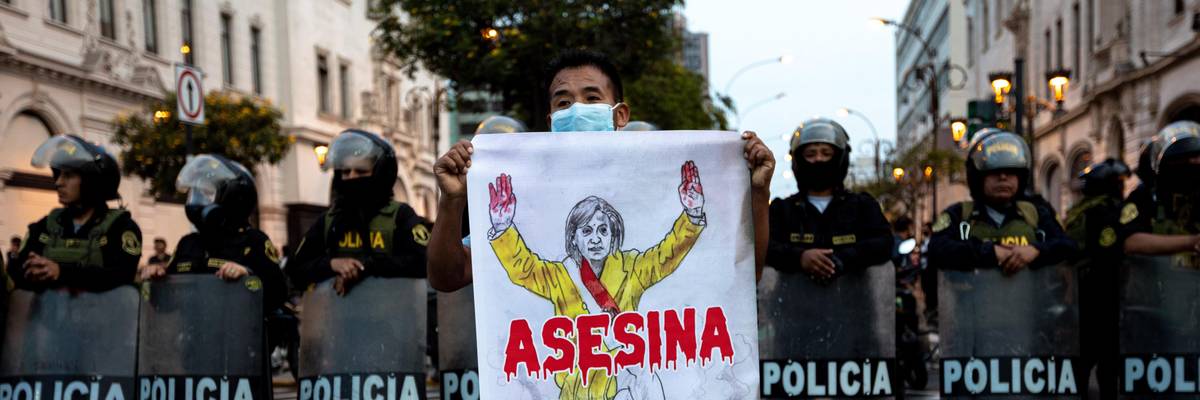
A protester holds up a sign with the likeness of Peruvian President Dina Boluarte that reads "murderer" during a December 12, 2022 demoinstration in the capital Lima to demand the release of former President Pedro Castillo. (Photo: Lucas Aguayo Araos/Picture Alliance via Getty Images)
Four Latin American presidents condemned the ouster and imprisonment of leftist Peruvian President Pedro Castillo on Tuesday, a move that preceded a national emergency declaration by the country's new government amid a deadly crackdown against what critics are calling a U.S.-backed "legislative coup."
"The oligarchic rulers of Peru could never accept that a rural schoolteacher and peasant leader could be brought into office by millions of poor, Black, and Indigenous people."
In a joint statement, the leftist leaders of Argentina, Bolivia, Colombia, and Mexico--respectively, Alberto Fernandez, Luis Arce, Gustavo Petro, and Andres Manuel Lopez Obrador--expressed their "deep concern over the recent events that resulted in the removal and detention of Jose Pedro Castillo Terrones, president of the Republic of Peru."
"It is not news to the world that President Castillo Terrones, from the day of his election, was the victim of anti-democratic harassment," the presidents said. "Our governments call on all the actors involved... to prioritize the will of the citizens that was pronounced at the polls."
"We exhort those in our [national] institutions to refrain from reversing the popular will expressed through free suffrage," the statement added. "We request that the authorities fully respect the human rights of President Pedro Castillo and that he be guaranteed judicial protection."
Progressive Chilean President Gabriel Boric, on the other hand, called an attempt by Castillo to dissolve Peru's Congress a "rupture of the constitutional order," while leftist Brazilian President-elect Luiz Inacio Lula da Silva said Castillo's removal was "constitutional."
On Wednesday, Luis Otarola Penaranda, the newly appointed Peruvian defense minister, announced a 30-day national emergency, a move he said means "the suspension of the rights of assembly, inviolability of the home, freedom of movement, and personal freedom and security" in the Andean nation of 33.3 million inhabitants.
The emergency declaration came as protesters blocked the Pan-American Highway south of the capital Lima, as well as the airport in Cusco, a major tourist hub, resulting in canceled flights.
Demonstrators also tried to reach the Congress building in Lima, according to The Washington Post, which reported that seven people, all of them teenagers, have been killed by state security forces, mostly in impoverished rural regions that strongly support Castillo.
Demonstrators are angry at the December 7 ouster and arrest of Castillo--a democratically elected former rural teacher and union organizer--by the country's right-wing-controlled Congress. On Tuesday, Peruvian Supreme Court Judge Cesar San Martin Castro rejected an appeal seeking Castillo's release from prison.
Infuriated by Castillo's promise of deep social reforms and a new constitution, Peru's oligarchs and the National Society of Industries, the country's leading business group, long sought his removal.
"The oligarchic rulers of Peru could never accept that a rural schoolteacher and peasant leader could be brought into office by millions of poor, Black, and Indigenous people who saw their hope for a better future in Castillo," Manolo De Los Santos, co-executive director of the People's Forum, explained in People's Dispatch.
Castillo was ousted from office, arrested, and charged with rebellion and conspiracy after he moved to dissolve Congress in a bid to preempt a legislative motion to dismiss him for "permanent moral incapacity."
In addition to attempting to dissolve Congress, Castillo also announced the start of an "exceptional emergency government" in which he would rule by decree until a Constituent Assembly was assembled within nine months. The president also intended to impose a 10:00 pm curfew. None of these policies were implemented.
Vice President Dina Boluarte was installed as the new president on December 7. Peru's sixth president in five years, Boluarte on Tuesday proposed to hold elections in April 2024.
The day after Boluarte took over, U.S. Assistant Secretary of State for Western Hemisphere Affairs Brian A. Nichols tweeted that "the U.S. welcomes President Boluarte and looks forward to working with her administration to achieve a more democratic, prosperous, and secure region."
Nichols--who has also pushed for U.S. military intervention in Haiti--added that "we applaud Peruvians as they unite in support of their democracy."
The United States has a long history of supporting autocrats and intervention in the region, including during "Operation Condor," a coordinated effort by right-wing military dictatorships in Chile, Argentina, Uruguay, Bolivia, Paraguay, Brazil, and, later, Peru and Ecuador. The campaign against perceived leftist threats was characterized by kidnappings, torture, disappearances, and murder, and claimed an estimated 60,000 lives, according to human rights groups.
Leftists around the world have condemned Castillo's ouster and what the U.S. peace group CodePink called the new government's "violent campaign of terror against protesters."
"We echo the demands of Peru's popular movements and support their right to resist, defend their democracy, and demand justice for the victims of this violence," the group said in a statement. "We demand that the U.S. not interfere as Peruvians fight to stabilize their democracy."
Dear Common Dreams reader, It’s been nearly 30 years since I co-founded Common Dreams with my late wife, Lina Newhouser. We had the radical notion that journalism should serve the public good, not corporate profits. It was clear to us from the outset what it would take to build such a project. No paid advertisements. No corporate sponsors. No millionaire publisher telling us what to think or do. Many people said we wouldn't last a year, but we proved those doubters wrong. Together with a tremendous team of journalists and dedicated staff, we built an independent media outlet free from the constraints of profits and corporate control. Our mission has always been simple: To inform. To inspire. To ignite change for the common good. Building Common Dreams was not easy. Our survival was never guaranteed. When you take on the most powerful forces—Wall Street greed, fossil fuel industry destruction, Big Tech lobbyists, and uber-rich oligarchs who have spent billions upon billions rigging the economy and democracy in their favor—the only bulwark you have is supporters who believe in your work. But here’s the urgent message from me today. It's never been this bad out there. And it's never been this hard to keep us going. At the very moment Common Dreams is most needed, the threats we face are intensifying. We need your support now more than ever. We don't accept corporate advertising and never will. We don't have a paywall because we don't think people should be blocked from critical news based on their ability to pay. Everything we do is funded by the donations of readers like you. When everyone does the little they can afford, we are strong. But if that support retreats or dries up, so do we. Will you donate now to make sure Common Dreams not only survives but thrives? —Craig Brown, Co-founder |
Four Latin American presidents condemned the ouster and imprisonment of leftist Peruvian President Pedro Castillo on Tuesday, a move that preceded a national emergency declaration by the country's new government amid a deadly crackdown against what critics are calling a U.S.-backed "legislative coup."
"The oligarchic rulers of Peru could never accept that a rural schoolteacher and peasant leader could be brought into office by millions of poor, Black, and Indigenous people."
In a joint statement, the leftist leaders of Argentina, Bolivia, Colombia, and Mexico--respectively, Alberto Fernandez, Luis Arce, Gustavo Petro, and Andres Manuel Lopez Obrador--expressed their "deep concern over the recent events that resulted in the removal and detention of Jose Pedro Castillo Terrones, president of the Republic of Peru."
"It is not news to the world that President Castillo Terrones, from the day of his election, was the victim of anti-democratic harassment," the presidents said. "Our governments call on all the actors involved... to prioritize the will of the citizens that was pronounced at the polls."
"We exhort those in our [national] institutions to refrain from reversing the popular will expressed through free suffrage," the statement added. "We request that the authorities fully respect the human rights of President Pedro Castillo and that he be guaranteed judicial protection."
Progressive Chilean President Gabriel Boric, on the other hand, called an attempt by Castillo to dissolve Peru's Congress a "rupture of the constitutional order," while leftist Brazilian President-elect Luiz Inacio Lula da Silva said Castillo's removal was "constitutional."
On Wednesday, Luis Otarola Penaranda, the newly appointed Peruvian defense minister, announced a 30-day national emergency, a move he said means "the suspension of the rights of assembly, inviolability of the home, freedom of movement, and personal freedom and security" in the Andean nation of 33.3 million inhabitants.
The emergency declaration came as protesters blocked the Pan-American Highway south of the capital Lima, as well as the airport in Cusco, a major tourist hub, resulting in canceled flights.
Demonstrators also tried to reach the Congress building in Lima, according to The Washington Post, which reported that seven people, all of them teenagers, have been killed by state security forces, mostly in impoverished rural regions that strongly support Castillo.
Demonstrators are angry at the December 7 ouster and arrest of Castillo--a democratically elected former rural teacher and union organizer--by the country's right-wing-controlled Congress. On Tuesday, Peruvian Supreme Court Judge Cesar San Martin Castro rejected an appeal seeking Castillo's release from prison.
Infuriated by Castillo's promise of deep social reforms and a new constitution, Peru's oligarchs and the National Society of Industries, the country's leading business group, long sought his removal.
"The oligarchic rulers of Peru could never accept that a rural schoolteacher and peasant leader could be brought into office by millions of poor, Black, and Indigenous people who saw their hope for a better future in Castillo," Manolo De Los Santos, co-executive director of the People's Forum, explained in People's Dispatch.
Castillo was ousted from office, arrested, and charged with rebellion and conspiracy after he moved to dissolve Congress in a bid to preempt a legislative motion to dismiss him for "permanent moral incapacity."
In addition to attempting to dissolve Congress, Castillo also announced the start of an "exceptional emergency government" in which he would rule by decree until a Constituent Assembly was assembled within nine months. The president also intended to impose a 10:00 pm curfew. None of these policies were implemented.
Vice President Dina Boluarte was installed as the new president on December 7. Peru's sixth president in five years, Boluarte on Tuesday proposed to hold elections in April 2024.
The day after Boluarte took over, U.S. Assistant Secretary of State for Western Hemisphere Affairs Brian A. Nichols tweeted that "the U.S. welcomes President Boluarte and looks forward to working with her administration to achieve a more democratic, prosperous, and secure region."
Nichols--who has also pushed for U.S. military intervention in Haiti--added that "we applaud Peruvians as they unite in support of their democracy."
The United States has a long history of supporting autocrats and intervention in the region, including during "Operation Condor," a coordinated effort by right-wing military dictatorships in Chile, Argentina, Uruguay, Bolivia, Paraguay, Brazil, and, later, Peru and Ecuador. The campaign against perceived leftist threats was characterized by kidnappings, torture, disappearances, and murder, and claimed an estimated 60,000 lives, according to human rights groups.
Leftists around the world have condemned Castillo's ouster and what the U.S. peace group CodePink called the new government's "violent campaign of terror against protesters."
"We echo the demands of Peru's popular movements and support their right to resist, defend their democracy, and demand justice for the victims of this violence," the group said in a statement. "We demand that the U.S. not interfere as Peruvians fight to stabilize their democracy."
Four Latin American presidents condemned the ouster and imprisonment of leftist Peruvian President Pedro Castillo on Tuesday, a move that preceded a national emergency declaration by the country's new government amid a deadly crackdown against what critics are calling a U.S.-backed "legislative coup."
"The oligarchic rulers of Peru could never accept that a rural schoolteacher and peasant leader could be brought into office by millions of poor, Black, and Indigenous people."
In a joint statement, the leftist leaders of Argentina, Bolivia, Colombia, and Mexico--respectively, Alberto Fernandez, Luis Arce, Gustavo Petro, and Andres Manuel Lopez Obrador--expressed their "deep concern over the recent events that resulted in the removal and detention of Jose Pedro Castillo Terrones, president of the Republic of Peru."
"It is not news to the world that President Castillo Terrones, from the day of his election, was the victim of anti-democratic harassment," the presidents said. "Our governments call on all the actors involved... to prioritize the will of the citizens that was pronounced at the polls."
"We exhort those in our [national] institutions to refrain from reversing the popular will expressed through free suffrage," the statement added. "We request that the authorities fully respect the human rights of President Pedro Castillo and that he be guaranteed judicial protection."
Progressive Chilean President Gabriel Boric, on the other hand, called an attempt by Castillo to dissolve Peru's Congress a "rupture of the constitutional order," while leftist Brazilian President-elect Luiz Inacio Lula da Silva said Castillo's removal was "constitutional."
On Wednesday, Luis Otarola Penaranda, the newly appointed Peruvian defense minister, announced a 30-day national emergency, a move he said means "the suspension of the rights of assembly, inviolability of the home, freedom of movement, and personal freedom and security" in the Andean nation of 33.3 million inhabitants.
The emergency declaration came as protesters blocked the Pan-American Highway south of the capital Lima, as well as the airport in Cusco, a major tourist hub, resulting in canceled flights.
Demonstrators also tried to reach the Congress building in Lima, according to The Washington Post, which reported that seven people, all of them teenagers, have been killed by state security forces, mostly in impoverished rural regions that strongly support Castillo.
Demonstrators are angry at the December 7 ouster and arrest of Castillo--a democratically elected former rural teacher and union organizer--by the country's right-wing-controlled Congress. On Tuesday, Peruvian Supreme Court Judge Cesar San Martin Castro rejected an appeal seeking Castillo's release from prison.
Infuriated by Castillo's promise of deep social reforms and a new constitution, Peru's oligarchs and the National Society of Industries, the country's leading business group, long sought his removal.
"The oligarchic rulers of Peru could never accept that a rural schoolteacher and peasant leader could be brought into office by millions of poor, Black, and Indigenous people who saw their hope for a better future in Castillo," Manolo De Los Santos, co-executive director of the People's Forum, explained in People's Dispatch.
Castillo was ousted from office, arrested, and charged with rebellion and conspiracy after he moved to dissolve Congress in a bid to preempt a legislative motion to dismiss him for "permanent moral incapacity."
In addition to attempting to dissolve Congress, Castillo also announced the start of an "exceptional emergency government" in which he would rule by decree until a Constituent Assembly was assembled within nine months. The president also intended to impose a 10:00 pm curfew. None of these policies were implemented.
Vice President Dina Boluarte was installed as the new president on December 7. Peru's sixth president in five years, Boluarte on Tuesday proposed to hold elections in April 2024.
The day after Boluarte took over, U.S. Assistant Secretary of State for Western Hemisphere Affairs Brian A. Nichols tweeted that "the U.S. welcomes President Boluarte and looks forward to working with her administration to achieve a more democratic, prosperous, and secure region."
Nichols--who has also pushed for U.S. military intervention in Haiti--added that "we applaud Peruvians as they unite in support of their democracy."
The United States has a long history of supporting autocrats and intervention in the region, including during "Operation Condor," a coordinated effort by right-wing military dictatorships in Chile, Argentina, Uruguay, Bolivia, Paraguay, Brazil, and, later, Peru and Ecuador. The campaign against perceived leftist threats was characterized by kidnappings, torture, disappearances, and murder, and claimed an estimated 60,000 lives, according to human rights groups.
Leftists around the world have condemned Castillo's ouster and what the U.S. peace group CodePink called the new government's "violent campaign of terror against protesters."
"We echo the demands of Peru's popular movements and support their right to resist, defend their democracy, and demand justice for the victims of this violence," the group said in a statement. "We demand that the U.S. not interfere as Peruvians fight to stabilize their democracy."