

SUBSCRIBE TO OUR FREE NEWSLETTER
Daily news & progressive opinion—funded by the people, not the corporations—delivered straight to your inbox.
5
#000000
#FFFFFF
To donate by check, phone, or other method, see our More Ways to Give page.
Daily news & progressive opinion—funded by the people, not the corporations—delivered straight to your inbox.
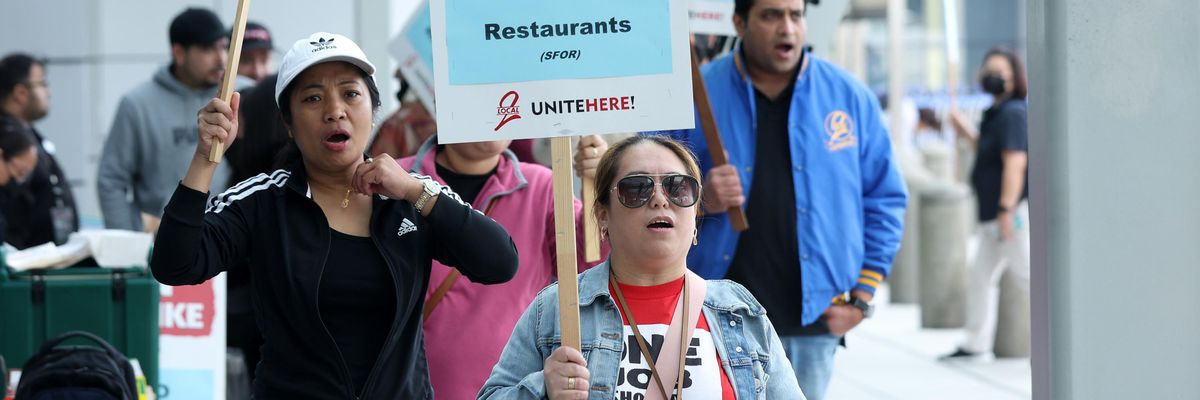
San Francisco International Airport food service workers carry signs as they strike outside of a terminal at the airport on September 26, 2022 in San Francisco, California. (Photo: Justin Sullivan/Getty Images)
San Francisco airport workers ended a three-day strike Thursday after reaching a tentative deal that includes "significant" pay increases and improved healthcare benefits.
The deal, which still must be ratified by union members, came after around 1,000 restaurant, coffee shop, and bar workers at the San Francisco International Airport (SFO) walked off the job to demand better wages and conditions, temporarily shuttering the operations of many of the airport's food and drink spots.
"All the hard work and sacrifice of the strike has paid off for my family."
Represented by UNITE HERE Local 2, the workers noted that they haven't received a wage increase in three years even as costs of living have surged, forcing many to work more than one job to meet basic needs. The majority of food workers at the airport make $17.05 per hour, the union said--far below the estimated living wage for San Francisco.
"This strike was so worth it to give my family a better life," said Blanca Gay, a snack bar attendant who has worked at SFO for 30 years. "My son is in college, but he had to switch from full-time to part-time just so he could work."
"With the raises we won, I can help my son go back to school full-time," Gay continued. "All the hard work and sacrifice of the strike has paid off for my family."
The union, which negotiated the deal with the SFO Airport Restaurant Employer Council, called the pay hikes "huge" but said the details of the agreement won't be released until after the workforce holds a ratification vote on Sunday. In August, 99.7% of SFO food service workers voted to authorize the strike.
"This victory shows the world that fast-food jobs can in fact be good, family-sustaining jobs, and it's all because workers had the courage to strike," Anand Singh, president of UNITE HERE Local 2, said in a statement. "After three years without a raise, SFO's fast-food workers were tired of working two or even three jobs just to survive--so they took their lives into their own hands and won a better future."
The strike by SFO workers came amid a broader wave of labor actions across the United States as companies continue to rake in record profits on the backs of their underpaid employees, many of whom have seen their wages eroded by corporate-driven inflation.
Citing data from Cornell University's Labor Action Tracker, journalist Michael Sainato reported for The Guardian earlier this week that "strikes in 2022 so far have significantly outpaced strike activity in 2021, with 180 strikes involving 78,000 workers in the first six months of 2022, compared with 102 strikes involving 26,500 workers in the first six months of 2021."
Johnnie Kallas, project director for the Labor Action Tracker, told Sainato that "strikes appear to be increasing as we head into the fall."
"These strikes are being led by workers in the service sector," said Kallas. "Starbucks workers have organized over 70 strikes so far this year in response to poor working conditions and employer retaliation. Over the past month, thousands of healthcare workers and educators have gone on strike to protest understaffing, low pay, and poor conditions for patients and students."
Dear Common Dreams reader, It’s been nearly 30 years since I co-founded Common Dreams with my late wife, Lina Newhouser. We had the radical notion that journalism should serve the public good, not corporate profits. It was clear to us from the outset what it would take to build such a project. No paid advertisements. No corporate sponsors. No millionaire publisher telling us what to think or do. Many people said we wouldn't last a year, but we proved those doubters wrong. Together with a tremendous team of journalists and dedicated staff, we built an independent media outlet free from the constraints of profits and corporate control. Our mission has always been simple: To inform. To inspire. To ignite change for the common good. Building Common Dreams was not easy. Our survival was never guaranteed. When you take on the most powerful forces—Wall Street greed, fossil fuel industry destruction, Big Tech lobbyists, and uber-rich oligarchs who have spent billions upon billions rigging the economy and democracy in their favor—the only bulwark you have is supporters who believe in your work. But here’s the urgent message from me today. It's never been this bad out there. And it's never been this hard to keep us going. At the very moment Common Dreams is most needed, the threats we face are intensifying. We need your support now more than ever. We don't accept corporate advertising and never will. We don't have a paywall because we don't think people should be blocked from critical news based on their ability to pay. Everything we do is funded by the donations of readers like you. When everyone does the little they can afford, we are strong. But if that support retreats or dries up, so do we. Will you donate now to make sure Common Dreams not only survives but thrives? —Craig Brown, Co-founder |
San Francisco airport workers ended a three-day strike Thursday after reaching a tentative deal that includes "significant" pay increases and improved healthcare benefits.
The deal, which still must be ratified by union members, came after around 1,000 restaurant, coffee shop, and bar workers at the San Francisco International Airport (SFO) walked off the job to demand better wages and conditions, temporarily shuttering the operations of many of the airport's food and drink spots.
"All the hard work and sacrifice of the strike has paid off for my family."
Represented by UNITE HERE Local 2, the workers noted that they haven't received a wage increase in three years even as costs of living have surged, forcing many to work more than one job to meet basic needs. The majority of food workers at the airport make $17.05 per hour, the union said--far below the estimated living wage for San Francisco.
"This strike was so worth it to give my family a better life," said Blanca Gay, a snack bar attendant who has worked at SFO for 30 years. "My son is in college, but he had to switch from full-time to part-time just so he could work."
"With the raises we won, I can help my son go back to school full-time," Gay continued. "All the hard work and sacrifice of the strike has paid off for my family."
The union, which negotiated the deal with the SFO Airport Restaurant Employer Council, called the pay hikes "huge" but said the details of the agreement won't be released until after the workforce holds a ratification vote on Sunday. In August, 99.7% of SFO food service workers voted to authorize the strike.
"This victory shows the world that fast-food jobs can in fact be good, family-sustaining jobs, and it's all because workers had the courage to strike," Anand Singh, president of UNITE HERE Local 2, said in a statement. "After three years without a raise, SFO's fast-food workers were tired of working two or even three jobs just to survive--so they took their lives into their own hands and won a better future."
The strike by SFO workers came amid a broader wave of labor actions across the United States as companies continue to rake in record profits on the backs of their underpaid employees, many of whom have seen their wages eroded by corporate-driven inflation.
Citing data from Cornell University's Labor Action Tracker, journalist Michael Sainato reported for The Guardian earlier this week that "strikes in 2022 so far have significantly outpaced strike activity in 2021, with 180 strikes involving 78,000 workers in the first six months of 2022, compared with 102 strikes involving 26,500 workers in the first six months of 2021."
Johnnie Kallas, project director for the Labor Action Tracker, told Sainato that "strikes appear to be increasing as we head into the fall."
"These strikes are being led by workers in the service sector," said Kallas. "Starbucks workers have organized over 70 strikes so far this year in response to poor working conditions and employer retaliation. Over the past month, thousands of healthcare workers and educators have gone on strike to protest understaffing, low pay, and poor conditions for patients and students."
San Francisco airport workers ended a three-day strike Thursday after reaching a tentative deal that includes "significant" pay increases and improved healthcare benefits.
The deal, which still must be ratified by union members, came after around 1,000 restaurant, coffee shop, and bar workers at the San Francisco International Airport (SFO) walked off the job to demand better wages and conditions, temporarily shuttering the operations of many of the airport's food and drink spots.
"All the hard work and sacrifice of the strike has paid off for my family."
Represented by UNITE HERE Local 2, the workers noted that they haven't received a wage increase in three years even as costs of living have surged, forcing many to work more than one job to meet basic needs. The majority of food workers at the airport make $17.05 per hour, the union said--far below the estimated living wage for San Francisco.
"This strike was so worth it to give my family a better life," said Blanca Gay, a snack bar attendant who has worked at SFO for 30 years. "My son is in college, but he had to switch from full-time to part-time just so he could work."
"With the raises we won, I can help my son go back to school full-time," Gay continued. "All the hard work and sacrifice of the strike has paid off for my family."
The union, which negotiated the deal with the SFO Airport Restaurant Employer Council, called the pay hikes "huge" but said the details of the agreement won't be released until after the workforce holds a ratification vote on Sunday. In August, 99.7% of SFO food service workers voted to authorize the strike.
"This victory shows the world that fast-food jobs can in fact be good, family-sustaining jobs, and it's all because workers had the courage to strike," Anand Singh, president of UNITE HERE Local 2, said in a statement. "After three years without a raise, SFO's fast-food workers were tired of working two or even three jobs just to survive--so they took their lives into their own hands and won a better future."
The strike by SFO workers came amid a broader wave of labor actions across the United States as companies continue to rake in record profits on the backs of their underpaid employees, many of whom have seen their wages eroded by corporate-driven inflation.
Citing data from Cornell University's Labor Action Tracker, journalist Michael Sainato reported for The Guardian earlier this week that "strikes in 2022 so far have significantly outpaced strike activity in 2021, with 180 strikes involving 78,000 workers in the first six months of 2022, compared with 102 strikes involving 26,500 workers in the first six months of 2021."
Johnnie Kallas, project director for the Labor Action Tracker, told Sainato that "strikes appear to be increasing as we head into the fall."
"These strikes are being led by workers in the service sector," said Kallas. "Starbucks workers have organized over 70 strikes so far this year in response to poor working conditions and employer retaliation. Over the past month, thousands of healthcare workers and educators have gone on strike to protest understaffing, low pay, and poor conditions for patients and students."

