SUBSCRIBE TO OUR FREE NEWSLETTER
Daily news & progressive opinion—funded by the people, not the corporations—delivered straight to your inbox.
5
#000000
#FFFFFF
To donate by check, phone, or other method, see our More Ways to Give page.
Daily news & progressive opinion—funded by the people, not the corporations—delivered straight to your inbox.
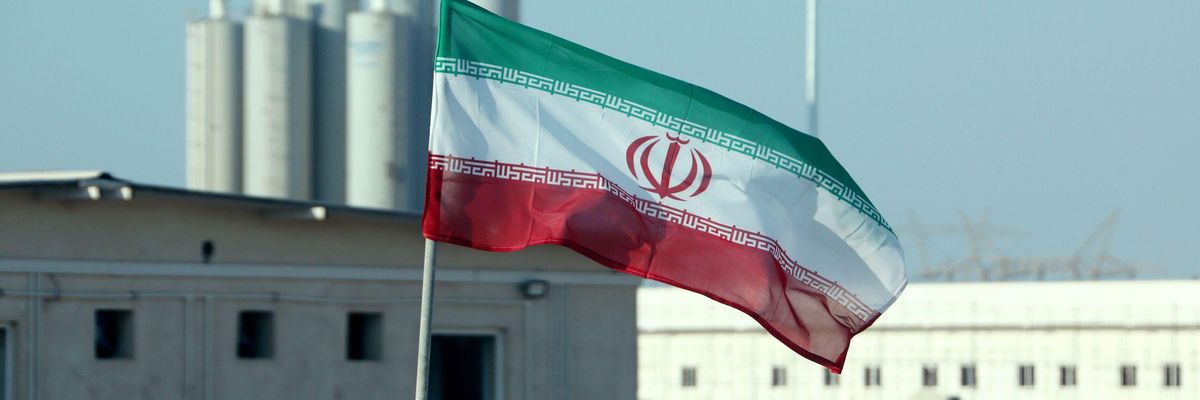
A picture taken on November 10, 2019, shows an Iranian flag in Iran's Bushehr nuclear power plant, during an official ceremony to kick-start works on a second reactor at the facility. (Photo: Atta Kenare/AFP via Getty Images)
Progressive Middle East watchers on Wednesday condemned the Biden administration's targeting of 15 firms and people in at least five countries allegedly linked to the sale and shipment of Iranian petroleum products in violation of U.S. economic sanctions.
"All of this could have been avoided if Biden just returned to the JCPOA via executive order."
In announcing the new sanctions, the U.S. Treasury Department cites an executive order signed in 2018 by then-President Donald Trump as the basis for penalizing petrochemical companies and individuals based in Iran, China, Singapore, the United Arab Emirates, and Vietnam.
Meanwhile, the State Department said in a statement that "the United States has been sincere and steadfast in pursuing a path of meaningful diplomacy to achieve a mutual return to full implementation of the Joint Comprehensive Plan of Action (JCPOA)," commonly called the Iran nuclear deal.
"It is Iran that has, to date, failed to demonstrate a similar commitment to that path," the statement contended, echoing U.S. Secretary of State Antony Blinken's suggestion that Iran, not the U.S.--which reneged on the agreement under Trump--is to blame for challenges hampering the latest efforts to revive the JCPOA.
Assal Rad, research director at the National Iranian American Council (NIAC), pushed back against an attempt by Blinken to blame Iran for the JCPOA impasse.
"The U.S. pulled out of the JCPOA under Trump and rather than acknowledge this and seriously pursue diplomacy, the Biden administration has forced Iran to choose between unreasonable concessions or more sanctions which kill the Iranian people," the peace group CodePink tweeted. "It's really that simple."
Middle East policy expert Sina Toossi tweeted that it was the U.S., not Iran, that needs to show its willingness to revive the nuclear deal.
"The Biden administration's 'commitment' to returning to the JCPOA can only be demonstrated by taking serious steps to rebuild trust and bring the U.S. back into compliance, not by doubling down on Trump's failed and self-defeating policies," he said.
Trita Parsi, executive director of the Quincy Institute for Responsible Statecraft, lamented that President Joe Biden "is continuing and embracing Trump's max pressure policy, while expecting a different result."
"All of this could have been avoided if Biden just returned to the JCPOA via executive order, as he did with Paris and the WHO," he added, referring to the U.S. rejoining the Paris climate agreement and World Health Organization after Trump-era disengagement.
The new sanctions come ahead of Biden's Middle East trip next week, which will include stops in Israel and Saudi Arabia, two erstwhile foes increasingly united by their common enemy, Iran.
As Paul Pillar of Georgetown University's Center for Security Studies noted Tuesday, the upcoming trip also comes amid "increasing talk about the United States getting more deeply committed to anti-Iran security arrangements on the side of Arab states of the Persian Gulf, especially Saudi Arabia and Israel."
NIAC policy director Ryan Costello last week accused the Biden administration of eschewing JCPOA revival in favor of "planning to bend the knee to [Saudi Crown Prince] Mohammed bin Salman in an apparent attempt to lower oil prices."
"A restored Iran deal can do far more to lower global oil prices, and it would have tangible benefits for U.S. security by removing the twin threats of a nuclear-armed Iran and a devastating war over Iran's nuclear program," Costello asserted. "It's not too late for Biden to make the right call."
Dear Common Dreams reader, It’s been nearly 30 years since I co-founded Common Dreams with my late wife, Lina Newhouser. We had the radical notion that journalism should serve the public good, not corporate profits. It was clear to us from the outset what it would take to build such a project. No paid advertisements. No corporate sponsors. No millionaire publisher telling us what to think or do. Many people said we wouldn't last a year, but we proved those doubters wrong. Together with a tremendous team of journalists and dedicated staff, we built an independent media outlet free from the constraints of profits and corporate control. Our mission has always been simple: To inform. To inspire. To ignite change for the common good. Building Common Dreams was not easy. Our survival was never guaranteed. When you take on the most powerful forces—Wall Street greed, fossil fuel industry destruction, Big Tech lobbyists, and uber-rich oligarchs who have spent billions upon billions rigging the economy and democracy in their favor—the only bulwark you have is supporters who believe in your work. But here’s the urgent message from me today. It's never been this bad out there. And it's never been this hard to keep us going. At the very moment Common Dreams is most needed, the threats we face are intensifying. We need your support now more than ever. We don't accept corporate advertising and never will. We don't have a paywall because we don't think people should be blocked from critical news based on their ability to pay. Everything we do is funded by the donations of readers like you. When everyone does the little they can afford, we are strong. But if that support retreats or dries up, so do we. Will you donate now to make sure Common Dreams not only survives but thrives? —Craig Brown, Co-founder |
Progressive Middle East watchers on Wednesday condemned the Biden administration's targeting of 15 firms and people in at least five countries allegedly linked to the sale and shipment of Iranian petroleum products in violation of U.S. economic sanctions.
"All of this could have been avoided if Biden just returned to the JCPOA via executive order."
In announcing the new sanctions, the U.S. Treasury Department cites an executive order signed in 2018 by then-President Donald Trump as the basis for penalizing petrochemical companies and individuals based in Iran, China, Singapore, the United Arab Emirates, and Vietnam.
Meanwhile, the State Department said in a statement that "the United States has been sincere and steadfast in pursuing a path of meaningful diplomacy to achieve a mutual return to full implementation of the Joint Comprehensive Plan of Action (JCPOA)," commonly called the Iran nuclear deal.
"It is Iran that has, to date, failed to demonstrate a similar commitment to that path," the statement contended, echoing U.S. Secretary of State Antony Blinken's suggestion that Iran, not the U.S.--which reneged on the agreement under Trump--is to blame for challenges hampering the latest efforts to revive the JCPOA.
Assal Rad, research director at the National Iranian American Council (NIAC), pushed back against an attempt by Blinken to blame Iran for the JCPOA impasse.
"The U.S. pulled out of the JCPOA under Trump and rather than acknowledge this and seriously pursue diplomacy, the Biden administration has forced Iran to choose between unreasonable concessions or more sanctions which kill the Iranian people," the peace group CodePink tweeted. "It's really that simple."
Middle East policy expert Sina Toossi tweeted that it was the U.S., not Iran, that needs to show its willingness to revive the nuclear deal.
"The Biden administration's 'commitment' to returning to the JCPOA can only be demonstrated by taking serious steps to rebuild trust and bring the U.S. back into compliance, not by doubling down on Trump's failed and self-defeating policies," he said.
Trita Parsi, executive director of the Quincy Institute for Responsible Statecraft, lamented that President Joe Biden "is continuing and embracing Trump's max pressure policy, while expecting a different result."
"All of this could have been avoided if Biden just returned to the JCPOA via executive order, as he did with Paris and the WHO," he added, referring to the U.S. rejoining the Paris climate agreement and World Health Organization after Trump-era disengagement.
The new sanctions come ahead of Biden's Middle East trip next week, which will include stops in Israel and Saudi Arabia, two erstwhile foes increasingly united by their common enemy, Iran.
As Paul Pillar of Georgetown University's Center for Security Studies noted Tuesday, the upcoming trip also comes amid "increasing talk about the United States getting more deeply committed to anti-Iran security arrangements on the side of Arab states of the Persian Gulf, especially Saudi Arabia and Israel."
NIAC policy director Ryan Costello last week accused the Biden administration of eschewing JCPOA revival in favor of "planning to bend the knee to [Saudi Crown Prince] Mohammed bin Salman in an apparent attempt to lower oil prices."
"A restored Iran deal can do far more to lower global oil prices, and it would have tangible benefits for U.S. security by removing the twin threats of a nuclear-armed Iran and a devastating war over Iran's nuclear program," Costello asserted. "It's not too late for Biden to make the right call."
Progressive Middle East watchers on Wednesday condemned the Biden administration's targeting of 15 firms and people in at least five countries allegedly linked to the sale and shipment of Iranian petroleum products in violation of U.S. economic sanctions.
"All of this could have been avoided if Biden just returned to the JCPOA via executive order."
In announcing the new sanctions, the U.S. Treasury Department cites an executive order signed in 2018 by then-President Donald Trump as the basis for penalizing petrochemical companies and individuals based in Iran, China, Singapore, the United Arab Emirates, and Vietnam.
Meanwhile, the State Department said in a statement that "the United States has been sincere and steadfast in pursuing a path of meaningful diplomacy to achieve a mutual return to full implementation of the Joint Comprehensive Plan of Action (JCPOA)," commonly called the Iran nuclear deal.
"It is Iran that has, to date, failed to demonstrate a similar commitment to that path," the statement contended, echoing U.S. Secretary of State Antony Blinken's suggestion that Iran, not the U.S.--which reneged on the agreement under Trump--is to blame for challenges hampering the latest efforts to revive the JCPOA.
Assal Rad, research director at the National Iranian American Council (NIAC), pushed back against an attempt by Blinken to blame Iran for the JCPOA impasse.
"The U.S. pulled out of the JCPOA under Trump and rather than acknowledge this and seriously pursue diplomacy, the Biden administration has forced Iran to choose between unreasonable concessions or more sanctions which kill the Iranian people," the peace group CodePink tweeted. "It's really that simple."
Middle East policy expert Sina Toossi tweeted that it was the U.S., not Iran, that needs to show its willingness to revive the nuclear deal.
"The Biden administration's 'commitment' to returning to the JCPOA can only be demonstrated by taking serious steps to rebuild trust and bring the U.S. back into compliance, not by doubling down on Trump's failed and self-defeating policies," he said.
Trita Parsi, executive director of the Quincy Institute for Responsible Statecraft, lamented that President Joe Biden "is continuing and embracing Trump's max pressure policy, while expecting a different result."
"All of this could have been avoided if Biden just returned to the JCPOA via executive order, as he did with Paris and the WHO," he added, referring to the U.S. rejoining the Paris climate agreement and World Health Organization after Trump-era disengagement.
The new sanctions come ahead of Biden's Middle East trip next week, which will include stops in Israel and Saudi Arabia, two erstwhile foes increasingly united by their common enemy, Iran.
As Paul Pillar of Georgetown University's Center for Security Studies noted Tuesday, the upcoming trip also comes amid "increasing talk about the United States getting more deeply committed to anti-Iran security arrangements on the side of Arab states of the Persian Gulf, especially Saudi Arabia and Israel."
NIAC policy director Ryan Costello last week accused the Biden administration of eschewing JCPOA revival in favor of "planning to bend the knee to [Saudi Crown Prince] Mohammed bin Salman in an apparent attempt to lower oil prices."
"A restored Iran deal can do far more to lower global oil prices, and it would have tangible benefits for U.S. security by removing the twin threats of a nuclear-armed Iran and a devastating war over Iran's nuclear program," Costello asserted. "It's not too late for Biden to make the right call."