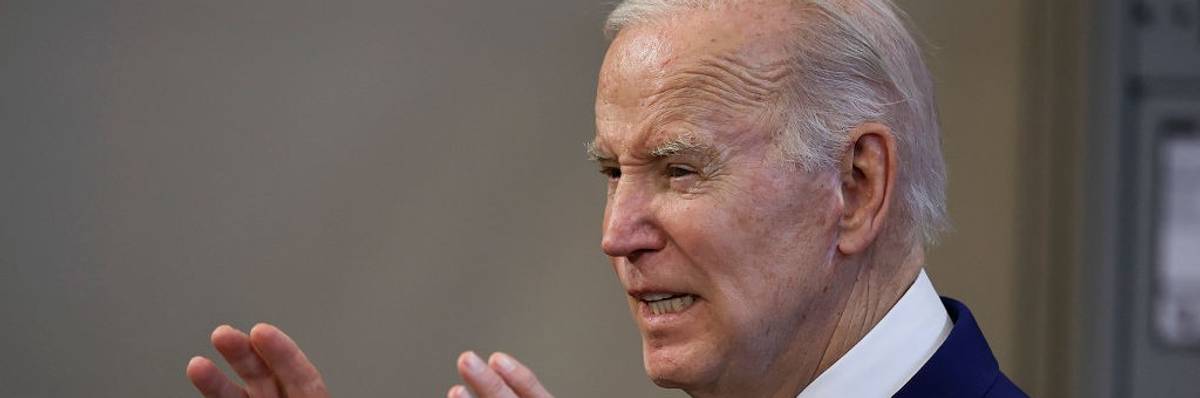
U.S. President Joe Biden delivers remarks on the economy at the International Brotherhood of Electrical Workers union Local 26 on February 15, 2023 in Lanham, Maryland.
Thanks Biden: As Economy Rallies, Americans Still Think Pres to Blame for Their Struggles
The tendency to blame Biden obscures the actions that large corporations are taking to keep prices high as inflation falls.
William Falk, the man who is editor of the popular weekly public affairs magazine called simply The Week, mused the other day about the American public's perception that President Joe Biden is doing a terrible job managing the nation's economy.
An ABC News/Washington Post poll earlier this year found that four in 10 Americans claim to be worse off since Biden became president.
Falk countered with these statistics:
Unemployment is near a historic low of 3.7%, down from 13% in 2020; a record 13 million jobs have been created since Biden became president; average wages have risen by 4.3% over last year; the infrastructure bill has boosted factory construction and manufacturing jobs; stocks have soared 20% over the last eight months.
Nobody wants to admit that the other guy, their political enemy, may actually be doing something right.
And inflation is cooling, with consumer prices rising 0.1% in May and 4% over the last year.
"Yet polls find that only 39% of Americans approve of Biden's policies," he pointed out.
Falk surmises that "negative partisanship" is at play. Just 7% of Republicans rate the economy as "good," while many others would call these pretty good economic times.
"Our politics are now so tribal, and the perceived stakes so high, that even a grudging admission of success by the other party's president feels like a betrayal," he suggested, adding that this "leaves millions of Americans rooting for America's failure."
It's become a central fact of the politics of this era that Republicans insist that the economy is hopelessly broken whenever a Democrat is in the White House, and vice versa, he added.
There's a lot to be said for that observation. You hear it every day on radio and TV commentary. You see it in the letters to the editor columns in the newspapers. You've probably witnessed many arguments between folks at the coffee shop or in the local neighborhood watering hole.
Nobody wants to admit that the other guy, their political enemy, may actually be doing something right.
Others who are similarly perplexed by the president's poll numbers, just before another presidential campaign gets underway, point to the lingering perception of high inflation that all too many Americans are experiencing when they open their billfolds.
As Falk pointed out, it has cooled considerably since last year, but Biden's foes have successfully placed inflation on the top of the list of his failures.
The price of gasoline serves as a weekly reminder when people fill up their cars, and many groceries still cost too much. And it certainly doesn't help that many of the country's biggest corporations are taking advantage of the situation.
The New York Times ran a revealing story a few weeks ago that spotlighted this phenomenon.
"The prices of oil, transportation, food ingredients, and other raw materials have fallen in recent months as the shocks stemming from the pandemic and the war in Ukraine have faded," the story began. "Yet many big businesses have continued raising prices at a rapid clip."
Some of the world's biggest companies have, in effect, said "too bad." They don't plan to change course and will continue increasing prices or keep them at elevated levels for the foreseeable future.
"That strategy has cushioned corporate profits. And it could keep inflation robust, contributing to the very pressures used to justify surging prices," the piece added.
The Times' went on to report the healthy profits that corporations, from PepsiCo to Colgate-Palmolive to McDonald's, have racked up since inflation flared after the government pumped money into the economy to counter the pandemic's disastrous impact.
But the business world has little to fear. In the end, it's all Joe Biden's fault.
We are at a crossroads
This country and this world are at a monumental crossroads. In a few short weeks, US voters will have an opportunity to beat back the forces of fascism and confront the billionaires who are rigging the economy, our media system, and our democracy, making it increasingly impossible for ordinary people to get by. We’re not just talking about the election. We’re talking about what must be done once these fascist elements are vanquished from power. We need a bolder set of solutions than what either major party has so far been willing to offer and a working-class movement ready to fight like hell for it. Trump didn't emerge from nowhere. The conditions that fueled MAGA authoritarianism were created by decades of radical neoliberal economic policies and a corrupt political system dominated by corporate interests. They slashed taxes on the super-rich, promising that the benefits would trickle down. They said giveaways to the corporate titans would make life more affordable for the rest of us. It was all bullshit. And when a bitter, betrayed populace searches for someone to blame, right-wing demagogues have little trouble finding scapegoats. People know when they're being lied to, but you won't hear any of this from the corporate media. Only independent journalism—powered and funded by people who believe in building a better world—can deliver truly trustworthy daily news. Our Fall Campaign is underway, and we need your help. To power our newsroom through the rest of the year, we need to raise $125,000 by midnight on October 31. So if you share our vision, please contribute whatever you can to sustain our work. |
William Falk, the man who is editor of the popular weekly public affairs magazine called simply The Week, mused the other day about the American public's perception that President Joe Biden is doing a terrible job managing the nation's economy.
An ABC News/Washington Post poll earlier this year found that four in 10 Americans claim to be worse off since Biden became president.
Falk countered with these statistics:
Unemployment is near a historic low of 3.7%, down from 13% in 2020; a record 13 million jobs have been created since Biden became president; average wages have risen by 4.3% over last year; the infrastructure bill has boosted factory construction and manufacturing jobs; stocks have soared 20% over the last eight months.
Nobody wants to admit that the other guy, their political enemy, may actually be doing something right.
And inflation is cooling, with consumer prices rising 0.1% in May and 4% over the last year.
"Yet polls find that only 39% of Americans approve of Biden's policies," he pointed out.
Falk surmises that "negative partisanship" is at play. Just 7% of Republicans rate the economy as "good," while many others would call these pretty good economic times.
"Our politics are now so tribal, and the perceived stakes so high, that even a grudging admission of success by the other party's president feels like a betrayal," he suggested, adding that this "leaves millions of Americans rooting for America's failure."
It's become a central fact of the politics of this era that Republicans insist that the economy is hopelessly broken whenever a Democrat is in the White House, and vice versa, he added.
There's a lot to be said for that observation. You hear it every day on radio and TV commentary. You see it in the letters to the editor columns in the newspapers. You've probably witnessed many arguments between folks at the coffee shop or in the local neighborhood watering hole.
Nobody wants to admit that the other guy, their political enemy, may actually be doing something right.
Others who are similarly perplexed by the president's poll numbers, just before another presidential campaign gets underway, point to the lingering perception of high inflation that all too many Americans are experiencing when they open their billfolds.
As Falk pointed out, it has cooled considerably since last year, but Biden's foes have successfully placed inflation on the top of the list of his failures.
The price of gasoline serves as a weekly reminder when people fill up their cars, and many groceries still cost too much. And it certainly doesn't help that many of the country's biggest corporations are taking advantage of the situation.
The New York Times ran a revealing story a few weeks ago that spotlighted this phenomenon.
"The prices of oil, transportation, food ingredients, and other raw materials have fallen in recent months as the shocks stemming from the pandemic and the war in Ukraine have faded," the story began. "Yet many big businesses have continued raising prices at a rapid clip."
Some of the world's biggest companies have, in effect, said "too bad." They don't plan to change course and will continue increasing prices or keep them at elevated levels for the foreseeable future.
"That strategy has cushioned corporate profits. And it could keep inflation robust, contributing to the very pressures used to justify surging prices," the piece added.
The Times' went on to report the healthy profits that corporations, from PepsiCo to Colgate-Palmolive to McDonald's, have racked up since inflation flared after the government pumped money into the economy to counter the pandemic's disastrous impact.
But the business world has little to fear. In the end, it's all Joe Biden's fault.
- Progressives Rip Corporations for 'Using Inflation as a Cover Story to Jack Up Prices and Pad Profits' ›
- Dollar Tree CEO--Who Made Over $10 Million Last Year--Blames Inflation for Price Hike to $1.25 ›
- Sanders Says True Economic Crisis Is 'Corporate Greed'--and GOP Congress Would Make It Worse ›