SUBSCRIBE TO OUR FREE NEWSLETTER
Daily news & progressive opinion—funded by the people, not the corporations—delivered straight to your inbox.
5
#000000
#FFFFFF
To donate by check, phone, or other method, see our More Ways to Give page.
Daily news & progressive opinion—funded by the people, not the corporations—delivered straight to your inbox.
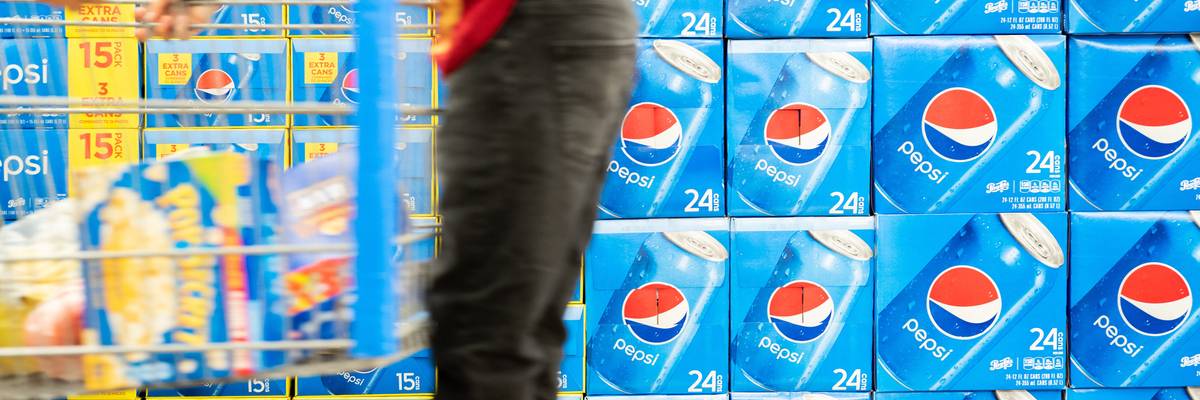
Pepsi sodas are displayed for sale at a Walmart on December 6, 2022 in Austin, Texas.
"After an unprecedented 10 interest rate hikes in a row, it's clear the corporate profiteering epidemic will persist no matter how many times the Fed doubles down," said Liz Zelnick of Accountable.US.
An analysis released Tuesday shows that executives at some of the top publicly traded companies in the United States aren't exactly being coy about using their pricing power to hike costs for consumers and boost revenues and profits—which are then dished out to wealthy shareholders.
The progressive watchdog group Accountable.US noted in its new report that "some of the largest general consumer S&P 500 companies have admitted to benefiting from increased prices as their net profits increased year-over-year and they rewarded shareholders with billions in handouts."
The report quotes directly from the executives of Kimberly-Clark, PepsiCo, General Mills, Tyson Foods, and other major U.S. companies.
Nelson Urdaneta, Kimberly-Clark's chief financial officer, said during the company's earnings call in April that "pricing has continued to be the big driver behind our top-line growth over the last three quarters."
The company, which sells consumer products such as toilet paper and diapers, "saw its [fiscal year] 2022 net income increase 6.3% year-over-year to nearly $2 billion and rewarded shareholders with $1.7 billion in stock buybacks and dividends," Accountable.US found.
On Tyson's earnings call in February, chief financial officer John Tyson hailed the "significant pricing power of our portfolio, with a year-over-year increase of 7.6%." Tyson stressed that the company will "continue to support and grow the dividend for our shareholders."
According to Accountable.US, Tyson "saw its net income increase from $3 billion in FY 2021 to over $3.2 billion in FY 2022 and rewarded shareholders with $1.35 billion in handouts—$652 million more than the previous year, including a 948.5% increase in stock buybacks."
"Corporate greed is a stubborn thing and requires serious action from Congress."
The new analysis came shortly after the Bureau of Labor Statistics released data showing that the consumer price index rose 4% in May compared to the previous year, the smallest increase since 2021.
Further evidence of cooling inflation sparked a fresh round of calls for the Federal Reserve to stop hiking interest rates before it pushes the economy into recession. The Fed is widely expected to announce Wednesday that it is pausing rate increases for the month of June, but it could resume the hikes as soon as the following month.
"The Fed should not only pause tomorrow but pause going forward and see how these 10 rate hikes play out," Rakeen Mabud, chief economist at the Groundwork Collaborative, said in an appearance on Yahoo Finance Tuesday morning.
Liz Zelnick, director of economic security and corporate power at Accountable.US, said in a statement that "after an unprecedented 10 interest rate hikes in a row, it's clear the corporate profiteering epidemic will persist no matter how many times the Fed doubles down."
The New York Times reported late last month that even as the prices of key raw materials have fallen in recent months, "many big businesses have continued raising prices at a rapid clip" and signaled that "they do not plan to change course"—which helps explain data showing that U.S. corporate profits rose to a record level in the first quarter of 2023.
"PepsiCo has become a prime example of how large corporations have countered increased costs, and then some," the Times noted. "Hugh Johnston, the company's chief financial officer, said in February that PepsiCo had raised its prices by enough to buffer further cost pressures in 2023. At the end of April, the company reported that it had raised the average price across its snacks and beverages by 16% in the first three months of the year. That added to a similar price increase in the fourth quarter of 2022 and increased its profit margin."
Zelnick said Tuesday that "higher interest rates haven't stopped S&P companies, especially in the Big Food industry, from inflating consumer prices despite reporting billions in extra net earnings and over a trillion dollars in giveaways to wealthy investors."
"Corporate greed is a stubborn thing and requires serious action from Congress," she added. "The Fed has not seen an adequate return on its investment in a policy that has already created fissures in the economy that could lead to recession. It's just not worth it."
Dear Common Dreams reader, It’s been nearly 30 years since I co-founded Common Dreams with my late wife, Lina Newhouser. We had the radical notion that journalism should serve the public good, not corporate profits. It was clear to us from the outset what it would take to build such a project. No paid advertisements. No corporate sponsors. No millionaire publisher telling us what to think or do. Many people said we wouldn't last a year, but we proved those doubters wrong. Together with a tremendous team of journalists and dedicated staff, we built an independent media outlet free from the constraints of profits and corporate control. Our mission has always been simple: To inform. To inspire. To ignite change for the common good. Building Common Dreams was not easy. Our survival was never guaranteed. When you take on the most powerful forces—Wall Street greed, fossil fuel industry destruction, Big Tech lobbyists, and uber-rich oligarchs who have spent billions upon billions rigging the economy and democracy in their favor—the only bulwark you have is supporters who believe in your work. But here’s the urgent message from me today. It's never been this bad out there. And it's never been this hard to keep us going. At the very moment Common Dreams is most needed, the threats we face are intensifying. We need your support now more than ever. We don't accept corporate advertising and never will. We don't have a paywall because we don't think people should be blocked from critical news based on their ability to pay. Everything we do is funded by the donations of readers like you. When everyone does the little they can afford, we are strong. But if that support retreats or dries up, so do we. Will you donate now to make sure Common Dreams not only survives but thrives? —Craig Brown, Co-founder |
An analysis released Tuesday shows that executives at some of the top publicly traded companies in the United States aren't exactly being coy about using their pricing power to hike costs for consumers and boost revenues and profits—which are then dished out to wealthy shareholders.
The progressive watchdog group Accountable.US noted in its new report that "some of the largest general consumer S&P 500 companies have admitted to benefiting from increased prices as their net profits increased year-over-year and they rewarded shareholders with billions in handouts."
The report quotes directly from the executives of Kimberly-Clark, PepsiCo, General Mills, Tyson Foods, and other major U.S. companies.
Nelson Urdaneta, Kimberly-Clark's chief financial officer, said during the company's earnings call in April that "pricing has continued to be the big driver behind our top-line growth over the last three quarters."
The company, which sells consumer products such as toilet paper and diapers, "saw its [fiscal year] 2022 net income increase 6.3% year-over-year to nearly $2 billion and rewarded shareholders with $1.7 billion in stock buybacks and dividends," Accountable.US found.
On Tyson's earnings call in February, chief financial officer John Tyson hailed the "significant pricing power of our portfolio, with a year-over-year increase of 7.6%." Tyson stressed that the company will "continue to support and grow the dividend for our shareholders."
According to Accountable.US, Tyson "saw its net income increase from $3 billion in FY 2021 to over $3.2 billion in FY 2022 and rewarded shareholders with $1.35 billion in handouts—$652 million more than the previous year, including a 948.5% increase in stock buybacks."
"Corporate greed is a stubborn thing and requires serious action from Congress."
The new analysis came shortly after the Bureau of Labor Statistics released data showing that the consumer price index rose 4% in May compared to the previous year, the smallest increase since 2021.
Further evidence of cooling inflation sparked a fresh round of calls for the Federal Reserve to stop hiking interest rates before it pushes the economy into recession. The Fed is widely expected to announce Wednesday that it is pausing rate increases for the month of June, but it could resume the hikes as soon as the following month.
"The Fed should not only pause tomorrow but pause going forward and see how these 10 rate hikes play out," Rakeen Mabud, chief economist at the Groundwork Collaborative, said in an appearance on Yahoo Finance Tuesday morning.
Liz Zelnick, director of economic security and corporate power at Accountable.US, said in a statement that "after an unprecedented 10 interest rate hikes in a row, it's clear the corporate profiteering epidemic will persist no matter how many times the Fed doubles down."
The New York Times reported late last month that even as the prices of key raw materials have fallen in recent months, "many big businesses have continued raising prices at a rapid clip" and signaled that "they do not plan to change course"—which helps explain data showing that U.S. corporate profits rose to a record level in the first quarter of 2023.
"PepsiCo has become a prime example of how large corporations have countered increased costs, and then some," the Times noted. "Hugh Johnston, the company's chief financial officer, said in February that PepsiCo had raised its prices by enough to buffer further cost pressures in 2023. At the end of April, the company reported that it had raised the average price across its snacks and beverages by 16% in the first three months of the year. That added to a similar price increase in the fourth quarter of 2022 and increased its profit margin."
Zelnick said Tuesday that "higher interest rates haven't stopped S&P companies, especially in the Big Food industry, from inflating consumer prices despite reporting billions in extra net earnings and over a trillion dollars in giveaways to wealthy investors."
"Corporate greed is a stubborn thing and requires serious action from Congress," she added. "The Fed has not seen an adequate return on its investment in a policy that has already created fissures in the economy that could lead to recession. It's just not worth it."
An analysis released Tuesday shows that executives at some of the top publicly traded companies in the United States aren't exactly being coy about using their pricing power to hike costs for consumers and boost revenues and profits—which are then dished out to wealthy shareholders.
The progressive watchdog group Accountable.US noted in its new report that "some of the largest general consumer S&P 500 companies have admitted to benefiting from increased prices as their net profits increased year-over-year and they rewarded shareholders with billions in handouts."
The report quotes directly from the executives of Kimberly-Clark, PepsiCo, General Mills, Tyson Foods, and other major U.S. companies.
Nelson Urdaneta, Kimberly-Clark's chief financial officer, said during the company's earnings call in April that "pricing has continued to be the big driver behind our top-line growth over the last three quarters."
The company, which sells consumer products such as toilet paper and diapers, "saw its [fiscal year] 2022 net income increase 6.3% year-over-year to nearly $2 billion and rewarded shareholders with $1.7 billion in stock buybacks and dividends," Accountable.US found.
On Tyson's earnings call in February, chief financial officer John Tyson hailed the "significant pricing power of our portfolio, with a year-over-year increase of 7.6%." Tyson stressed that the company will "continue to support and grow the dividend for our shareholders."
According to Accountable.US, Tyson "saw its net income increase from $3 billion in FY 2021 to over $3.2 billion in FY 2022 and rewarded shareholders with $1.35 billion in handouts—$652 million more than the previous year, including a 948.5% increase in stock buybacks."
"Corporate greed is a stubborn thing and requires serious action from Congress."
The new analysis came shortly after the Bureau of Labor Statistics released data showing that the consumer price index rose 4% in May compared to the previous year, the smallest increase since 2021.
Further evidence of cooling inflation sparked a fresh round of calls for the Federal Reserve to stop hiking interest rates before it pushes the economy into recession. The Fed is widely expected to announce Wednesday that it is pausing rate increases for the month of June, but it could resume the hikes as soon as the following month.
"The Fed should not only pause tomorrow but pause going forward and see how these 10 rate hikes play out," Rakeen Mabud, chief economist at the Groundwork Collaborative, said in an appearance on Yahoo Finance Tuesday morning.
Liz Zelnick, director of economic security and corporate power at Accountable.US, said in a statement that "after an unprecedented 10 interest rate hikes in a row, it's clear the corporate profiteering epidemic will persist no matter how many times the Fed doubles down."
The New York Times reported late last month that even as the prices of key raw materials have fallen in recent months, "many big businesses have continued raising prices at a rapid clip" and signaled that "they do not plan to change course"—which helps explain data showing that U.S. corporate profits rose to a record level in the first quarter of 2023.
"PepsiCo has become a prime example of how large corporations have countered increased costs, and then some," the Times noted. "Hugh Johnston, the company's chief financial officer, said in February that PepsiCo had raised its prices by enough to buffer further cost pressures in 2023. At the end of April, the company reported that it had raised the average price across its snacks and beverages by 16% in the first three months of the year. That added to a similar price increase in the fourth quarter of 2022 and increased its profit margin."
Zelnick said Tuesday that "higher interest rates haven't stopped S&P companies, especially in the Big Food industry, from inflating consumer prices despite reporting billions in extra net earnings and over a trillion dollars in giveaways to wealthy investors."
"Corporate greed is a stubborn thing and requires serious action from Congress," she added. "The Fed has not seen an adequate return on its investment in a policy that has already created fissures in the economy that could lead to recession. It's just not worth it."