SUBSCRIBE TO OUR FREE NEWSLETTER
Daily news & progressive opinion—funded by the people, not the corporations—delivered straight to your inbox.
5
#000000
#FFFFFF
To donate by check, phone, or other method, see our More Ways to Give page.
Daily news & progressive opinion—funded by the people, not the corporations—delivered straight to your inbox.
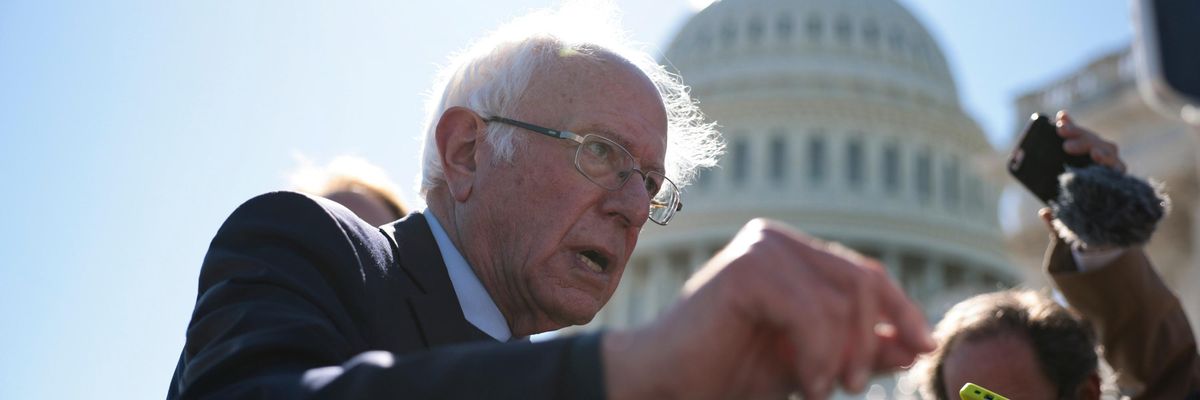
Sen. Bernie Sanders (I-Vt.) speaks with reporters as he leaves the U.S. Capitol building on October 21, 2021 in Washington, D.C. (Photo: Anna Moneymaker/Getty Images)
Senate Budget Committee Chair Bernie Sanders announced Monday that there will be a hearing on Medicare for All this Thursday.
"We spend twice as much per capita on healthcare as any other nation but with worse health outcomes for our people," Sanders (I-Vt.) tweeted Monday. "Does that make sense to anyone? It's time for Medicare for All."
The hearing, which Sanders first announced in March, is called "Medicare for All: Protecting Health, Saving Lives, Saving Money," and is scheduled to feature testimony from witnesses including Assistant Professor of Medicine at Harvard Medical School Adam Gaffney, National Nurses United executive director Bonnie Castillo, and Congressional Budget Office (CBO) director Phillip Swage.
"The need for fundamental healthcare reform has never been so urgent," said Gaffney--a critical care physician and past president of Physicians for a National Health Program--on Monday.
An index released in March by Gallup and West Health showed that 44% of the U.S. adult population, or roughly 112 million Americans, had difficulties paying for healthcare or prescribed medicines over the last three months.
A study released months earlier also by West Health and Gallup found that Covid-19 has worsened fears about payments for those needs, with nearly six in 10 U.S. adults saying that they are more worried about the cost of healthcare.
Forty-eight percent of adults also said the pandemic worsened their view of the U.S. healthcare system. Sixty percent said that because of Covid-19, they were more concerned that some Americans have unequal access to quality healthcare services.
Sanders, a longtime proponent of a single-payer healthcare system, has frequently pointed to the CBO's estimate that Medicare for All could deliver Americans $650 billion in annual savings while providing better care and outcomes than the current for-profit system.
Thursday's Senate Budge Committee hearing will mark the second congressional hearing on Medicare for All since the pandemic began in 2020.
The first was held by the House Oversight Committee in March and examined Reps. Pramila Jayapal (D-Wash.) and Debbie Dingell's (D-Mich.) Medicare for All Act of 2021.
That hearing was co-led by Rep. Cori Bush, who said at the time that "Congress must implement a system that prioritizes people over profits, humanity over greed, and compassion over exploitation."
"We are going to make healthcare a human right in this country," she said.
Dear Common Dreams reader, It’s been nearly 30 years since I co-founded Common Dreams with my late wife, Lina Newhouser. We had the radical notion that journalism should serve the public good, not corporate profits. It was clear to us from the outset what it would take to build such a project. No paid advertisements. No corporate sponsors. No millionaire publisher telling us what to think or do. Many people said we wouldn't last a year, but we proved those doubters wrong. Together with a tremendous team of journalists and dedicated staff, we built an independent media outlet free from the constraints of profits and corporate control. Our mission has always been simple: To inform. To inspire. To ignite change for the common good. Building Common Dreams was not easy. Our survival was never guaranteed. When you take on the most powerful forces—Wall Street greed, fossil fuel industry destruction, Big Tech lobbyists, and uber-rich oligarchs who have spent billions upon billions rigging the economy and democracy in their favor—the only bulwark you have is supporters who believe in your work. But here’s the urgent message from me today. It's never been this bad out there. And it's never been this hard to keep us going. At the very moment Common Dreams is most needed, the threats we face are intensifying. We need your support now more than ever. We don't accept corporate advertising and never will. We don't have a paywall because we don't think people should be blocked from critical news based on their ability to pay. Everything we do is funded by the donations of readers like you. When everyone does the little they can afford, we are strong. But if that support retreats or dries up, so do we. Will you donate now to make sure Common Dreams not only survives but thrives? —Craig Brown, Co-founder |
Senate Budget Committee Chair Bernie Sanders announced Monday that there will be a hearing on Medicare for All this Thursday.
"We spend twice as much per capita on healthcare as any other nation but with worse health outcomes for our people," Sanders (I-Vt.) tweeted Monday. "Does that make sense to anyone? It's time for Medicare for All."
The hearing, which Sanders first announced in March, is called "Medicare for All: Protecting Health, Saving Lives, Saving Money," and is scheduled to feature testimony from witnesses including Assistant Professor of Medicine at Harvard Medical School Adam Gaffney, National Nurses United executive director Bonnie Castillo, and Congressional Budget Office (CBO) director Phillip Swage.
"The need for fundamental healthcare reform has never been so urgent," said Gaffney--a critical care physician and past president of Physicians for a National Health Program--on Monday.
An index released in March by Gallup and West Health showed that 44% of the U.S. adult population, or roughly 112 million Americans, had difficulties paying for healthcare or prescribed medicines over the last three months.
A study released months earlier also by West Health and Gallup found that Covid-19 has worsened fears about payments for those needs, with nearly six in 10 U.S. adults saying that they are more worried about the cost of healthcare.
Forty-eight percent of adults also said the pandemic worsened their view of the U.S. healthcare system. Sixty percent said that because of Covid-19, they were more concerned that some Americans have unequal access to quality healthcare services.
Sanders, a longtime proponent of a single-payer healthcare system, has frequently pointed to the CBO's estimate that Medicare for All could deliver Americans $650 billion in annual savings while providing better care and outcomes than the current for-profit system.
Thursday's Senate Budge Committee hearing will mark the second congressional hearing on Medicare for All since the pandemic began in 2020.
The first was held by the House Oversight Committee in March and examined Reps. Pramila Jayapal (D-Wash.) and Debbie Dingell's (D-Mich.) Medicare for All Act of 2021.
That hearing was co-led by Rep. Cori Bush, who said at the time that "Congress must implement a system that prioritizes people over profits, humanity over greed, and compassion over exploitation."
"We are going to make healthcare a human right in this country," she said.
Senate Budget Committee Chair Bernie Sanders announced Monday that there will be a hearing on Medicare for All this Thursday.
"We spend twice as much per capita on healthcare as any other nation but with worse health outcomes for our people," Sanders (I-Vt.) tweeted Monday. "Does that make sense to anyone? It's time for Medicare for All."
The hearing, which Sanders first announced in March, is called "Medicare for All: Protecting Health, Saving Lives, Saving Money," and is scheduled to feature testimony from witnesses including Assistant Professor of Medicine at Harvard Medical School Adam Gaffney, National Nurses United executive director Bonnie Castillo, and Congressional Budget Office (CBO) director Phillip Swage.
"The need for fundamental healthcare reform has never been so urgent," said Gaffney--a critical care physician and past president of Physicians for a National Health Program--on Monday.
An index released in March by Gallup and West Health showed that 44% of the U.S. adult population, or roughly 112 million Americans, had difficulties paying for healthcare or prescribed medicines over the last three months.
A study released months earlier also by West Health and Gallup found that Covid-19 has worsened fears about payments for those needs, with nearly six in 10 U.S. adults saying that they are more worried about the cost of healthcare.
Forty-eight percent of adults also said the pandemic worsened their view of the U.S. healthcare system. Sixty percent said that because of Covid-19, they were more concerned that some Americans have unequal access to quality healthcare services.
Sanders, a longtime proponent of a single-payer healthcare system, has frequently pointed to the CBO's estimate that Medicare for All could deliver Americans $650 billion in annual savings while providing better care and outcomes than the current for-profit system.
Thursday's Senate Budge Committee hearing will mark the second congressional hearing on Medicare for All since the pandemic began in 2020.
The first was held by the House Oversight Committee in March and examined Reps. Pramila Jayapal (D-Wash.) and Debbie Dingell's (D-Mich.) Medicare for All Act of 2021.
That hearing was co-led by Rep. Cori Bush, who said at the time that "Congress must implement a system that prioritizes people over profits, humanity over greed, and compassion over exploitation."
"We are going to make healthcare a human right in this country," she said.