SUBSCRIBE TO OUR FREE NEWSLETTER
Daily news & progressive opinion—funded by the people, not the corporations—delivered straight to your inbox.
5
#000000
#FFFFFF
To donate by check, phone, or other method, see our More Ways to Give page.
Daily news & progressive opinion—funded by the people, not the corporations—delivered straight to your inbox.
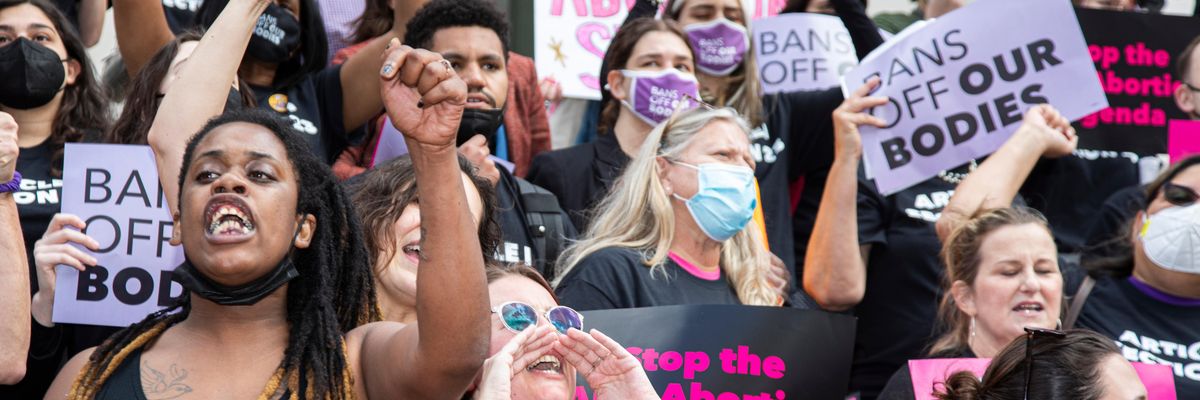
Protesters opposed to anti-choice legislation gather at the Florida Capitol in Tallahassee on February 16, 2022. (Photo: Mark Wallheiser/Getty Images)
After Florida's GOP governor on Thursday signed a 15-week abortion ban inspired by a contested Mississippi law that could soon reverse Roe v. Wade, pro-choice advocates warned of impacts across the region, given that the Sunshine State has long been "an oasis of reproductive care in the South."
With Gov. Ron DeSantis' support, Florida's law is set to take effect this summer. His signature came after Republican state legislators in Kentucky on Wednesday overrode their Democratic governor's veto of a similar bill and GOP Oklahoma Gov. Kevin Stitt on Tuesday signed a near-total abortion ban.
In a tweet about the recent developments, the pro-choice Guttmacher Institute said the latest state-level bans "not only violate the rights and autonomy of people seeking essential care, but will devastate abortion access across large parts of the nation."
The Center for Reproductive Rights--which is helping challenge the Mississippi law--similarly pointed out that "Florida has been a critical haven for abortion access in the South, and this ban will decimate abortion access for Floridians and the entire region."
Florida "allows abortions up to 24 weeks, the limit defined in the 1973 Supreme Court decision Roe v. Wade," HuffPost explained as the measure moved through the Legislature earlier this year. "For hundreds of miles, other states have much more restrictive policies--if you headed west from Florida, you'd have to go all the way through the deep South and Texas to New Mexico to find a similar level of reproductive care and accessibility."
As HuffPost reported:
The legislation is modeled directly after the 15-week abortion ban in Mississippi that was debated in front of the Supreme Court last month in Dobbs v. Jackson Women's Health Organization. The Mississippi law threatens to move the federal gestational limit allowed in Roe from 24 weeks to 15 weeks. Mississippi has also asked the conservative Supreme Court majority to overturn Roe altogether. Although the decision in the case is not expected until June, many experts and advocates believe that Roe will either be gutted or overturned.
The Florida ban would go into effect on July 1, 2022, likely weeks or even days after the Supreme Court rules in that case.
Highlighting that Florida joins not only Kentucky but also Arizona in recently banning abortions after 15 weeks, NARAL Pro-Choice America president Mini Timmaraju noted Thursday that "this is a shameless step towards what could be a terrifying new future for reproductive freedom in the country."
"Anti-choice politicians across the United States, emboldened by the Supreme Court's anti-choice supermajority, are clamoring at the opportunity to enact abortion bans like Mississippi's," she added. "No matter what kind of ban, let's be clear: They are all meant to take away people's freedom to make their own decisions about pregnancy and parenthood and impose one-size-fits-all restrictions."
Laura Goodhue, executive director of Florida Alliance of Planned Parenthood Affiliates, was similarly critical, charging that "by signing this cruel piece of legislation, Gov. Ron DeSantis has taken away Floridians' freedom to control their own bodies."
"The so-called 'Free State of Florida' will never be truly free so long as politicians like DeSantis are able to impose their beliefs on the rest of us," she said. "This is a full-scale assault on patients and their healthcare providers."
Some critics emphasized that Florida's looming law--which has no exceptions for rape or incest and limits abortions to protect the life and health of the pregnant person--will disproportionately impact marginalized communities.
As Kara Gross, legislative director and senior policy counsel at the ACLU of Florida, put it: "Gov. DeSantis and the Florida Legislature's shameful abortion ban would push abortion care out of reach for countless Floridians."
"It is not always possible for people to obtain an abortion within the arbitrary timeframe provided in this bill, even if they've been trying to get one for weeks," she pointed out. "There are already so many barriers to abortion care, especially for young people, those with fewer resources, and those who live in rural areas."
"Make no mistake: If this abortion ban goes into effect, it would have devastating consequences for pregnant people, especially those who are not able to afford to travel out of state in search of the essential healthcare they need," Gross said, vowing that her group "will take swift legal action to protect Floridians' rights and defend against this cruel attack on our bodily autonomy."
State legislation resembling Mississippi's 15-week ban as well as a Texas measure that empowers anti-choice vigilantes to sue anyone who "aids or abets" an abortion after six weeks--before many people know they are pregnant--has bolstered calls for Congress to codify Roe into federal law.
The Women's Health Protection Act would do just that. Although all but one Democrat in the U.S. House of Representatives passed the bill shortly after the Texas law took effect last year, Sen. Joe Manchin (D-W.Va.) in February joined with the upper chamber's Republicans to block it.
The Leadership Conference on Civil and Human Rights tweeted Thursday that "restrictive abortion laws are yet another way in which healthcare access is denied to those who face systemic oppression in this country--and that is why we urgently need the Women's Health Protection Act."
Dear Common Dreams reader, It’s been nearly 30 years since I co-founded Common Dreams with my late wife, Lina Newhouser. We had the radical notion that journalism should serve the public good, not corporate profits. It was clear to us from the outset what it would take to build such a project. No paid advertisements. No corporate sponsors. No millionaire publisher telling us what to think or do. Many people said we wouldn't last a year, but we proved those doubters wrong. Together with a tremendous team of journalists and dedicated staff, we built an independent media outlet free from the constraints of profits and corporate control. Our mission has always been simple: To inform. To inspire. To ignite change for the common good. Building Common Dreams was not easy. Our survival was never guaranteed. When you take on the most powerful forces—Wall Street greed, fossil fuel industry destruction, Big Tech lobbyists, and uber-rich oligarchs who have spent billions upon billions rigging the economy and democracy in their favor—the only bulwark you have is supporters who believe in your work. But here’s the urgent message from me today. It's never been this bad out there. And it's never been this hard to keep us going. At the very moment Common Dreams is most needed, the threats we face are intensifying. We need your support now more than ever. We don't accept corporate advertising and never will. We don't have a paywall because we don't think people should be blocked from critical news based on their ability to pay. Everything we do is funded by the donations of readers like you. When everyone does the little they can afford, we are strong. But if that support retreats or dries up, so do we. Will you donate now to make sure Common Dreams not only survives but thrives? —Craig Brown, Co-founder |
After Florida's GOP governor on Thursday signed a 15-week abortion ban inspired by a contested Mississippi law that could soon reverse Roe v. Wade, pro-choice advocates warned of impacts across the region, given that the Sunshine State has long been "an oasis of reproductive care in the South."
With Gov. Ron DeSantis' support, Florida's law is set to take effect this summer. His signature came after Republican state legislators in Kentucky on Wednesday overrode their Democratic governor's veto of a similar bill and GOP Oklahoma Gov. Kevin Stitt on Tuesday signed a near-total abortion ban.
In a tweet about the recent developments, the pro-choice Guttmacher Institute said the latest state-level bans "not only violate the rights and autonomy of people seeking essential care, but will devastate abortion access across large parts of the nation."
The Center for Reproductive Rights--which is helping challenge the Mississippi law--similarly pointed out that "Florida has been a critical haven for abortion access in the South, and this ban will decimate abortion access for Floridians and the entire region."
Florida "allows abortions up to 24 weeks, the limit defined in the 1973 Supreme Court decision Roe v. Wade," HuffPost explained as the measure moved through the Legislature earlier this year. "For hundreds of miles, other states have much more restrictive policies--if you headed west from Florida, you'd have to go all the way through the deep South and Texas to New Mexico to find a similar level of reproductive care and accessibility."
As HuffPost reported:
The legislation is modeled directly after the 15-week abortion ban in Mississippi that was debated in front of the Supreme Court last month in Dobbs v. Jackson Women's Health Organization. The Mississippi law threatens to move the federal gestational limit allowed in Roe from 24 weeks to 15 weeks. Mississippi has also asked the conservative Supreme Court majority to overturn Roe altogether. Although the decision in the case is not expected until June, many experts and advocates believe that Roe will either be gutted or overturned.
The Florida ban would go into effect on July 1, 2022, likely weeks or even days after the Supreme Court rules in that case.
Highlighting that Florida joins not only Kentucky but also Arizona in recently banning abortions after 15 weeks, NARAL Pro-Choice America president Mini Timmaraju noted Thursday that "this is a shameless step towards what could be a terrifying new future for reproductive freedom in the country."
"Anti-choice politicians across the United States, emboldened by the Supreme Court's anti-choice supermajority, are clamoring at the opportunity to enact abortion bans like Mississippi's," she added. "No matter what kind of ban, let's be clear: They are all meant to take away people's freedom to make their own decisions about pregnancy and parenthood and impose one-size-fits-all restrictions."
Laura Goodhue, executive director of Florida Alliance of Planned Parenthood Affiliates, was similarly critical, charging that "by signing this cruel piece of legislation, Gov. Ron DeSantis has taken away Floridians' freedom to control their own bodies."
"The so-called 'Free State of Florida' will never be truly free so long as politicians like DeSantis are able to impose their beliefs on the rest of us," she said. "This is a full-scale assault on patients and their healthcare providers."
Some critics emphasized that Florida's looming law--which has no exceptions for rape or incest and limits abortions to protect the life and health of the pregnant person--will disproportionately impact marginalized communities.
As Kara Gross, legislative director and senior policy counsel at the ACLU of Florida, put it: "Gov. DeSantis and the Florida Legislature's shameful abortion ban would push abortion care out of reach for countless Floridians."
"It is not always possible for people to obtain an abortion within the arbitrary timeframe provided in this bill, even if they've been trying to get one for weeks," she pointed out. "There are already so many barriers to abortion care, especially for young people, those with fewer resources, and those who live in rural areas."
"Make no mistake: If this abortion ban goes into effect, it would have devastating consequences for pregnant people, especially those who are not able to afford to travel out of state in search of the essential healthcare they need," Gross said, vowing that her group "will take swift legal action to protect Floridians' rights and defend against this cruel attack on our bodily autonomy."
State legislation resembling Mississippi's 15-week ban as well as a Texas measure that empowers anti-choice vigilantes to sue anyone who "aids or abets" an abortion after six weeks--before many people know they are pregnant--has bolstered calls for Congress to codify Roe into federal law.
The Women's Health Protection Act would do just that. Although all but one Democrat in the U.S. House of Representatives passed the bill shortly after the Texas law took effect last year, Sen. Joe Manchin (D-W.Va.) in February joined with the upper chamber's Republicans to block it.
The Leadership Conference on Civil and Human Rights tweeted Thursday that "restrictive abortion laws are yet another way in which healthcare access is denied to those who face systemic oppression in this country--and that is why we urgently need the Women's Health Protection Act."
After Florida's GOP governor on Thursday signed a 15-week abortion ban inspired by a contested Mississippi law that could soon reverse Roe v. Wade, pro-choice advocates warned of impacts across the region, given that the Sunshine State has long been "an oasis of reproductive care in the South."
With Gov. Ron DeSantis' support, Florida's law is set to take effect this summer. His signature came after Republican state legislators in Kentucky on Wednesday overrode their Democratic governor's veto of a similar bill and GOP Oklahoma Gov. Kevin Stitt on Tuesday signed a near-total abortion ban.
In a tweet about the recent developments, the pro-choice Guttmacher Institute said the latest state-level bans "not only violate the rights and autonomy of people seeking essential care, but will devastate abortion access across large parts of the nation."
The Center for Reproductive Rights--which is helping challenge the Mississippi law--similarly pointed out that "Florida has been a critical haven for abortion access in the South, and this ban will decimate abortion access for Floridians and the entire region."
Florida "allows abortions up to 24 weeks, the limit defined in the 1973 Supreme Court decision Roe v. Wade," HuffPost explained as the measure moved through the Legislature earlier this year. "For hundreds of miles, other states have much more restrictive policies--if you headed west from Florida, you'd have to go all the way through the deep South and Texas to New Mexico to find a similar level of reproductive care and accessibility."
As HuffPost reported:
The legislation is modeled directly after the 15-week abortion ban in Mississippi that was debated in front of the Supreme Court last month in Dobbs v. Jackson Women's Health Organization. The Mississippi law threatens to move the federal gestational limit allowed in Roe from 24 weeks to 15 weeks. Mississippi has also asked the conservative Supreme Court majority to overturn Roe altogether. Although the decision in the case is not expected until June, many experts and advocates believe that Roe will either be gutted or overturned.
The Florida ban would go into effect on July 1, 2022, likely weeks or even days after the Supreme Court rules in that case.
Highlighting that Florida joins not only Kentucky but also Arizona in recently banning abortions after 15 weeks, NARAL Pro-Choice America president Mini Timmaraju noted Thursday that "this is a shameless step towards what could be a terrifying new future for reproductive freedom in the country."
"Anti-choice politicians across the United States, emboldened by the Supreme Court's anti-choice supermajority, are clamoring at the opportunity to enact abortion bans like Mississippi's," she added. "No matter what kind of ban, let's be clear: They are all meant to take away people's freedom to make their own decisions about pregnancy and parenthood and impose one-size-fits-all restrictions."
Laura Goodhue, executive director of Florida Alliance of Planned Parenthood Affiliates, was similarly critical, charging that "by signing this cruel piece of legislation, Gov. Ron DeSantis has taken away Floridians' freedom to control their own bodies."
"The so-called 'Free State of Florida' will never be truly free so long as politicians like DeSantis are able to impose their beliefs on the rest of us," she said. "This is a full-scale assault on patients and their healthcare providers."
Some critics emphasized that Florida's looming law--which has no exceptions for rape or incest and limits abortions to protect the life and health of the pregnant person--will disproportionately impact marginalized communities.
As Kara Gross, legislative director and senior policy counsel at the ACLU of Florida, put it: "Gov. DeSantis and the Florida Legislature's shameful abortion ban would push abortion care out of reach for countless Floridians."
"It is not always possible for people to obtain an abortion within the arbitrary timeframe provided in this bill, even if they've been trying to get one for weeks," she pointed out. "There are already so many barriers to abortion care, especially for young people, those with fewer resources, and those who live in rural areas."
"Make no mistake: If this abortion ban goes into effect, it would have devastating consequences for pregnant people, especially those who are not able to afford to travel out of state in search of the essential healthcare they need," Gross said, vowing that her group "will take swift legal action to protect Floridians' rights and defend against this cruel attack on our bodily autonomy."
State legislation resembling Mississippi's 15-week ban as well as a Texas measure that empowers anti-choice vigilantes to sue anyone who "aids or abets" an abortion after six weeks--before many people know they are pregnant--has bolstered calls for Congress to codify Roe into federal law.
The Women's Health Protection Act would do just that. Although all but one Democrat in the U.S. House of Representatives passed the bill shortly after the Texas law took effect last year, Sen. Joe Manchin (D-W.Va.) in February joined with the upper chamber's Republicans to block it.
The Leadership Conference on Civil and Human Rights tweeted Thursday that "restrictive abortion laws are yet another way in which healthcare access is denied to those who face systemic oppression in this country--and that is why we urgently need the Women's Health Protection Act."