SUBSCRIBE TO OUR FREE NEWSLETTER
Daily news & progressive opinion—funded by the people, not the corporations—delivered straight to your inbox.
5
#000000
#FFFFFF
To donate by check, phone, or other method, see our More Ways to Give page.
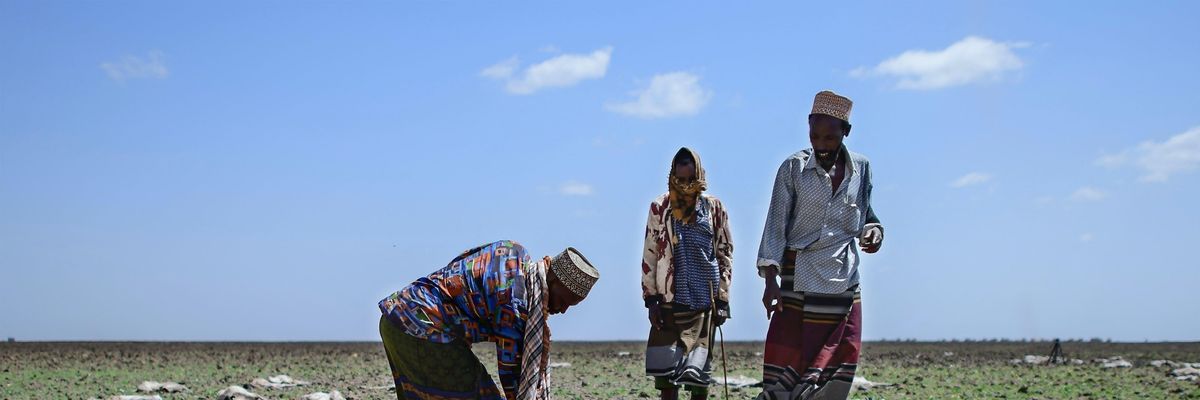
As Russia's invasion of Ukraine diverts both food and attention from Africa, Oxfam International warned Tuesday that up to 28 million people in the continent's eastern nations are at risk of famine if a historic drought continues.
"I think about what will my family eat, where will their next meal come from, whether I will get the daily jerrycan of water."
"East Africa faces a profoundly alarming hunger crisis. Areas of Ethiopia, Kenya, Somalia, South Sudan, and beyond are experiencing an unfolding full-scale catastrophe," Oxfam International executive director Gabriela Bucher said in a statement. "Even if the rains do arrive this month, full recovery will be near impossible unless urgent action is taken today."
Three consecutive rainy seasons have failed to materialize in the Horn of Africa, with scientists and aid agencies warning that the March rains could fail again. The crisis, which is exacerbated by wars in Ethiopia and Somalia, has destroyed crops and livelihoods, killed off large numbers of livestock, and forced both pastoral and farming families from their homes.
Ahmed Mohamud Omar, an elderly pastoralist from Wajir County, Kenya, told Oxfam that "due to the droughts our donkeys have perished and the ones remaining are too weak to pull carts. My only tuk-tuk is now parked idle because I can't afford its fuel. I no longer have my camels or goats; I think about what will my family eat, where will their next meal come from, whether I will get the daily jerrycan of water."
Bob Kitchen, vice president of emergencies at the International Rescue Committee, said in a statement that "food insecurity across the Horn of Africa is precarious and is set to worsen as the Ukraine crisis threatens the reliance on grain the region has."
"At least four million Somalis are projected to face emergency levels of hunger by June of this year," he added. "In the Sahel, almost 30 million people are in need of urgent humanitarian assistance, with vulnerabilities and needs worsening as climate shocks, conflict, and the Covid-19 pandemic continue to wreak havoc across the region."
Meanwhile, Russia's invasion of Ukraine--according to Oxfam, the two countries combined provide up to 90% of East Africa's imported wheat--is further fueling hunger not only in Africa but in other global crisis zones including Afghanistan and Yemen.
Roughly 13,000 Afghan newborns have died of malnutrition and hunger-related diseases since January, while 95% of Afghans do not have enough to eat--a situation one senior United Nations official last week called "a food insecurity and malnutrition crisis of unparalleled proportions."
Related Content

In war-torn Yemen, which gets around 30% of its wheat from Ukraine, multiple United Nations agencies warned last week of a projected five-fold increase in famine conditions.
"The repercussions of the Ukrainian conflict on the global food system will reverberate around the globe, but it is the poorest and most vulnerable people who will be among those hit hardest and fastest," said Oxfam's Bucher. "Rising food prices are a hammer blow to millions of people who are already suffering multiple crises, and make the huge shortfall in aid potentially lethal."
"East Africa cannot wait," she continued. "The hunger crisis, fueled by changes in our climate and Covid-19, is worsening by the day. Oxfam is calling on all donors to urgently fill the U.N. humanitarian appeal funding gap, and to get funds as quickly as possible to local humanitarian organizations."
"We call upon the governments especially from grain exporting countries to do all they can to find suitable alternatives to the imminent disruption in the supply chain from Ukraine towards low-income, food-import dependent countries," Bucher said. "And--as we witness the tremors triggered by the failure in international efforts to tackle the climate crisis--we underscore the need to ramp up action on climate adaptation and mitigation."
"To not act now would be immoral and a dereliction of the humanitarian imperative," she stressed.
As Russia's invasion of Ukraine diverts both food and attention from Africa, Oxfam International warned Tuesday that up to 28 million people in the continent's eastern nations are at risk of famine if a historic drought continues.
"I think about what will my family eat, where will their next meal come from, whether I will get the daily jerrycan of water."
"East Africa faces a profoundly alarming hunger crisis. Areas of Ethiopia, Kenya, Somalia, South Sudan, and beyond are experiencing an unfolding full-scale catastrophe," Oxfam International executive director Gabriela Bucher said in a statement. "Even if the rains do arrive this month, full recovery will be near impossible unless urgent action is taken today."
Three consecutive rainy seasons have failed to materialize in the Horn of Africa, with scientists and aid agencies warning that the March rains could fail again. The crisis, which is exacerbated by wars in Ethiopia and Somalia, has destroyed crops and livelihoods, killed off large numbers of livestock, and forced both pastoral and farming families from their homes.
Ahmed Mohamud Omar, an elderly pastoralist from Wajir County, Kenya, told Oxfam that "due to the droughts our donkeys have perished and the ones remaining are too weak to pull carts. My only tuk-tuk is now parked idle because I can't afford its fuel. I no longer have my camels or goats; I think about what will my family eat, where will their next meal come from, whether I will get the daily jerrycan of water."
Bob Kitchen, vice president of emergencies at the International Rescue Committee, said in a statement that "food insecurity across the Horn of Africa is precarious and is set to worsen as the Ukraine crisis threatens the reliance on grain the region has."
"At least four million Somalis are projected to face emergency levels of hunger by June of this year," he added. "In the Sahel, almost 30 million people are in need of urgent humanitarian assistance, with vulnerabilities and needs worsening as climate shocks, conflict, and the Covid-19 pandemic continue to wreak havoc across the region."
Meanwhile, Russia's invasion of Ukraine--according to Oxfam, the two countries combined provide up to 90% of East Africa's imported wheat--is further fueling hunger not only in Africa but in other global crisis zones including Afghanistan and Yemen.
Roughly 13,000 Afghan newborns have died of malnutrition and hunger-related diseases since January, while 95% of Afghans do not have enough to eat--a situation one senior United Nations official last week called "a food insecurity and malnutrition crisis of unparalleled proportions."
Related Content
In war-torn Yemen, which gets around 30% of its wheat from Ukraine, multiple United Nations agencies warned last week of a projected five-fold increase in famine conditions.
"The repercussions of the Ukrainian conflict on the global food system will reverberate around the globe, but it is the poorest and most vulnerable people who will be among those hit hardest and fastest," said Oxfam's Bucher. "Rising food prices are a hammer blow to millions of people who are already suffering multiple crises, and make the huge shortfall in aid potentially lethal."
"East Africa cannot wait," she continued. "The hunger crisis, fueled by changes in our climate and Covid-19, is worsening by the day. Oxfam is calling on all donors to urgently fill the U.N. humanitarian appeal funding gap, and to get funds as quickly as possible to local humanitarian organizations."
"We call upon the governments especially from grain exporting countries to do all they can to find suitable alternatives to the imminent disruption in the supply chain from Ukraine towards low-income, food-import dependent countries," Bucher said. "And--as we witness the tremors triggered by the failure in international efforts to tackle the climate crisis--we underscore the need to ramp up action on climate adaptation and mitigation."
"To not act now would be immoral and a dereliction of the humanitarian imperative," she stressed.
As Russia's invasion of Ukraine diverts both food and attention from Africa, Oxfam International warned Tuesday that up to 28 million people in the continent's eastern nations are at risk of famine if a historic drought continues.
"I think about what will my family eat, where will their next meal come from, whether I will get the daily jerrycan of water."
"East Africa faces a profoundly alarming hunger crisis. Areas of Ethiopia, Kenya, Somalia, South Sudan, and beyond are experiencing an unfolding full-scale catastrophe," Oxfam International executive director Gabriela Bucher said in a statement. "Even if the rains do arrive this month, full recovery will be near impossible unless urgent action is taken today."
Three consecutive rainy seasons have failed to materialize in the Horn of Africa, with scientists and aid agencies warning that the March rains could fail again. The crisis, which is exacerbated by wars in Ethiopia and Somalia, has destroyed crops and livelihoods, killed off large numbers of livestock, and forced both pastoral and farming families from their homes.
Ahmed Mohamud Omar, an elderly pastoralist from Wajir County, Kenya, told Oxfam that "due to the droughts our donkeys have perished and the ones remaining are too weak to pull carts. My only tuk-tuk is now parked idle because I can't afford its fuel. I no longer have my camels or goats; I think about what will my family eat, where will their next meal come from, whether I will get the daily jerrycan of water."
Bob Kitchen, vice president of emergencies at the International Rescue Committee, said in a statement that "food insecurity across the Horn of Africa is precarious and is set to worsen as the Ukraine crisis threatens the reliance on grain the region has."
"At least four million Somalis are projected to face emergency levels of hunger by June of this year," he added. "In the Sahel, almost 30 million people are in need of urgent humanitarian assistance, with vulnerabilities and needs worsening as climate shocks, conflict, and the Covid-19 pandemic continue to wreak havoc across the region."
Meanwhile, Russia's invasion of Ukraine--according to Oxfam, the two countries combined provide up to 90% of East Africa's imported wheat--is further fueling hunger not only in Africa but in other global crisis zones including Afghanistan and Yemen.
Roughly 13,000 Afghan newborns have died of malnutrition and hunger-related diseases since January, while 95% of Afghans do not have enough to eat--a situation one senior United Nations official last week called "a food insecurity and malnutrition crisis of unparalleled proportions."
Related Content
In war-torn Yemen, which gets around 30% of its wheat from Ukraine, multiple United Nations agencies warned last week of a projected five-fold increase in famine conditions.
"The repercussions of the Ukrainian conflict on the global food system will reverberate around the globe, but it is the poorest and most vulnerable people who will be among those hit hardest and fastest," said Oxfam's Bucher. "Rising food prices are a hammer blow to millions of people who are already suffering multiple crises, and make the huge shortfall in aid potentially lethal."
"East Africa cannot wait," she continued. "The hunger crisis, fueled by changes in our climate and Covid-19, is worsening by the day. Oxfam is calling on all donors to urgently fill the U.N. humanitarian appeal funding gap, and to get funds as quickly as possible to local humanitarian organizations."
"We call upon the governments especially from grain exporting countries to do all they can to find suitable alternatives to the imminent disruption in the supply chain from Ukraine towards low-income, food-import dependent countries," Bucher said. "And--as we witness the tremors triggered by the failure in international efforts to tackle the climate crisis--we underscore the need to ramp up action on climate adaptation and mitigation."
"To not act now would be immoral and a dereliction of the humanitarian imperative," she stressed.