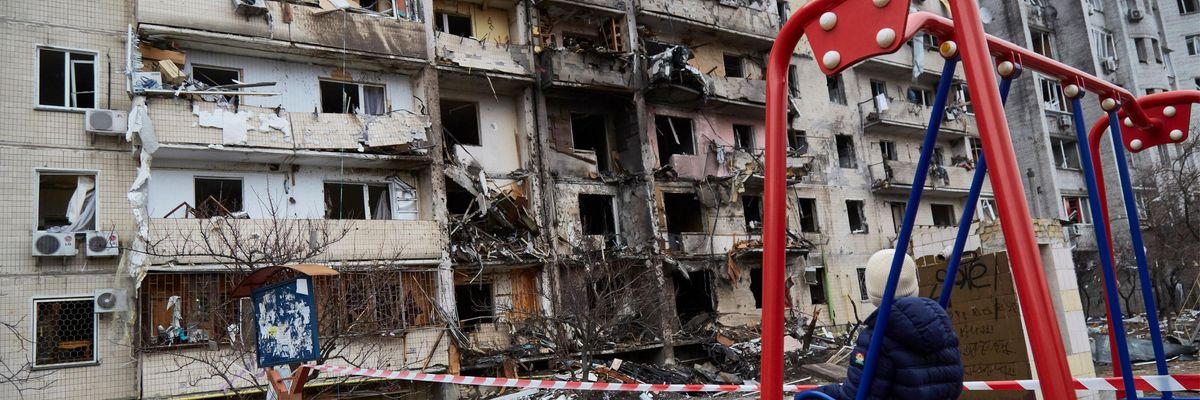
A child swings outside a residential building damaged by a missile on February 25, 2022 in Kyiv, Ukraine. (Photo: Pierre Crom/Getty Images)
Amnesty Says Russia's 'Indiscriminate Attacks' in Ukraine May Be War Crimes
The ICC prosecutor, who is following the invasion "with increasing concern," signals the court may launch an investigation.
Amnesty International declared Friday that Russia's invasion of Ukraine "has been marked by indiscriminate attacks on civilian areas and strikes on protected objects such as hospitals" that may amount to war crimes.
"The Russian military has shown a blatant disregard for civilian lives."
The human rights group's Crisis Evidence Lab analyzed photos, videos, and satellite imagery of three attacks--in the Ukrainian cities Vuhledar, Kharkiv, and Uman--carried out in the early hours of the invasion, which Russian President Vladimir Putin announced before dawn on Thursday.
"The Russian military has shown a blatant disregard for civilian lives by using ballistic missiles and other explosive weapons with wide-area effects in densely populated areas," said Agnes Callamard, Amnesty's secretary general, in a statement.
"Some of these attacks may be war crimes," she continued. "The Russian government, which falsely claims to use only precision-guided weapons, should take responsibility for these acts."
Callamard added that "the Russian troops should immediately stop carrying out indiscriminate attacks in violation of the laws of war. The continuation of the use of ballistic missiles and other inaccurate explosive weapons causing civilian deaths and injuries is inexcusable."
Amnesty's researchers believe the trio of analyzed attacks killed at least six civilians and injured at least a dozen others. Ukrainian President Volodymyr Zelenskyy said late Thursday that the overall death toll had topped 130 and more than 300 people were wounded on the first day of the assault.
Though the United Nations Security Council (UNSC) is scheduled to meet Thursday to discuss Putin's widely condemned invasion, Russia is one of the five permanent members--along with China, France, the United Kingdom, and the United States--meaning it has veto power over resolutions.
Russia also currently leads the 15-member UNSC--though Ukraine's ambassador, Sergiy Kyslytsya, suggested during a meeting earlier this week that his Russian counterpart, Vasily Nebenzya, should relinquish the rotating presidency, which is set to shift to the United Arab Emirates in March.
That meeting concluded with Kyslytsya telling Nebenzya that "there is no purgatory for war criminals; they go straight to hell, ambassador," to which the Russian responded that "we are not carrying out aggression against the Ukrainian people--this is against that junta, that seized power in Kyiv."
Given the current limitations of the UNSC, Amnesty International is calling for an emergency session of the U.N. General Assembly. As Callamard put it: "If the Security Council is paralyzed through veto, it is up to the entire membership to step up."
Warning that the "lives, safety, and well-being" of millions of Ukrainians are at stake, she urged the General Assembly to adopt a resolution denouncing Russia's "unlawful attack and calling for an end to all violations of humanitarian law and human rights."
Amnesty was far from alone in sounding the alarm about Russia violating international law.
A spokesperson for the U.N. High Commissioner for Human Rights Michelle Bachelet said Friday that "we are gravely concerned about developments" in Ukraine and "we are receiving increasing reports of civilian casualties."
"Civilians are terrified of further escalation, with many attempting to flee their homes and others taking shelter where possible," added the spokesperson. "As the high commissioner has warned, the military action by the Russian Federation clearly violates international law. It puts at risk countless lives and it must be immediately halted."
International Criminal Court (ICC) Prosecutor Karim A.A. Khan similarly said Friday that "I have been closely following recent developments in and around Ukraine with increasing concern."
Though neither Ukraine nor Russia is a state party to the Rome Statute of the ICC, Khan pointed out that due to a 2015 declaration following Russia's annexation of Crimea, "my office may exercise its jurisdiction over and investigate any act of genocide, crime against humanity, or war crime committed within the territory of Ukraine" since February 20, 2014.
"Any person who commits such crimes, including by ordering, inciting, or contributing in another manner to the commission of these crimes, may be liable to prosecution before the court, with full respect for the principle of complementarity," he said. "It is imperative that all parties to the conflict respect their obligations under international humanitarian law."
The ICC also investigates crimes of aggression, but Khan explained that because neither involved nation is party to the Rome Statute, "the court cannot exercise jurisdiction over this alleged crime in this situation."
The prosecutor--who is on mission in Bangladesh but plans to release a fuller statement upon returning to The Hague--vowed that his office "will continue to closely monitor the situation" and "remains fully committed to the prevention of atrocity crimes and to ensuring that anyone responsible for such crimes is held accountable."
After reports that Russia attacked a kindergarten and orphanage in the city of Okhtyrka, Ukrainian Minister of Foreign Affairs Dmytro Kuleba tweeted Friday that officials are collecting evidence of "war crimes and violations of the Rome Statute" that will be sent to The Hague.
As Common Dreams reported earlier Friday, Russian forces also have been accused of using cluster munitions in the ongoing assault of Ukraine, leading an international coalition to call for "an immediate halt to use of the internationally banned weapon."
An Urgent Message From Our Co-Founder
Dear Common Dreams reader, It’s been nearly 30 years since I co-founded Common Dreams with my late wife, Lina Newhouser. We had the radical notion that journalism should serve the public good, not corporate profits. It was clear to us from the outset what it would take to build such a project. No paid advertisements. No corporate sponsors. No millionaire publisher telling us what to think or do. Many people said we wouldn't last a year, but we proved those doubters wrong. Together with a tremendous team of journalists and dedicated staff, we built an independent media outlet free from the constraints of profits and corporate control. Our mission has always been simple: To inform. To inspire. To ignite change for the common good. Building Common Dreams was not easy. Our survival was never guaranteed. When you take on the most powerful forces—Wall Street greed, fossil fuel industry destruction, Big Tech lobbyists, and uber-rich oligarchs who have spent billions upon billions rigging the economy and democracy in their favor—the only bulwark you have is supporters who believe in your work. But here’s the urgent message from me today. It's never been this bad out there. And it's never been this hard to keep us going. At the very moment Common Dreams is most needed, the threats we face are intensifying. We need your support now more than ever. We don't accept corporate advertising and never will. We don't have a paywall because we don't think people should be blocked from critical news based on their ability to pay. Everything we do is funded by the donations of readers like you. When everyone does the little they can afford, we are strong. But if that support retreats or dries up, so do we. Will you donate now to make sure Common Dreams not only survives but thrives? —Craig Brown, Co-founder |
Amnesty International declared Friday that Russia's invasion of Ukraine "has been marked by indiscriminate attacks on civilian areas and strikes on protected objects such as hospitals" that may amount to war crimes.
"The Russian military has shown a blatant disregard for civilian lives."
The human rights group's Crisis Evidence Lab analyzed photos, videos, and satellite imagery of three attacks--in the Ukrainian cities Vuhledar, Kharkiv, and Uman--carried out in the early hours of the invasion, which Russian President Vladimir Putin announced before dawn on Thursday.
"The Russian military has shown a blatant disregard for civilian lives by using ballistic missiles and other explosive weapons with wide-area effects in densely populated areas," said Agnes Callamard, Amnesty's secretary general, in a statement.
"Some of these attacks may be war crimes," she continued. "The Russian government, which falsely claims to use only precision-guided weapons, should take responsibility for these acts."
Callamard added that "the Russian troops should immediately stop carrying out indiscriminate attacks in violation of the laws of war. The continuation of the use of ballistic missiles and other inaccurate explosive weapons causing civilian deaths and injuries is inexcusable."
Amnesty's researchers believe the trio of analyzed attacks killed at least six civilians and injured at least a dozen others. Ukrainian President Volodymyr Zelenskyy said late Thursday that the overall death toll had topped 130 and more than 300 people were wounded on the first day of the assault.
Though the United Nations Security Council (UNSC) is scheduled to meet Thursday to discuss Putin's widely condemned invasion, Russia is one of the five permanent members--along with China, France, the United Kingdom, and the United States--meaning it has veto power over resolutions.
Russia also currently leads the 15-member UNSC--though Ukraine's ambassador, Sergiy Kyslytsya, suggested during a meeting earlier this week that his Russian counterpart, Vasily Nebenzya, should relinquish the rotating presidency, which is set to shift to the United Arab Emirates in March.
That meeting concluded with Kyslytsya telling Nebenzya that "there is no purgatory for war criminals; they go straight to hell, ambassador," to which the Russian responded that "we are not carrying out aggression against the Ukrainian people--this is against that junta, that seized power in Kyiv."
Given the current limitations of the UNSC, Amnesty International is calling for an emergency session of the U.N. General Assembly. As Callamard put it: "If the Security Council is paralyzed through veto, it is up to the entire membership to step up."
Warning that the "lives, safety, and well-being" of millions of Ukrainians are at stake, she urged the General Assembly to adopt a resolution denouncing Russia's "unlawful attack and calling for an end to all violations of humanitarian law and human rights."
Amnesty was far from alone in sounding the alarm about Russia violating international law.
A spokesperson for the U.N. High Commissioner for Human Rights Michelle Bachelet said Friday that "we are gravely concerned about developments" in Ukraine and "we are receiving increasing reports of civilian casualties."
"Civilians are terrified of further escalation, with many attempting to flee their homes and others taking shelter where possible," added the spokesperson. "As the high commissioner has warned, the military action by the Russian Federation clearly violates international law. It puts at risk countless lives and it must be immediately halted."
International Criminal Court (ICC) Prosecutor Karim A.A. Khan similarly said Friday that "I have been closely following recent developments in and around Ukraine with increasing concern."
Though neither Ukraine nor Russia is a state party to the Rome Statute of the ICC, Khan pointed out that due to a 2015 declaration following Russia's annexation of Crimea, "my office may exercise its jurisdiction over and investigate any act of genocide, crime against humanity, or war crime committed within the territory of Ukraine" since February 20, 2014.
"Any person who commits such crimes, including by ordering, inciting, or contributing in another manner to the commission of these crimes, may be liable to prosecution before the court, with full respect for the principle of complementarity," he said. "It is imperative that all parties to the conflict respect their obligations under international humanitarian law."
The ICC also investigates crimes of aggression, but Khan explained that because neither involved nation is party to the Rome Statute, "the court cannot exercise jurisdiction over this alleged crime in this situation."
The prosecutor--who is on mission in Bangladesh but plans to release a fuller statement upon returning to The Hague--vowed that his office "will continue to closely monitor the situation" and "remains fully committed to the prevention of atrocity crimes and to ensuring that anyone responsible for such crimes is held accountable."
After reports that Russia attacked a kindergarten and orphanage in the city of Okhtyrka, Ukrainian Minister of Foreign Affairs Dmytro Kuleba tweeted Friday that officials are collecting evidence of "war crimes and violations of the Rome Statute" that will be sent to The Hague.
As Common Dreams reported earlier Friday, Russian forces also have been accused of using cluster munitions in the ongoing assault of Ukraine, leading an international coalition to call for "an immediate halt to use of the internationally banned weapon."
Amnesty International declared Friday that Russia's invasion of Ukraine "has been marked by indiscriminate attacks on civilian areas and strikes on protected objects such as hospitals" that may amount to war crimes.
"The Russian military has shown a blatant disregard for civilian lives."
The human rights group's Crisis Evidence Lab analyzed photos, videos, and satellite imagery of three attacks--in the Ukrainian cities Vuhledar, Kharkiv, and Uman--carried out in the early hours of the invasion, which Russian President Vladimir Putin announced before dawn on Thursday.
"The Russian military has shown a blatant disregard for civilian lives by using ballistic missiles and other explosive weapons with wide-area effects in densely populated areas," said Agnes Callamard, Amnesty's secretary general, in a statement.
"Some of these attacks may be war crimes," she continued. "The Russian government, which falsely claims to use only precision-guided weapons, should take responsibility for these acts."
Callamard added that "the Russian troops should immediately stop carrying out indiscriminate attacks in violation of the laws of war. The continuation of the use of ballistic missiles and other inaccurate explosive weapons causing civilian deaths and injuries is inexcusable."
Amnesty's researchers believe the trio of analyzed attacks killed at least six civilians and injured at least a dozen others. Ukrainian President Volodymyr Zelenskyy said late Thursday that the overall death toll had topped 130 and more than 300 people were wounded on the first day of the assault.
Though the United Nations Security Council (UNSC) is scheduled to meet Thursday to discuss Putin's widely condemned invasion, Russia is one of the five permanent members--along with China, France, the United Kingdom, and the United States--meaning it has veto power over resolutions.
Russia also currently leads the 15-member UNSC--though Ukraine's ambassador, Sergiy Kyslytsya, suggested during a meeting earlier this week that his Russian counterpart, Vasily Nebenzya, should relinquish the rotating presidency, which is set to shift to the United Arab Emirates in March.
That meeting concluded with Kyslytsya telling Nebenzya that "there is no purgatory for war criminals; they go straight to hell, ambassador," to which the Russian responded that "we are not carrying out aggression against the Ukrainian people--this is against that junta, that seized power in Kyiv."
Given the current limitations of the UNSC, Amnesty International is calling for an emergency session of the U.N. General Assembly. As Callamard put it: "If the Security Council is paralyzed through veto, it is up to the entire membership to step up."
Warning that the "lives, safety, and well-being" of millions of Ukrainians are at stake, she urged the General Assembly to adopt a resolution denouncing Russia's "unlawful attack and calling for an end to all violations of humanitarian law and human rights."
Amnesty was far from alone in sounding the alarm about Russia violating international law.
A spokesperson for the U.N. High Commissioner for Human Rights Michelle Bachelet said Friday that "we are gravely concerned about developments" in Ukraine and "we are receiving increasing reports of civilian casualties."
"Civilians are terrified of further escalation, with many attempting to flee their homes and others taking shelter where possible," added the spokesperson. "As the high commissioner has warned, the military action by the Russian Federation clearly violates international law. It puts at risk countless lives and it must be immediately halted."
International Criminal Court (ICC) Prosecutor Karim A.A. Khan similarly said Friday that "I have been closely following recent developments in and around Ukraine with increasing concern."
Though neither Ukraine nor Russia is a state party to the Rome Statute of the ICC, Khan pointed out that due to a 2015 declaration following Russia's annexation of Crimea, "my office may exercise its jurisdiction over and investigate any act of genocide, crime against humanity, or war crime committed within the territory of Ukraine" since February 20, 2014.
"Any person who commits such crimes, including by ordering, inciting, or contributing in another manner to the commission of these crimes, may be liable to prosecution before the court, with full respect for the principle of complementarity," he said. "It is imperative that all parties to the conflict respect their obligations under international humanitarian law."
The ICC also investigates crimes of aggression, but Khan explained that because neither involved nation is party to the Rome Statute, "the court cannot exercise jurisdiction over this alleged crime in this situation."
The prosecutor--who is on mission in Bangladesh but plans to release a fuller statement upon returning to The Hague--vowed that his office "will continue to closely monitor the situation" and "remains fully committed to the prevention of atrocity crimes and to ensuring that anyone responsible for such crimes is held accountable."
After reports that Russia attacked a kindergarten and orphanage in the city of Okhtyrka, Ukrainian Minister of Foreign Affairs Dmytro Kuleba tweeted Friday that officials are collecting evidence of "war crimes and violations of the Rome Statute" that will be sent to The Hague.
As Common Dreams reported earlier Friday, Russian forces also have been accused of using cluster munitions in the ongoing assault of Ukraine, leading an international coalition to call for "an immediate halt to use of the internationally banned weapon."