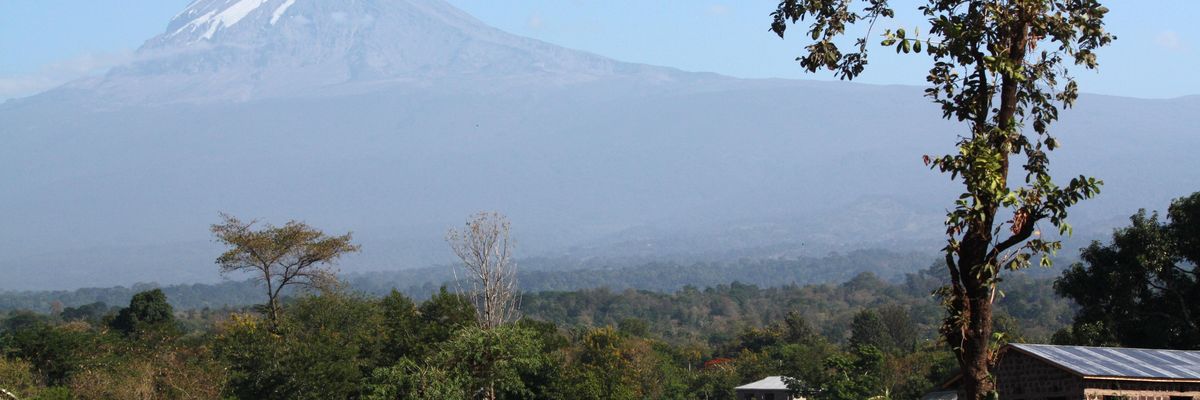
The glacier at the top of Mount Kilimanjaro, one of three glaciers in Africa, is expected to be deglaciated by the 2040s. (Photo: Koen Muurling/Flickr/cc)
Africa's Disappearing Glaciers Signal 'Irreversible' Threat to Earth System: Report
The authors of a U.N. report urge greater investment in climate adaptation and weather services on the continent.
Oct 19, 2021
A new United Nations-backed report reveals the extent of Africa's "disproportionate vulnerability" to the climate emergency, with the continent's three glaciers expected to disappear entirely in the next two decades as the population faces the increasingly dire effects of the heating of the planet.
"Total deglaciation" of the glaciers of the Rwenzori Mountains in Uganda and Mount Kilimanjaro in Tanzania is expected by the 2040s, while the Mount Kenya massif could lose its ice caps a decade sooner, "which will make it one of the first entire mountain ranges to lose glacier cover due to human-induced climate change," according to the State of the Climate in Africa 2020 report.
"In sub-Saharan Africa, climate change could further lower gross domestic product (GDP) by up to 3% by 2050."
The loss of the three glaciers in East Africa, which are retreating at faster rates than the global average, "signals the threat of imminent and irreversible change to the Earth system," said World Meteorological Organization (WMO) Secretary-General Petteri Taalas.
"Administrative barriers" currently put long term observation efforts at the mountains' summits at risk of being abandoned, according to the report by the WMO, the African Union Commission (AUC), the Economic Commission for Africa, and other agencies--but the authors noted that "investing in climate adaptation, early warning systems, and weather and climate services can pay off."
"In sub-Saharan Africa, climate change could further lower gross domestic product (GDP) by up to 3% by 2050," wrote Josefa Leonel Correia Sacko, commissioner for rural economy and agriculture at the AUC. "This presents a serious challenge for climate adaptation and resilience actions because not only are physical conditions getting worse, but also the number of people being affected is increasing."
While the loss of the three glaciers could have significant adverse effects for tourism revenue, investing in climate adaptation would cost $30 to $50 billion annually over the next decade, or 2% to 3% of the GDP, while sparking economic development and generating "more jobs in support of economic recovery from the Covid-19 pandemic."
As African nations' economies face long-term threats from the climate emergency, the report notes that millions of people's lives are already being upended on the continent by the effects of the warming planet.
More than 800,000 people were affected by severe flooding in the Sudan last year; 155 deaths were reported there and 285 were reported in Kenya due to the flooding, which scientists have linked to heavier rainfall resulting from the warming atmosphere.
South Sudan, Ethiopia, Uganda, and Chad were among several countries that reported significant displacement due to drought, flooding, and other climate crisis impacts last year, while in Madagascar, as Common Dreams reported in August, "famine-like conditions have been driven by climate change."
With each flood or drought in sub-Saharan Africa, said the WMO, food insecurity increases by 5% to 20%.
\u201c#StateofClimate in #Africa \n#Climatechange impacts combined with conflict, instability, economic crises and #COVID19 caused 40% \u2b06\ufe0f in population suffering food insecurity in 2020\nFood insecurity increases by 5\u201320 percentage points with each flood or drought in sub-Saharan Africa\u201d— World Meteorological Organization (@World Meteorological Organization) 1634648758
Central African countries reported extreme events including landslides and heavy rainfall which led to economic losses and the collapse of Palar Bridge in Cameroon.
While Africa's 54 countries are responsible for less than 4% of fossil fuel emissions, the report estimates that by 2030, up to 118 million people on the continent will be exposed to drought, floods, and extreme heat fueled by the continued extraction of oil, gas, and coal advanced by the Global North.
"This will place additional burdens on poverty alleviation efforts and significantly hamper growth in prosperity," the report said.
An Urgent Message From Our Co-Founder
Dear Common Dreams reader, The U.S. is on a fast track to authoritarianism like nothing I've ever seen. Meanwhile, corporate news outlets are utterly capitulating to Trump, twisting their coverage to avoid drawing his ire while lining up to stuff cash in his pockets. That's why I believe that Common Dreams is doing the best and most consequential reporting that we've ever done. Our small but mighty team is a progressive reporting powerhouse, covering the news every day that the corporate media never will. Our mission has always been simple: To inform. To inspire. And to ignite change for the common good. Now here's the key piece that I want all our readers to understand: None of this would be possible without your financial support. That's not just some fundraising cliche. It's the absolute and literal truth. We don't accept corporate advertising and never will. We don't have a paywall because we don't think people should be blocked from critical news based on their ability to pay. Everything we do is funded by the donations of readers like you. Will you donate now to help power the nonprofit, independent reporting of Common Dreams? Thank you for being a vital member of our community. Together, we can keep independent journalism alive when it’s needed most. - Craig Brown, Co-founder |
Our work is licensed under Creative Commons (CC BY-NC-ND 3.0). Feel free to republish and share widely.
A new United Nations-backed report reveals the extent of Africa's "disproportionate vulnerability" to the climate emergency, with the continent's three glaciers expected to disappear entirely in the next two decades as the population faces the increasingly dire effects of the heating of the planet.
"Total deglaciation" of the glaciers of the Rwenzori Mountains in Uganda and Mount Kilimanjaro in Tanzania is expected by the 2040s, while the Mount Kenya massif could lose its ice caps a decade sooner, "which will make it one of the first entire mountain ranges to lose glacier cover due to human-induced climate change," according to the State of the Climate in Africa 2020 report.
"In sub-Saharan Africa, climate change could further lower gross domestic product (GDP) by up to 3% by 2050."

The loss of the three glaciers in East Africa, which are retreating at faster rates than the global average, "signals the threat of imminent and irreversible change to the Earth system," said World Meteorological Organization (WMO) Secretary-General Petteri Taalas.
"Administrative barriers" currently put long term observation efforts at the mountains' summits at risk of being abandoned, according to the report by the WMO, the African Union Commission (AUC), the Economic Commission for Africa, and other agencies--but the authors noted that "investing in climate adaptation, early warning systems, and weather and climate services can pay off."
"In sub-Saharan Africa, climate change could further lower gross domestic product (GDP) by up to 3% by 2050," wrote Josefa Leonel Correia Sacko, commissioner for rural economy and agriculture at the AUC. "This presents a serious challenge for climate adaptation and resilience actions because not only are physical conditions getting worse, but also the number of people being affected is increasing."
While the loss of the three glaciers could have significant adverse effects for tourism revenue, investing in climate adaptation would cost $30 to $50 billion annually over the next decade, or 2% to 3% of the GDP, while sparking economic development and generating "more jobs in support of economic recovery from the Covid-19 pandemic."
As African nations' economies face long-term threats from the climate emergency, the report notes that millions of people's lives are already being upended on the continent by the effects of the warming planet.
More than 800,000 people were affected by severe flooding in the Sudan last year; 155 deaths were reported there and 285 were reported in Kenya due to the flooding, which scientists have linked to heavier rainfall resulting from the warming atmosphere.
South Sudan, Ethiopia, Uganda, and Chad were among several countries that reported significant displacement due to drought, flooding, and other climate crisis impacts last year, while in Madagascar, as Common Dreams reported in August, "famine-like conditions have been driven by climate change."
With each flood or drought in sub-Saharan Africa, said the WMO, food insecurity increases by 5% to 20%.
\u201c#StateofClimate in #Africa \n#Climatechange impacts combined with conflict, instability, economic crises and #COVID19 caused 40% \u2b06\ufe0f in population suffering food insecurity in 2020\nFood insecurity increases by 5\u201320 percentage points with each flood or drought in sub-Saharan Africa\u201d— World Meteorological Organization (@World Meteorological Organization) 1634648758
Central African countries reported extreme events including landslides and heavy rainfall which led to economic losses and the collapse of Palar Bridge in Cameroon.
While Africa's 54 countries are responsible for less than 4% of fossil fuel emissions, the report estimates that by 2030, up to 118 million people on the continent will be exposed to drought, floods, and extreme heat fueled by the continued extraction of oil, gas, and coal advanced by the Global North.
"This will place additional burdens on poverty alleviation efforts and significantly hamper growth in prosperity," the report said.
A new United Nations-backed report reveals the extent of Africa's "disproportionate vulnerability" to the climate emergency, with the continent's three glaciers expected to disappear entirely in the next two decades as the population faces the increasingly dire effects of the heating of the planet.
"Total deglaciation" of the glaciers of the Rwenzori Mountains in Uganda and Mount Kilimanjaro in Tanzania is expected by the 2040s, while the Mount Kenya massif could lose its ice caps a decade sooner, "which will make it one of the first entire mountain ranges to lose glacier cover due to human-induced climate change," according to the State of the Climate in Africa 2020 report.
"In sub-Saharan Africa, climate change could further lower gross domestic product (GDP) by up to 3% by 2050."
The loss of the three glaciers in East Africa, which are retreating at faster rates than the global average, "signals the threat of imminent and irreversible change to the Earth system," said World Meteorological Organization (WMO) Secretary-General Petteri Taalas.
"Administrative barriers" currently put long term observation efforts at the mountains' summits at risk of being abandoned, according to the report by the WMO, the African Union Commission (AUC), the Economic Commission for Africa, and other agencies--but the authors noted that "investing in climate adaptation, early warning systems, and weather and climate services can pay off."
"In sub-Saharan Africa, climate change could further lower gross domestic product (GDP) by up to 3% by 2050," wrote Josefa Leonel Correia Sacko, commissioner for rural economy and agriculture at the AUC. "This presents a serious challenge for climate adaptation and resilience actions because not only are physical conditions getting worse, but also the number of people being affected is increasing."
While the loss of the three glaciers could have significant adverse effects for tourism revenue, investing in climate adaptation would cost $30 to $50 billion annually over the next decade, or 2% to 3% of the GDP, while sparking economic development and generating "more jobs in support of economic recovery from the Covid-19 pandemic."
As African nations' economies face long-term threats from the climate emergency, the report notes that millions of people's lives are already being upended on the continent by the effects of the warming planet.
More than 800,000 people were affected by severe flooding in the Sudan last year; 155 deaths were reported there and 285 were reported in Kenya due to the flooding, which scientists have linked to heavier rainfall resulting from the warming atmosphere.
South Sudan, Ethiopia, Uganda, and Chad were among several countries that reported significant displacement due to drought, flooding, and other climate crisis impacts last year, while in Madagascar, as Common Dreams reported in August, "famine-like conditions have been driven by climate change."
With each flood or drought in sub-Saharan Africa, said the WMO, food insecurity increases by 5% to 20%.
\u201c#StateofClimate in #Africa \n#Climatechange impacts combined with conflict, instability, economic crises and #COVID19 caused 40% \u2b06\ufe0f in population suffering food insecurity in 2020\nFood insecurity increases by 5\u201320 percentage points with each flood or drought in sub-Saharan Africa\u201d— World Meteorological Organization (@World Meteorological Organization) 1634648758
Central African countries reported extreme events including landslides and heavy rainfall which led to economic losses and the collapse of Palar Bridge in Cameroon.
While Africa's 54 countries are responsible for less than 4% of fossil fuel emissions, the report estimates that by 2030, up to 118 million people on the continent will be exposed to drought, floods, and extreme heat fueled by the continued extraction of oil, gas, and coal advanced by the Global North.
"This will place additional burdens on poverty alleviation efforts and significantly hamper growth in prosperity," the report said.
We've had enough. The 1% own and operate the corporate media. They are doing everything they can to defend the status quo, squash dissent and protect the wealthy and the powerful. The Common Dreams media model is different. We cover the news that matters to the 99%. Our mission? To inform. To inspire. To ignite change for the common good. How? Nonprofit. Independent. Reader-supported. Free to read. Free to republish. Free to share. With no advertising. No paywalls. No selling of your data. Thousands of small donations fund our newsroom and allow us to continue publishing. Can you chip in? We can't do it without you. Thank you.