SUBSCRIBE TO OUR FREE NEWSLETTER
Daily news & progressive opinion—funded by the people, not the corporations—delivered straight to your inbox.
5
#000000
#FFFFFF
To donate by check, phone, or other method, see our More Ways to Give page.
Daily news & progressive opinion—funded by the people, not the corporations—delivered straight to your inbox.
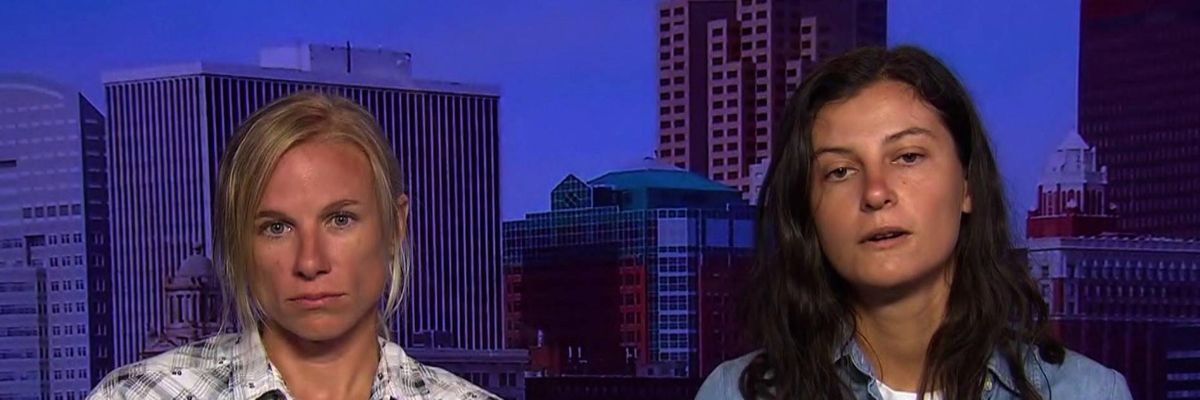
#NoDAPL water protectors Jessica Reznicek (L) and Ruby Montoya during a 2017 appearance on Democracy Now! (Photo: Democracy Now! screen grab)
Environmentalists in recent days expressed outrage over the eight-year prison sentence handed to Jessica Reznicek--a nonviolent water protector who pleaded guilty to damaging equipment at the Dakota Access Pipeline in Iowa--while calling the fossil fuel companies who knowingly caused the climate emergency the real criminals who should be held to account.
"Why is Jessica Reznicek going to prison and Big Oil executives aren't?"
--Rebecca Parson, congressional candidate
United States District Court Judge Rebecca Goodgame Ebinger last week sentenced Jessica Reznicek to eight years behind bars, $3,198,512.70 in restitution, and three years' post-prison supervised release after the 39-year-old activist pleaded guilty to a single count of damaging an energy facility.
In September 2019 Reznicek and 31-year-old Ruby Montoya were each indicted on nine federal charges including damaging an energy facility, use of fire in the commission of a felony, and malicious use of fire. Each of the women faced up to 110 years in prison. Montoya has yet to be sentenced.
According to the U.S. Department of Justice:
Reznicek, as early as November 8, 2016, and continuing until May 2, 2017, conspired with other individuals to damage the Dakota Access Pipeline at several locations... Specifically, the defendant admitted to damaging and attempting to damage the pipeline using an oxy-acetylene cutting torch and fires near pipeline instrumentation and equipment in Mahaska, Boone, and Wapello counties [in] Iowa.
The Des Moines Register reported Ebinger said a terrorism sentencing enhancement could apply because "not only the flow of oil, but the government's continued response were targets of this action."
However, environmentalists and other observers questioned the sanity of a system that prosecutes as terrorists people protecting the planet against the existential threat of a climate emergency caused largely by fossil fuel use, while protecting and rewarding perpetrators of what a growing number of international jurists call the crime of ecocide.
Reznicek's sentencing on June 30 came on the same day as the publication of secretly recorded videos showing a senior ExxonMobil government affairs executive discussing lobbying related to infrastructure legislation, involvement with "shadow groups" that cast down on scientific consensus about the climate emergency, and "wins" during the Trump administration. ExxonMobil and other fossil fuel corporations have known about human-caused global heating for decades.
"How many years do you think ANY fossil fuel CEO will serve for knowingly destroying our planet's climate?" tweeted 350 Tacoma in response to Reznicek's sentencing.
The Nation editor-at-large Mark Hertsgaard noted in a recent opinion piece published in Common Dreams that "oil companies, the executives in charge of them, the propagandists they've employed, and the politicians they've funded have largely escaped blame, much less had to pay-whether through financial penalties or prison time--for the immense damage they have done."
Prior to her sentencing, Reznicek told the court that she acted out of concern that the pipeline--which has a history of leaks--would further contaminate Iowa's drinking water.
"The toxins we enter into our waterways here in Iowa enter into the Mississippi, which enters into the Gulf," she explained. "Going to this extreme was out of character for me."
"It wasn't an easy thing to do," Reznicek said. "It wasn't an easy decision to make. I discerned it at length. The conclusion that I made was that, in my heart, this was the right thing to do. In my heart, this was not violent. In my heart, the laws that protect this pipeline are the laws that are violent."
"The people who are constructing the pipeline are ultimately the people who are contributing to the desecration of the Earth," she added.
FBI Omaha Special Agent in Charge Eugene Kowel said following Reznicek's sentencing that "protecting the American people from terrorism--both international and domestic--remains the FBI's number one priority."
"We will continue to work with our law enforcement partners to bring domestic terrorists like Jessica Reznicek to justice," Kowel added. "Her sentence today should be a deterrent to anyone who intends to commit violence through an act of domestic terrorism."
Some activists contrasted Reznicek's sentence to the leniency shown so far toward participants in the deadly January 6 attack on the United States Capitol.
Other activists noted that direct action protests can result in the cancellation of pipeline projects. They point to President Joe Biden's rescission of the Keystone XL Pipeline's permit and, more recently, last week's cancellation of the Byhalia Connection Pipeline in Mississippi and Tennessee as proof of what grassroots organizing can accomplish.
Reznicek's sentencing came as Indigenous-led direct action protests against the Line 3 tar sands pipeline project in Minnesota and elsewhere continue--and Stop Line 3 water protectors face felony charges for engaging in peaceful civil disobedience.
Dear Common Dreams reader, It’s been nearly 30 years since I co-founded Common Dreams with my late wife, Lina Newhouser. We had the radical notion that journalism should serve the public good, not corporate profits. It was clear to us from the outset what it would take to build such a project. No paid advertisements. No corporate sponsors. No millionaire publisher telling us what to think or do. Many people said we wouldn't last a year, but we proved those doubters wrong. Together with a tremendous team of journalists and dedicated staff, we built an independent media outlet free from the constraints of profits and corporate control. Our mission has always been simple: To inform. To inspire. To ignite change for the common good. Building Common Dreams was not easy. Our survival was never guaranteed. When you take on the most powerful forces—Wall Street greed, fossil fuel industry destruction, Big Tech lobbyists, and uber-rich oligarchs who have spent billions upon billions rigging the economy and democracy in their favor—the only bulwark you have is supporters who believe in your work. But here’s the urgent message from me today. It's never been this bad out there. And it's never been this hard to keep us going. At the very moment Common Dreams is most needed, the threats we face are intensifying. We need your support now more than ever. We don't accept corporate advertising and never will. We don't have a paywall because we don't think people should be blocked from critical news based on their ability to pay. Everything we do is funded by the donations of readers like you. When everyone does the little they can afford, we are strong. But if that support retreats or dries up, so do we. Will you donate now to make sure Common Dreams not only survives but thrives? —Craig Brown, Co-founder |
Environmentalists in recent days expressed outrage over the eight-year prison sentence handed to Jessica Reznicek--a nonviolent water protector who pleaded guilty to damaging equipment at the Dakota Access Pipeline in Iowa--while calling the fossil fuel companies who knowingly caused the climate emergency the real criminals who should be held to account.
"Why is Jessica Reznicek going to prison and Big Oil executives aren't?"
--Rebecca Parson, congressional candidate
United States District Court Judge Rebecca Goodgame Ebinger last week sentenced Jessica Reznicek to eight years behind bars, $3,198,512.70 in restitution, and three years' post-prison supervised release after the 39-year-old activist pleaded guilty to a single count of damaging an energy facility.
In September 2019 Reznicek and 31-year-old Ruby Montoya were each indicted on nine federal charges including damaging an energy facility, use of fire in the commission of a felony, and malicious use of fire. Each of the women faced up to 110 years in prison. Montoya has yet to be sentenced.
According to the U.S. Department of Justice:
Reznicek, as early as November 8, 2016, and continuing until May 2, 2017, conspired with other individuals to damage the Dakota Access Pipeline at several locations... Specifically, the defendant admitted to damaging and attempting to damage the pipeline using an oxy-acetylene cutting torch and fires near pipeline instrumentation and equipment in Mahaska, Boone, and Wapello counties [in] Iowa.
The Des Moines Register reported Ebinger said a terrorism sentencing enhancement could apply because "not only the flow of oil, but the government's continued response were targets of this action."
However, environmentalists and other observers questioned the sanity of a system that prosecutes as terrorists people protecting the planet against the existential threat of a climate emergency caused largely by fossil fuel use, while protecting and rewarding perpetrators of what a growing number of international jurists call the crime of ecocide.
Reznicek's sentencing on June 30 came on the same day as the publication of secretly recorded videos showing a senior ExxonMobil government affairs executive discussing lobbying related to infrastructure legislation, involvement with "shadow groups" that cast down on scientific consensus about the climate emergency, and "wins" during the Trump administration. ExxonMobil and other fossil fuel corporations have known about human-caused global heating for decades.
"How many years do you think ANY fossil fuel CEO will serve for knowingly destroying our planet's climate?" tweeted 350 Tacoma in response to Reznicek's sentencing.
The Nation editor-at-large Mark Hertsgaard noted in a recent opinion piece published in Common Dreams that "oil companies, the executives in charge of them, the propagandists they've employed, and the politicians they've funded have largely escaped blame, much less had to pay-whether through financial penalties or prison time--for the immense damage they have done."
Prior to her sentencing, Reznicek told the court that she acted out of concern that the pipeline--which has a history of leaks--would further contaminate Iowa's drinking water.
"The toxins we enter into our waterways here in Iowa enter into the Mississippi, which enters into the Gulf," she explained. "Going to this extreme was out of character for me."
"It wasn't an easy thing to do," Reznicek said. "It wasn't an easy decision to make. I discerned it at length. The conclusion that I made was that, in my heart, this was the right thing to do. In my heart, this was not violent. In my heart, the laws that protect this pipeline are the laws that are violent."
"The people who are constructing the pipeline are ultimately the people who are contributing to the desecration of the Earth," she added.
FBI Omaha Special Agent in Charge Eugene Kowel said following Reznicek's sentencing that "protecting the American people from terrorism--both international and domestic--remains the FBI's number one priority."
"We will continue to work with our law enforcement partners to bring domestic terrorists like Jessica Reznicek to justice," Kowel added. "Her sentence today should be a deterrent to anyone who intends to commit violence through an act of domestic terrorism."
Some activists contrasted Reznicek's sentence to the leniency shown so far toward participants in the deadly January 6 attack on the United States Capitol.
Other activists noted that direct action protests can result in the cancellation of pipeline projects. They point to President Joe Biden's rescission of the Keystone XL Pipeline's permit and, more recently, last week's cancellation of the Byhalia Connection Pipeline in Mississippi and Tennessee as proof of what grassroots organizing can accomplish.
Reznicek's sentencing came as Indigenous-led direct action protests against the Line 3 tar sands pipeline project in Minnesota and elsewhere continue--and Stop Line 3 water protectors face felony charges for engaging in peaceful civil disobedience.
Environmentalists in recent days expressed outrage over the eight-year prison sentence handed to Jessica Reznicek--a nonviolent water protector who pleaded guilty to damaging equipment at the Dakota Access Pipeline in Iowa--while calling the fossil fuel companies who knowingly caused the climate emergency the real criminals who should be held to account.
"Why is Jessica Reznicek going to prison and Big Oil executives aren't?"
--Rebecca Parson, congressional candidate
United States District Court Judge Rebecca Goodgame Ebinger last week sentenced Jessica Reznicek to eight years behind bars, $3,198,512.70 in restitution, and three years' post-prison supervised release after the 39-year-old activist pleaded guilty to a single count of damaging an energy facility.
In September 2019 Reznicek and 31-year-old Ruby Montoya were each indicted on nine federal charges including damaging an energy facility, use of fire in the commission of a felony, and malicious use of fire. Each of the women faced up to 110 years in prison. Montoya has yet to be sentenced.
According to the U.S. Department of Justice:
Reznicek, as early as November 8, 2016, and continuing until May 2, 2017, conspired with other individuals to damage the Dakota Access Pipeline at several locations... Specifically, the defendant admitted to damaging and attempting to damage the pipeline using an oxy-acetylene cutting torch and fires near pipeline instrumentation and equipment in Mahaska, Boone, and Wapello counties [in] Iowa.
The Des Moines Register reported Ebinger said a terrorism sentencing enhancement could apply because "not only the flow of oil, but the government's continued response were targets of this action."
However, environmentalists and other observers questioned the sanity of a system that prosecutes as terrorists people protecting the planet against the existential threat of a climate emergency caused largely by fossil fuel use, while protecting and rewarding perpetrators of what a growing number of international jurists call the crime of ecocide.
Reznicek's sentencing on June 30 came on the same day as the publication of secretly recorded videos showing a senior ExxonMobil government affairs executive discussing lobbying related to infrastructure legislation, involvement with "shadow groups" that cast down on scientific consensus about the climate emergency, and "wins" during the Trump administration. ExxonMobil and other fossil fuel corporations have known about human-caused global heating for decades.
"How many years do you think ANY fossil fuel CEO will serve for knowingly destroying our planet's climate?" tweeted 350 Tacoma in response to Reznicek's sentencing.
The Nation editor-at-large Mark Hertsgaard noted in a recent opinion piece published in Common Dreams that "oil companies, the executives in charge of them, the propagandists they've employed, and the politicians they've funded have largely escaped blame, much less had to pay-whether through financial penalties or prison time--for the immense damage they have done."
Prior to her sentencing, Reznicek told the court that she acted out of concern that the pipeline--which has a history of leaks--would further contaminate Iowa's drinking water.
"The toxins we enter into our waterways here in Iowa enter into the Mississippi, which enters into the Gulf," she explained. "Going to this extreme was out of character for me."
"It wasn't an easy thing to do," Reznicek said. "It wasn't an easy decision to make. I discerned it at length. The conclusion that I made was that, in my heart, this was the right thing to do. In my heart, this was not violent. In my heart, the laws that protect this pipeline are the laws that are violent."
"The people who are constructing the pipeline are ultimately the people who are contributing to the desecration of the Earth," she added.
FBI Omaha Special Agent in Charge Eugene Kowel said following Reznicek's sentencing that "protecting the American people from terrorism--both international and domestic--remains the FBI's number one priority."
"We will continue to work with our law enforcement partners to bring domestic terrorists like Jessica Reznicek to justice," Kowel added. "Her sentence today should be a deterrent to anyone who intends to commit violence through an act of domestic terrorism."
Some activists contrasted Reznicek's sentence to the leniency shown so far toward participants in the deadly January 6 attack on the United States Capitol.
Other activists noted that direct action protests can result in the cancellation of pipeline projects. They point to President Joe Biden's rescission of the Keystone XL Pipeline's permit and, more recently, last week's cancellation of the Byhalia Connection Pipeline in Mississippi and Tennessee as proof of what grassroots organizing can accomplish.
Reznicek's sentencing came as Indigenous-led direct action protests against the Line 3 tar sands pipeline project in Minnesota and elsewhere continue--and Stop Line 3 water protectors face felony charges for engaging in peaceful civil disobedience.