

SUBSCRIBE TO OUR FREE NEWSLETTER
Daily news & progressive opinion—funded by the people, not the corporations—delivered straight to your inbox.
5
#000000
#FFFFFF
To donate by check, phone, or other method, see our More Ways to Give page.
Daily news & progressive opinion—funded by the people, not the corporations—delivered straight to your inbox.
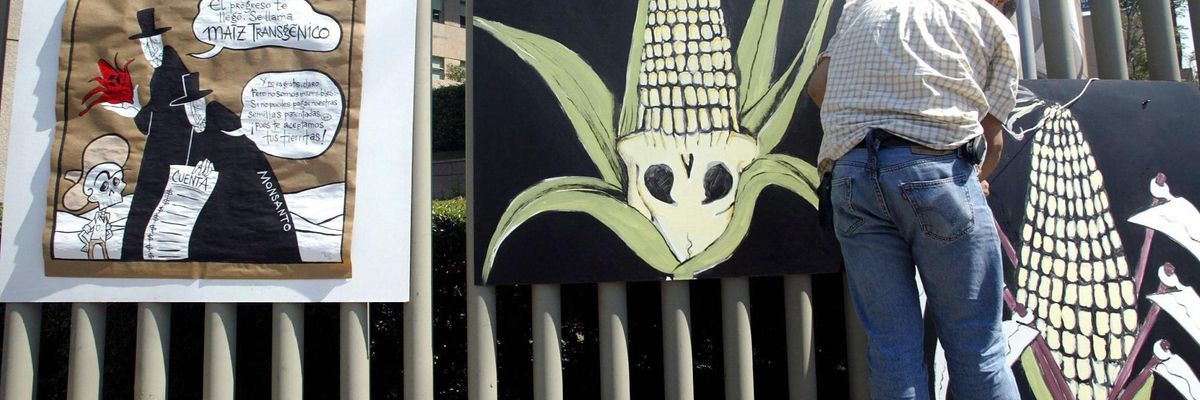
An activist from the environmental group Greenpeace participates in a protest against the use of transgenic corn on November 8, 2004, in Mexico City. (Photo: Juan Barreto/AFP via Getty Images)
A coalition of 80 U.S. agricultural, consumer, environmental, public health, and worker groups sent a letter Thursday to key figures in the Biden administration calling for them to "respect Mexico's sovereignty and refrain from interfering with its right to enact health-protective policies"--specifically, the phaseout of the herbicide glyphosate and the cultivation of genetically modified corn.
"It is completely unacceptable for U.S. public agencies to be doing the bidding of pesticide corporations like Bayer."
--Kristin Schafer, PANNA
"Mexican President Andres Manuel Lopez Obrador quietly rocked the agribusiness world with his New Year's Eve decree," Timothy A. Wise of the Institute for Agriculture and Trade Policy (ITAP) noted earlier this year. "His administration sent an even stronger aftershock two weeks later, clarifying that the government would also phase out GM corn imports in three years and the ban would include not just corn for human consumption but yellow corn destined primarily for livestock."
"Mexico imports about 30% of its corn each year, overwhelmingly from the United States," Wise added. "Almost all of that is yellow corn for animal feed and industrial uses. Lopez Obrador's commitment to reducing and, by 2024, eliminating such imports reflects his administration's plan to ramp up Mexican production as part of the campaign to increase self-sufficiency in corn and other key food crops."
The groups' letter on the Mexican policies and U.S. interference--published in English (pdf) and Spanish (pdf)--is addressed to recently confirmed U.S. Secretary of Agriculture Tom Vilsack and U.S. Trade Representative Katherine Tai. Its lead author is Kristin Schafer, executive director of Pesticide Action Network North America (PANNA).
"We call on Secretary Vilsack and Trade Representative Tai, as key leaders in the new administration, to respect Mexico's decision to protect both public health and the integrity of Mexican farming," Schafer said in a statement. "It is completely unacceptable for U.S. public agencies to be doing the bidding of pesticide corporations like Bayer, who are solely concerned with maintaining their bottom-line profits."
Fernando Bejarano, director of Pesticide Action Network in Mexico, explained that "we are part of the No Maize No Country Campaign, a broad coalition of peasant organizations, nonprofit NGOs, academics, and consumers which support the presidential decree and fight for food sovereignty with the agroecological transformation of agricultural systems that guarantee the right to produce and consume healthy, nutritious food, free of pesticides and transgenics."
"We reject the pressure from corporations such as Bayer-Monsanto--and their CropLife trade association--which are working in both the United States and Mexico to undermine the presidential decree that phases out the use of glyphosate and transgenic corn," Bejarano said.
The letter highlights Guardian reporting on U.S. government documents obtained by the Center for Biological Diversity through a Freedom of Information Act request. The documents revealed that CropLife America and Bayer AG--which acquired glyphosate-based herbicide developer Monsanto in 2018--worked with U.S. officials to lobby against Mexico's plans.
According to journalist Carey Gillam's mid-February report:
The emails reviewed by the Guardian come from the Office of the U.S. Trade Representative (USTR) and other U.S. agencies. They detail worry and frustration with Mexico's position. One email makes a reference to staff within Lopez Obrador's administration as "vocal anti-biotechnology activists," and another email states that Mexico's health agency (Cofepris) is "becoming a big time problem."
Internal USTR communications lay out how the agrochemical industry is "pushing" for the U.S. to "fold this issue" into the United States-Mexico-Canada Agreement (USMCA) trade deal that went into effect July 1. The records then show the USTR does exactly that, telling Mexico its actions on glyphosate and genetically engineered crops raise concerns "regarding compliance" with USMCA.
Citing discussions with CropLife, the U.S. Environmental Protection Agency (EPA) joined in the effort, discussing in an inter-agency email "how we could use USMCA to work through these issues."
The Guardian also noted correspondence involving the Foreign Agricultural Service of the U.S. Department of Agriculture (USDA).
As the letter to Vilsack and Tai points out: "This interference and pressure from the agrochemical industry is continuing. On March 22nd, industry representatives sent a letter directed to your attention as leaders of USTR and USDA, identifying Mexico's planned phaseout of glyphosate and genetically modified corn as a 'leading concern' for agribusiness interests and the pesticide industry (represented by the pesticide industry's trade group, CropLife America)."
"We strongly object to any interference by U.S. government officials or agribusiness interests in a sovereign state's right to enact policy measures to protect the health and well-being of its people," the letter states. "We urge your agencies to resist and reject these ongoing efforts."
"We welcome the administration's stated commitment to listening to the science, improving public health, protecting the environment, and limiting exposure to dangerous chemicals and pesticides, while holding polluters accountable and prioritizing environmental justice, particularly for communities of color and low-income communities," it adds. "We trust that these stated commitments, as well as your dedication to 'fairness for farmers,' extend equally to other countries and include respect for other nations' and peoples' rights to self-determination."
Other signatories to the letter include the American Sustainable Business Council, Beyond Pesticides, Center for Biological Diversity, Friends of the Earth, Greenpeace USA, Indigenous Environmental Network, ITAP, and Organic Consumers Association.
Dear Common Dreams reader, It’s been nearly 30 years since I co-founded Common Dreams with my late wife, Lina Newhouser. We had the radical notion that journalism should serve the public good, not corporate profits. It was clear to us from the outset what it would take to build such a project. No paid advertisements. No corporate sponsors. No millionaire publisher telling us what to think or do. Many people said we wouldn't last a year, but we proved those doubters wrong. Together with a tremendous team of journalists and dedicated staff, we built an independent media outlet free from the constraints of profits and corporate control. Our mission has always been simple: To inform. To inspire. To ignite change for the common good. Building Common Dreams was not easy. Our survival was never guaranteed. When you take on the most powerful forces—Wall Street greed, fossil fuel industry destruction, Big Tech lobbyists, and uber-rich oligarchs who have spent billions upon billions rigging the economy and democracy in their favor—the only bulwark you have is supporters who believe in your work. But here’s the urgent message from me today. It's never been this bad out there. And it's never been this hard to keep us going. At the very moment Common Dreams is most needed, the threats we face are intensifying. We need your support now more than ever. We don't accept corporate advertising and never will. We don't have a paywall because we don't think people should be blocked from critical news based on their ability to pay. Everything we do is funded by the donations of readers like you. When everyone does the little they can afford, we are strong. But if that support retreats or dries up, so do we. Will you donate now to make sure Common Dreams not only survives but thrives? —Craig Brown, Co-founder |
A coalition of 80 U.S. agricultural, consumer, environmental, public health, and worker groups sent a letter Thursday to key figures in the Biden administration calling for them to "respect Mexico's sovereignty and refrain from interfering with its right to enact health-protective policies"--specifically, the phaseout of the herbicide glyphosate and the cultivation of genetically modified corn.
"It is completely unacceptable for U.S. public agencies to be doing the bidding of pesticide corporations like Bayer."
--Kristin Schafer, PANNA
"Mexican President Andres Manuel Lopez Obrador quietly rocked the agribusiness world with his New Year's Eve decree," Timothy A. Wise of the Institute for Agriculture and Trade Policy (ITAP) noted earlier this year. "His administration sent an even stronger aftershock two weeks later, clarifying that the government would also phase out GM corn imports in three years and the ban would include not just corn for human consumption but yellow corn destined primarily for livestock."
"Mexico imports about 30% of its corn each year, overwhelmingly from the United States," Wise added. "Almost all of that is yellow corn for animal feed and industrial uses. Lopez Obrador's commitment to reducing and, by 2024, eliminating such imports reflects his administration's plan to ramp up Mexican production as part of the campaign to increase self-sufficiency in corn and other key food crops."
The groups' letter on the Mexican policies and U.S. interference--published in English (pdf) and Spanish (pdf)--is addressed to recently confirmed U.S. Secretary of Agriculture Tom Vilsack and U.S. Trade Representative Katherine Tai. Its lead author is Kristin Schafer, executive director of Pesticide Action Network North America (PANNA).
"We call on Secretary Vilsack and Trade Representative Tai, as key leaders in the new administration, to respect Mexico's decision to protect both public health and the integrity of Mexican farming," Schafer said in a statement. "It is completely unacceptable for U.S. public agencies to be doing the bidding of pesticide corporations like Bayer, who are solely concerned with maintaining their bottom-line profits."
Fernando Bejarano, director of Pesticide Action Network in Mexico, explained that "we are part of the No Maize No Country Campaign, a broad coalition of peasant organizations, nonprofit NGOs, academics, and consumers which support the presidential decree and fight for food sovereignty with the agroecological transformation of agricultural systems that guarantee the right to produce and consume healthy, nutritious food, free of pesticides and transgenics."
"We reject the pressure from corporations such as Bayer-Monsanto--and their CropLife trade association--which are working in both the United States and Mexico to undermine the presidential decree that phases out the use of glyphosate and transgenic corn," Bejarano said.
The letter highlights Guardian reporting on U.S. government documents obtained by the Center for Biological Diversity through a Freedom of Information Act request. The documents revealed that CropLife America and Bayer AG--which acquired glyphosate-based herbicide developer Monsanto in 2018--worked with U.S. officials to lobby against Mexico's plans.
According to journalist Carey Gillam's mid-February report:
The emails reviewed by the Guardian come from the Office of the U.S. Trade Representative (USTR) and other U.S. agencies. They detail worry and frustration with Mexico's position. One email makes a reference to staff within Lopez Obrador's administration as "vocal anti-biotechnology activists," and another email states that Mexico's health agency (Cofepris) is "becoming a big time problem."
Internal USTR communications lay out how the agrochemical industry is "pushing" for the U.S. to "fold this issue" into the United States-Mexico-Canada Agreement (USMCA) trade deal that went into effect July 1. The records then show the USTR does exactly that, telling Mexico its actions on glyphosate and genetically engineered crops raise concerns "regarding compliance" with USMCA.
Citing discussions with CropLife, the U.S. Environmental Protection Agency (EPA) joined in the effort, discussing in an inter-agency email "how we could use USMCA to work through these issues."
The Guardian also noted correspondence involving the Foreign Agricultural Service of the U.S. Department of Agriculture (USDA).
As the letter to Vilsack and Tai points out: "This interference and pressure from the agrochemical industry is continuing. On March 22nd, industry representatives sent a letter directed to your attention as leaders of USTR and USDA, identifying Mexico's planned phaseout of glyphosate and genetically modified corn as a 'leading concern' for agribusiness interests and the pesticide industry (represented by the pesticide industry's trade group, CropLife America)."
"We strongly object to any interference by U.S. government officials or agribusiness interests in a sovereign state's right to enact policy measures to protect the health and well-being of its people," the letter states. "We urge your agencies to resist and reject these ongoing efforts."
"We welcome the administration's stated commitment to listening to the science, improving public health, protecting the environment, and limiting exposure to dangerous chemicals and pesticides, while holding polluters accountable and prioritizing environmental justice, particularly for communities of color and low-income communities," it adds. "We trust that these stated commitments, as well as your dedication to 'fairness for farmers,' extend equally to other countries and include respect for other nations' and peoples' rights to self-determination."
Other signatories to the letter include the American Sustainable Business Council, Beyond Pesticides, Center for Biological Diversity, Friends of the Earth, Greenpeace USA, Indigenous Environmental Network, ITAP, and Organic Consumers Association.
A coalition of 80 U.S. agricultural, consumer, environmental, public health, and worker groups sent a letter Thursday to key figures in the Biden administration calling for them to "respect Mexico's sovereignty and refrain from interfering with its right to enact health-protective policies"--specifically, the phaseout of the herbicide glyphosate and the cultivation of genetically modified corn.
"It is completely unacceptable for U.S. public agencies to be doing the bidding of pesticide corporations like Bayer."
--Kristin Schafer, PANNA
"Mexican President Andres Manuel Lopez Obrador quietly rocked the agribusiness world with his New Year's Eve decree," Timothy A. Wise of the Institute for Agriculture and Trade Policy (ITAP) noted earlier this year. "His administration sent an even stronger aftershock two weeks later, clarifying that the government would also phase out GM corn imports in three years and the ban would include not just corn for human consumption but yellow corn destined primarily for livestock."
"Mexico imports about 30% of its corn each year, overwhelmingly from the United States," Wise added. "Almost all of that is yellow corn for animal feed and industrial uses. Lopez Obrador's commitment to reducing and, by 2024, eliminating such imports reflects his administration's plan to ramp up Mexican production as part of the campaign to increase self-sufficiency in corn and other key food crops."
The groups' letter on the Mexican policies and U.S. interference--published in English (pdf) and Spanish (pdf)--is addressed to recently confirmed U.S. Secretary of Agriculture Tom Vilsack and U.S. Trade Representative Katherine Tai. Its lead author is Kristin Schafer, executive director of Pesticide Action Network North America (PANNA).
"We call on Secretary Vilsack and Trade Representative Tai, as key leaders in the new administration, to respect Mexico's decision to protect both public health and the integrity of Mexican farming," Schafer said in a statement. "It is completely unacceptable for U.S. public agencies to be doing the bidding of pesticide corporations like Bayer, who are solely concerned with maintaining their bottom-line profits."
Fernando Bejarano, director of Pesticide Action Network in Mexico, explained that "we are part of the No Maize No Country Campaign, a broad coalition of peasant organizations, nonprofit NGOs, academics, and consumers which support the presidential decree and fight for food sovereignty with the agroecological transformation of agricultural systems that guarantee the right to produce and consume healthy, nutritious food, free of pesticides and transgenics."
"We reject the pressure from corporations such as Bayer-Monsanto--and their CropLife trade association--which are working in both the United States and Mexico to undermine the presidential decree that phases out the use of glyphosate and transgenic corn," Bejarano said.
The letter highlights Guardian reporting on U.S. government documents obtained by the Center for Biological Diversity through a Freedom of Information Act request. The documents revealed that CropLife America and Bayer AG--which acquired glyphosate-based herbicide developer Monsanto in 2018--worked with U.S. officials to lobby against Mexico's plans.
According to journalist Carey Gillam's mid-February report:
The emails reviewed by the Guardian come from the Office of the U.S. Trade Representative (USTR) and other U.S. agencies. They detail worry and frustration with Mexico's position. One email makes a reference to staff within Lopez Obrador's administration as "vocal anti-biotechnology activists," and another email states that Mexico's health agency (Cofepris) is "becoming a big time problem."
Internal USTR communications lay out how the agrochemical industry is "pushing" for the U.S. to "fold this issue" into the United States-Mexico-Canada Agreement (USMCA) trade deal that went into effect July 1. The records then show the USTR does exactly that, telling Mexico its actions on glyphosate and genetically engineered crops raise concerns "regarding compliance" with USMCA.
Citing discussions with CropLife, the U.S. Environmental Protection Agency (EPA) joined in the effort, discussing in an inter-agency email "how we could use USMCA to work through these issues."
The Guardian also noted correspondence involving the Foreign Agricultural Service of the U.S. Department of Agriculture (USDA).
As the letter to Vilsack and Tai points out: "This interference and pressure from the agrochemical industry is continuing. On March 22nd, industry representatives sent a letter directed to your attention as leaders of USTR and USDA, identifying Mexico's planned phaseout of glyphosate and genetically modified corn as a 'leading concern' for agribusiness interests and the pesticide industry (represented by the pesticide industry's trade group, CropLife America)."
"We strongly object to any interference by U.S. government officials or agribusiness interests in a sovereign state's right to enact policy measures to protect the health and well-being of its people," the letter states. "We urge your agencies to resist and reject these ongoing efforts."
"We welcome the administration's stated commitment to listening to the science, improving public health, protecting the environment, and limiting exposure to dangerous chemicals and pesticides, while holding polluters accountable and prioritizing environmental justice, particularly for communities of color and low-income communities," it adds. "We trust that these stated commitments, as well as your dedication to 'fairness for farmers,' extend equally to other countries and include respect for other nations' and peoples' rights to self-determination."
Other signatories to the letter include the American Sustainable Business Council, Beyond Pesticides, Center for Biological Diversity, Friends of the Earth, Greenpeace USA, Indigenous Environmental Network, ITAP, and Organic Consumers Association.

