SUBSCRIBE TO OUR FREE NEWSLETTER
Daily news & progressive opinion—funded by the people, not the corporations—delivered straight to your inbox.
5
#000000
#FFFFFF
To donate by check, phone, or other method, see our More Ways to Give page.
Daily news & progressive opinion—funded by the people, not the corporations—delivered straight to your inbox.
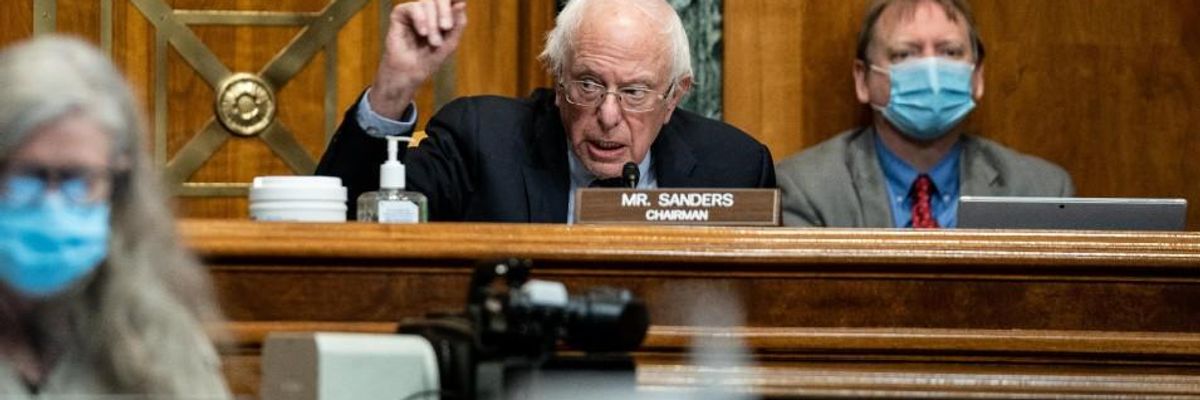
Sen. Bernie Sanders (I-Vt.) speaks during a Senate Budget Committee hearing on February 10, 2021 at the U.S. Capitol in Washington, D.C. (Photo: Anna Moneymaker-Pool/Getty Images)
The Congressional Budget Office said Monday that raising the federal minimum wage to $15 an hour would have a significantly broader budgetary impact than two provisions of the 2017 Republican tax cut legislation that passed through reconciliation, a finding that provides another boost to Sen. Bernie Sanders' effort to include the pay increase in the Senate coronavirus relief package.
In response to a request by Sanders--the chairman of the Senate Budget Committee--for a comparison of the budgetary effect of the Raise the Wage Act of 2021 with that of the GOP tax bill's zeroing out of Obamacare's individual mandate penalty and the measure's Arctic National Wildlife Refuge (ANWR) drilling provision, the CBO found that the $15 minimum wage legislation would have a more sweeping impact.
"It is popular, it is what the people want, it is what justice demands."
--Sen. Bernie Sanders
"The analysis of the Raise the Wage Act encompasses a much broader range of behavioral effects than that of the 2017 tax act, and the increased minimum wage would in turn affect a broader range of budget functions than CBO estimated that the change in the mandate penalty would," the budget office noted in a letter (pdf) to Sanders. "Increasing the minimum wage would affect more budget functions than CBO estimated that the ANWR provisions would."
Under the Senate's so-called Byrd Rule, each provision of a reconciliation bill must have a direct--not "merely incidental"--impact on the federal spending and revenue. The CBO's latest analysis--which comes a week after the budget office found the wage hike would add $54 billion to the deficit over ten years--was viewed as additional confirmation that the wage increase should qualify under reconciliation.
"Sounds like a passing grade to me, folks," said Elizabeth Pancotti, policy director at Employ America, in response to the CBO analysis.
Warren Gunnels, Sanders' staff director, also welcomed the CBO's new findings in a tweet late Monday.
"Raising the minimum wage to $15 would have a much bigger impact on the federal budget than oil drilling in the Arctic and the repeal of individual mandate penalties," Gunnels noted. "Both of those provisions were deemed permissible under reconciliation. Let's go."
The CBO analysis came as Sanders is working to make the case to the Senate parliamentarian--and to skeptical Democrats, including President Joe Biden and Sen. Kyrsten Sinema (D-Ariz.)--that the Raise the Wage Act complies with reconciliation rules and thus can and must be included in the Senate's coronavirus relief package.
In an appearance on CNN late Monday, Sanders said he "absolutely" believes that raising the federal minimum wage to $15 an hour is "consistent with the rules of the Senate and the reconciliation process," a procedural tool Democrats are using to pass a coronavirus relief package without the support of obstructionist Republicans.
"When you have half of the people in this country living paycheck to paycheck, and all over this country you're having workers trying to survive on $9 or $10 an hour or even less than that--the American people...Republicans, Democrats, Independents want to raise the minimum wage to a living wage, 15 bucks an hour," said Sanders.
"It is popular, it is what the people want, it is what justice demands," the Vermont senator added. "So I'm gonna fight as hard as I can, and I believe that we will succeed in including the minimum wage in the reconciliation bill."
Dear Common Dreams reader, It’s been nearly 30 years since I co-founded Common Dreams with my late wife, Lina Newhouser. We had the radical notion that journalism should serve the public good, not corporate profits. It was clear to us from the outset what it would take to build such a project. No paid advertisements. No corporate sponsors. No millionaire publisher telling us what to think or do. Many people said we wouldn't last a year, but we proved those doubters wrong. Together with a tremendous team of journalists and dedicated staff, we built an independent media outlet free from the constraints of profits and corporate control. Our mission has always been simple: To inform. To inspire. To ignite change for the common good. Building Common Dreams was not easy. Our survival was never guaranteed. When you take on the most powerful forces—Wall Street greed, fossil fuel industry destruction, Big Tech lobbyists, and uber-rich oligarchs who have spent billions upon billions rigging the economy and democracy in their favor—the only bulwark you have is supporters who believe in your work. But here’s the urgent message from me today. It's never been this bad out there. And it's never been this hard to keep us going. At the very moment Common Dreams is most needed, the threats we face are intensifying. We need your support now more than ever. We don't accept corporate advertising and never will. We don't have a paywall because we don't think people should be blocked from critical news based on their ability to pay. Everything we do is funded by the donations of readers like you. When everyone does the little they can afford, we are strong. But if that support retreats or dries up, so do we. Will you donate now to make sure Common Dreams not only survives but thrives? —Craig Brown, Co-founder |
The Congressional Budget Office said Monday that raising the federal minimum wage to $15 an hour would have a significantly broader budgetary impact than two provisions of the 2017 Republican tax cut legislation that passed through reconciliation, a finding that provides another boost to Sen. Bernie Sanders' effort to include the pay increase in the Senate coronavirus relief package.
In response to a request by Sanders--the chairman of the Senate Budget Committee--for a comparison of the budgetary effect of the Raise the Wage Act of 2021 with that of the GOP tax bill's zeroing out of Obamacare's individual mandate penalty and the measure's Arctic National Wildlife Refuge (ANWR) drilling provision, the CBO found that the $15 minimum wage legislation would have a more sweeping impact.
"It is popular, it is what the people want, it is what justice demands."
--Sen. Bernie Sanders
"The analysis of the Raise the Wage Act encompasses a much broader range of behavioral effects than that of the 2017 tax act, and the increased minimum wage would in turn affect a broader range of budget functions than CBO estimated that the change in the mandate penalty would," the budget office noted in a letter (pdf) to Sanders. "Increasing the minimum wage would affect more budget functions than CBO estimated that the ANWR provisions would."
Under the Senate's so-called Byrd Rule, each provision of a reconciliation bill must have a direct--not "merely incidental"--impact on the federal spending and revenue. The CBO's latest analysis--which comes a week after the budget office found the wage hike would add $54 billion to the deficit over ten years--was viewed as additional confirmation that the wage increase should qualify under reconciliation.
"Sounds like a passing grade to me, folks," said Elizabeth Pancotti, policy director at Employ America, in response to the CBO analysis.
Warren Gunnels, Sanders' staff director, also welcomed the CBO's new findings in a tweet late Monday.
"Raising the minimum wage to $15 would have a much bigger impact on the federal budget than oil drilling in the Arctic and the repeal of individual mandate penalties," Gunnels noted. "Both of those provisions were deemed permissible under reconciliation. Let's go."
The CBO analysis came as Sanders is working to make the case to the Senate parliamentarian--and to skeptical Democrats, including President Joe Biden and Sen. Kyrsten Sinema (D-Ariz.)--that the Raise the Wage Act complies with reconciliation rules and thus can and must be included in the Senate's coronavirus relief package.
In an appearance on CNN late Monday, Sanders said he "absolutely" believes that raising the federal minimum wage to $15 an hour is "consistent with the rules of the Senate and the reconciliation process," a procedural tool Democrats are using to pass a coronavirus relief package without the support of obstructionist Republicans.
"When you have half of the people in this country living paycheck to paycheck, and all over this country you're having workers trying to survive on $9 or $10 an hour or even less than that--the American people...Republicans, Democrats, Independents want to raise the minimum wage to a living wage, 15 bucks an hour," said Sanders.
"It is popular, it is what the people want, it is what justice demands," the Vermont senator added. "So I'm gonna fight as hard as I can, and I believe that we will succeed in including the minimum wage in the reconciliation bill."
The Congressional Budget Office said Monday that raising the federal minimum wage to $15 an hour would have a significantly broader budgetary impact than two provisions of the 2017 Republican tax cut legislation that passed through reconciliation, a finding that provides another boost to Sen. Bernie Sanders' effort to include the pay increase in the Senate coronavirus relief package.
In response to a request by Sanders--the chairman of the Senate Budget Committee--for a comparison of the budgetary effect of the Raise the Wage Act of 2021 with that of the GOP tax bill's zeroing out of Obamacare's individual mandate penalty and the measure's Arctic National Wildlife Refuge (ANWR) drilling provision, the CBO found that the $15 minimum wage legislation would have a more sweeping impact.
"It is popular, it is what the people want, it is what justice demands."
--Sen. Bernie Sanders
"The analysis of the Raise the Wage Act encompasses a much broader range of behavioral effects than that of the 2017 tax act, and the increased minimum wage would in turn affect a broader range of budget functions than CBO estimated that the change in the mandate penalty would," the budget office noted in a letter (pdf) to Sanders. "Increasing the minimum wage would affect more budget functions than CBO estimated that the ANWR provisions would."
Under the Senate's so-called Byrd Rule, each provision of a reconciliation bill must have a direct--not "merely incidental"--impact on the federal spending and revenue. The CBO's latest analysis--which comes a week after the budget office found the wage hike would add $54 billion to the deficit over ten years--was viewed as additional confirmation that the wage increase should qualify under reconciliation.
"Sounds like a passing grade to me, folks," said Elizabeth Pancotti, policy director at Employ America, in response to the CBO analysis.
Warren Gunnels, Sanders' staff director, also welcomed the CBO's new findings in a tweet late Monday.
"Raising the minimum wage to $15 would have a much bigger impact on the federal budget than oil drilling in the Arctic and the repeal of individual mandate penalties," Gunnels noted. "Both of those provisions were deemed permissible under reconciliation. Let's go."
The CBO analysis came as Sanders is working to make the case to the Senate parliamentarian--and to skeptical Democrats, including President Joe Biden and Sen. Kyrsten Sinema (D-Ariz.)--that the Raise the Wage Act complies with reconciliation rules and thus can and must be included in the Senate's coronavirus relief package.
In an appearance on CNN late Monday, Sanders said he "absolutely" believes that raising the federal minimum wage to $15 an hour is "consistent with the rules of the Senate and the reconciliation process," a procedural tool Democrats are using to pass a coronavirus relief package without the support of obstructionist Republicans.
"When you have half of the people in this country living paycheck to paycheck, and all over this country you're having workers trying to survive on $9 or $10 an hour or even less than that--the American people...Republicans, Democrats, Independents want to raise the minimum wage to a living wage, 15 bucks an hour," said Sanders.
"It is popular, it is what the people want, it is what justice demands," the Vermont senator added. "So I'm gonna fight as hard as I can, and I believe that we will succeed in including the minimum wage in the reconciliation bill."