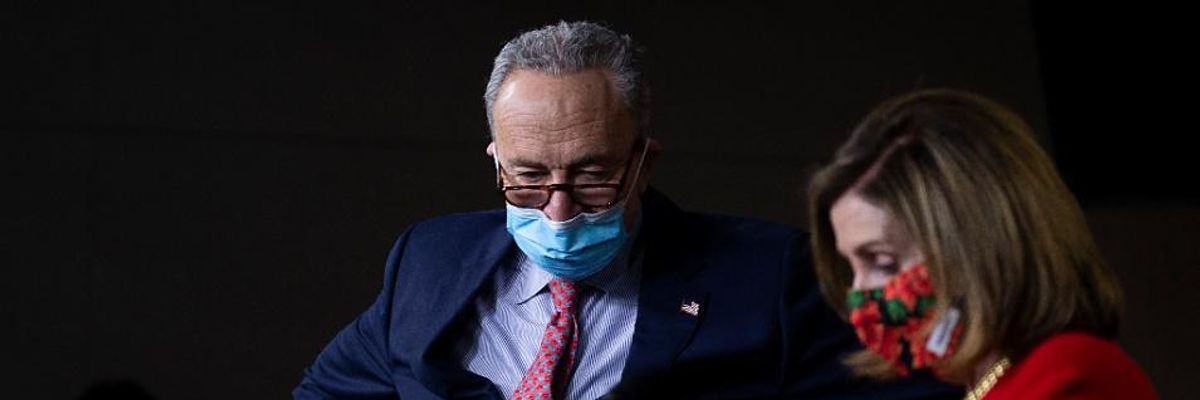
Senate Majority Leader Chuck Schumer (D-N.Y.) listens as House Speaker Nancy Pelosi (D-Calif.) speaks during a press conference on Capitol Hill in Washington, D.C. (Photo: Tasos Katopodis/Getty Images)
'Will End Up Hurting Tens of Millions': Progressives Push Back as Dems Weigh Lower Income Cutoff for Relief Checks
"Means testing is a form of austerity. Scaling back on stimulus would be a mistake."
Despite warnings that doing so would be both politically and morally senseless, top Democratic lawmakers are reportedly discussing a proposal to further limit eligibility for direct relief payments by lowering the annual income cutoff, a restriction that would potentially disqualify tens of millions of people from the next round of survival checks.
Citing unnamed people familiar with internal planning, the Washington Post reported Tuesday that "one proposal discussed by senior Democrats includes lowering the threshold for the payments to begin phasing out above $50,000 for single taxpayers, $75,000 for people who file as the heads of households, and $100,000 for married couples."
"We should not be alienating working-class and middle-class Americans by excluding them from Covid relief. The argument is so obvious it's surprising it has to be stated."
--Rep. Ro Khanna
With talks over eligibility for the $1,400 payments proposed by President Joe Biden still ongoing, progressives are vocally making clear that they oppose additional means testing for relief checks that already fall short of the $2,000 Democrats promised on the campaign trail--messaging that helped the party take narrow control of the Senate.
"Democrats in Congress should not waste a single day or shrink their relief package by a single dollar in pursuit of votes from Republican politicians who answer to billionaires and white supremacist insurrectionists," tweeted the Working Families Party. "We need jobs and care now."
Ohio congressional candidate Nina Turner, formerly a top surrogate for Sen. Bernie Sanders' (I-Vt.) 2020 presidential campaign, said late Tuesday that "means testing is a form of austerity."
"Scaling back on stimulus would be a mistake," Turner argued.
The Biden White House said earlier this week that it is opposed to the direct payment counter-offer put forth by Republican senators, who proposed $1,000 checks for which only individuals earning less than $40,000 a year and married couples earning less than $80,000 a year would be fully eligible.
But the new administration has also said it is open to negotiating the eligibility threshold for the $1,400 checks, which at least two of Biden's top economic advisers have said should bemore targeted to those with lower incomes--an argument also made by the U.S. Chamber of Commerce, the nation's top business lobby.
Previous rounds of relief checks began gradually phasing out for individuals who earned more than $75,000 a year and joint filers who earned more than $150,000; that same framework was proposed by the House-passed CASH Act, which Republicans blocked at the end of last year.
In a letter (pdf) to Senate Majority Leader Chuck Schumer (D-N.Y.) and House Speaker Nancy Pelosi (D-Calif.) last week, more than two dozen members of the Congressional Progressive Caucus cautioned "against an overemphasis on targeting aid, when we know that it comes at the expense of delivering relief quickly and efficiently."
"At this moment of fiscal crisis, Congress should err on the side of offering generous relief to a larger pool of people, rather than too little," the letter reads. "The cost of doing too little too slowly far outweighs the concerns about a relatively small share of households getting 'too much.'"
Lots of talk these last few weeks about how $600 + $1,400 = $2,000, but I'll note for those of you following along at home that $600 + some amount less than $1,400 because you no longer qualify for the full stimulus does not equal $2,000. https://t.co/bQ9f8RYJ2y
-- Osita Nwanevu (@OsitaNwanevu) February 2, 2021
Matt Bruenig, founder of the People's Policy Project, a left-wing think tank, pointed out in an interview with the Post that "people have not filed their taxes for 2020, meaning that targeted checks would go out based on income information that is now one to two years out of date, with a pandemic and mass job loss having occurred in the interim."
"This is not targeting," said Bruenig. "It is the illusion of targeting, an illusion that will end up hurting tens of millions of people who are currently in need but weren't in 2019."
"This is not targeting. It is the illusion of targeting, an illusion that will end up hurting tens of millions of people who are currently in need but weren't in 2019."
--Matt Bruenig, People's Policy Project
Progressive members of Congress have argued that limiting the number of people eligible to receive relief payments would be a massive unforced error by Democrats, a needless restriction of popular relief that would weaken a legislative package which--according to some economists--is already inadequate to the task of fighting the ongoing recession, public health emergency, looming eviction crisis, and devastating surge in hunger nationwide.
Negotiations over who will qualify for direct relief payments continued as Senate Democrats on Tuesday took the first step toward approving a coronavirus relief package through budget reconciliation, an expedited process that requires a mere simple-majority vote--meaning a unified Democratic caucus would not need any support from Republican senators to pass legislation.
Speaking to HuffPost earlier this week, Rep. Ro Khanna (D-Calif.) called into question both the political and economic arguments that have been advanced in recent days in favor of curtailing eligibility for the checks.
"We are in a low-interest rate, low-inflation period where the velocity of money has been reduced given the pandemic," said Khanna. "I have yet to hear a single coherent argument on how our economy will suffer if we give people $2,000 checks."
"We should not be alienating working-class and middle-class Americans by excluding them from Covid relief," Khanna added. "The argument is so obvious it's surprising it has to be stated."
We are at a crossroads
This country and this world are at a monumental crossroads. In a few short weeks, US voters will have an opportunity to beat back the forces of fascism and confront the billionaires who are rigging the economy, our media system, and our democracy, making it increasingly impossible for ordinary people to get by. We’re not just talking about the election. We’re talking about what must be done once these fascist elements are vanquished from power. We need a bolder set of solutions than what either major party has so far been willing to offer and a working-class movement ready to fight like hell for it. Trump didn't emerge from nowhere. The conditions that fueled MAGA authoritarianism were created by decades of radical neoliberal economic policies and a corrupt political system dominated by corporate interests. They slashed taxes on the super-rich, promising that the benefits would trickle down. They said giveaways to the corporate titans would make life more affordable for the rest of us. It was all bullshit. And when a bitter, betrayed populace searches for someone to blame, right-wing demagogues have little trouble finding scapegoats. People know when they're being lied to, but you won't hear any of this from the corporate media. Only independent journalism—powered and funded by people who believe in building a better world—can deliver truly trustworthy daily news. Our Fall Campaign is underway, and we need your help. To power our newsroom through the rest of the year, we need to raise $125,000 by midnight on October 31. So if you share our vision, please contribute whatever you can to sustain our work. |
Despite warnings that doing so would be both politically and morally senseless, top Democratic lawmakers are reportedly discussing a proposal to further limit eligibility for direct relief payments by lowering the annual income cutoff, a restriction that would potentially disqualify tens of millions of people from the next round of survival checks.
Citing unnamed people familiar with internal planning, the Washington Post reported Tuesday that "one proposal discussed by senior Democrats includes lowering the threshold for the payments to begin phasing out above $50,000 for single taxpayers, $75,000 for people who file as the heads of households, and $100,000 for married couples."
"We should not be alienating working-class and middle-class Americans by excluding them from Covid relief. The argument is so obvious it's surprising it has to be stated."
--Rep. Ro Khanna
With talks over eligibility for the $1,400 payments proposed by President Joe Biden still ongoing, progressives are vocally making clear that they oppose additional means testing for relief checks that already fall short of the $2,000 Democrats promised on the campaign trail--messaging that helped the party take narrow control of the Senate.
"Democrats in Congress should not waste a single day or shrink their relief package by a single dollar in pursuit of votes from Republican politicians who answer to billionaires and white supremacist insurrectionists," tweeted the Working Families Party. "We need jobs and care now."
Ohio congressional candidate Nina Turner, formerly a top surrogate for Sen. Bernie Sanders' (I-Vt.) 2020 presidential campaign, said late Tuesday that "means testing is a form of austerity."
"Scaling back on stimulus would be a mistake," Turner argued.
The Biden White House said earlier this week that it is opposed to the direct payment counter-offer put forth by Republican senators, who proposed $1,000 checks for which only individuals earning less than $40,000 a year and married couples earning less than $80,000 a year would be fully eligible.
But the new administration has also said it is open to negotiating the eligibility threshold for the $1,400 checks, which at least two of Biden's top economic advisers have said should bemore targeted to those with lower incomes--an argument also made by the U.S. Chamber of Commerce, the nation's top business lobby.
Previous rounds of relief checks began gradually phasing out for individuals who earned more than $75,000 a year and joint filers who earned more than $150,000; that same framework was proposed by the House-passed CASH Act, which Republicans blocked at the end of last year.
In a letter (pdf) to Senate Majority Leader Chuck Schumer (D-N.Y.) and House Speaker Nancy Pelosi (D-Calif.) last week, more than two dozen members of the Congressional Progressive Caucus cautioned "against an overemphasis on targeting aid, when we know that it comes at the expense of delivering relief quickly and efficiently."
"At this moment of fiscal crisis, Congress should err on the side of offering generous relief to a larger pool of people, rather than too little," the letter reads. "The cost of doing too little too slowly far outweighs the concerns about a relatively small share of households getting 'too much.'"
Lots of talk these last few weeks about how $600 + $1,400 = $2,000, but I'll note for those of you following along at home that $600 + some amount less than $1,400 because you no longer qualify for the full stimulus does not equal $2,000. https://t.co/bQ9f8RYJ2y
-- Osita Nwanevu (@OsitaNwanevu) February 2, 2021
Matt Bruenig, founder of the People's Policy Project, a left-wing think tank, pointed out in an interview with the Post that "people have not filed their taxes for 2020, meaning that targeted checks would go out based on income information that is now one to two years out of date, with a pandemic and mass job loss having occurred in the interim."
"This is not targeting," said Bruenig. "It is the illusion of targeting, an illusion that will end up hurting tens of millions of people who are currently in need but weren't in 2019."
"This is not targeting. It is the illusion of targeting, an illusion that will end up hurting tens of millions of people who are currently in need but weren't in 2019."
--Matt Bruenig, People's Policy Project
Progressive members of Congress have argued that limiting the number of people eligible to receive relief payments would be a massive unforced error by Democrats, a needless restriction of popular relief that would weaken a legislative package which--according to some economists--is already inadequate to the task of fighting the ongoing recession, public health emergency, looming eviction crisis, and devastating surge in hunger nationwide.
Negotiations over who will qualify for direct relief payments continued as Senate Democrats on Tuesday took the first step toward approving a coronavirus relief package through budget reconciliation, an expedited process that requires a mere simple-majority vote--meaning a unified Democratic caucus would not need any support from Republican senators to pass legislation.
Speaking to HuffPost earlier this week, Rep. Ro Khanna (D-Calif.) called into question both the political and economic arguments that have been advanced in recent days in favor of curtailing eligibility for the checks.
"We are in a low-interest rate, low-inflation period where the velocity of money has been reduced given the pandemic," said Khanna. "I have yet to hear a single coherent argument on how our economy will suffer if we give people $2,000 checks."
"We should not be alienating working-class and middle-class Americans by excluding them from Covid relief," Khanna added. "The argument is so obvious it's surprising it has to be stated."
Despite warnings that doing so would be both politically and morally senseless, top Democratic lawmakers are reportedly discussing a proposal to further limit eligibility for direct relief payments by lowering the annual income cutoff, a restriction that would potentially disqualify tens of millions of people from the next round of survival checks.
Citing unnamed people familiar with internal planning, the Washington Post reported Tuesday that "one proposal discussed by senior Democrats includes lowering the threshold for the payments to begin phasing out above $50,000 for single taxpayers, $75,000 for people who file as the heads of households, and $100,000 for married couples."
"We should not be alienating working-class and middle-class Americans by excluding them from Covid relief. The argument is so obvious it's surprising it has to be stated."
--Rep. Ro Khanna
With talks over eligibility for the $1,400 payments proposed by President Joe Biden still ongoing, progressives are vocally making clear that they oppose additional means testing for relief checks that already fall short of the $2,000 Democrats promised on the campaign trail--messaging that helped the party take narrow control of the Senate.
"Democrats in Congress should not waste a single day or shrink their relief package by a single dollar in pursuit of votes from Republican politicians who answer to billionaires and white supremacist insurrectionists," tweeted the Working Families Party. "We need jobs and care now."
Ohio congressional candidate Nina Turner, formerly a top surrogate for Sen. Bernie Sanders' (I-Vt.) 2020 presidential campaign, said late Tuesday that "means testing is a form of austerity."
"Scaling back on stimulus would be a mistake," Turner argued.
The Biden White House said earlier this week that it is opposed to the direct payment counter-offer put forth by Republican senators, who proposed $1,000 checks for which only individuals earning less than $40,000 a year and married couples earning less than $80,000 a year would be fully eligible.
But the new administration has also said it is open to negotiating the eligibility threshold for the $1,400 checks, which at least two of Biden's top economic advisers have said should bemore targeted to those with lower incomes--an argument also made by the U.S. Chamber of Commerce, the nation's top business lobby.
Previous rounds of relief checks began gradually phasing out for individuals who earned more than $75,000 a year and joint filers who earned more than $150,000; that same framework was proposed by the House-passed CASH Act, which Republicans blocked at the end of last year.
In a letter (pdf) to Senate Majority Leader Chuck Schumer (D-N.Y.) and House Speaker Nancy Pelosi (D-Calif.) last week, more than two dozen members of the Congressional Progressive Caucus cautioned "against an overemphasis on targeting aid, when we know that it comes at the expense of delivering relief quickly and efficiently."
"At this moment of fiscal crisis, Congress should err on the side of offering generous relief to a larger pool of people, rather than too little," the letter reads. "The cost of doing too little too slowly far outweighs the concerns about a relatively small share of households getting 'too much.'"
Lots of talk these last few weeks about how $600 + $1,400 = $2,000, but I'll note for those of you following along at home that $600 + some amount less than $1,400 because you no longer qualify for the full stimulus does not equal $2,000. https://t.co/bQ9f8RYJ2y
-- Osita Nwanevu (@OsitaNwanevu) February 2, 2021
Matt Bruenig, founder of the People's Policy Project, a left-wing think tank, pointed out in an interview with the Post that "people have not filed their taxes for 2020, meaning that targeted checks would go out based on income information that is now one to two years out of date, with a pandemic and mass job loss having occurred in the interim."
"This is not targeting," said Bruenig. "It is the illusion of targeting, an illusion that will end up hurting tens of millions of people who are currently in need but weren't in 2019."
"This is not targeting. It is the illusion of targeting, an illusion that will end up hurting tens of millions of people who are currently in need but weren't in 2019."
--Matt Bruenig, People's Policy Project
Progressive members of Congress have argued that limiting the number of people eligible to receive relief payments would be a massive unforced error by Democrats, a needless restriction of popular relief that would weaken a legislative package which--according to some economists--is already inadequate to the task of fighting the ongoing recession, public health emergency, looming eviction crisis, and devastating surge in hunger nationwide.
Negotiations over who will qualify for direct relief payments continued as Senate Democrats on Tuesday took the first step toward approving a coronavirus relief package through budget reconciliation, an expedited process that requires a mere simple-majority vote--meaning a unified Democratic caucus would not need any support from Republican senators to pass legislation.
Speaking to HuffPost earlier this week, Rep. Ro Khanna (D-Calif.) called into question both the political and economic arguments that have been advanced in recent days in favor of curtailing eligibility for the checks.
"We are in a low-interest rate, low-inflation period where the velocity of money has been reduced given the pandemic," said Khanna. "I have yet to hear a single coherent argument on how our economy will suffer if we give people $2,000 checks."
"We should not be alienating working-class and middle-class Americans by excluding them from Covid relief," Khanna added. "The argument is so obvious it's surprising it has to be stated."