SUBSCRIBE TO OUR FREE NEWSLETTER
Daily news & progressive opinion—funded by the people, not the corporations—delivered straight to your inbox.
5
#000000
#FFFFFF
To donate by check, phone, or other method, see our More Ways to Give page.
Daily news & progressive opinion—funded by the people, not the corporations—delivered straight to your inbox.
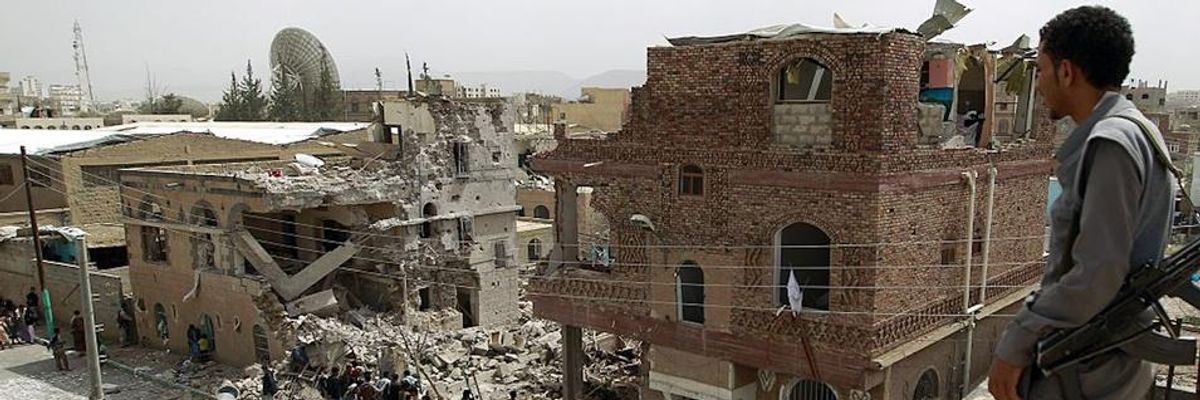
A Houthi militant watches from the roof of a building as people inspect the debris of a house destroyed in an airstrike by the Saudi-led coalition in the Yemeni capital city of Sanaa on July 3, 2015. (Photo: Mohammed Huwais/AFP/Getty Images)
Experts on the adverse effects of the military-industrial complex on Wednesday blasted a plan by the Trump administration to sell nearly half a billion dollars worth of advanced U.S. bombs to Saudi Arabia, which for over five years has been leading an airstrike campaign and starvation blockade that have added tens of thousands of civilian deaths to the already staggering toll in Yemen's ongoing civil war.
"The Biden administration has indicated a desire to rethink the U.S. relation[ship] with Saudi Arabia. The outgoing president should not use his lame-duck period to make that more difficult."
--Jeff Abramson,
Arms Control Association
Bloomberg reports the U.S. State Department has notified Congress of its intention to license the sale of some 7,500 Raytheon Paveway precision-guided, air-to-ground munitions valued at $478 million to the kingdom, despite its status as one of the world's worst human rights violators and prolific perpetrator of U.S.-backed war crimes in Yemen.
If the license is approved, Raytheon will have a green light to sell the arms directly to the Saudi regime.
Human rights advocates condemned the proposed sale, citing conduct by Saudi and allied military forces in Yemen.
"This deal should not be allowed to stand," asserted William D. Hartung, director of the arms and security program at the Center for International Policy, in a statement Wednesday. "The United States should not be selling precision-guided bombs to Saudi Arabia at this time, given their leading role in the air war in Yemen which has killed thousands of civilians and prolonged a conflict that is now the world's worst humanitarian catastrophe."
Hartung continued:
Saudi access to tens of thousands of precision-guided munitions thus far has not diminished the civilian toll in Yemen, so Pentagon claims that more accurate bombs will reduce civilian casualties don't hold up to scrutiny. A sale could also be seen as a reward to the Saudi regime at a time when it has yet to take responsibility for the murder of [journalist] Jamal Khashoggi or reduced its campaign of internal repression against regime critics and human rights defenders. Last but not least, this should be a decision for a new administration, not a lame-duck president.
Jeff Abramson, a senior fellow at the Arms Control Association, accused the Trump administration of "dangerously pushing more weapons into the Middle East to countries that have a record of misusing them.:
"The United States simply should not be selling weapons to Saudi Arabia, especially given their role in exacerbating the suffering in Yemen," stressed Abramson. "The Biden administration has indicated a desire to rethink the U.S. relation[ship] with Saudi Arabia. The outgoing president should not use his lame-duck period to make that more difficult."
However, as Washington Post military and national security reporter Missy Ryan noted Wednesday, former four-star general Lloyd Austin, who is President-elect Joe Biden's nominee for defense secretary, is currently a member of Raytheon's board of directors.
The United Nations--which has called the situation in Yemen the world's worst humanitarian crisis--in September recommended that the International Criminal Court investigate possible war crimes committed by all sides in the six-year civil war, which has claimed over 100,000 lives.
The U.N. cited U.S.-backed Saudi-led coalition airstrikes that have killed thousands of civilians, the Saudi-led blockade that has exacerbated famine conditions and disease that have killed at least tens of thousands of people, and a wide range of human rights violations by both Yemeni government forces and the Iran-backed Houthi rebels, including unlawful imprisonment and killing, forced disappearances, and use of child soldiers.
Dear Common Dreams reader, It’s been nearly 30 years since I co-founded Common Dreams with my late wife, Lina Newhouser. We had the radical notion that journalism should serve the public good, not corporate profits. It was clear to us from the outset what it would take to build such a project. No paid advertisements. No corporate sponsors. No millionaire publisher telling us what to think or do. Many people said we wouldn't last a year, but we proved those doubters wrong. Together with a tremendous team of journalists and dedicated staff, we built an independent media outlet free from the constraints of profits and corporate control. Our mission has always been simple: To inform. To inspire. To ignite change for the common good. Building Common Dreams was not easy. Our survival was never guaranteed. When you take on the most powerful forces—Wall Street greed, fossil fuel industry destruction, Big Tech lobbyists, and uber-rich oligarchs who have spent billions upon billions rigging the economy and democracy in their favor—the only bulwark you have is supporters who believe in your work. But here’s the urgent message from me today. It's never been this bad out there. And it's never been this hard to keep us going. At the very moment Common Dreams is most needed, the threats we face are intensifying. We need your support now more than ever. We don't accept corporate advertising and never will. We don't have a paywall because we don't think people should be blocked from critical news based on their ability to pay. Everything we do is funded by the donations of readers like you. When everyone does the little they can afford, we are strong. But if that support retreats or dries up, so do we. Will you donate now to make sure Common Dreams not only survives but thrives? —Craig Brown, Co-founder |
Experts on the adverse effects of the military-industrial complex on Wednesday blasted a plan by the Trump administration to sell nearly half a billion dollars worth of advanced U.S. bombs to Saudi Arabia, which for over five years has been leading an airstrike campaign and starvation blockade that have added tens of thousands of civilian deaths to the already staggering toll in Yemen's ongoing civil war.
"The Biden administration has indicated a desire to rethink the U.S. relation[ship] with Saudi Arabia. The outgoing president should not use his lame-duck period to make that more difficult."
--Jeff Abramson,
Arms Control Association
Bloomberg reports the U.S. State Department has notified Congress of its intention to license the sale of some 7,500 Raytheon Paveway precision-guided, air-to-ground munitions valued at $478 million to the kingdom, despite its status as one of the world's worst human rights violators and prolific perpetrator of U.S.-backed war crimes in Yemen.
If the license is approved, Raytheon will have a green light to sell the arms directly to the Saudi regime.
Human rights advocates condemned the proposed sale, citing conduct by Saudi and allied military forces in Yemen.
"This deal should not be allowed to stand," asserted William D. Hartung, director of the arms and security program at the Center for International Policy, in a statement Wednesday. "The United States should not be selling precision-guided bombs to Saudi Arabia at this time, given their leading role in the air war in Yemen which has killed thousands of civilians and prolonged a conflict that is now the world's worst humanitarian catastrophe."
Hartung continued:
Saudi access to tens of thousands of precision-guided munitions thus far has not diminished the civilian toll in Yemen, so Pentagon claims that more accurate bombs will reduce civilian casualties don't hold up to scrutiny. A sale could also be seen as a reward to the Saudi regime at a time when it has yet to take responsibility for the murder of [journalist] Jamal Khashoggi or reduced its campaign of internal repression against regime critics and human rights defenders. Last but not least, this should be a decision for a new administration, not a lame-duck president.
Jeff Abramson, a senior fellow at the Arms Control Association, accused the Trump administration of "dangerously pushing more weapons into the Middle East to countries that have a record of misusing them.:
"The United States simply should not be selling weapons to Saudi Arabia, especially given their role in exacerbating the suffering in Yemen," stressed Abramson. "The Biden administration has indicated a desire to rethink the U.S. relation[ship] with Saudi Arabia. The outgoing president should not use his lame-duck period to make that more difficult."
However, as Washington Post military and national security reporter Missy Ryan noted Wednesday, former four-star general Lloyd Austin, who is President-elect Joe Biden's nominee for defense secretary, is currently a member of Raytheon's board of directors.
The United Nations--which has called the situation in Yemen the world's worst humanitarian crisis--in September recommended that the International Criminal Court investigate possible war crimes committed by all sides in the six-year civil war, which has claimed over 100,000 lives.
The U.N. cited U.S.-backed Saudi-led coalition airstrikes that have killed thousands of civilians, the Saudi-led blockade that has exacerbated famine conditions and disease that have killed at least tens of thousands of people, and a wide range of human rights violations by both Yemeni government forces and the Iran-backed Houthi rebels, including unlawful imprisonment and killing, forced disappearances, and use of child soldiers.
Experts on the adverse effects of the military-industrial complex on Wednesday blasted a plan by the Trump administration to sell nearly half a billion dollars worth of advanced U.S. bombs to Saudi Arabia, which for over five years has been leading an airstrike campaign and starvation blockade that have added tens of thousands of civilian deaths to the already staggering toll in Yemen's ongoing civil war.
"The Biden administration has indicated a desire to rethink the U.S. relation[ship] with Saudi Arabia. The outgoing president should not use his lame-duck period to make that more difficult."
--Jeff Abramson,
Arms Control Association
Bloomberg reports the U.S. State Department has notified Congress of its intention to license the sale of some 7,500 Raytheon Paveway precision-guided, air-to-ground munitions valued at $478 million to the kingdom, despite its status as one of the world's worst human rights violators and prolific perpetrator of U.S.-backed war crimes in Yemen.
If the license is approved, Raytheon will have a green light to sell the arms directly to the Saudi regime.
Human rights advocates condemned the proposed sale, citing conduct by Saudi and allied military forces in Yemen.
"This deal should not be allowed to stand," asserted William D. Hartung, director of the arms and security program at the Center for International Policy, in a statement Wednesday. "The United States should not be selling precision-guided bombs to Saudi Arabia at this time, given their leading role in the air war in Yemen which has killed thousands of civilians and prolonged a conflict that is now the world's worst humanitarian catastrophe."
Hartung continued:
Saudi access to tens of thousands of precision-guided munitions thus far has not diminished the civilian toll in Yemen, so Pentagon claims that more accurate bombs will reduce civilian casualties don't hold up to scrutiny. A sale could also be seen as a reward to the Saudi regime at a time when it has yet to take responsibility for the murder of [journalist] Jamal Khashoggi or reduced its campaign of internal repression against regime critics and human rights defenders. Last but not least, this should be a decision for a new administration, not a lame-duck president.
Jeff Abramson, a senior fellow at the Arms Control Association, accused the Trump administration of "dangerously pushing more weapons into the Middle East to countries that have a record of misusing them.:
"The United States simply should not be selling weapons to Saudi Arabia, especially given their role in exacerbating the suffering in Yemen," stressed Abramson. "The Biden administration has indicated a desire to rethink the U.S. relation[ship] with Saudi Arabia. The outgoing president should not use his lame-duck period to make that more difficult."
However, as Washington Post military and national security reporter Missy Ryan noted Wednesday, former four-star general Lloyd Austin, who is President-elect Joe Biden's nominee for defense secretary, is currently a member of Raytheon's board of directors.
The United Nations--which has called the situation in Yemen the world's worst humanitarian crisis--in September recommended that the International Criminal Court investigate possible war crimes committed by all sides in the six-year civil war, which has claimed over 100,000 lives.
The U.N. cited U.S.-backed Saudi-led coalition airstrikes that have killed thousands of civilians, the Saudi-led blockade that has exacerbated famine conditions and disease that have killed at least tens of thousands of people, and a wide range of human rights violations by both Yemeni government forces and the Iran-backed Houthi rebels, including unlawful imprisonment and killing, forced disappearances, and use of child soldiers.