SUBSCRIBE TO OUR FREE NEWSLETTER
Daily news & progressive opinion—funded by the people, not the corporations—delivered straight to your inbox.
5
#000000
#FFFFFF
To donate by check, phone, or other method, see our More Ways to Give page.
Daily news & progressive opinion—funded by the people, not the corporations—delivered straight to your inbox.
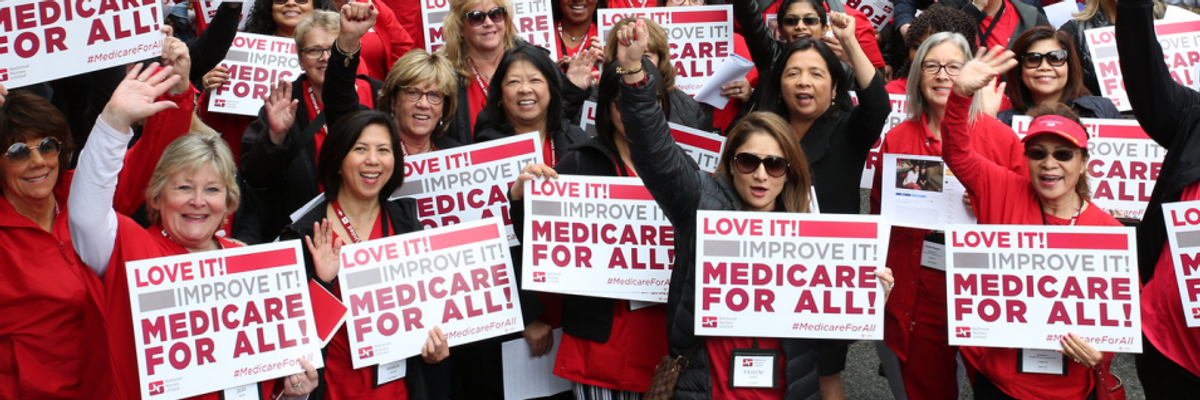
Medicare for All advocates on Wednesday noted that the U.S. Supreme Court's decision to allow employers to refuse to cover contraceptives presented a clear argument in favor of a universal healthcare system under which employment would not be tied to healthcare. (Photo: NNU/flickr/cc)
Healthcare advocates Wednesday charged that the U.S. Supreme Court's decision on birth control access is just the latest evidence that the federal government must expand Medicare coverage to all Americans, eliminating the for-profit system in which employment is tied to people's ability to obtain medical care.
Shortly after the 7-2 ruling in Trump vs. Pennsylvania declared the Trump administration was correct to exempt employers from having to cover birth control for employees on religious or moral grounds, Sen. Bernie Sanders (I-Vt.) pointed out how such rulings make clear that under the current for-profit healthcare system, medical decisions will never simply be between a patient and doctor.
"Patients' ability to get contraception shouldn't be up to employers. It should be a decision between patients and their doctors," tweeted Sanders, whose Medicare for All Act of 2019 has 14 co-sponsors in the Senate. "Healthcare--including birth control--is a right, not an employee benefit."
Sanders' outrage over the ruling echoed that of national reproductive rights groups such as NARAL and Planned Parenthood, but those organizations did not suggest fundamentally reforming the healthcare system by covering everyone in the U.S. under the existing Medicare system and taking women's healthcare decisions out of the hands of their employers.
"We must fight Trump's rollback of these rights by passing Medicare for All," said Sanders.
Rep. Ro Khanna (D-Calif.) wrote later in the day that "this wouldn't even be an issue if healthcare wasn't tied to employment."
The ruling was the latest example for Medicare for All advocates to point to as they decry the dangerous risks inherent in the current for-profit health insurance system.
The Economic Policy Institute estimated in May that since the coronavirus pandemic began in the U.S., 16.2 million Americans have lost the health coverage they had access to through their employers, as the unemployment crisis caused by the public health emergency has left more than 32 million without work. EPI and others have recommended since the pandemic began that Medicare and Medicaid be expanded to cope with the economic effects.
Progressive congressional candidates Christopher Hale, who is running in Tennessee, and Beth Doglio, who is running in Washington, also wrote on social media that women's access to birth control should not be up to one's employer.
In 2014, after the Supreme Court first ruled that employers can refuse to cover contraceptives in Burwell vs. Hobby Lobby, Hale wrote at Time magazine that the decision revealed "that Obamacare--for all the good it's done in increasing access to quality and affordable healthcare--is a messy law."
"It asks employees to be at the whim of its employers' objectives and mission for what healthcare benefits they receive," Hale wrote. "This isn't sustainable. A person's access to quality healthcare shouldn't depend on who their boss is."
Medicare for All would represent "freedom" to Americans, wrote Justice Democrats co-founder and radio host Kyle Kulinski, while the for-profit employment-based system is "tyranny."
"Do you know what would be great? If employers and insurance companies weren't involved in birth control or healthcare at all," tweeted Holly Stallcup, executive director of Rise, a faith-based women's organization in Texas. "If all medically related decisions really were between doctor and patient. Medicare for All would be happy to help."
Dear Common Dreams reader, It’s been nearly 30 years since I co-founded Common Dreams with my late wife, Lina Newhouser. We had the radical notion that journalism should serve the public good, not corporate profits. It was clear to us from the outset what it would take to build such a project. No paid advertisements. No corporate sponsors. No millionaire publisher telling us what to think or do. Many people said we wouldn't last a year, but we proved those doubters wrong. Together with a tremendous team of journalists and dedicated staff, we built an independent media outlet free from the constraints of profits and corporate control. Our mission has always been simple: To inform. To inspire. To ignite change for the common good. Building Common Dreams was not easy. Our survival was never guaranteed. When you take on the most powerful forces—Wall Street greed, fossil fuel industry destruction, Big Tech lobbyists, and uber-rich oligarchs who have spent billions upon billions rigging the economy and democracy in their favor—the only bulwark you have is supporters who believe in your work. But here’s the urgent message from me today. It's never been this bad out there. And it's never been this hard to keep us going. At the very moment Common Dreams is most needed, the threats we face are intensifying. We need your support now more than ever. We don't accept corporate advertising and never will. We don't have a paywall because we don't think people should be blocked from critical news based on their ability to pay. Everything we do is funded by the donations of readers like you. When everyone does the little they can afford, we are strong. But if that support retreats or dries up, so do we. Will you donate now to make sure Common Dreams not only survives but thrives? —Craig Brown, Co-founder |
Healthcare advocates Wednesday charged that the U.S. Supreme Court's decision on birth control access is just the latest evidence that the federal government must expand Medicare coverage to all Americans, eliminating the for-profit system in which employment is tied to people's ability to obtain medical care.
Shortly after the 7-2 ruling in Trump vs. Pennsylvania declared the Trump administration was correct to exempt employers from having to cover birth control for employees on religious or moral grounds, Sen. Bernie Sanders (I-Vt.) pointed out how such rulings make clear that under the current for-profit healthcare system, medical decisions will never simply be between a patient and doctor.
"Patients' ability to get contraception shouldn't be up to employers. It should be a decision between patients and their doctors," tweeted Sanders, whose Medicare for All Act of 2019 has 14 co-sponsors in the Senate. "Healthcare--including birth control--is a right, not an employee benefit."
Sanders' outrage over the ruling echoed that of national reproductive rights groups such as NARAL and Planned Parenthood, but those organizations did not suggest fundamentally reforming the healthcare system by covering everyone in the U.S. under the existing Medicare system and taking women's healthcare decisions out of the hands of their employers.
"We must fight Trump's rollback of these rights by passing Medicare for All," said Sanders.
Rep. Ro Khanna (D-Calif.) wrote later in the day that "this wouldn't even be an issue if healthcare wasn't tied to employment."
The ruling was the latest example for Medicare for All advocates to point to as they decry the dangerous risks inherent in the current for-profit health insurance system.
The Economic Policy Institute estimated in May that since the coronavirus pandemic began in the U.S., 16.2 million Americans have lost the health coverage they had access to through their employers, as the unemployment crisis caused by the public health emergency has left more than 32 million without work. EPI and others have recommended since the pandemic began that Medicare and Medicaid be expanded to cope with the economic effects.
Progressive congressional candidates Christopher Hale, who is running in Tennessee, and Beth Doglio, who is running in Washington, also wrote on social media that women's access to birth control should not be up to one's employer.
In 2014, after the Supreme Court first ruled that employers can refuse to cover contraceptives in Burwell vs. Hobby Lobby, Hale wrote at Time magazine that the decision revealed "that Obamacare--for all the good it's done in increasing access to quality and affordable healthcare--is a messy law."
"It asks employees to be at the whim of its employers' objectives and mission for what healthcare benefits they receive," Hale wrote. "This isn't sustainable. A person's access to quality healthcare shouldn't depend on who their boss is."
Medicare for All would represent "freedom" to Americans, wrote Justice Democrats co-founder and radio host Kyle Kulinski, while the for-profit employment-based system is "tyranny."
"Do you know what would be great? If employers and insurance companies weren't involved in birth control or healthcare at all," tweeted Holly Stallcup, executive director of Rise, a faith-based women's organization in Texas. "If all medically related decisions really were between doctor and patient. Medicare for All would be happy to help."
Healthcare advocates Wednesday charged that the U.S. Supreme Court's decision on birth control access is just the latest evidence that the federal government must expand Medicare coverage to all Americans, eliminating the for-profit system in which employment is tied to people's ability to obtain medical care.
Shortly after the 7-2 ruling in Trump vs. Pennsylvania declared the Trump administration was correct to exempt employers from having to cover birth control for employees on religious or moral grounds, Sen. Bernie Sanders (I-Vt.) pointed out how such rulings make clear that under the current for-profit healthcare system, medical decisions will never simply be between a patient and doctor.
"Patients' ability to get contraception shouldn't be up to employers. It should be a decision between patients and their doctors," tweeted Sanders, whose Medicare for All Act of 2019 has 14 co-sponsors in the Senate. "Healthcare--including birth control--is a right, not an employee benefit."
Sanders' outrage over the ruling echoed that of national reproductive rights groups such as NARAL and Planned Parenthood, but those organizations did not suggest fundamentally reforming the healthcare system by covering everyone in the U.S. under the existing Medicare system and taking women's healthcare decisions out of the hands of their employers.
"We must fight Trump's rollback of these rights by passing Medicare for All," said Sanders.
Rep. Ro Khanna (D-Calif.) wrote later in the day that "this wouldn't even be an issue if healthcare wasn't tied to employment."
The ruling was the latest example for Medicare for All advocates to point to as they decry the dangerous risks inherent in the current for-profit health insurance system.
The Economic Policy Institute estimated in May that since the coronavirus pandemic began in the U.S., 16.2 million Americans have lost the health coverage they had access to through their employers, as the unemployment crisis caused by the public health emergency has left more than 32 million without work. EPI and others have recommended since the pandemic began that Medicare and Medicaid be expanded to cope with the economic effects.
Progressive congressional candidates Christopher Hale, who is running in Tennessee, and Beth Doglio, who is running in Washington, also wrote on social media that women's access to birth control should not be up to one's employer.
In 2014, after the Supreme Court first ruled that employers can refuse to cover contraceptives in Burwell vs. Hobby Lobby, Hale wrote at Time magazine that the decision revealed "that Obamacare--for all the good it's done in increasing access to quality and affordable healthcare--is a messy law."
"It asks employees to be at the whim of its employers' objectives and mission for what healthcare benefits they receive," Hale wrote. "This isn't sustainable. A person's access to quality healthcare shouldn't depend on who their boss is."
Medicare for All would represent "freedom" to Americans, wrote Justice Democrats co-founder and radio host Kyle Kulinski, while the for-profit employment-based system is "tyranny."
"Do you know what would be great? If employers and insurance companies weren't involved in birth control or healthcare at all," tweeted Holly Stallcup, executive director of Rise, a faith-based women's organization in Texas. "If all medically related decisions really were between doctor and patient. Medicare for All would be happy to help."