
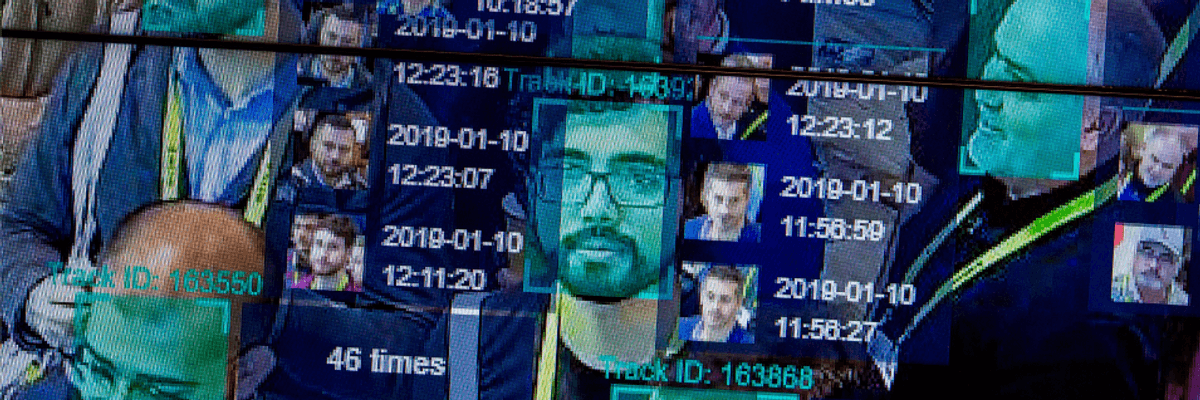
A live demonstration uses artificial intelligence and facial recognition in dense crowd spatial-temporal technology at the Horizon Robotics exhibit at the Las Vegas Convention Center during CES 2019 in Las Vegas on January 10, 2019. (Photo: David McNew/AFP/Getty Images)
'Your Turn, Amazon and Microsoft': Civil Liberties Advocates Applaud IBM Decision to Ditch Facial Recognition
"This huge IBM move will force other large tech companies to take a stand, even if their silence is their statement."
Tech giant IBM is getting out of the facial recognition software business, the company's CEO announced Monday in a letter to Congress calling on lawmakers to develop polices to address racial injustice and inequity, leading rights advocates to call on other companies in the field to walk away from the technology.
"This huge IBM move will force other large tech companies to take a stand, even if their silence is their statement," tweeted Wired writer Jessi Hempel.
The company's CEO, Arvind Krishna, declared in his letter to Congress that IBM was stepping away from facial recognition due to the technology's racial and gender biases as well as other concerns about mass surveillance and its use by law enforcement.
"IBM firmly opposes and will not condone uses of any technology, including facial recognition technology offered by other vendors, for mass surveillance, racial profiling, violations of basic human rights and freedoms, or any purpose which is not consistent with our values," said Krishna.
As CNBC reported:
IBM decided to shut down its facial recognition products and announce its decision as the death of George Floyd brought the topic of police reform and racial inequity into the forefront of the national conversation, a person familiar with the situation told CNBC. It follows testimony from Joy Buolamwini, founder of Algorithmic Justice League, before Congress last year, about her research for MIT into the bias she found in facial recognition software.
The ACLU welcomed the decision and urged IBM's competitors to do the same.
Krishna's letter also expressed support for the Justice in Policing Act, a legislative package introduced by congressional Democrats on Monday..
In a statement, ACLU senior legislative counsel Kanya Bennett urged lawmakers to avoid investing in surveillance infrastructure as they look to address policing issues around the country.
"We need to invest in technologies that can help eliminate the digital divide," said Bennett, "not technologies that create a surveillance infrastructure that exacerbates policing abuses and structural racism."
We are at a crossroads
This country and this world are at a monumental crossroads. US voters have an opportunity to beat back the forces of fascism and confront the billionaires who are rigging the economy, our media system, and our democracy, making it increasingly impossible for ordinary people to get by. We’re not just talking about the election. We’re talking about what must be done once these fascist elements are vanquished from power. We need a bolder set of solutions than what either major party has so far been willing to offer and a working-class movement ready to fight like hell for it. Trump didn't emerge from nowhere. The conditions that fueled MAGA authoritarianism were created by decades of radical neoliberal economic policies and a corrupt political system dominated by corporate interests. They slashed taxes on the super-rich, promising that the benefits would trickle down. They said giveaways to the corporate titans would make life more affordable for the rest of us. It was all bullshit. And when a bitter, betrayed populace searches for someone to blame, right-wing demagogues have little trouble finding scapegoats. People know when they're being lied to, but you won't hear any of this from the corporate media. Only independent journalism—powered and funded by people who believe in building a better world—can deliver truly trustworthy daily news. Our Fall Campaign is underway, and we need your help. To power our newsroom through the rest of the year, we need to raise $125,000 by midnight on October 31. So if you share our vision, please contribute whatever you can to sustain our work. |
Tech giant IBM is getting out of the facial recognition software business, the company's CEO announced Monday in a letter to Congress calling on lawmakers to develop polices to address racial injustice and inequity, leading rights advocates to call on other companies in the field to walk away from the technology.
"This huge IBM move will force other large tech companies to take a stand, even if their silence is their statement," tweeted Wired writer Jessi Hempel.
The company's CEO, Arvind Krishna, declared in his letter to Congress that IBM was stepping away from facial recognition due to the technology's racial and gender biases as well as other concerns about mass surveillance and its use by law enforcement.
"IBM firmly opposes and will not condone uses of any technology, including facial recognition technology offered by other vendors, for mass surveillance, racial profiling, violations of basic human rights and freedoms, or any purpose which is not consistent with our values," said Krishna.
As CNBC reported:
IBM decided to shut down its facial recognition products and announce its decision as the death of George Floyd brought the topic of police reform and racial inequity into the forefront of the national conversation, a person familiar with the situation told CNBC. It follows testimony from Joy Buolamwini, founder of Algorithmic Justice League, before Congress last year, about her research for MIT into the bias she found in facial recognition software.
The ACLU welcomed the decision and urged IBM's competitors to do the same.
Krishna's letter also expressed support for the Justice in Policing Act, a legislative package introduced by congressional Democrats on Monday..
In a statement, ACLU senior legislative counsel Kanya Bennett urged lawmakers to avoid investing in surveillance infrastructure as they look to address policing issues around the country.
"We need to invest in technologies that can help eliminate the digital divide," said Bennett, "not technologies that create a surveillance infrastructure that exacerbates policing abuses and structural racism."