SUBSCRIBE TO OUR FREE NEWSLETTER
Daily news & progressive opinion—funded by the people, not the corporations—delivered straight to your inbox.
5
#000000
#FFFFFF
To donate by check, phone, or other method, see our More Ways to Give page.
Daily news & progressive opinion—funded by the people, not the corporations—delivered straight to your inbox.
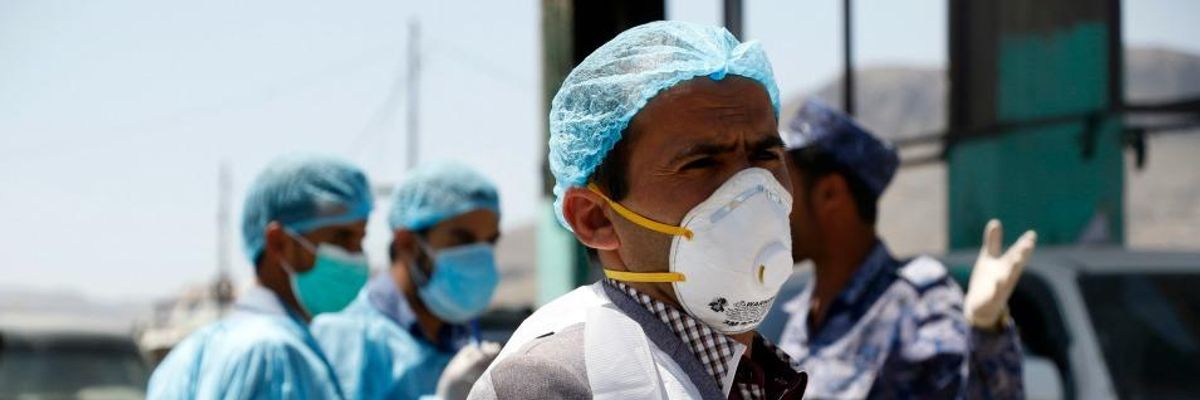
Medical personnel check people's temperature on the street as a precautionary measure against the spread of coronavirus COVID-19 on April 5, 2020 on the outskirts of Sana'a, Yemen. (Photo: Mohammed Hamoud/Getty Images)
The United Nations warned Monday that the World Health Organization would likely impose drastic cuts to humanitarian aid in Yemen this week, a move that follows the Trump administration's slashing of funds for the global health agency.
Lise Grande, U.N. humanitarian coordinator for Yemen, said WHO is expected to suspend about 80% of its funding for Yemen's hospitals, primary healthcare programs, and other healthcare needs.
The announcement at a panel hosted by the Center for Strategic and International Studies came two weeks after Yemen reported its first confirmed case of COVID-19, the disease caused by the coronavirus. Although the official number of cases remains low, Al-Monitor reported last week that many cases may have been kept secret from the public and from global health organizations.
The emergence of COVID-19 in the war-torn country--where five years of U.S.-backed war and Saudi intervention has have led to the world's largest humanitarian crisis with 22 million in need of assistance--has led to fears among human rights groups that an outbreak could quickly overwhelm the country's healthcare system.
As international relations researcher Guy Burton wrote on social media, the timing of WHO's drawdown "could not be worse."
Grande said at the panel discussion that WHO is "facing a funding crisis of gargantuan proportions" and will likely need to make cuts. The statement came days after the U.S. halted funding for the organization, with President Donald Trump accusing WHO of "mismanaging" the coronavirus pandemic. The U.S. contributed $400 million to the agency in 2019, more than any other nation.
Grande said WHO's "donors have lost confidence" in the agency's efforts in Yemen, echoing the Trump administration's reasoning for pulling its own healthcare aid from Yemen last month. U.S. officials said it was suspending the aid because the Houthis, who control northern Yemen, have imposed restrictions on organizations delivering humanitarian assistance.
WHO's suspension of aid is expected to "reduce" or "more likely" suspend operations entirely in 189 hospitals in Yemen as well as 200 primary care facilities.
The U.N. Children's Fund will also have to scale back or shut down its services throughout the country in 18 major healthcare centers and more than 2,000 doctors' offices.
As Al-Monitor reported, efforts to suppress the coronavirus pandemic in Yemen could be directly impacted as the distribution of hygiene products will be reduced or eliminated. More than 140 camps for displaced Yemenis will also lose services.
About 250,000 children suffering from malnourishment will lose healthcare services as a result of the expected cuts.
Intercept journalist Murtaza Hussain wrote on Twitter that Trump's decision to "deflect blame" for the rapid spread of COVID-19 in the U.S. onto WHO will result in the continued suffering of Yemenis.
The United States' suspension of aid in Yemen and for WHO follows the Trump administration's decision to continue imposing sanctions on Iran, Venezuela, and other nations even as the pandemic threatens millions of lives in the hardest-hit countries.
"From Tehran to Sanaa," wrote Defense Priorities fellow Shahed Ghoreishi, "cruelty seems to be the point."
Dear Common Dreams reader, It’s been nearly 30 years since I co-founded Common Dreams with my late wife, Lina Newhouser. We had the radical notion that journalism should serve the public good, not corporate profits. It was clear to us from the outset what it would take to build such a project. No paid advertisements. No corporate sponsors. No millionaire publisher telling us what to think or do. Many people said we wouldn't last a year, but we proved those doubters wrong. Together with a tremendous team of journalists and dedicated staff, we built an independent media outlet free from the constraints of profits and corporate control. Our mission has always been simple: To inform. To inspire. To ignite change for the common good. Building Common Dreams was not easy. Our survival was never guaranteed. When you take on the most powerful forces—Wall Street greed, fossil fuel industry destruction, Big Tech lobbyists, and uber-rich oligarchs who have spent billions upon billions rigging the economy and democracy in their favor—the only bulwark you have is supporters who believe in your work. But here’s the urgent message from me today. It's never been this bad out there. And it's never been this hard to keep us going. At the very moment Common Dreams is most needed, the threats we face are intensifying. We need your support now more than ever. We don't accept corporate advertising and never will. We don't have a paywall because we don't think people should be blocked from critical news based on their ability to pay. Everything we do is funded by the donations of readers like you. When everyone does the little they can afford, we are strong. But if that support retreats or dries up, so do we. Will you donate now to make sure Common Dreams not only survives but thrives? —Craig Brown, Co-founder |
The United Nations warned Monday that the World Health Organization would likely impose drastic cuts to humanitarian aid in Yemen this week, a move that follows the Trump administration's slashing of funds for the global health agency.
Lise Grande, U.N. humanitarian coordinator for Yemen, said WHO is expected to suspend about 80% of its funding for Yemen's hospitals, primary healthcare programs, and other healthcare needs.
The announcement at a panel hosted by the Center for Strategic and International Studies came two weeks after Yemen reported its first confirmed case of COVID-19, the disease caused by the coronavirus. Although the official number of cases remains low, Al-Monitor reported last week that many cases may have been kept secret from the public and from global health organizations.
The emergence of COVID-19 in the war-torn country--where five years of U.S.-backed war and Saudi intervention has have led to the world's largest humanitarian crisis with 22 million in need of assistance--has led to fears among human rights groups that an outbreak could quickly overwhelm the country's healthcare system.
As international relations researcher Guy Burton wrote on social media, the timing of WHO's drawdown "could not be worse."
Grande said at the panel discussion that WHO is "facing a funding crisis of gargantuan proportions" and will likely need to make cuts. The statement came days after the U.S. halted funding for the organization, with President Donald Trump accusing WHO of "mismanaging" the coronavirus pandemic. The U.S. contributed $400 million to the agency in 2019, more than any other nation.
Grande said WHO's "donors have lost confidence" in the agency's efforts in Yemen, echoing the Trump administration's reasoning for pulling its own healthcare aid from Yemen last month. U.S. officials said it was suspending the aid because the Houthis, who control northern Yemen, have imposed restrictions on organizations delivering humanitarian assistance.
WHO's suspension of aid is expected to "reduce" or "more likely" suspend operations entirely in 189 hospitals in Yemen as well as 200 primary care facilities.
The U.N. Children's Fund will also have to scale back or shut down its services throughout the country in 18 major healthcare centers and more than 2,000 doctors' offices.
As Al-Monitor reported, efforts to suppress the coronavirus pandemic in Yemen could be directly impacted as the distribution of hygiene products will be reduced or eliminated. More than 140 camps for displaced Yemenis will also lose services.
About 250,000 children suffering from malnourishment will lose healthcare services as a result of the expected cuts.
Intercept journalist Murtaza Hussain wrote on Twitter that Trump's decision to "deflect blame" for the rapid spread of COVID-19 in the U.S. onto WHO will result in the continued suffering of Yemenis.
The United States' suspension of aid in Yemen and for WHO follows the Trump administration's decision to continue imposing sanctions on Iran, Venezuela, and other nations even as the pandemic threatens millions of lives in the hardest-hit countries.
"From Tehran to Sanaa," wrote Defense Priorities fellow Shahed Ghoreishi, "cruelty seems to be the point."
The United Nations warned Monday that the World Health Organization would likely impose drastic cuts to humanitarian aid in Yemen this week, a move that follows the Trump administration's slashing of funds for the global health agency.
Lise Grande, U.N. humanitarian coordinator for Yemen, said WHO is expected to suspend about 80% of its funding for Yemen's hospitals, primary healthcare programs, and other healthcare needs.
The announcement at a panel hosted by the Center for Strategic and International Studies came two weeks after Yemen reported its first confirmed case of COVID-19, the disease caused by the coronavirus. Although the official number of cases remains low, Al-Monitor reported last week that many cases may have been kept secret from the public and from global health organizations.
The emergence of COVID-19 in the war-torn country--where five years of U.S.-backed war and Saudi intervention has have led to the world's largest humanitarian crisis with 22 million in need of assistance--has led to fears among human rights groups that an outbreak could quickly overwhelm the country's healthcare system.
As international relations researcher Guy Burton wrote on social media, the timing of WHO's drawdown "could not be worse."
Grande said at the panel discussion that WHO is "facing a funding crisis of gargantuan proportions" and will likely need to make cuts. The statement came days after the U.S. halted funding for the organization, with President Donald Trump accusing WHO of "mismanaging" the coronavirus pandemic. The U.S. contributed $400 million to the agency in 2019, more than any other nation.
Grande said WHO's "donors have lost confidence" in the agency's efforts in Yemen, echoing the Trump administration's reasoning for pulling its own healthcare aid from Yemen last month. U.S. officials said it was suspending the aid because the Houthis, who control northern Yemen, have imposed restrictions on organizations delivering humanitarian assistance.
WHO's suspension of aid is expected to "reduce" or "more likely" suspend operations entirely in 189 hospitals in Yemen as well as 200 primary care facilities.
The U.N. Children's Fund will also have to scale back or shut down its services throughout the country in 18 major healthcare centers and more than 2,000 doctors' offices.
As Al-Monitor reported, efforts to suppress the coronavirus pandemic in Yemen could be directly impacted as the distribution of hygiene products will be reduced or eliminated. More than 140 camps for displaced Yemenis will also lose services.
About 250,000 children suffering from malnourishment will lose healthcare services as a result of the expected cuts.
Intercept journalist Murtaza Hussain wrote on Twitter that Trump's decision to "deflect blame" for the rapid spread of COVID-19 in the U.S. onto WHO will result in the continued suffering of Yemenis.
The United States' suspension of aid in Yemen and for WHO follows the Trump administration's decision to continue imposing sanctions on Iran, Venezuela, and other nations even as the pandemic threatens millions of lives in the hardest-hit countries.
"From Tehran to Sanaa," wrote Defense Priorities fellow Shahed Ghoreishi, "cruelty seems to be the point."