SUBSCRIBE TO OUR FREE NEWSLETTER
Daily news & progressive opinion—funded by the people, not the corporations—delivered straight to your inbox.
5
#000000
#FFFFFF
To donate by check, phone, or other method, see our More Ways to Give page.
Daily news & progressive opinion—funded by the people, not the corporations—delivered straight to your inbox.
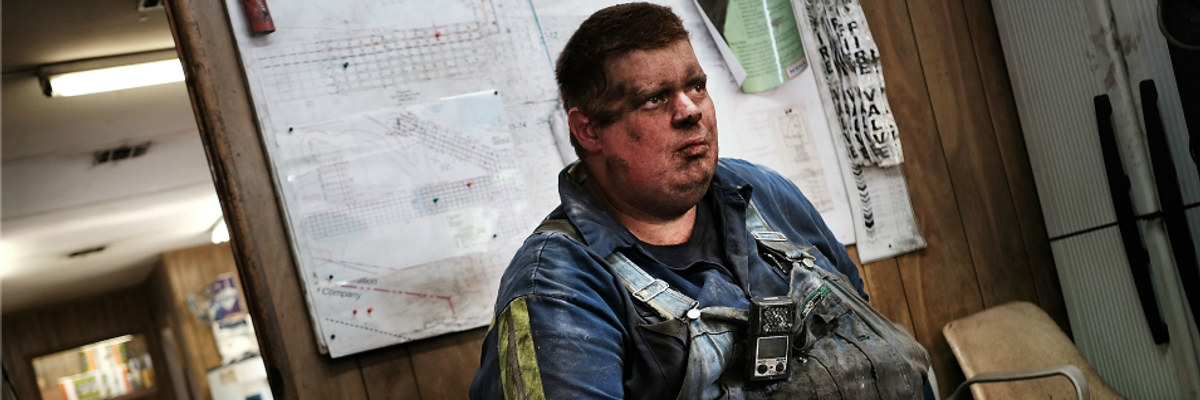
Coal miner Doug Rutherford takes a break after his shift at a small mine on May 19, 2017 outside the city of Welch, West Virginia. (Photo: Spencer Platt/Getty Images)
Some of the largest coal companies in the United States are using the coronavirus crisis to pressure Congress to slash the tax that finances the Black Lung Disability Trust Fund, a lifeline for more than 20,000 miners whose lung disease makes them more vulnerable to COVID-19.
The Washington Post reported this week that the National Mining Association (NMA), a trade group that represents the biggest U.S. coal operators still standing, "asked Congress last month for a 55 percent cut in the excise tax for the trust fund, and a suspension of another fee that pays to clean up abandoned mines. Altogether the operators say they could save about $220 million."
"Nobody knows what this virus is going to do when it gets to this area. It's probably just going to wipe us out."
--Jimmy Moore, a 74-year-old black lung patient in Shelby Gap, Kentucky
"While the level of taxation to back the fund has fluctuated sharply over the past two years," the Post noted, "it currently stands at $1.10 for every ton of coal mined underground and 55 cents for surface coal."
Harold Sturgill, a 60-year-old retired miner who was diagnosed with black lung in 1998, said in an interview with the Post that coal companies are "going to try to use this virus thing to stop paying benefits."
"They're crooks," Sturgill said.
The NMA explicitly pointed to the coronavirus crisis in its tax cut request to Congress (pdf)--which was not included in the stimulus package that Congress passed last month--and labeled the coal industry "essential" to energy production in the United States. A group of Republican senators is currently pressuring the Federal Reserve to allow coal companies to benefit from the multi-trillion-dollar CARES Act.
"As the country faces this unique and mounting challenge around the COVID-19 pandemic, U.S. coal miners continue to work to provide the resources necessary to power America while bracing for the severe financial distress facing all sectors across the nation," NMA wrote to congressional leaders. "To minimize the impact of this crisis on the coal industry, Congress should ensure all businesses have the financial resources necessary to ride out the pandemic."
The group, according to the Post, intends to keep pushing for the tax cut in future stimulus legislation.
"At a time when the country is facing a pandemic due to a respiratory illness, it is particularly egregious for the coal industry to advocate reducing the Black Lung Excise Tax."
--Reps. Raul Grijalva and Matthew Cartwright
As EcoWatch reported earlier this week, "in some states like West Virginia, coal mines have been classified as essential services and are staying open during the COVID-19 pandemic, even though the close quarters miners work in and the known risks to respiratory health put miners in harm's way during the spread of the coronavirus."
"Nobody knows what this virus is going to do when it gets to this area," Jimmy Moore, a 74-year-old black lung patient in Shelby Gap, Kentucky, told HuffPost. "It's probably just going to wipe us out."
Miners and advocates have long warned about the financial health of the Black Lung Disability Trust Fund, which is deeply in debt, and repeatedly asked lawmakers to act to ensure that the program is sustainable over the long term. Last July, as Common Dreams reported, a group of around 120 retired miners traveled to Washington, D.C. to demand congressional action to secure the fund's finances, only to be brushed aside by Senate Majority Leader Mitch McConnell, a Kentucky Republican.
Lynda Glagola, chairwoman of the National Coalition of Black Lung and Respiratory Disease Clinics, told the Post that if Congress grants the coal industry its desired tax cut, "the fund will spiral deeper and deeper into debt causing it to become a red financial flag."
"Especially at this time, as the economy is collapsing right before our eyes," Glagola warned, "lawmakers will soon be looking for programs to cut to save money and reduce the national debt and deficit."
In response to NMA's request, Rep. Raul Grijalva (D-Ariz.)--chairman of the House Natural Resources Committee--and Rep. Matthew Cartwright (D-Pa.) wrote a letter (pdf) to congressional leaders last month urging them to reject the coal industry's "wish-list" and "focus federal resources on the workers, families, and communities that are being hardest hit by this crisis."
"The coal industry is taking advantage of the country's current circumstances to advocate for policies that are completely unrelated to the current crisis, policies that would in fact set back efforts to improve the health and lives of people across the country," the lawmakers wrote. "At a time when the country is facing a pandemic due to a respiratory illness, it is particularly egregious for the coal industry to advocate reducing the Black Lung Excise Tax."
Dear Common Dreams reader, It’s been nearly 30 years since I co-founded Common Dreams with my late wife, Lina Newhouser. We had the radical notion that journalism should serve the public good, not corporate profits. It was clear to us from the outset what it would take to build such a project. No paid advertisements. No corporate sponsors. No millionaire publisher telling us what to think or do. Many people said we wouldn't last a year, but we proved those doubters wrong. Together with a tremendous team of journalists and dedicated staff, we built an independent media outlet free from the constraints of profits and corporate control. Our mission has always been simple: To inform. To inspire. To ignite change for the common good. Building Common Dreams was not easy. Our survival was never guaranteed. When you take on the most powerful forces—Wall Street greed, fossil fuel industry destruction, Big Tech lobbyists, and uber-rich oligarchs who have spent billions upon billions rigging the economy and democracy in their favor—the only bulwark you have is supporters who believe in your work. But here’s the urgent message from me today. It's never been this bad out there. And it's never been this hard to keep us going. At the very moment Common Dreams is most needed, the threats we face are intensifying. We need your support now more than ever. We don't accept corporate advertising and never will. We don't have a paywall because we don't think people should be blocked from critical news based on their ability to pay. Everything we do is funded by the donations of readers like you. When everyone does the little they can afford, we are strong. But if that support retreats or dries up, so do we. Will you donate now to make sure Common Dreams not only survives but thrives? —Craig Brown, Co-founder |
Some of the largest coal companies in the United States are using the coronavirus crisis to pressure Congress to slash the tax that finances the Black Lung Disability Trust Fund, a lifeline for more than 20,000 miners whose lung disease makes them more vulnerable to COVID-19.
The Washington Post reported this week that the National Mining Association (NMA), a trade group that represents the biggest U.S. coal operators still standing, "asked Congress last month for a 55 percent cut in the excise tax for the trust fund, and a suspension of another fee that pays to clean up abandoned mines. Altogether the operators say they could save about $220 million."
"Nobody knows what this virus is going to do when it gets to this area. It's probably just going to wipe us out."
--Jimmy Moore, a 74-year-old black lung patient in Shelby Gap, Kentucky
"While the level of taxation to back the fund has fluctuated sharply over the past two years," the Post noted, "it currently stands at $1.10 for every ton of coal mined underground and 55 cents for surface coal."
Harold Sturgill, a 60-year-old retired miner who was diagnosed with black lung in 1998, said in an interview with the Post that coal companies are "going to try to use this virus thing to stop paying benefits."
"They're crooks," Sturgill said.
The NMA explicitly pointed to the coronavirus crisis in its tax cut request to Congress (pdf)--which was not included in the stimulus package that Congress passed last month--and labeled the coal industry "essential" to energy production in the United States. A group of Republican senators is currently pressuring the Federal Reserve to allow coal companies to benefit from the multi-trillion-dollar CARES Act.
"As the country faces this unique and mounting challenge around the COVID-19 pandemic, U.S. coal miners continue to work to provide the resources necessary to power America while bracing for the severe financial distress facing all sectors across the nation," NMA wrote to congressional leaders. "To minimize the impact of this crisis on the coal industry, Congress should ensure all businesses have the financial resources necessary to ride out the pandemic."
The group, according to the Post, intends to keep pushing for the tax cut in future stimulus legislation.
"At a time when the country is facing a pandemic due to a respiratory illness, it is particularly egregious for the coal industry to advocate reducing the Black Lung Excise Tax."
--Reps. Raul Grijalva and Matthew Cartwright
As EcoWatch reported earlier this week, "in some states like West Virginia, coal mines have been classified as essential services and are staying open during the COVID-19 pandemic, even though the close quarters miners work in and the known risks to respiratory health put miners in harm's way during the spread of the coronavirus."
"Nobody knows what this virus is going to do when it gets to this area," Jimmy Moore, a 74-year-old black lung patient in Shelby Gap, Kentucky, told HuffPost. "It's probably just going to wipe us out."
Miners and advocates have long warned about the financial health of the Black Lung Disability Trust Fund, which is deeply in debt, and repeatedly asked lawmakers to act to ensure that the program is sustainable over the long term. Last July, as Common Dreams reported, a group of around 120 retired miners traveled to Washington, D.C. to demand congressional action to secure the fund's finances, only to be brushed aside by Senate Majority Leader Mitch McConnell, a Kentucky Republican.
Lynda Glagola, chairwoman of the National Coalition of Black Lung and Respiratory Disease Clinics, told the Post that if Congress grants the coal industry its desired tax cut, "the fund will spiral deeper and deeper into debt causing it to become a red financial flag."
"Especially at this time, as the economy is collapsing right before our eyes," Glagola warned, "lawmakers will soon be looking for programs to cut to save money and reduce the national debt and deficit."
In response to NMA's request, Rep. Raul Grijalva (D-Ariz.)--chairman of the House Natural Resources Committee--and Rep. Matthew Cartwright (D-Pa.) wrote a letter (pdf) to congressional leaders last month urging them to reject the coal industry's "wish-list" and "focus federal resources on the workers, families, and communities that are being hardest hit by this crisis."
"The coal industry is taking advantage of the country's current circumstances to advocate for policies that are completely unrelated to the current crisis, policies that would in fact set back efforts to improve the health and lives of people across the country," the lawmakers wrote. "At a time when the country is facing a pandemic due to a respiratory illness, it is particularly egregious for the coal industry to advocate reducing the Black Lung Excise Tax."
Some of the largest coal companies in the United States are using the coronavirus crisis to pressure Congress to slash the tax that finances the Black Lung Disability Trust Fund, a lifeline for more than 20,000 miners whose lung disease makes them more vulnerable to COVID-19.
The Washington Post reported this week that the National Mining Association (NMA), a trade group that represents the biggest U.S. coal operators still standing, "asked Congress last month for a 55 percent cut in the excise tax for the trust fund, and a suspension of another fee that pays to clean up abandoned mines. Altogether the operators say they could save about $220 million."
"Nobody knows what this virus is going to do when it gets to this area. It's probably just going to wipe us out."
--Jimmy Moore, a 74-year-old black lung patient in Shelby Gap, Kentucky
"While the level of taxation to back the fund has fluctuated sharply over the past two years," the Post noted, "it currently stands at $1.10 for every ton of coal mined underground and 55 cents for surface coal."
Harold Sturgill, a 60-year-old retired miner who was diagnosed with black lung in 1998, said in an interview with the Post that coal companies are "going to try to use this virus thing to stop paying benefits."
"They're crooks," Sturgill said.
The NMA explicitly pointed to the coronavirus crisis in its tax cut request to Congress (pdf)--which was not included in the stimulus package that Congress passed last month--and labeled the coal industry "essential" to energy production in the United States. A group of Republican senators is currently pressuring the Federal Reserve to allow coal companies to benefit from the multi-trillion-dollar CARES Act.
"As the country faces this unique and mounting challenge around the COVID-19 pandemic, U.S. coal miners continue to work to provide the resources necessary to power America while bracing for the severe financial distress facing all sectors across the nation," NMA wrote to congressional leaders. "To minimize the impact of this crisis on the coal industry, Congress should ensure all businesses have the financial resources necessary to ride out the pandemic."
The group, according to the Post, intends to keep pushing for the tax cut in future stimulus legislation.
"At a time when the country is facing a pandemic due to a respiratory illness, it is particularly egregious for the coal industry to advocate reducing the Black Lung Excise Tax."
--Reps. Raul Grijalva and Matthew Cartwright
As EcoWatch reported earlier this week, "in some states like West Virginia, coal mines have been classified as essential services and are staying open during the COVID-19 pandemic, even though the close quarters miners work in and the known risks to respiratory health put miners in harm's way during the spread of the coronavirus."
"Nobody knows what this virus is going to do when it gets to this area," Jimmy Moore, a 74-year-old black lung patient in Shelby Gap, Kentucky, told HuffPost. "It's probably just going to wipe us out."
Miners and advocates have long warned about the financial health of the Black Lung Disability Trust Fund, which is deeply in debt, and repeatedly asked lawmakers to act to ensure that the program is sustainable over the long term. Last July, as Common Dreams reported, a group of around 120 retired miners traveled to Washington, D.C. to demand congressional action to secure the fund's finances, only to be brushed aside by Senate Majority Leader Mitch McConnell, a Kentucky Republican.
Lynda Glagola, chairwoman of the National Coalition of Black Lung and Respiratory Disease Clinics, told the Post that if Congress grants the coal industry its desired tax cut, "the fund will spiral deeper and deeper into debt causing it to become a red financial flag."
"Especially at this time, as the economy is collapsing right before our eyes," Glagola warned, "lawmakers will soon be looking for programs to cut to save money and reduce the national debt and deficit."
In response to NMA's request, Rep. Raul Grijalva (D-Ariz.)--chairman of the House Natural Resources Committee--and Rep. Matthew Cartwright (D-Pa.) wrote a letter (pdf) to congressional leaders last month urging them to reject the coal industry's "wish-list" and "focus federal resources on the workers, families, and communities that are being hardest hit by this crisis."
"The coal industry is taking advantage of the country's current circumstances to advocate for policies that are completely unrelated to the current crisis, policies that would in fact set back efforts to improve the health and lives of people across the country," the lawmakers wrote. "At a time when the country is facing a pandemic due to a respiratory illness, it is particularly egregious for the coal industry to advocate reducing the Black Lung Excise Tax."