SUBSCRIBE TO OUR FREE NEWSLETTER
Daily news & progressive opinion—funded by the people, not the corporations—delivered straight to your inbox.
5
#000000
#FFFFFF
To donate by check, phone, or other method, see our More Ways to Give page.
Daily news & progressive opinion—funded by the people, not the corporations—delivered straight to your inbox.
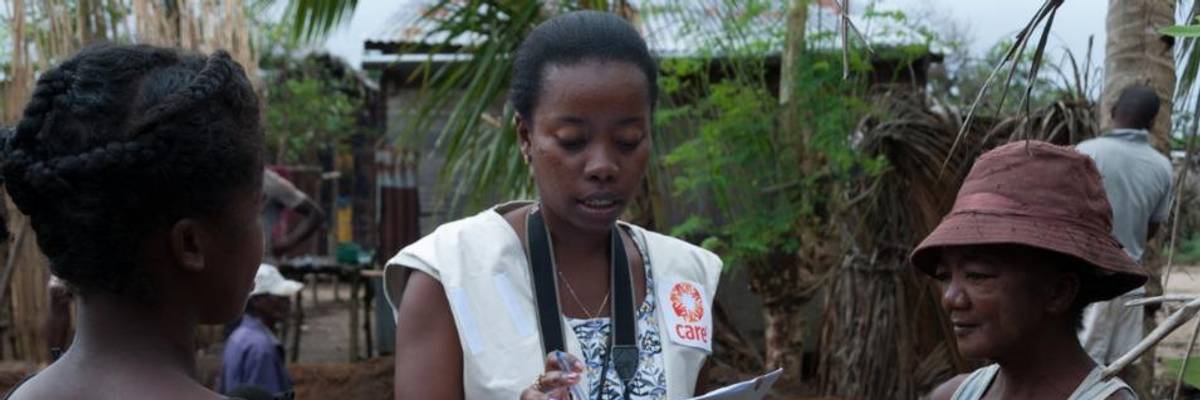
An aid worker speaks with two women in Madagascar, which CARE International named as having the most-underreported humanitarian crisis in the world. (Photo: Clement Radar/CARE)
Out of the top 10 most under-reported humanitarian crises in the world last year--many of them climate-related--nine were on the African continent, according to a new report.
Madagascar had the least-reported crisis in the study--entitled "Suffering in Silence" (pdf)--released Tuesday by CARE International, as 2.6 million people in the country are affected by chronic drought which has left more than 900,000 in immediate need of food assistance.
Out of 24 million online media articles examined by CARE International, just 612 reports were about the humanitarian emergency in Madagascar--and the country was just the most extreme example of the international community's neglect of the world's second-most populous continent.
"In 2019, over 51 million people suffered in 10 crises away from the public eye," the report reads. "Although for the average person on earth, life is better today than ever before, around 2% of the global population (160 million people) will require $28.8 billion in humanitarian assistance to survive. This is a fivefold increase of needs since 2007."
With 80% of Madagascar's population engaged in agriculture, the climate crisis and resulting drought has caused damage to many families' livelihoods. The food shortages brought on by chronic drought conditions also led to Madagascar having the fourth-highest rate of malnutrition in the world, making it easier for diseases like measles to infect over 100,000 people in 2019.
CARE International noted that millions of people in Africa are "suffering in silence" even as the climate crisis gains more international attention, thanks to grassroots climate activists like Greta Thunberg, Extinction Rebellion, and students all over the world--including across Africa--who have led climate marches over the past year.
"It is shocking to see how little media reporting there is about human suffering related to global warming in the South, the lack of political action to address this injustice, and solutions applied to ease the burden for communities."
--Sally Austin, CARE International"The increased public attention for the global climate crisis is encouraging, but we must ensure that the conversation is not limited to the Global North and much-needed transformations there," said Sally Austin, head of emergency operations for CARE International. "It is shocking to see how little media reporting there is about human suffering related to global warming in the South, the lack of political action to address this injustice, and solutions applied to ease the burden for communities."
Other crises in Africa that have been intensified by the climate crisis include Zambia's droughts, which left 2.3 million people in need of food assistance, and a mix of extreme drought and flooding in Kenya.
In southern Africa, where Zambia lies, temperatures are rising at two times the global rate. The pattern has contributed to a sharp drop in wheat and maize crops as well as in safe drinking water in much of the country.
Daily life for many in Zambia illustrates what climate leaders mean when they warn that people in frontline communities--who have contributed the least to the climate crisis--are suffering the most.
"The drought has placed additional hardships and risks on women as they cope with the changing climate," the report reads. "For example, some women now report waking up as early as 3:00 am in order to be the first to collect the scarce water available and then spend all day searching for food. Many have resorted to collecting whatever wild fruits they can find to feed their families."
In Kenya, rainfall in 2019 was at least 20% below average, and as CARE International says, "When there is not too little rainfall, there is far too much."
"Heavy rains displaced tens of thousands of people during the fall months and destroyed farmland and livestock," the report reads. "This worsened an already dire food situation in the country."
North Korea is the only country on CARE's list that isn't in Africa; other under-reported emergencies are taking place in Eritrea, Central African Republic, Burundi, Burkina Faso, Ethiopia, and the countries of the Lake Chad Basin--made up of Nigeria, Chad, and Cameroon.
None of the countries on the list were covered in more than about 9,000 media articles all over the world throughout 2019.
Armed conflicts are major drivers of humanitarian crises in several African countries. CARE's report notes that the climate crisis is worsening political and economic instability across the continent.
"We're seeing increasing linkages between the effects of man-made climate change and the longevity and complexity of humanitarian crises," said Austin. "From Madagascar to Lake Chad to North Korea, the majority of crises ranked in our report are partly a consequence of declining natural resources, increasing extreme weather events and global warming more broadly."
The report notes that three of the least-reported crises in the world are also on the United Nations' list of the least-funded international emergencies.
With this in mind, CARE says, media outlets and humanitarian groups can help to close the gaps by considering "reporting as a form of aid."
"Crises that are neglected are also often the most underfunded and protracted," the report reads. "With close links between public awareness and funding, it needs to be acknowledged that generating attention is a form of aid in itself. As such, humanitarian funding should include budget lines to raise public awareness, particularly in low-profile countries."
Dear Common Dreams reader, It’s been nearly 30 years since I co-founded Common Dreams with my late wife, Lina Newhouser. We had the radical notion that journalism should serve the public good, not corporate profits. It was clear to us from the outset what it would take to build such a project. No paid advertisements. No corporate sponsors. No millionaire publisher telling us what to think or do. Many people said we wouldn't last a year, but we proved those doubters wrong. Together with a tremendous team of journalists and dedicated staff, we built an independent media outlet free from the constraints of profits and corporate control. Our mission has always been simple: To inform. To inspire. To ignite change for the common good. Building Common Dreams was not easy. Our survival was never guaranteed. When you take on the most powerful forces—Wall Street greed, fossil fuel industry destruction, Big Tech lobbyists, and uber-rich oligarchs who have spent billions upon billions rigging the economy and democracy in their favor—the only bulwark you have is supporters who believe in your work. But here’s the urgent message from me today. It's never been this bad out there. And it's never been this hard to keep us going. At the very moment Common Dreams is most needed, the threats we face are intensifying. We need your support now more than ever. We don't accept corporate advertising and never will. We don't have a paywall because we don't think people should be blocked from critical news based on their ability to pay. Everything we do is funded by the donations of readers like you. When everyone does the little they can afford, we are strong. But if that support retreats or dries up, so do we. Will you donate now to make sure Common Dreams not only survives but thrives? —Craig Brown, Co-founder |
Out of the top 10 most under-reported humanitarian crises in the world last year--many of them climate-related--nine were on the African continent, according to a new report.
Madagascar had the least-reported crisis in the study--entitled "Suffering in Silence" (pdf)--released Tuesday by CARE International, as 2.6 million people in the country are affected by chronic drought which has left more than 900,000 in immediate need of food assistance.
Out of 24 million online media articles examined by CARE International, just 612 reports were about the humanitarian emergency in Madagascar--and the country was just the most extreme example of the international community's neglect of the world's second-most populous continent.
"In 2019, over 51 million people suffered in 10 crises away from the public eye," the report reads. "Although for the average person on earth, life is better today than ever before, around 2% of the global population (160 million people) will require $28.8 billion in humanitarian assistance to survive. This is a fivefold increase of needs since 2007."
With 80% of Madagascar's population engaged in agriculture, the climate crisis and resulting drought has caused damage to many families' livelihoods. The food shortages brought on by chronic drought conditions also led to Madagascar having the fourth-highest rate of malnutrition in the world, making it easier for diseases like measles to infect over 100,000 people in 2019.
CARE International noted that millions of people in Africa are "suffering in silence" even as the climate crisis gains more international attention, thanks to grassroots climate activists like Greta Thunberg, Extinction Rebellion, and students all over the world--including across Africa--who have led climate marches over the past year.
"It is shocking to see how little media reporting there is about human suffering related to global warming in the South, the lack of political action to address this injustice, and solutions applied to ease the burden for communities."
--Sally Austin, CARE International"The increased public attention for the global climate crisis is encouraging, but we must ensure that the conversation is not limited to the Global North and much-needed transformations there," said Sally Austin, head of emergency operations for CARE International. "It is shocking to see how little media reporting there is about human suffering related to global warming in the South, the lack of political action to address this injustice, and solutions applied to ease the burden for communities."
Other crises in Africa that have been intensified by the climate crisis include Zambia's droughts, which left 2.3 million people in need of food assistance, and a mix of extreme drought and flooding in Kenya.
In southern Africa, where Zambia lies, temperatures are rising at two times the global rate. The pattern has contributed to a sharp drop in wheat and maize crops as well as in safe drinking water in much of the country.
Daily life for many in Zambia illustrates what climate leaders mean when they warn that people in frontline communities--who have contributed the least to the climate crisis--are suffering the most.
"The drought has placed additional hardships and risks on women as they cope with the changing climate," the report reads. "For example, some women now report waking up as early as 3:00 am in order to be the first to collect the scarce water available and then spend all day searching for food. Many have resorted to collecting whatever wild fruits they can find to feed their families."
In Kenya, rainfall in 2019 was at least 20% below average, and as CARE International says, "When there is not too little rainfall, there is far too much."
"Heavy rains displaced tens of thousands of people during the fall months and destroyed farmland and livestock," the report reads. "This worsened an already dire food situation in the country."
North Korea is the only country on CARE's list that isn't in Africa; other under-reported emergencies are taking place in Eritrea, Central African Republic, Burundi, Burkina Faso, Ethiopia, and the countries of the Lake Chad Basin--made up of Nigeria, Chad, and Cameroon.
None of the countries on the list were covered in more than about 9,000 media articles all over the world throughout 2019.
Armed conflicts are major drivers of humanitarian crises in several African countries. CARE's report notes that the climate crisis is worsening political and economic instability across the continent.
"We're seeing increasing linkages between the effects of man-made climate change and the longevity and complexity of humanitarian crises," said Austin. "From Madagascar to Lake Chad to North Korea, the majority of crises ranked in our report are partly a consequence of declining natural resources, increasing extreme weather events and global warming more broadly."
The report notes that three of the least-reported crises in the world are also on the United Nations' list of the least-funded international emergencies.
With this in mind, CARE says, media outlets and humanitarian groups can help to close the gaps by considering "reporting as a form of aid."
"Crises that are neglected are also often the most underfunded and protracted," the report reads. "With close links between public awareness and funding, it needs to be acknowledged that generating attention is a form of aid in itself. As such, humanitarian funding should include budget lines to raise public awareness, particularly in low-profile countries."
Out of the top 10 most under-reported humanitarian crises in the world last year--many of them climate-related--nine were on the African continent, according to a new report.
Madagascar had the least-reported crisis in the study--entitled "Suffering in Silence" (pdf)--released Tuesday by CARE International, as 2.6 million people in the country are affected by chronic drought which has left more than 900,000 in immediate need of food assistance.
Out of 24 million online media articles examined by CARE International, just 612 reports were about the humanitarian emergency in Madagascar--and the country was just the most extreme example of the international community's neglect of the world's second-most populous continent.
"In 2019, over 51 million people suffered in 10 crises away from the public eye," the report reads. "Although for the average person on earth, life is better today than ever before, around 2% of the global population (160 million people) will require $28.8 billion in humanitarian assistance to survive. This is a fivefold increase of needs since 2007."
With 80% of Madagascar's population engaged in agriculture, the climate crisis and resulting drought has caused damage to many families' livelihoods. The food shortages brought on by chronic drought conditions also led to Madagascar having the fourth-highest rate of malnutrition in the world, making it easier for diseases like measles to infect over 100,000 people in 2019.
CARE International noted that millions of people in Africa are "suffering in silence" even as the climate crisis gains more international attention, thanks to grassroots climate activists like Greta Thunberg, Extinction Rebellion, and students all over the world--including across Africa--who have led climate marches over the past year.
"It is shocking to see how little media reporting there is about human suffering related to global warming in the South, the lack of political action to address this injustice, and solutions applied to ease the burden for communities."
--Sally Austin, CARE International"The increased public attention for the global climate crisis is encouraging, but we must ensure that the conversation is not limited to the Global North and much-needed transformations there," said Sally Austin, head of emergency operations for CARE International. "It is shocking to see how little media reporting there is about human suffering related to global warming in the South, the lack of political action to address this injustice, and solutions applied to ease the burden for communities."
Other crises in Africa that have been intensified by the climate crisis include Zambia's droughts, which left 2.3 million people in need of food assistance, and a mix of extreme drought and flooding in Kenya.
In southern Africa, where Zambia lies, temperatures are rising at two times the global rate. The pattern has contributed to a sharp drop in wheat and maize crops as well as in safe drinking water in much of the country.
Daily life for many in Zambia illustrates what climate leaders mean when they warn that people in frontline communities--who have contributed the least to the climate crisis--are suffering the most.
"The drought has placed additional hardships and risks on women as they cope with the changing climate," the report reads. "For example, some women now report waking up as early as 3:00 am in order to be the first to collect the scarce water available and then spend all day searching for food. Many have resorted to collecting whatever wild fruits they can find to feed their families."
In Kenya, rainfall in 2019 was at least 20% below average, and as CARE International says, "When there is not too little rainfall, there is far too much."
"Heavy rains displaced tens of thousands of people during the fall months and destroyed farmland and livestock," the report reads. "This worsened an already dire food situation in the country."
North Korea is the only country on CARE's list that isn't in Africa; other under-reported emergencies are taking place in Eritrea, Central African Republic, Burundi, Burkina Faso, Ethiopia, and the countries of the Lake Chad Basin--made up of Nigeria, Chad, and Cameroon.
None of the countries on the list were covered in more than about 9,000 media articles all over the world throughout 2019.
Armed conflicts are major drivers of humanitarian crises in several African countries. CARE's report notes that the climate crisis is worsening political and economic instability across the continent.
"We're seeing increasing linkages between the effects of man-made climate change and the longevity and complexity of humanitarian crises," said Austin. "From Madagascar to Lake Chad to North Korea, the majority of crises ranked in our report are partly a consequence of declining natural resources, increasing extreme weather events and global warming more broadly."
The report notes that three of the least-reported crises in the world are also on the United Nations' list of the least-funded international emergencies.
With this in mind, CARE says, media outlets and humanitarian groups can help to close the gaps by considering "reporting as a form of aid."
"Crises that are neglected are also often the most underfunded and protracted," the report reads. "With close links between public awareness and funding, it needs to be acknowledged that generating attention is a form of aid in itself. As such, humanitarian funding should include budget lines to raise public awareness, particularly in low-profile countries."