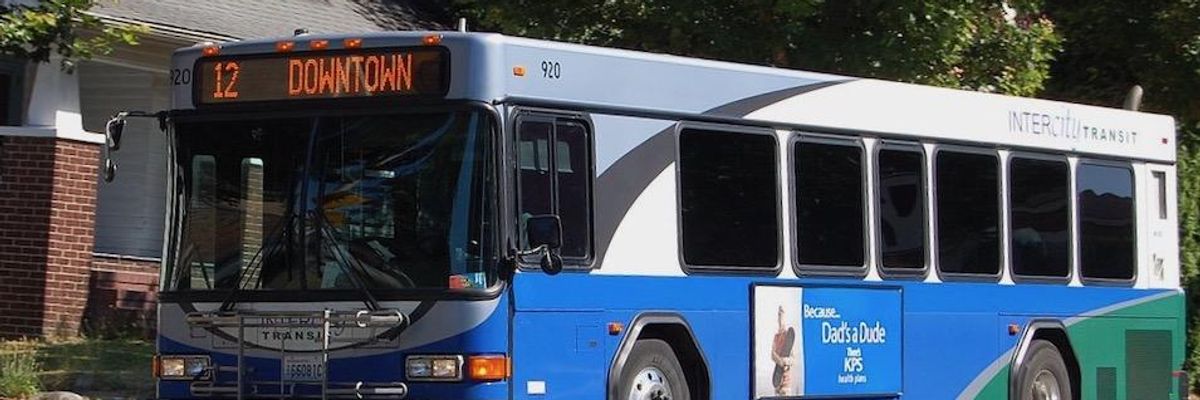
Intercity Transit Bus 902 on Route 12 to downtown Olympia. (Photo: Bluedisk/cc)

Move by Olympia, Washington to Create 'Zero Fare' Public Transit Called a 'Beautiful Thing'
City is latest in the country to offer publicly-funded transportation for residents and visitors.
Public transit in the Washington state capitol Olympia and surrounding areas is free at point of service as of January 1 as the region's Intercity Transit pilots a "zero fare" program through the next five years.
"It's a beautiful thing," bus rider Nate Hooks told Oregon Public Broadcasting (OPB).
The change reportedly came after the transit system mulled over the best way to continue to collect fares and found that the cost of upgrading collections machines outweighed the benefits of the revenue.
According to the Olympian:
[Intercity Transit] says fares currently net less than 2 percent of its operating revenue, while replacing an outdated fare collection system would cost at least $1 million.
Instead, the system decided to fund the "zero fare" approach to riders by increasing sales taxes in the Olympia-Lacey-Tumwater tricity area serviced by Intercity Transit.
"It costs a lot of money to collect money, which is surprising to a lot of people," the system's general manager Ann Freeman-Manzanares told OPB. "Looking at the broad list of things the community wanted us to address--in terms of access, equity, speed, reliability, addressing the environment, making sure that we're as efficient as possible--the combination of those things actually led us to zero-fare."
All services by the transit system save vanpool rides are fare-free.
Intercity Transit says that it is using the term "zero-fare" because the rides are already paid for by taxes, including a bump for the purpose of providing free-at-point-of-service approved by voters in 2018.
Olympia joins a number of other cities and municipalities in the U.S. experimenting with fare-free rides. As Common Dreams reported, Missouri's Kansas City approved a measure to that effect on December 5.
Mitchel Patrick Irons, a transit rider, told OPB that the new policy would be materially helpful to him.
"It will make a big difference in a lot of ways," said Irons. "I'm used to not having what you need in life, let alone what you want. I think it is great having a little more money."
We are at a crossroads
This country and this world are at a monumental crossroads. In a few short weeks, US voters will have an opportunity to beat back the forces of fascism and confront the billionaires who are rigging the economy, our media system, and our democracy, making it increasingly impossible for ordinary people to get by. We’re not just talking about the election. We’re talking about what must be done once these fascist elements are vanquished from power. We need a bolder set of solutions than what either major party has so far been willing to offer and a working-class movement ready to fight like hell for it. Trump didn't emerge from nowhere. The conditions that fueled MAGA authoritarianism were created by decades of radical neoliberal economic policies and a corrupt political system dominated by corporate interests. They slashed taxes on the super-rich, promising that the benefits would trickle down. They said giveaways to the corporate titans would make life more affordable for the rest of us. It was all bullshit. And when a bitter, betrayed populace searches for someone to blame, right-wing demagogues have little trouble finding scapegoats. People know when they're being lied to, but you won't hear any of this from the corporate media. Only independent journalism—powered and funded by people who believe in building a better world—can deliver truly trustworthy daily news. Our Fall Campaign is underway, and we need your help. To power our newsroom through the rest of the year, we need to raise $125,000 by midnight on October 31. So if you share our vision, please contribute whatever you can to sustain our work. |
Public transit in the Washington state capitol Olympia and surrounding areas is free at point of service as of January 1 as the region's Intercity Transit pilots a "zero fare" program through the next five years.
"It's a beautiful thing," bus rider Nate Hooks told Oregon Public Broadcasting (OPB).
The change reportedly came after the transit system mulled over the best way to continue to collect fares and found that the cost of upgrading collections machines outweighed the benefits of the revenue.
According to the Olympian:
[Intercity Transit] says fares currently net less than 2 percent of its operating revenue, while replacing an outdated fare collection system would cost at least $1 million.
Instead, the system decided to fund the "zero fare" approach to riders by increasing sales taxes in the Olympia-Lacey-Tumwater tricity area serviced by Intercity Transit.
"It costs a lot of money to collect money, which is surprising to a lot of people," the system's general manager Ann Freeman-Manzanares told OPB. "Looking at the broad list of things the community wanted us to address--in terms of access, equity, speed, reliability, addressing the environment, making sure that we're as efficient as possible--the combination of those things actually led us to zero-fare."
All services by the transit system save vanpool rides are fare-free.
Intercity Transit says that it is using the term "zero-fare" because the rides are already paid for by taxes, including a bump for the purpose of providing free-at-point-of-service approved by voters in 2018.
Olympia joins a number of other cities and municipalities in the U.S. experimenting with fare-free rides. As Common Dreams reported, Missouri's Kansas City approved a measure to that effect on December 5.
Mitchel Patrick Irons, a transit rider, told OPB that the new policy would be materially helpful to him.
"It will make a big difference in a lot of ways," said Irons. "I'm used to not having what you need in life, let alone what you want. I think it is great having a little more money."