SUBSCRIBE TO OUR FREE NEWSLETTER
Daily news & progressive opinion—funded by the people, not the corporations—delivered straight to your inbox.
5
#000000
#FFFFFF
To donate by check, phone, or other method, see our More Ways to Give page.
Daily news & progressive opinion—funded by the people, not the corporations—delivered straight to your inbox.
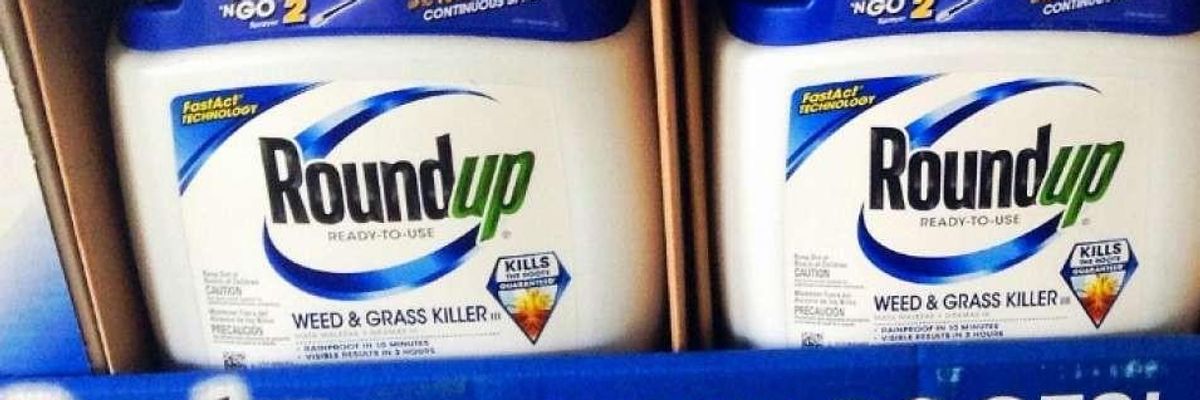
The active ingredient in RoundUp is glyphosate, which the World Health Organization classifies as a probable human carcinogen. (Photo: Mike Mozart/Flickr/cc)
Environmentalists swiftly slammed the Trump administration Tuesday for reaffirming the federal government's position that the world's most widely used herbicide poses no threat to public health--despite other global experts tying it to cancer.
After conducting a safety review of the weed killer, the Environmental Protection Agency said in a statement Tuesday that "EPA continues to find that there are no risks to public health when glyphosate is used in accordance with its current label and that glyphosate is not a carcinogen."
The agency did, however, identify ecological risks associated with glyphosate--the active ingredient in Monsanto's Roundup--and proposed some new management measures designed to protect pollinators and reduce the problem of weeds becoming resistant to the herbicide.
The EPA's conclusion Tuesday contradicts that of the International Agency for Research on Cancer, a branch of the World Health Organization (WHO) that classifies glyphosate as a probable human carcinogen.
The American agrochemical company Monsanto--which merged with the German pharmaceutical giant Bayer last year--has faced multiple lawsuits brought by people who say their illnesses were caused by exposure to RoundUp. The company, like the EPA, maintains that glyphosate is safe when used as instructed.
Critics of the EPA's announcement Tuesday highlighted that the agency's position conflicts with the WHO's classification.
"EPA's pesticide office is out on a limb here--with Monsanto and Bayer and virtually nobody else," Dr. Jennifer Sass, a senior scientist with the Healthy People and Thriving Communities Program at the Natural Resources Defense Council, said in a statement.
"Health agencies and credible non-industry experts who've reviewed this question have all found a link between glyphosate and cancer," she said. "EPA should take the advice of its own science advisers--who have rejected the agency's no-cancer-risk classification."
The Environmental Working Group (EWG), in a statement, pointed out:
A report published in January in the Environmental Sciences Europe documented how the EPA ignored a large number of independent, peer-reviewed studies that link glyphosate to cancer in humans. Instead, the report found, the EPA used research paid for by Monsanto to support the agency's position that glyphosate is not carcinogenic.
EWG president Ken Cook on Tuesday called out President Donald Trump and EPA Administrator Andrew Wheeler--both for the glyphosate announcement specifically and the agency's policies more broadly.
"Today's decision by Administrator Wheeler, like virtually every one he and the Trump administration make, completely ignores science in favor of polluters like Bayer," Cook charged.
"This move by EPA should not come as a surprise," he said. "Under the control of Trump and Wheeler, the agency is virtually incapable of taking steps to protect people from dangerous chemicals like glyphosate."
Dear Common Dreams reader, It’s been nearly 30 years since I co-founded Common Dreams with my late wife, Lina Newhouser. We had the radical notion that journalism should serve the public good, not corporate profits. It was clear to us from the outset what it would take to build such a project. No paid advertisements. No corporate sponsors. No millionaire publisher telling us what to think or do. Many people said we wouldn't last a year, but we proved those doubters wrong. Together with a tremendous team of journalists and dedicated staff, we built an independent media outlet free from the constraints of profits and corporate control. Our mission has always been simple: To inform. To inspire. To ignite change for the common good. Building Common Dreams was not easy. Our survival was never guaranteed. When you take on the most powerful forces—Wall Street greed, fossil fuel industry destruction, Big Tech lobbyists, and uber-rich oligarchs who have spent billions upon billions rigging the economy and democracy in their favor—the only bulwark you have is supporters who believe in your work. But here’s the urgent message from me today. It's never been this bad out there. And it's never been this hard to keep us going. At the very moment Common Dreams is most needed, the threats we face are intensifying. We need your support now more than ever. We don't accept corporate advertising and never will. We don't have a paywall because we don't think people should be blocked from critical news based on their ability to pay. Everything we do is funded by the donations of readers like you. When everyone does the little they can afford, we are strong. But if that support retreats or dries up, so do we. Will you donate now to make sure Common Dreams not only survives but thrives? —Craig Brown, Co-founder |
Environmentalists swiftly slammed the Trump administration Tuesday for reaffirming the federal government's position that the world's most widely used herbicide poses no threat to public health--despite other global experts tying it to cancer.
After conducting a safety review of the weed killer, the Environmental Protection Agency said in a statement Tuesday that "EPA continues to find that there are no risks to public health when glyphosate is used in accordance with its current label and that glyphosate is not a carcinogen."
The agency did, however, identify ecological risks associated with glyphosate--the active ingredient in Monsanto's Roundup--and proposed some new management measures designed to protect pollinators and reduce the problem of weeds becoming resistant to the herbicide.
The EPA's conclusion Tuesday contradicts that of the International Agency for Research on Cancer, a branch of the World Health Organization (WHO) that classifies glyphosate as a probable human carcinogen.
The American agrochemical company Monsanto--which merged with the German pharmaceutical giant Bayer last year--has faced multiple lawsuits brought by people who say their illnesses were caused by exposure to RoundUp. The company, like the EPA, maintains that glyphosate is safe when used as instructed.
Critics of the EPA's announcement Tuesday highlighted that the agency's position conflicts with the WHO's classification.
"EPA's pesticide office is out on a limb here--with Monsanto and Bayer and virtually nobody else," Dr. Jennifer Sass, a senior scientist with the Healthy People and Thriving Communities Program at the Natural Resources Defense Council, said in a statement.
"Health agencies and credible non-industry experts who've reviewed this question have all found a link between glyphosate and cancer," she said. "EPA should take the advice of its own science advisers--who have rejected the agency's no-cancer-risk classification."
The Environmental Working Group (EWG), in a statement, pointed out:
A report published in January in the Environmental Sciences Europe documented how the EPA ignored a large number of independent, peer-reviewed studies that link glyphosate to cancer in humans. Instead, the report found, the EPA used research paid for by Monsanto to support the agency's position that glyphosate is not carcinogenic.
EWG president Ken Cook on Tuesday called out President Donald Trump and EPA Administrator Andrew Wheeler--both for the glyphosate announcement specifically and the agency's policies more broadly.
"Today's decision by Administrator Wheeler, like virtually every one he and the Trump administration make, completely ignores science in favor of polluters like Bayer," Cook charged.
"This move by EPA should not come as a surprise," he said. "Under the control of Trump and Wheeler, the agency is virtually incapable of taking steps to protect people from dangerous chemicals like glyphosate."
Environmentalists swiftly slammed the Trump administration Tuesday for reaffirming the federal government's position that the world's most widely used herbicide poses no threat to public health--despite other global experts tying it to cancer.
After conducting a safety review of the weed killer, the Environmental Protection Agency said in a statement Tuesday that "EPA continues to find that there are no risks to public health when glyphosate is used in accordance with its current label and that glyphosate is not a carcinogen."
The agency did, however, identify ecological risks associated with glyphosate--the active ingredient in Monsanto's Roundup--and proposed some new management measures designed to protect pollinators and reduce the problem of weeds becoming resistant to the herbicide.
The EPA's conclusion Tuesday contradicts that of the International Agency for Research on Cancer, a branch of the World Health Organization (WHO) that classifies glyphosate as a probable human carcinogen.
The American agrochemical company Monsanto--which merged with the German pharmaceutical giant Bayer last year--has faced multiple lawsuits brought by people who say their illnesses were caused by exposure to RoundUp. The company, like the EPA, maintains that glyphosate is safe when used as instructed.
Critics of the EPA's announcement Tuesday highlighted that the agency's position conflicts with the WHO's classification.
"EPA's pesticide office is out on a limb here--with Monsanto and Bayer and virtually nobody else," Dr. Jennifer Sass, a senior scientist with the Healthy People and Thriving Communities Program at the Natural Resources Defense Council, said in a statement.
"Health agencies and credible non-industry experts who've reviewed this question have all found a link between glyphosate and cancer," she said. "EPA should take the advice of its own science advisers--who have rejected the agency's no-cancer-risk classification."
The Environmental Working Group (EWG), in a statement, pointed out:
A report published in January in the Environmental Sciences Europe documented how the EPA ignored a large number of independent, peer-reviewed studies that link glyphosate to cancer in humans. Instead, the report found, the EPA used research paid for by Monsanto to support the agency's position that glyphosate is not carcinogenic.
EWG president Ken Cook on Tuesday called out President Donald Trump and EPA Administrator Andrew Wheeler--both for the glyphosate announcement specifically and the agency's policies more broadly.
"Today's decision by Administrator Wheeler, like virtually every one he and the Trump administration make, completely ignores science in favor of polluters like Bayer," Cook charged.
"This move by EPA should not come as a surprise," he said. "Under the control of Trump and Wheeler, the agency is virtually incapable of taking steps to protect people from dangerous chemicals like glyphosate."