SUBSCRIBE TO OUR FREE NEWSLETTER
Daily news & progressive opinion—funded by the people, not the corporations—delivered straight to your inbox.
5
#000000
#FFFFFF
To donate by check, phone, or other method, see our More Ways to Give page.
Daily news & progressive opinion—funded by the people, not the corporations—delivered straight to your inbox.
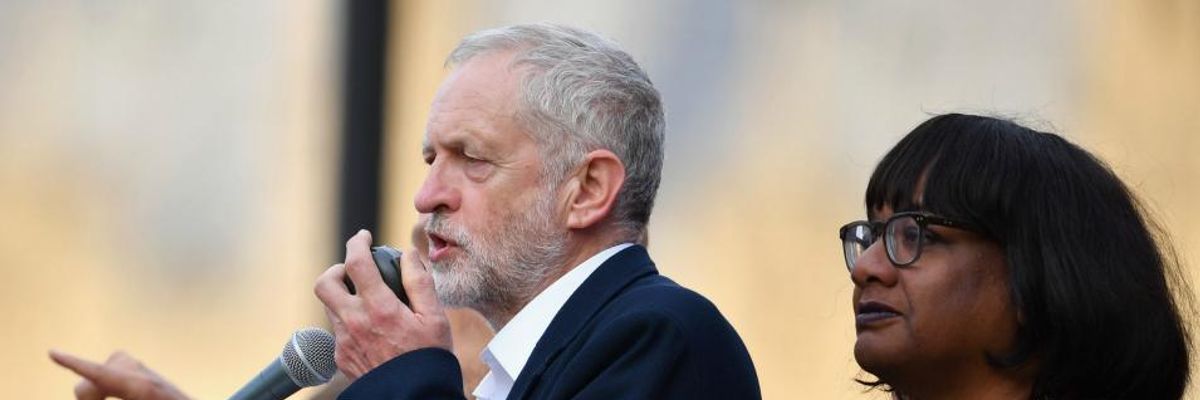
Labour leader Jeremy Corbyn is joined by Shadow Health Secretary Diane Abbott as he delivers a speech on June 27, 2016 in London, England. (Photo: Jeff J Mitchell/Getty Images)
Key figures in the United Kingdom's Labour Party are speaking out against the possible extradition of Julian Assange to the United States after British police arrested the WikiLeaks founder and forcibly dragged him out of the Ecuadorian Embassy in London Thursday.
"The extradition of Julian Assange to the U.S. for exposing evidence of atrocities in Iraq and Afghanistan should be opposed by the British government," tweeted Jeremy Corbyn, the opposition party's leader.
Along with his concise comment, Corbyn posted a video in which Labour MP and Shadow Home Secretary Diane Abbott says:
And we should recall what WikiLeaks actually disclosed: Who can forget the Pentagon video footage of a missile attack in 2007 in Iraq, which killed 18 civilians and two Reuters journalists? It is the monumental amount of leaks such as this that lifted the veil on U.S.-led military operation in a variety of theaters, none of which have produced a favorable outcome [for] the people of those countries. Julian Assange is not being pursued to protect U.S. national security. He is being pursued because he has exposed wrongdoing by U.S. administrations and their military forces.
Abbott also shared the video and said on Twitter, "In this country we have protections for whistleblowers, those who take personal risk to disclose wrongdoing in the public interest."
In an interview on BBC Radio 4's "Today" program, Abbott said that "this is all about WikiLeaks and all of that embarrassing information about the activities of the American military and security services that was made public."
Until Thursday, Assange had lived as a political asylee at the embassy since 2012, to avoid extradition to Sweden--which dropped its request in early 2018--or the United States. After a week of warnings from WikiLeaks and Assange's attorneys, Ecuador revoked the journalist and publisher's asylum protection and allowed British police into the embassy to arrest him--decisions that were widely condemned by political leaders, whistleblowers, journalists, and human rights advocates worldwide.
Assange now faces extradition proceedings in the United Kingdom, which fall under the jurisdiction of the country's courts and Tory home secretary. The U.S. Justice Department unsealed an indictment after Assange's arrest that reveals the extradition request officially comes "in connection with a federal charge of conspiracy to commit computer intrusion."
As Common Dreams reported Thursday, some American reporters and talking heads on cable news shows suggested that because the charge is tied to an alleged "computer hacking conspiracy," Assange's possible extradition poses no threat to journalism.
However, critics argue the charge is part of a ploy by the Trump administration to punish Assange for publishing classified information about the U.S. wars in Iraq and Afghanistan--provided by Army whistleblower Chelsea Manning, who remains jailed for refusing to testify before a grand jury--and that extraditing Assange "would set a dangerous precedent for journalists everywhere."
Glenn Greenwald is among those arguing that the indictment "poses grave threats to press freedom." In a piece for The Intercept Greenwald co-authored with Micah Lee, he also called out media outlets for misrepresenting the indictment in reports Thursday.
Linking to a Guardian column by Owen Jones, Greenwald pointed out on Twitter Friday that people on "the actual left" in the United Kingdom, the United States, Latin America, and Europe have denounced the extradition effort while "U.S. establishment liberals have largely cheered it." As Greenwald put it, that shows "liberals are authoritarians who revere U.S. security institutions."
"Whatever you think of Julian Assange, his extradition to the U.S. must be opposed," Jones wrote in his column Friday. "Extraditing the founder of WikiLeaks is an attempt by the U.S. to intimidate anyone who exposes its crimes."
Dear Common Dreams reader, It’s been nearly 30 years since I co-founded Common Dreams with my late wife, Lina Newhouser. We had the radical notion that journalism should serve the public good, not corporate profits. It was clear to us from the outset what it would take to build such a project. No paid advertisements. No corporate sponsors. No millionaire publisher telling us what to think or do. Many people said we wouldn't last a year, but we proved those doubters wrong. Together with a tremendous team of journalists and dedicated staff, we built an independent media outlet free from the constraints of profits and corporate control. Our mission has always been simple: To inform. To inspire. To ignite change for the common good. Building Common Dreams was not easy. Our survival was never guaranteed. When you take on the most powerful forces—Wall Street greed, fossil fuel industry destruction, Big Tech lobbyists, and uber-rich oligarchs who have spent billions upon billions rigging the economy and democracy in their favor—the only bulwark you have is supporters who believe in your work. But here’s the urgent message from me today. It's never been this bad out there. And it's never been this hard to keep us going. At the very moment Common Dreams is most needed, the threats we face are intensifying. We need your support now more than ever. We don't accept corporate advertising and never will. We don't have a paywall because we don't think people should be blocked from critical news based on their ability to pay. Everything we do is funded by the donations of readers like you. When everyone does the little they can afford, we are strong. But if that support retreats or dries up, so do we. Will you donate now to make sure Common Dreams not only survives but thrives? —Craig Brown, Co-founder |
Key figures in the United Kingdom's Labour Party are speaking out against the possible extradition of Julian Assange to the United States after British police arrested the WikiLeaks founder and forcibly dragged him out of the Ecuadorian Embassy in London Thursday.
"The extradition of Julian Assange to the U.S. for exposing evidence of atrocities in Iraq and Afghanistan should be opposed by the British government," tweeted Jeremy Corbyn, the opposition party's leader.
Along with his concise comment, Corbyn posted a video in which Labour MP and Shadow Home Secretary Diane Abbott says:
And we should recall what WikiLeaks actually disclosed: Who can forget the Pentagon video footage of a missile attack in 2007 in Iraq, which killed 18 civilians and two Reuters journalists? It is the monumental amount of leaks such as this that lifted the veil on U.S.-led military operation in a variety of theaters, none of which have produced a favorable outcome [for] the people of those countries. Julian Assange is not being pursued to protect U.S. national security. He is being pursued because he has exposed wrongdoing by U.S. administrations and their military forces.
Abbott also shared the video and said on Twitter, "In this country we have protections for whistleblowers, those who take personal risk to disclose wrongdoing in the public interest."
In an interview on BBC Radio 4's "Today" program, Abbott said that "this is all about WikiLeaks and all of that embarrassing information about the activities of the American military and security services that was made public."
Until Thursday, Assange had lived as a political asylee at the embassy since 2012, to avoid extradition to Sweden--which dropped its request in early 2018--or the United States. After a week of warnings from WikiLeaks and Assange's attorneys, Ecuador revoked the journalist and publisher's asylum protection and allowed British police into the embassy to arrest him--decisions that were widely condemned by political leaders, whistleblowers, journalists, and human rights advocates worldwide.
Assange now faces extradition proceedings in the United Kingdom, which fall under the jurisdiction of the country's courts and Tory home secretary. The U.S. Justice Department unsealed an indictment after Assange's arrest that reveals the extradition request officially comes "in connection with a federal charge of conspiracy to commit computer intrusion."
As Common Dreams reported Thursday, some American reporters and talking heads on cable news shows suggested that because the charge is tied to an alleged "computer hacking conspiracy," Assange's possible extradition poses no threat to journalism.
However, critics argue the charge is part of a ploy by the Trump administration to punish Assange for publishing classified information about the U.S. wars in Iraq and Afghanistan--provided by Army whistleblower Chelsea Manning, who remains jailed for refusing to testify before a grand jury--and that extraditing Assange "would set a dangerous precedent for journalists everywhere."
Glenn Greenwald is among those arguing that the indictment "poses grave threats to press freedom." In a piece for The Intercept Greenwald co-authored with Micah Lee, he also called out media outlets for misrepresenting the indictment in reports Thursday.
Linking to a Guardian column by Owen Jones, Greenwald pointed out on Twitter Friday that people on "the actual left" in the United Kingdom, the United States, Latin America, and Europe have denounced the extradition effort while "U.S. establishment liberals have largely cheered it." As Greenwald put it, that shows "liberals are authoritarians who revere U.S. security institutions."
"Whatever you think of Julian Assange, his extradition to the U.S. must be opposed," Jones wrote in his column Friday. "Extraditing the founder of WikiLeaks is an attempt by the U.S. to intimidate anyone who exposes its crimes."
Key figures in the United Kingdom's Labour Party are speaking out against the possible extradition of Julian Assange to the United States after British police arrested the WikiLeaks founder and forcibly dragged him out of the Ecuadorian Embassy in London Thursday.
"The extradition of Julian Assange to the U.S. for exposing evidence of atrocities in Iraq and Afghanistan should be opposed by the British government," tweeted Jeremy Corbyn, the opposition party's leader.
Along with his concise comment, Corbyn posted a video in which Labour MP and Shadow Home Secretary Diane Abbott says:
And we should recall what WikiLeaks actually disclosed: Who can forget the Pentagon video footage of a missile attack in 2007 in Iraq, which killed 18 civilians and two Reuters journalists? It is the monumental amount of leaks such as this that lifted the veil on U.S.-led military operation in a variety of theaters, none of which have produced a favorable outcome [for] the people of those countries. Julian Assange is not being pursued to protect U.S. national security. He is being pursued because he has exposed wrongdoing by U.S. administrations and their military forces.
Abbott also shared the video and said on Twitter, "In this country we have protections for whistleblowers, those who take personal risk to disclose wrongdoing in the public interest."
In an interview on BBC Radio 4's "Today" program, Abbott said that "this is all about WikiLeaks and all of that embarrassing information about the activities of the American military and security services that was made public."
Until Thursday, Assange had lived as a political asylee at the embassy since 2012, to avoid extradition to Sweden--which dropped its request in early 2018--or the United States. After a week of warnings from WikiLeaks and Assange's attorneys, Ecuador revoked the journalist and publisher's asylum protection and allowed British police into the embassy to arrest him--decisions that were widely condemned by political leaders, whistleblowers, journalists, and human rights advocates worldwide.
Assange now faces extradition proceedings in the United Kingdom, which fall under the jurisdiction of the country's courts and Tory home secretary. The U.S. Justice Department unsealed an indictment after Assange's arrest that reveals the extradition request officially comes "in connection with a federal charge of conspiracy to commit computer intrusion."
As Common Dreams reported Thursday, some American reporters and talking heads on cable news shows suggested that because the charge is tied to an alleged "computer hacking conspiracy," Assange's possible extradition poses no threat to journalism.
However, critics argue the charge is part of a ploy by the Trump administration to punish Assange for publishing classified information about the U.S. wars in Iraq and Afghanistan--provided by Army whistleblower Chelsea Manning, who remains jailed for refusing to testify before a grand jury--and that extraditing Assange "would set a dangerous precedent for journalists everywhere."
Glenn Greenwald is among those arguing that the indictment "poses grave threats to press freedom." In a piece for The Intercept Greenwald co-authored with Micah Lee, he also called out media outlets for misrepresenting the indictment in reports Thursday.
Linking to a Guardian column by Owen Jones, Greenwald pointed out on Twitter Friday that people on "the actual left" in the United Kingdom, the United States, Latin America, and Europe have denounced the extradition effort while "U.S. establishment liberals have largely cheered it." As Greenwald put it, that shows "liberals are authoritarians who revere U.S. security institutions."
"Whatever you think of Julian Assange, his extradition to the U.S. must be opposed," Jones wrote in his column Friday. "Extraditing the founder of WikiLeaks is an attempt by the U.S. to intimidate anyone who exposes its crimes."