SUBSCRIBE TO OUR FREE NEWSLETTER
Daily news & progressive opinion—funded by the people, not the corporations—delivered straight to your inbox.
5
#000000
#FFFFFF
To donate by check, phone, or other method, see our More Ways to Give page.
Daily news & progressive opinion—funded by the people, not the corporations—delivered straight to your inbox.
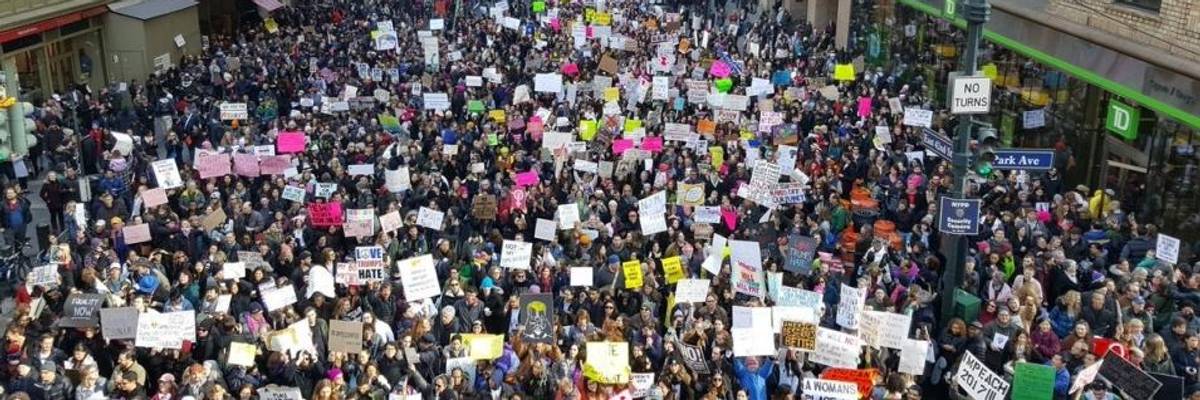
"The defining political fact of our time is not polarization. It's the inability of even large bipartisan majorities to get what they want on issues like these," argued Wu. (Photo: AP)
Most Americans support Medicare for All, higher taxes on the rich, a Green New Deal, and other major items on the progressive agenda--so why has Congress failed to enact them?
The reason, Columbia University Law School professor Tim Wu argued in an op-ed for the New York Times on Tuesday, is that the influence of corporations and the donor class on the American political system has drowned out the policy desires of the public.
"Call it the oppression of the supermajority. Ignoring what most of the country wants--as much as demagogy and political divisiveness--is what is making the public so angry."
--Tim Wu, Columbia University
"In our era, it is primarily Congress that prevents popular laws from being passed or getting serious consideration. (Holding an occasional hearing does not count as 'doing something')," Wu wrote. "Entire categories of public policy options are effectively off-limits because of the combined influence of industry groups and donor interests."
To bolster his argument, Wu rattled off a number of policies that--despite polling extremely well among large, bipartisan swaths of the American public--have not garnered enough support among lawmakers to pass Congress.
"About 75 percent of Americans favor higher taxes for the ultra-wealthy. The idea of a federal law that would guarantee paid maternity leave attracts 67 percent support," Wu noted. "Eighty-three percent favor strong net neutrality rules for broadband, and more than 60 percent want stronger privacy laws. Seventy-one percent think we should be able to buy drugs imported from Canada, and 92 percent want Medicare to negotiate for lower drug prices. The list goes on."
Since the election of President Donald Trump in 2016, Congress has in many cases done the opposite of what most Americans want by slashing taxes on the rich, failing to restore net neutrality rules, and attempting to strip healthcare from millions of Americans.
"The defining political fact of our time is not polarization. It's the inability of even large bipartisan majorities to get what they want on issues like these," argued Wu. "Call it the oppression of the supermajority. Ignoring what most of the country wants--as much as demagogy and political divisiveness--is what is making the public so angry."
Wu's contention that the "combined influence" of the donor class and big business is significantly responsible for Congress' refusal to enact popular policies matches the conclusion of a 2014 study (pdf) by political scientists Martin Gilens and Benjamin Page, who found that in the United States, "the majority does not rule--at least not in the causal sense of actually determining policy outcomes."
"When a majority of citizens disagrees with economic elites or with organized interests, they generally lose," Gilens and Page wrote. "Moreover, because of the strong status quo bias built into the U.S. political system, even when fairly large majorities of Americans favor policy change, they generally do not get it."
With the 2020 elections rapidly approaching, Wu concluded that "we need to talk more openly about which candidates are most likely to deliver the economic policies that the supermajority wants."
Though many popular and bold progressive ideas have previously been--and still are--dismissed as fringe and impractical by pundits and members of Congress, major Democratic presidential candidates like Sens. Bernie Sanders (I-Vt.), Elizabeth Warren (D-Mass.), Kamala Harris (D-Calif.), and Kirsten Gillibrand (D-N.Y.) have each expressed support for Medicare for All and a Green New Deal.
Several presidential candidates have also vowed to reject corporate PAC money--though some have reportedly put out calls to Wall Street donors to gauge support.
But no 2020 contenders have committed to killing the Senate filibuster, which critics have characterized as an anti-democratic relic that--if left in place--would make big-ticket progressive agenda items virtually impossible to pass.
"Many are talking about big progressive plans. All are empty promises while the filibuster lives," said Ezra Levin, co-founder of the progressive advocacy group Indivisible.
Dear Common Dreams reader, It’s been nearly 30 years since I co-founded Common Dreams with my late wife, Lina Newhouser. We had the radical notion that journalism should serve the public good, not corporate profits. It was clear to us from the outset what it would take to build such a project. No paid advertisements. No corporate sponsors. No millionaire publisher telling us what to think or do. Many people said we wouldn't last a year, but we proved those doubters wrong. Together with a tremendous team of journalists and dedicated staff, we built an independent media outlet free from the constraints of profits and corporate control. Our mission has always been simple: To inform. To inspire. To ignite change for the common good. Building Common Dreams was not easy. Our survival was never guaranteed. When you take on the most powerful forces—Wall Street greed, fossil fuel industry destruction, Big Tech lobbyists, and uber-rich oligarchs who have spent billions upon billions rigging the economy and democracy in their favor—the only bulwark you have is supporters who believe in your work. But here’s the urgent message from me today. It's never been this bad out there. And it's never been this hard to keep us going. At the very moment Common Dreams is most needed, the threats we face are intensifying. We need your support now more than ever. We don't accept corporate advertising and never will. We don't have a paywall because we don't think people should be blocked from critical news based on their ability to pay. Everything we do is funded by the donations of readers like you. When everyone does the little they can afford, we are strong. But if that support retreats or dries up, so do we. Will you donate now to make sure Common Dreams not only survives but thrives? —Craig Brown, Co-founder |
Most Americans support Medicare for All, higher taxes on the rich, a Green New Deal, and other major items on the progressive agenda--so why has Congress failed to enact them?
The reason, Columbia University Law School professor Tim Wu argued in an op-ed for the New York Times on Tuesday, is that the influence of corporations and the donor class on the American political system has drowned out the policy desires of the public.
"Call it the oppression of the supermajority. Ignoring what most of the country wants--as much as demagogy and political divisiveness--is what is making the public so angry."
--Tim Wu, Columbia University
"In our era, it is primarily Congress that prevents popular laws from being passed or getting serious consideration. (Holding an occasional hearing does not count as 'doing something')," Wu wrote. "Entire categories of public policy options are effectively off-limits because of the combined influence of industry groups and donor interests."
To bolster his argument, Wu rattled off a number of policies that--despite polling extremely well among large, bipartisan swaths of the American public--have not garnered enough support among lawmakers to pass Congress.
"About 75 percent of Americans favor higher taxes for the ultra-wealthy. The idea of a federal law that would guarantee paid maternity leave attracts 67 percent support," Wu noted. "Eighty-three percent favor strong net neutrality rules for broadband, and more than 60 percent want stronger privacy laws. Seventy-one percent think we should be able to buy drugs imported from Canada, and 92 percent want Medicare to negotiate for lower drug prices. The list goes on."
Since the election of President Donald Trump in 2016, Congress has in many cases done the opposite of what most Americans want by slashing taxes on the rich, failing to restore net neutrality rules, and attempting to strip healthcare from millions of Americans.
"The defining political fact of our time is not polarization. It's the inability of even large bipartisan majorities to get what they want on issues like these," argued Wu. "Call it the oppression of the supermajority. Ignoring what most of the country wants--as much as demagogy and political divisiveness--is what is making the public so angry."
Wu's contention that the "combined influence" of the donor class and big business is significantly responsible for Congress' refusal to enact popular policies matches the conclusion of a 2014 study (pdf) by political scientists Martin Gilens and Benjamin Page, who found that in the United States, "the majority does not rule--at least not in the causal sense of actually determining policy outcomes."
"When a majority of citizens disagrees with economic elites or with organized interests, they generally lose," Gilens and Page wrote. "Moreover, because of the strong status quo bias built into the U.S. political system, even when fairly large majorities of Americans favor policy change, they generally do not get it."
With the 2020 elections rapidly approaching, Wu concluded that "we need to talk more openly about which candidates are most likely to deliver the economic policies that the supermajority wants."
Though many popular and bold progressive ideas have previously been--and still are--dismissed as fringe and impractical by pundits and members of Congress, major Democratic presidential candidates like Sens. Bernie Sanders (I-Vt.), Elizabeth Warren (D-Mass.), Kamala Harris (D-Calif.), and Kirsten Gillibrand (D-N.Y.) have each expressed support for Medicare for All and a Green New Deal.
Several presidential candidates have also vowed to reject corporate PAC money--though some have reportedly put out calls to Wall Street donors to gauge support.
But no 2020 contenders have committed to killing the Senate filibuster, which critics have characterized as an anti-democratic relic that--if left in place--would make big-ticket progressive agenda items virtually impossible to pass.
"Many are talking about big progressive plans. All are empty promises while the filibuster lives," said Ezra Levin, co-founder of the progressive advocacy group Indivisible.
Most Americans support Medicare for All, higher taxes on the rich, a Green New Deal, and other major items on the progressive agenda--so why has Congress failed to enact them?
The reason, Columbia University Law School professor Tim Wu argued in an op-ed for the New York Times on Tuesday, is that the influence of corporations and the donor class on the American political system has drowned out the policy desires of the public.
"Call it the oppression of the supermajority. Ignoring what most of the country wants--as much as demagogy and political divisiveness--is what is making the public so angry."
--Tim Wu, Columbia University
"In our era, it is primarily Congress that prevents popular laws from being passed or getting serious consideration. (Holding an occasional hearing does not count as 'doing something')," Wu wrote. "Entire categories of public policy options are effectively off-limits because of the combined influence of industry groups and donor interests."
To bolster his argument, Wu rattled off a number of policies that--despite polling extremely well among large, bipartisan swaths of the American public--have not garnered enough support among lawmakers to pass Congress.
"About 75 percent of Americans favor higher taxes for the ultra-wealthy. The idea of a federal law that would guarantee paid maternity leave attracts 67 percent support," Wu noted. "Eighty-three percent favor strong net neutrality rules for broadband, and more than 60 percent want stronger privacy laws. Seventy-one percent think we should be able to buy drugs imported from Canada, and 92 percent want Medicare to negotiate for lower drug prices. The list goes on."
Since the election of President Donald Trump in 2016, Congress has in many cases done the opposite of what most Americans want by slashing taxes on the rich, failing to restore net neutrality rules, and attempting to strip healthcare from millions of Americans.
"The defining political fact of our time is not polarization. It's the inability of even large bipartisan majorities to get what they want on issues like these," argued Wu. "Call it the oppression of the supermajority. Ignoring what most of the country wants--as much as demagogy and political divisiveness--is what is making the public so angry."
Wu's contention that the "combined influence" of the donor class and big business is significantly responsible for Congress' refusal to enact popular policies matches the conclusion of a 2014 study (pdf) by political scientists Martin Gilens and Benjamin Page, who found that in the United States, "the majority does not rule--at least not in the causal sense of actually determining policy outcomes."
"When a majority of citizens disagrees with economic elites or with organized interests, they generally lose," Gilens and Page wrote. "Moreover, because of the strong status quo bias built into the U.S. political system, even when fairly large majorities of Americans favor policy change, they generally do not get it."
With the 2020 elections rapidly approaching, Wu concluded that "we need to talk more openly about which candidates are most likely to deliver the economic policies that the supermajority wants."
Though many popular and bold progressive ideas have previously been--and still are--dismissed as fringe and impractical by pundits and members of Congress, major Democratic presidential candidates like Sens. Bernie Sanders (I-Vt.), Elizabeth Warren (D-Mass.), Kamala Harris (D-Calif.), and Kirsten Gillibrand (D-N.Y.) have each expressed support for Medicare for All and a Green New Deal.
Several presidential candidates have also vowed to reject corporate PAC money--though some have reportedly put out calls to Wall Street donors to gauge support.
But no 2020 contenders have committed to killing the Senate filibuster, which critics have characterized as an anti-democratic relic that--if left in place--would make big-ticket progressive agenda items virtually impossible to pass.
"Many are talking about big progressive plans. All are empty promises while the filibuster lives," said Ezra Levin, co-founder of the progressive advocacy group Indivisible.